


U-Factor measures how well a window blocks heat from escaping or entering through conduction, so lower is always better for insulation. SHGC measures how much solar heat the window lets in as sunlight passes through the glass, and whether lower or higher is better depends entirely on your climate and which direction the window faces. Most homeowners need to balance both numbers rather than chase a low score on just one.
TL;DR:
- In hot climates or west-facing exposures, prioritize low SHGC (around 0.25 to 0.30) to reduce afternoon heat gain, even if it means accepting a slightly higher U-Factor.
- For cold climates or south-facing windows, aim for the lowest U-Factor possible (around 0.22 to 0.28) to improve insulation, with a higher SHGC on south walls for passive solar heating.
- Always check for whole-product NFRC labels, not just center-of-glass figures, to ensure the performance accounts for framing, spacers, and installation quality.
- In coastal or storm-prone areas, proper installation and framing can significantly impact real-world performance beyond NFRC-rated ratings.
- Align your window choices with your climate zone and orientation, focusing on low U-Factor in colder areas and low SHGC in hotter regions to optimize energy savings.
Table of Contents
- What Does U-Factor Actually Measure?
- What Does SHGC Measure and Why Does It Cut Both Ways?
- U-Factor vs SHGC: The Side-by-Side Breakdown
- Recommended U-Factor and SHGC Targets by Climate Zone
- A Homeowner’s Checklist for Balancing Both Ratings
- Three Homeowner Scenarios and What to Prioritize
- Why Installation Quality Changes the Numbers You Paid For
- Getting the Balance Right Without Overthinking It
- Ready to Replace Windows That Actually Match Your Climate?
- Sources
- FAQ
What Does U-Factor Actually Measure?
U-Factor tells you how much heat moves through a window when there’s a temperature difference between inside and outside, regardless of sunlight. Think of it as the window’s resistance to heat leaking out in winter or creeping in during a cold snap. It’s measured in Btu per hour, per square foot, per degree Fahrenheit of temperature difference, and unlike R-value (which measures resistance), U-Factor measures the rate of heat flow. That’s why the math runs backward from what people expect: lower U-Factor means less heat transfer, which means better insulation.
Residential windows generally fall within a typical range of U-Factor values, with older single-pane units near the higher end and modern triple-pane, gas-filled units near the lower end. Windows with U-Factors around the mid to lower part of this range are considered to perform well by current standards.
Here’s where a lot of homeowners get tripped up: not every U-Factor number on a spec sheet means the same thing.
- Center-of-glass U-Factor measures only the middle of the pane, ignoring the frame and edges.
- Whole-product U-Factor measures the entire assembled unit, including the frame, spacer, and edge seals.
- Manufacturers sometimes advertise the center-of-glass number because it looks better on paper.
- The National Fenestration Rating Council (NFRC) requires labels to show whole-product values, which is the number you actually want.
- A window that looks great at center-of-glass can perform noticeably worse once you account for the frame.
Pro Tip: Ask for the NFRC label, not just a spec sheet number. If a quote only lists a center-of-glass value, ask directly for the whole-product U-Factor before you sign anything.
The gap between those two numbers isn’t trivial. Framing materials, spacers, and how the unit is actually installed can shift real-world performance by a meaningful margin compared to the glass-only figure, according to glazing industry guidance on framing and performance values. A vinyl frame with a poor spacer can drag down an otherwise excellent piece of glass. That’s also why window frame material matters as much as the glazing package itself.
In practical terms, U-Factor is the number that governs your heating bill in winter and, to a lesser extent, how much cool air escapes in summer. A drafty window with a high U-Factor makes the room next to it feel cold even when your thermostat says 70 degrees, because your body is losing heat to that cold glass surface through radiation. If you’ve ever sat near an old window in January and felt a chill despite the heat running, that’s U-Factor working against you in real time. For a deeper look at how this number translates into monthly costs, our explainer on window U-value breaks down the mechanics further.
What Does SHGC Measure and Why Does It Cut Both Ways?
SHGC, or Solar Heat Gain Coefficient, measures the fraction of solar radiation that passes through a window and turns into heat inside your home. It runs on a scale from 0 to 1. A rating of 0 would mean no solar heat gets through at all (purely theoretical), and 1 would mean the window is basically a hole letting in every bit of solar heat that hits it.
Unlike U-Factor, there’s no universal “lower is always better” rule here, and that trips people up constantly.
- Low SHGC (around 0.25 to 0.30) blocks solar heat, which is what you want in a hot, sun-drenched climate or on a west-facing window that catches brutal afternoon sun.
- Higher SHGC (0.40 and above) lets in more solar warmth, which can actually reduce heating costs on south-facing windows in cold climates through passive solar gain.
- Most residential windows sold today land somewhere between 0.20 and 0.55, depending on the glass package.
- Orientation changes the calculus more than climate zone alone.
Low-E coatings are the main tool manufacturers use to dial SHGC up or down without changing the frame or glass thickness. A microscopically thin metallic layer on the glass reflects specific wavelengths of solar radiation while still letting visible light through. The trade-off is real: push SHGC too low and you start cutting into visible light transmittance, which can make a room feel dimmer or give the glass a slight tint or reflective look. Manufacturers tune different Low-E formulas for different climate needs, which is why a “cool climate” Low-E package and a “solar control” Low-E package aren’t interchangeable.
Pro Tip: If a room already runs hot in the afternoon, a slightly higher U-Factor paired with a genuinely low SHGC will usually feel more comfortable than the reverse. Solar heat gain is what makes a west-facing living room unbearable at 4 p.m., not drafts.
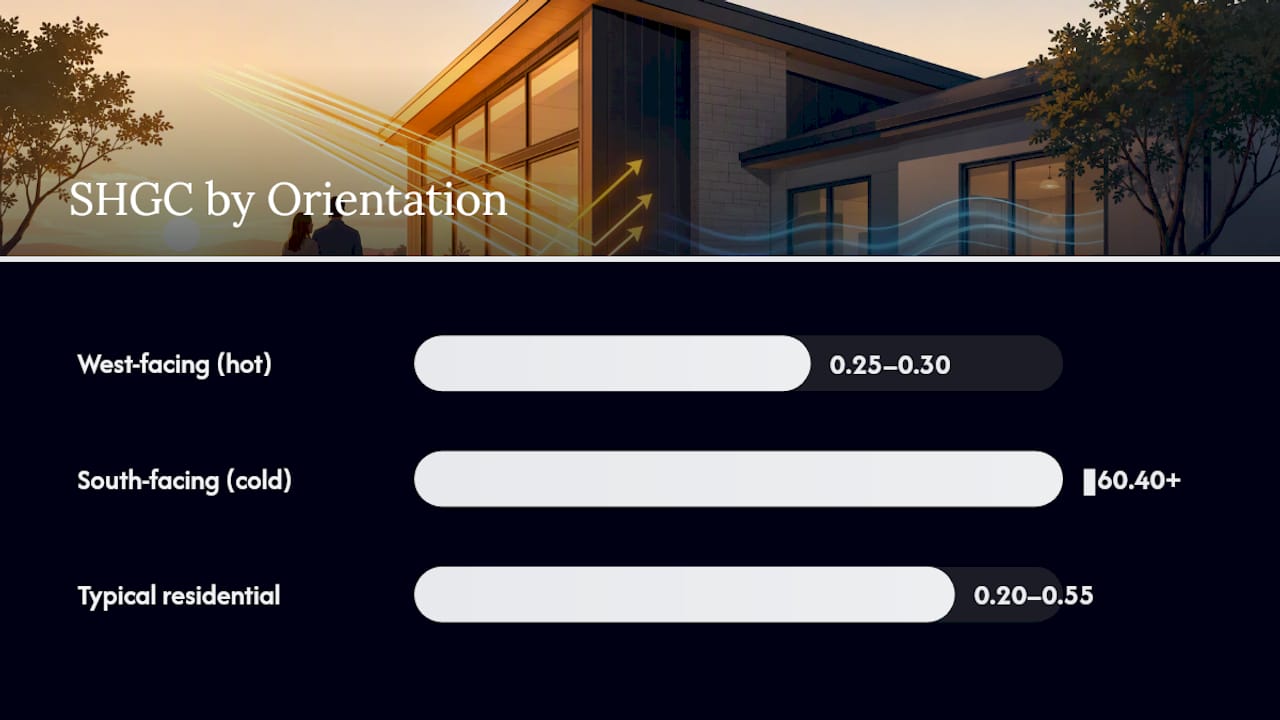
A few real-world examples make this concrete. A sunroom on the south side of a house in a northern climate benefits from a moderate-to-high SHGC, because that free solar heat offsets furnace runtime on sunny winter days. A second-floor bedroom facing west in a hot climate needs the opposite: an SHGC as low as reasonably possible, because that same sun is adding cooling load every single afternoon from spring through fall. Building-performance guidance from WBDG’s window and glazing resources backs up this same logic: specify low SHGC where air conditioning dominates your energy bill, and consider higher SHGC where passive heating genuinely offsets furnace use.
U-Factor vs SHGC: The Side-by-Side Breakdown
The confusion between these two numbers usually comes down to one thing: they’re solving different problems. U-Factor is about heat that moves because of temperature difference. SHGC is about heat that arrives specifically as sunlight. A window can excel at one and be mediocre at the other.
| What it controls | U-Factor | SHGC |
|---|---|---|
| Type of heat transfer | Conduction, convection, radiation from temperature difference | Solar radiation converted to heat |
| Scale | Roughly 0.20 to 0.55 | 0 to 1 |
| Rule of thumb | Lower is always better | Depends on climate and orientation |
| Biggest impact | Winter heating costs, comfort near glass | Summer cooling load, room temperature swings |
| Improved by | Multiple panes, gas fills, better frames, spacers | Low-E coatings, tints, glazing composition |
Trade-offs show up constantly on real spec sheets. You’ll see a window with an excellent U-Factor of 0.24 paired with an SHGC of 0.45, which is a strong pick for a cold-climate south wall but a poor pick for a west-facing bedroom in a hot region. You’ll also see the reverse: a window with a mediocre U-Factor of 0.32 but a very low SHGC of 0.22, aggressively marketed as a “solar control” product for the Sun Belt, that still lets more heat leak through the frame than a better-insulated option would.
Decision rules simplify once you frame them by climate:
- Hot climates: prioritize low SHGC first, then get the best U-Factor you can within budget.
- Cold climates: prioritize low U-Factor first; consider a higher SHGC specifically on south-facing glass for passive solar gain.
- Mixed or temperate climates: don’t average the two. Set SHGC per orientation (low on east and west) while keeping U-Factor consistently low across every window in the house.
Orientation is the piece most buyers skip entirely, and it’s the one that saves or costs the most money. South-facing glass gets long, relatively low-angle sun exposure that’s easy to manage with overhangs and can be harnessed for heat in winter. East and west-facing glass catch low-angle morning and afternoon sun that’s brutal to shade and drives cooling costs hard. North-facing windows get almost no direct solar gain, so SHGC barely matters there. U-Factor still matters on every single face of the house, because it doesn’t care which way the window points.
Recommended U-Factor and SHGC Targets by Climate Zone
ENERGY STAR sets different qualifying thresholds depending on which of the country’s climate zones a window is sold into, because a window that performs great in Minnesota can be the wrong choice in South Texas. According to Consumer Reports’ breakdown of ENERGY STAR’s climate-zone system, the current framework uses roughly the following target bands:
| Climate zone | Target U-Factor | Target SHGC | Priority |
|---|---|---|---|
| Northern | Low U-Factor | No SHGC requirement in far north | Insulation dominates |
| North-Central | Moderate U-Factor | Moderate SHGC | Balanced, lean insulation |
| South-Central | Moderate U-Factor | Lower SHGC | Balanced, lean solar control |
| Southern | Higher U-Factor | Lower SHGC | Solar control dominates |
If your home sits along the Texas Gulf Coast, you’re squarely in the zone where SHGC does the heavy lifting. South Texas summers run long and intense, and a window with an SHGC above 0.30 on an east or west exposure will show up on your electric bill every single month from March through October. U-Factor still matters for the handful of cooler nights each winter, but it’s the secondary concern here, not the primary one.
Orientation adjustments layer on top of the zone target. Even within a Southern-zone home, a north-facing window can tolerate a slightly higher SHGC than the zone minimum suggests, since it never sees direct sun. East and west exposures deserve the strictest SHGC number you can find, sometimes pushing below 0.22 on especially exposed elevations.
None of these bands are universal guarantees, though. ENERGY STAR’s own product criteria note that qualification is checked model by model and zone by zone, so a window certified for one region isn’t automatically certified everywhere. Always confirm the specific model’s NFRC label against your zone using the ENERGY STAR product finder before you commit to a purchase.
A Homeowner’s Checklist for Balancing Both Ratings
Getting quotes from three different installers can produce three different sets of numbers, and it’s not always clear which ones to trust. Work through this before you sign anything:
- Ask for whole-product NFRC values, not center-of-glass figures. If a salesperson can’t produce the actual NFRC label, that’s a red flag worth pushing on.
- Match your target numbers to your climate zone first. Pull the ENERGY STAR band for your region before you start comparing specific products.
- Adjust SHGC targets by orientation, room by room if needed. A whole-house average is less useful than knowing which windows face west.
- Ask about frame material and spacer type. A great glass package installed in a cheap frame with a poor spacer will underperform its glass-only numbers.
- Confirm the Low-E coating type matches your priority. Solar control Low-E and cold-climate Low-E are formulated differently; ask which one is specified.
- Check gas fill. Argon or krypton fill between panes measurably improves U-Factor over an air-filled unit.
- Watch for vague or unusually low numbers with no NFRC backup. If a spec sheet lists a U-Factor of 0.18 with no visible NFRC certification, treat that number with skepticism.
Pro Tip: Keep a copy of the NFRC label for every window you install. If you ever apply for a utility rebate or sell the house, having the documented whole-product ratings on hand saves a scramble later.
Three Homeowner Scenarios and What to Prioritize
A sun-drenched living room with west-facing windows. This is the classic afternoon-heat problem. Prioritize SHGC in the 0.25 to 0.30 range or lower, and pair it with the best U-Factor your budget allows. The SHGC number does most of the comfort work here; a slightly higher U-Factor is a smaller trade-off than living with an SHGC of 0.45 on that exposure.
A cold-climate home with south-facing windows. Here the calculus flips. Prioritize a low U-Factor, ideally 0.22 to 0.28 depending on your specific zone, and consider allowing a moderate-to-high SHGC on the south wall specifically to capture passive solar heat on sunny winter days. North-facing windows in the same house should still get the lowest U-Factor available, since they gain nothing from solar heat.
A mixed or temperate climate with windows on every exposure. Resist the urge to buy one uniform product for the whole house.
- East and west windows: low SHGC, standard-to-good U-Factor.
- South windows: low U-Factor, moderate SHGC if passive heating is a priority.
- North windows: low U-Factor, SHGC is largely irrelevant.
Treating every window in a mixed-climate home identically almost always means overpaying for solar control you don’t need on the north side, or under-specifying it on the west side where you need it most.
Why Installation Quality Changes the Numbers You Paid For
A window’s rated U-Factor and SHGC assume correct installation. Gaps around the frame, poor flashing, or a rushed install can undercut even a premium unit’s real-world performance, because air leakage around the frame doesn’t show up on the NFRC label at all. Some contractors often see this on older coastal homes where the original window performed fine on paper but was never sealed correctly to begin with.
A few things worth knowing before you decide whether to replace or repair:
- Replacement makes the most sense when frames are warped, seals have failed, or the glass is single-pane with no realistic upgrade path.
- Shading, solar films, or storm windows can extend the life of a structurally sound frame if full replacement isn’t in the budget yet.
- A proper window evaluation should look at frame condition, current U-Factor and SHGC estimates, and orientation on every exposed wall, not just a generic quote.
- Whole-unit performance depends on how well the frame is sealed to the wall, which matters as much as the glass package itself.
Homeowners going through Buffalo Roofing & Exteriors’ window replacement workflow for coastal homes get an assessment that accounts for South Texas humidity, salt air, and storm exposure alongside the standard energy ratings, since coastal conditions add wear that inland climate-zone tables don’t capture.
Getting the Balance Right Without Overthinking It
Chasing a single “perfect” number on a spec sheet is the wrong instinct. The right approach starts with your climate zone, adjusts for which way each window faces, and then treats U-Factor and SHGC as two separate problems that happen to live on the same piece of glass. South Texas homeowners in particular should weight SHGC heavily on east and west exposures and not get distracted by a slightly better U-Factor on a product that lets in too much solar heat.
Windows are a significant investment, and the payback period depends on your current windows’ condition, local utility rates, and whether rebates are available in your area. Check for utility and state incentive programs before finalizing a decision. Before signing anything, verify the NFRC whole-unit values yourself and talk through orientation-specific choices with your installer rather than accepting a one-size-fits-all quote; also consider how new interior doors improve energy efficiency in older Portland homes to enhance your building envelope before replacing windows, as recommended by One Day Doors & Closets.
— Results
Ready to Replace Windows That Actually Match Your Climate?
The NFRC label on every quoted window option shows real whole-product U-Factor and SHGC values instead of a marketing number that ignores the frame. That matters most along the Texas Gulf Coast, where the wrong SHGC on a west-facing wall can cost you every single summer.

Some estimates are built around a home’s specific orientation and climate exposure rather than a generic recommendation, with available financing options and workmanship warranties to make the investment manageable. If your current windows are drafty, fogged, or clearly underperforming, start with a free estimate through our windows service page and we’ll walk your home room by room before recommending anything.
FAQ
What Is a Good U-Factor and SHGC for Windows?
A good U-Factor is generally considered low, with colder zones requiring lower values than warmer zones. A good SHGC varies depending on climate and window orientation; lower SHGC values are typically better for hot, sun-exposed windows, while higher values may be preferred for south-facing windows in cold climates that benefit from passive solar heating.
Is 0.27 a Good U-Factor for Windows?
A U-Factor around the mid to lower typical range is generally considered to represent strong performance for residential windows and may meet ENERGY STAR thresholds in many climate zones.
Is a U-Factor of 0.28 Good?
A U-Factor near the mid-range is generally considered solid performance and may meet ENERGY STAR thresholds for some zones, though colder zones generally require lower values.
Is 0.29 a Good U-Factor for Windows?
A U-Factor close to the mid-range may be reasonable for some applications, but you should verify your specific climate zone’s requirements to confirm eligibility.
Should I Prioritize U-Factor or SHGC First?
Prioritize whichever metric governs your dominant energy load: SHGC first in hot, cooling-dominant climates like South Texas, and U-Factor first in cold, heating-dominant climates, then optimize the other metric within your budget.