TL;DR: San Antonio is one of the most hail-active cities in the country, averaging more than four severe hail days per year. Hail damage to your roof is often invisible from the ground but can slash years off your shingles’ life. This guide explains how to spot damage, navigate your insurance claim, and decide between repair and full replacement.
If you live in San Antonio, hail is not a question of if — it’s a question of when. From 2016 to 2025, San Antonio averaged 4.4 severe hail days per year — the highest of any 10-year stretch on record. That’s not bad luck; that’s geography. San Antonio sits right in the heart of a corridor that funnels supercell thunderstorms up from the Gulf of Mexico every spring.
The April 2016 storm alone showed what that can mean. San Antonio’s most destructive hailstorm dropped 4.5-inch hail across the North Side, damaged more than 110,000 vehicles, and caused an estimated $1.36 billion in damage — the costliest hail event ever recorded in Texas.
At Buffalo Roofing & Exteriors, we serve homeowners across San Antonio and the surrounding Hill Country. After every significant storm we field calls from people who looked at their roof from the driveway, saw nothing obviously wrong, and figured they were fine. They weren’t. This guide will help you understand what actually happens to your roof during a hailstorm — and what to do about it.
Why San Antonio Hail Is Especially Hard on Roofs
San Antonio’s hail threat is compounded by the region’s intense UV radiation, high summer temperatures, and dramatic thermal cycling (roofs can swing 100°F+ between a summer midday and a winter night). A shingle that loses its protective granule coating to hail doesn’t just have a cosmetic blemish — it’s now exposed to some of the harshest sun in the continental U.S.
The loss of protective granules exposes underlying asphalt to damaging sun rays. When asphalt is directly exposed to the sun without a protective layer of granules, the shingle becomes vulnerable to UV light degradation, which can accelerate cracking, blistering, algae formation, edge damage, and water leaks.
In short: a storm that might cause cosmetic-only damage on a roof in a cooler, cloudier climate can functionally destroy a San Antonio shingle roof within a few seasons.
How to Spot Hail Damage on Your Roof
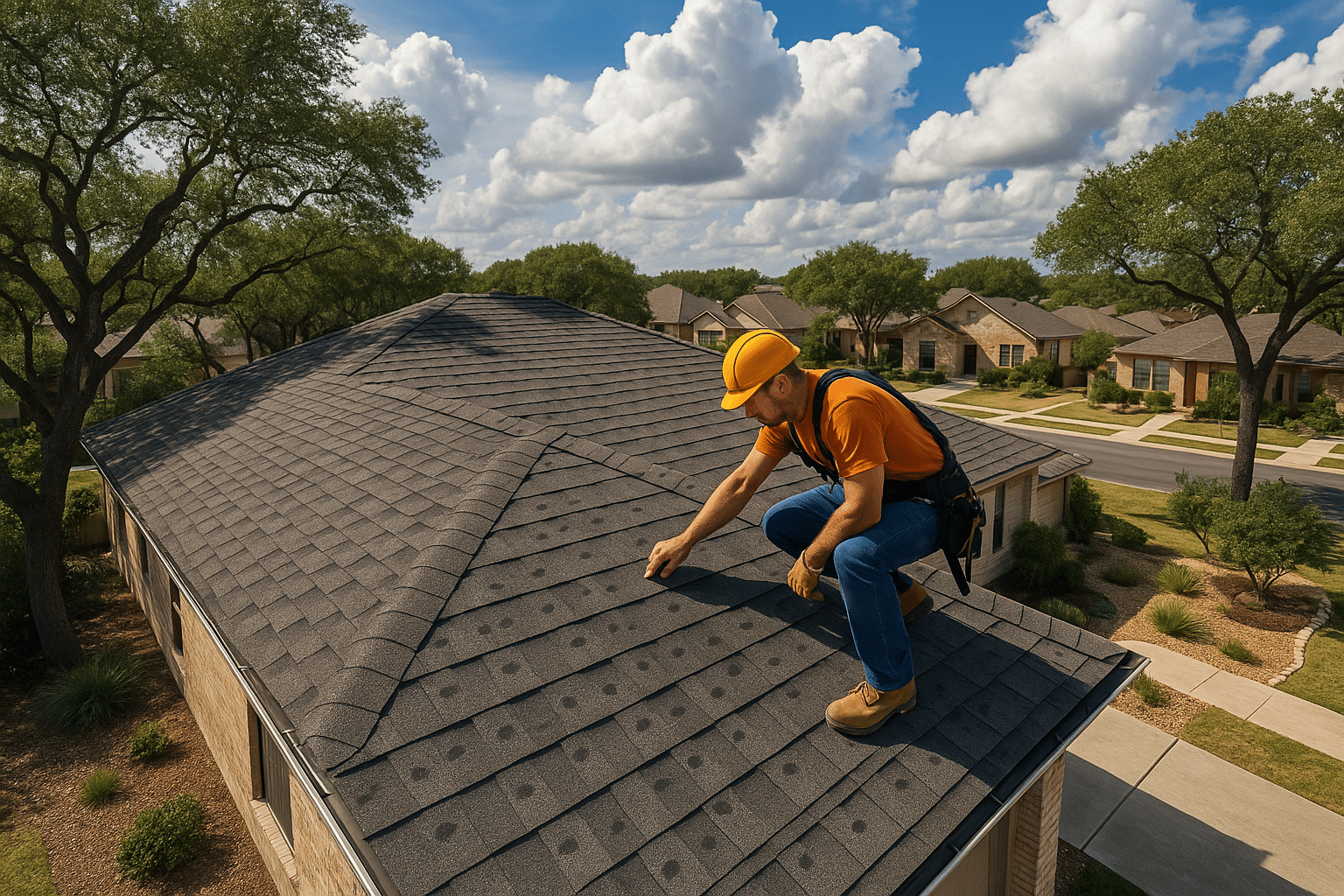
Most hail damage is invisible from the ground. From thirty feet below on your driveway, damage spots are nearly invisible. Here’s what a professional looks for on each common roofing material in the San Antonio market.
Asphalt Shingles
Asphalt shingles are the most common residential roofing material in Texas. Signs of hail damage on asphalt and composition shingles include random damage with no discernible pattern, hail hits that are black in color, loss of granules which may expose the roof felt, asphalt and/or mat that appears shiny, and hail hits that are soft to the touch — like the bruise on an apple.
Don’t ignore your gutters either. Check your gutters and downspout exits for an unusual accumulation of black, sand-like granules. While all asphalt shingles shed some granules over their lifetime, a sudden heavy deposit after a storm indicates hail has stripped the protective coating — and significant granule loss can accelerate shingle aging by 5 to 7 years.
Metal Roofs
Metal roofs are generally long-lasting and can be resistant to hail damage, but severe hailstorms may still cause problems. You may find dents or depressions on the metal surface or damage to the paint and coating, which could lead to rust. Hailstones can also damage seams, leading to the loosening of fasteners and eventual water damage.
Clay and Concrete Tile
Spanish tile, clay tile, and concrete tile are popular in San Antonio’s older neighborhoods and newer Hill Country-style builds. Slate and clay tile roofs are often considered the most reliable of all roof types but can still be vulnerable to cracking from hail. Large hailstones can even break individual tiles, resulting in roof leaks.
Flat and TPO Roofs (Commercial & Residential)
If you own a commercial building, a flat-roofed addition, or a home with a TPO (thermoplastic polyolefin) or other membrane system, hail can puncture or crack the membrane and compromise seams. Have a professional assess any membrane roof after a significant storm — membrane damage is almost impossible to detect without getting on the roof.
- Start outside, not on the roof. Check gutters, downspouts, AC condenser fins, and window sills. Dents there confirm hail hit the property.
- Look for shingle bruises. Press the surface gently — soft or spongy spots mean the mat is compromised underneath.
- Check flashing. Hail-dented metal flashing around chimneys, vents, or roof edges can cause poor water runoff, risking leaks and other water-related damage to the roofing layers and the interior.
- Don’t climb up yourself. A wet or hail-damaged roof is dangerous. Let a licensed contractor do the hands-on inspection.
Repair or Replace? How to Make the Right Call
This is the question we hear most often after a storm — and the honest answer depends on three things: the age of your roof, how widespread the damage is, and what your insurance policy covers.
When repair is the right move
Some forms of roof hail damage repair can be completed without replacing the entire roofing system, especially if the damage is localized and caught early. Repair generally makes sense when:
- Your roof is under 10 years old and otherwise in good condition
- Damage is confined to one or two sections rather than spread across multiple slopes
- Damage is limited to a small area (under 10% of the roof)
When replacement is the smarter investment
If hail has hit multiple slopes of your roof, or there are dozens of damaged shingles, replacing the entire roof may be more cost-effective than patching.
Consider full replacement when:
- Your roof is 20+ years old. Replacement is almost always the right recommendation here. Even when the scope of damage might technically allow repair, you are still spending money on a roof that is likely in its final years.
- You’ve had prior hail events and the shingles are already granule-depleted
- Hail damage may not cause immediate leaks, but it creates tiny punctures that worsen over time, allowing water to seep into the underlayment or decking and cause hidden moisture problems.
One useful industry benchmark: most insurers use the test-square method — if a 10×10-foot section of roof shows 8 to 10 or more hail impacts, full replacement is typically approved. However, some carriers have different thresholds, and the age and condition of the roof also factor into the decision.
A trusted local contractor can walk you through both options with a written assessment — that documentation also strengthens your insurance claim.
Navigating Your Insurance Claim in Texas
Texas homeowners have specific rights and timelines to know about before you pick up the phone to call your insurer.
Act quickly — there’s a deadline
In Texas, the statute of limitations for filing a hail damage claim on your roof is typically one year from the date of the storm that caused the damage. Don’t wait for a leak to appear before you call. Hidden water damage can spread to insulation, drywall, flooring, and personal belongings if roof damage is not addressed quickly.
Document everything first
As soon as it is safe to do so after a storm, photograph and video everything — your roof, gutters, siding, windows, and any interior damage like ceiling stains or water intrusion. One of the most common reasons for claim delays is incomplete documentation. Insurance companies rely on photographs, inspection reports, contractor estimates, and other records to understand what happened to the property.
Understand your wind/hail deductible
Texas policies almost always carry a separate wind and hail deductible — and it works differently than a standard flat deductible. Your wind and hail deductible is the amount you pay out of pocket before your homeowners insurance kicks in. Wind and hail deductibles are some of the most misunderstood parts of hail damage claims. They are calculated as a percentage of Coverage A (your dwelling coverage limit), rather than a percentage of the repair cost. For example, on a policy with $200,000 in dwelling coverage and a 2% wind/hail deductible, you are responsible for the first $4,000 of the cost of repair.
Know your legal rights — and the red flags
Texas law gives you the right to choose your own contractor. Texas homeowners have the right to choose their own contractor — your insurer cannot force you to use a preferred vendor.
One critical warning: under Texas Business and Commerce Code §27.02 and Insurance Code Chapter 707, it is illegal for a roofing contractor to waive or absorb your deductible. If a contractor offers to ‘cover your deductible,’ walk away — this constitutes insurance fraud under Texas law.
Also reassuring: a hail claim by itself cannot trigger claims-based non-renewal in Texas. Under Texas Insurance Code §551.107, losses caused by natural causes do not count toward the three-claims-in-three-years threshold.
What to Expect From a Professional Hail Damage Assessment
At Buffalo Roofing & Exteriors, our assessments follow a methodical process. We evaluate every slope of the roof, all flashings, gutters, vents, pipe boots, and skylights. We document impact density per test square — the same method insurance adjusters use — and provide a written report you can submit directly to your carrier.
We also handle the full scope of storm-related exterior damage in one visit. If hail cracked your siding, dented your gutters, or compromised a window, you get one detailed report and one point of contact — not four different contractors to manage.
If you are weighing which contractor to hire, our guide on how to choose the right roofing contractor in San Antonio walks through exactly what credentials and questions matter most in this market.
Roofing Materials Worth Considering After a Hail Event
A roof replacement is also an opportunity to upgrade. Here’s how the most popular San Antonio-area materials compare for hail performance:
- Class 4 impact-resistant asphalt shingles — The highest impact-resistance rating from Underwriters Laboratories. Many Texas insurers offer a premium discount for Class 4 shingles. Good fit for most neighborhoods.
- Metal roofing — Extremely durable against wind and hail with a long service life. Can show cosmetic denting in severe events, but structural damage is rare. A strong long-term value in the San Antonio market.
- Clay and Spanish tile — Beautiful and long-lasting, but individual tiles can crack in large hailstorms. Repair costs can be higher because of the specialized labor involved.
- Architectural shingles — Thicker than standard three-tab shingles and more resistant to impact. A cost-effective middle ground for most homeowners.
The National Roofing Contractors Association (NRCA) offers resources on roofing material performance standards and impact ratings that can help you compare options. According to the NRCA, any impact that compromises the long-term integrity of the roofing system should be considered for repair or replacement.
Your Next Step After a San Antonio Hailstorm
Here’s the short checklist:
- Check gutters, downspouts, and the AC unit for dents — these confirm hail reached your property.
- Photograph any visible exterior damage from the ground.
- Call a licensed, local roofing contractor for a professional assessment — do not wait for a leak.
- Review your policy’s wind/hail deductible and coverage limits before your adjuster visit.
- Get a written contractor report before or alongside the adjuster’s visit to strengthen your claim.
- File your claim well within the one-year Texas deadline.
Buffalo Roofing & Exteriors offers free estimates for storm and hail damage throughout San Antonio and the surrounding area. We are licensed, insured, and carry 200+ five-star Google reviews from homeowners across South and Central Texas. We also offer financing through Improvifi — from $1,000 to $50,000, with $0 down and no impact to your credit score — so cost is never the reason to delay a repair.
Call us or request your free quote online. One call covers your roof, gutters, siding, windows, and more — so you can get back to normal faster.
Recommended Reads
- How to Choose the Right Roofing Contractor in San Antonio
- TPO Roof Repair in Corpus Christi, TX
- Flat Roof Repair in Corpus Christi, TX