

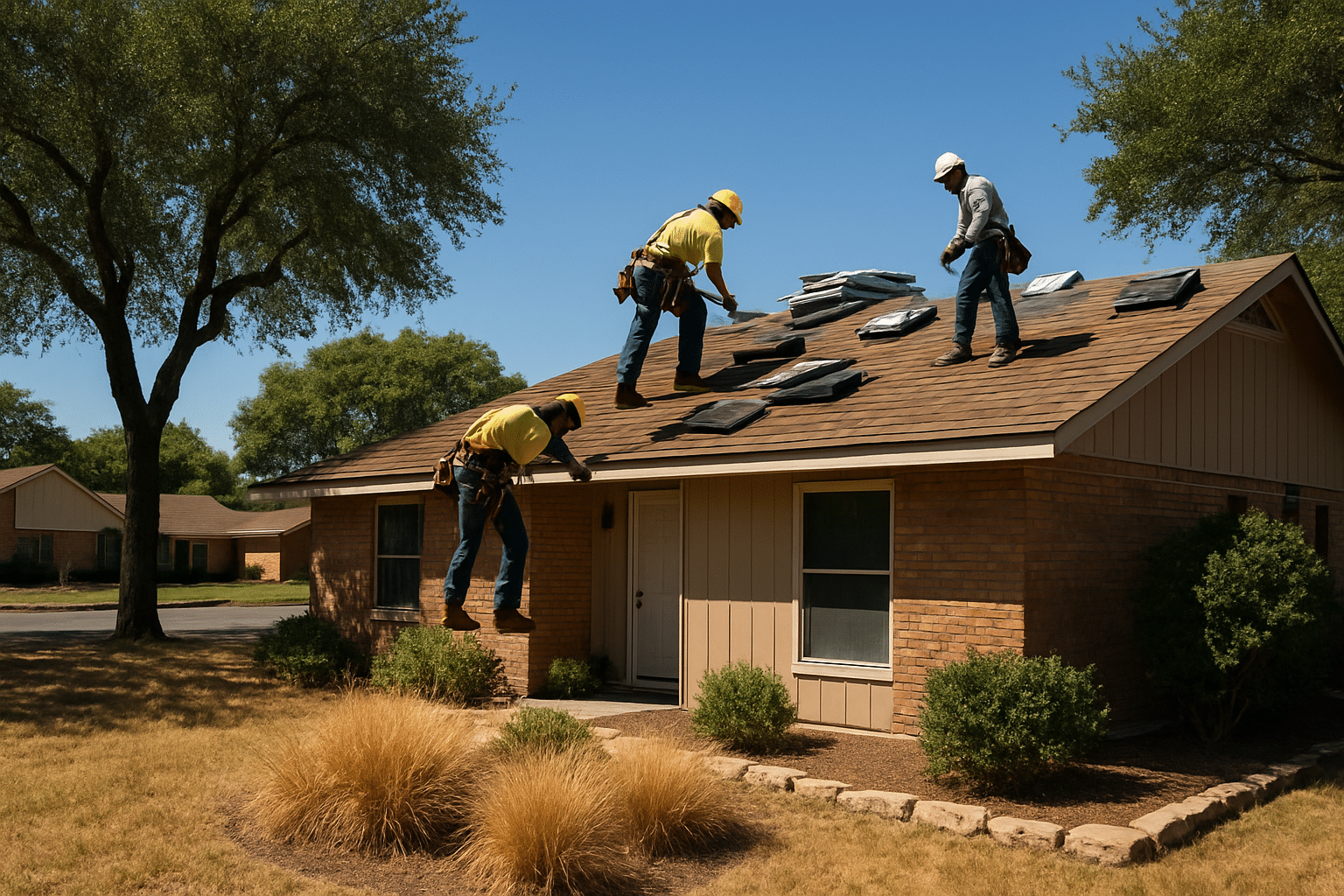
TL;DR: San Antonio homeowners typically pay $9,500–$22,000 for a full roof replacement in 2026, depending on home size, material, and roof complexity. Hail is the dominant roofing threat here, so Class 4 impact-resistant shingles are often the smartest long-term investment. Get a free quote from Buffalo Roofing & Exteriors to see an accurate number for your specific home.
If you’re staring at a leaky ceiling after a spring storm — or you’ve just noticed your shingles look like the surface of the moon — your first question is almost always the same: how much is this going to cost me?
The honest answer is: it depends. But that’s not very useful on its own. This guide breaks down real 2026 price ranges for San Antonio, explains what drives cost up or down, and tells you exactly what to ask your contractor so you don’t get blindsided.
What San Antonio Homeowners Are Actually Paying in 2026
The typical investment ranges from $8,500 to $20,000 for a standard residential home, though smaller projects may start at $5,000 and premium installations can exceed $37,000.
Most San Antonio homeowners with an average-sized home pay around $12,500 to $18,000 for a full roof replacement using architectural asphalt shingles — the most popular choice in the area.
For a quick reference, here’s how prices break down by home size using architectural shingles as the baseline:
- Smaller homes (1,500–1,800 sq ft): $9,500–$13,000
- Mid-size homes (1,800–2,500 sq ft): $12,500–$18,000
- Larger homes (2,500–4,000 sq ft): $18,000–$30,000+
Note that roofing contractors measure in “squares” (100 square feet), and a 2,000 sq ft home typically has 2,200–2,400 sq ft of actual roof surface once you account for pitch and slope. That gap matters when comparing quotes.
Cost by Roofing Material
Material choice is one of the biggest levers on your final price. Here’s what each major option runs in the San Antonio market:
Asphalt Shingles — $9,500 to $24,000
Asphalt shingles are the most common choice across South and Central Texas. An architectural shingle roof costs $4 to $6 per square foot installed, or $7,500 to $16,000 on average. Architectural shingles — also called 3D, laminate, or dimensional shingles — are thicker and last longer than basic 3-tab shingles.
For San Antonio specifically, a standard 30-year architectural shingle replacement on a typical home runs $9,500–$14,500, while Class 4 impact-rated shingles (recommended for hail) run $11,500–$17,500, and premium designer shingles can reach $15,500–$24,000.
Metal Roofing — $15,000 to $40,000+
A metal roof costs $5 to $16 per square foot installed, or $7,500 to $40,000 on average, depending on the metal type and gauge. Standing seam metal is at the top of that range and is increasingly popular in the San Antonio area for its longevity and heat-reflectivity. In a climate with intense UV and 100°F summers, the energy savings can be significant over a 40–70 year lifespan.
Clay, Spanish & Concrete Tile — $18,000 to $50,000+
A tile roof costs $7 to $25 per square foot, or $10,500 to $62,500 installed on average. Clay and Spanish tile are common in San Antonio neighborhoods like Alamo Heights and Stone Oak, where the aesthetic fits the Hill Country and Mediterranean architectural style. Tile is heavy — your roof deck must be inspected to confirm it can support the load before installation.
TPO and Flat Roofing Systems
Some San Antonio homes — and many small commercial properties — have low-slope or flat roofs that require a different system entirely. TPO (Thermoplastic Polyolefin) is a single-ply membrane that reflects UV and handles thermal expansion well, making it a strong performer in Texas heat. If you have a flat or nearly flat roof section, ask specifically about TPO — it won’t be covered by standard shingle pricing.
What Makes Your Price Go Up (or Down)
Two neighbors with the same square footage can get quotes that differ by $5,000 or more. Here’s why:
- Roof pitch: Anything above an 8/12 pitch requires roof jacks and slower work — add 10–25% to your base cost.
- Multiple stories: Two-story homes cost more than single-story due to access challenges — add 10–15%.
- Tear-off layers: If you have two layers of old shingles, tear-off takes twice as long and disposal doubles — add 10–20%.
- Decking damage: Each sheet of decking replaced costs $60–$90, and heavy decking damage adds $500–$3,000 to your total.
- Roof complexity: Lots of valleys, dormers, hips, and penetrations slow installation and require more flashing work.
- Class 4 upgrade: Class 4 impact-resistant shingles cost 20–35% more than standard architectural shingles — but keep reading, because that extra cost often pays for itself.
What About Permits?
Inside the City of San Antonio, permits are billed at $5 per $1,000 of construction value plus a $50 base fee. Most contractors handle the permit application as part of their scope. Always confirm this is included before signing a contract.
Why San Antonio Is a Hail-Heavy Market — and Why That Changes Your Decision
San Antonio is not a coastal city, so it doesn’t face the same hurricane and windstorm code requirements that apply along the Gulf Coast (Corpus Christi, Harlingen, Aransas Pass). What it does face is relentless hail.
Central Texas often gets labeled a hail hotspot, and the label holds up for San Antonio specifically. Radar-based NOAA data going back to 2014 shows more than 200 verified hail days within ten kilometers of San Antonio, with May standing out as the clear peak month and meaningful activity continuing from March through August.
Central Texas sits inside what meteorologists call Hail Alley, the corridor running from around San Antonio through Austin and up toward Dallas where warm Gulf air collides with drier air pushing down from the plains. The National Weather Service’s Austin/San Antonio office tracks an average of 5 to 8 significant hail events — one inch in diameter or larger — along the I-35 corridor every year, and that number can roughly double in an active season.
A single bad hail event can cut years off a standard asphalt roof’s lifespan. That’s why the material choice you make at replacement time carries real financial consequences beyond the sticker price.
Should You Upgrade to Class 4 Impact-Resistant Shingles?
For most San Antonio homeowners replacing a roof, the answer is yes — and here’s the math.
Texas law requires insurers to discount premiums for Class 4 impact-resistant roofing. This isn’t a negotiating tactic — it’s a regulatory mandate from the Texas Department of Insurance (TDI). The Texas TDI mandate requires insurers to discount impact-resistant roofing, with Class 4 shingles saving 15–35% on Texas premiums.
The test that earns that rating is called UL 2218. Class 4 shingles must survive two direct strikes from a 2-inch diameter steel ball (weighing 1.4 lbs) dropped from 20 feet without cracking, tearing, or splitting. Standard shingles typically don’t pass that test.
The break-even analysis varies, but for most Central Texas homes, Class 4 pays back within 5 to 10 years through the discount alone — and the resilience benefits beyond that are essentially free.
One important nuance: a cosmetic damage exclusion — formally Texas Endorsement HO-145 — removes coverage for hail damage that affects the appearance of your roof but does not cause functional failure such as cracking or leaking. Many Texas carriers require this endorsement as a condition of offering the full Class 4 impact-resistant roofing credit. If hail dents your Class 4 shingles but doesn’t crack them, the carrier pays nothing under this exclusion. Talk to your insurance agent about how your specific policy handles this before you decide.
If your home has already been hit by hail, see our guide to hail damage roof repair in San Antonio before scheduling a full replacement — in some cases, repair is a viable option.
Neighborhood Context: What San Antonio Homes Actually Cost to Re-Roof
Home size and complexity vary a lot by neighborhood. Stone Oak, Alamo Heights, and Shavano Park homes average larger — 2,400 to 4,000 sq ft — with more complex designs, putting typical replacement costs at $12,000–$22,000. Schertz, Universal City, and Converse tract homes (1,800–2,500 sq ft) with simpler designs typically run $9,500–$15,000. Boerne, Fair Oaks Ranch, and Helotes feature larger custom homes (3,000–6,000 sq ft) with complex pitches, pushing totals to $16,000–$30,000.
What a Roof Replacement Quote Should Include
A trustworthy contractor will hand you a written, itemized proposal — not a back-of-napkin number. Make sure yours covers:
- Material type, brand, and shingle class (especially UL 2218 rating if applicable)
- Number of squares being installed
- Tear-off and disposal of old roofing
- Underlayment, flashing, drip edge, ridge vent, and starter strips
- Decking inspection and per-sheet replacement cost if needed
- Permit fee (pulled by the contractor)
- Manufacturer warranty duration and workmanship warranty terms
- Cleanup and haul-away
If a San Antonio roofing estimate looks substantially lower than market ranges, be cautious. Deep discounts usually mean something is missing from the scope — often underlayment quality, decking inspection, or proper flashing.
Does Insurance Cover a Roof Replacement in San Antonio?
If your roof was damaged by hail or wind, your homeowner’s insurance policy may cover all or most of the replacement cost — minus your deductible. The key is proper documentation. File the claim promptly after a storm, have an independent inspection done, and keep records of the damage.
One firm warning: any roofer who offers to waive your deductible is committing insurance fraud — which is a felony in Texas. Avoid contractors who lead with that pitch.
Buffalo Roofing & Exteriors has helped hundreds of South and Central Texas homeowners navigate the insurance claim process — we document damage thoroughly, communicate directly with adjusters, and make sure nothing gets left off your claim.
How to Pay for a Roof Replacement
Beyond insurance, there are several ways to manage the out-of-pocket cost:
- Insurance proceeds: If storm damage is confirmed, your insurer pays the bulk after your deductible.
- Financing: Buffalo Roofing & Exteriors offers Improvifi financing from $1,000 to $50,000 with $0 down and no credit score impact to apply — so you can move forward without draining savings.
- Energy efficiency rebates: Certain metal and cool-roof systems may qualify for utility or federal incentives. Ask your contractor to verify eligibility before you choose a material.
How Buffalo Roofing & Exteriors Prices a San Antonio Roof Replacement
We’re a locally owned, BBB-accredited contractor serving San Antonio and South Texas with four regional locations. Every estimate starts with a proper roof measurement and visual assessment — not a satellite guess. We price line by line so you can see exactly what you’re paying for.
We offer free estimates with no pressure and no obligation. If you’re also comparing your situation to coastal markets, our Corpus Christi roof replacement cost guide shows how pricing and material requirements differ along the Gulf Coast.
Not sure whether you need a repair or a full replacement? Our team will give you an honest assessment — and if a repair is the right call, that’s what we’ll recommend. Ready to get a real number for your home? Learn what to look for when choosing a San Antonio roofing contractor, then reach out for your free quote.
Recommended Reads
- How Much Does a Roof Replacement Cost in Corpus Christi? (2026 Price Guide)
- How to Choose the Right Roofing Contractor in San Antonio
- Hail Damage Roof Repair in San Antonio: What Homeowners Need to Know