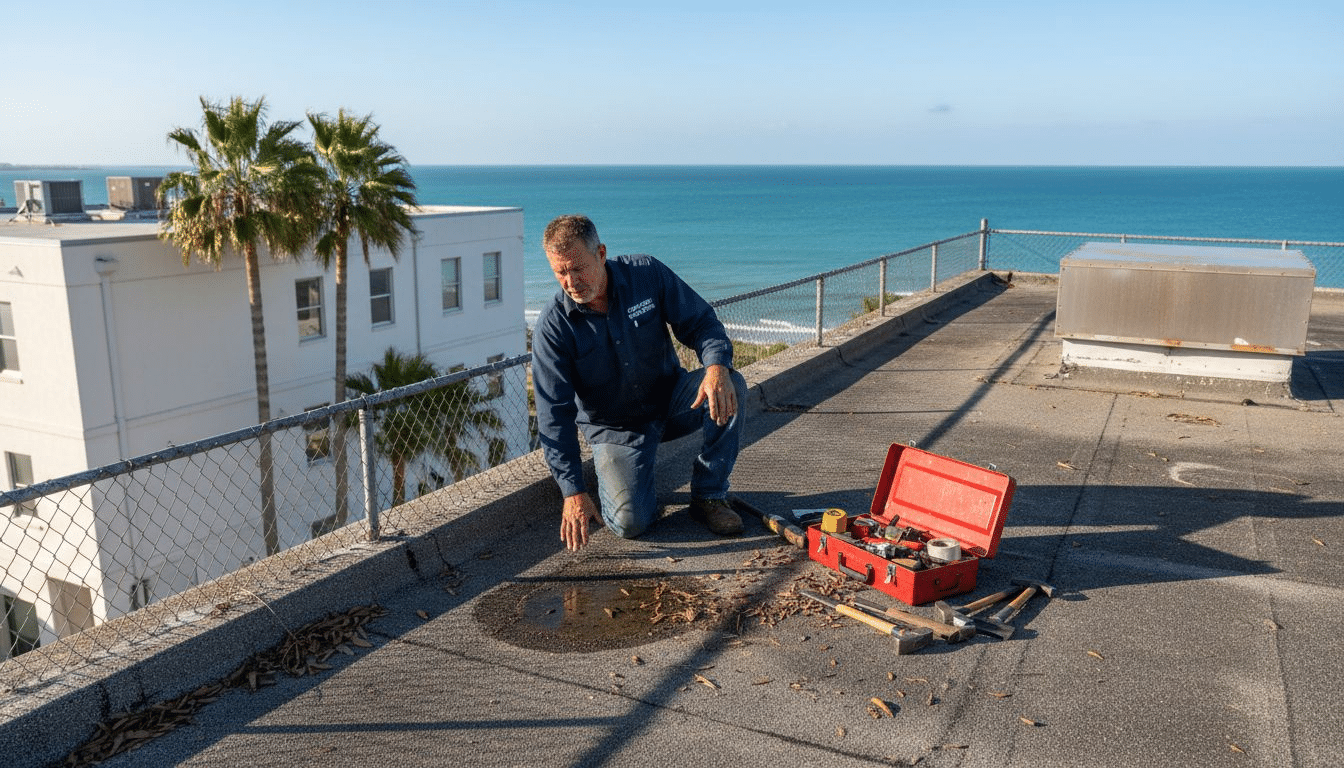
Salt air, intense sun, and hurricane season put every commercial roof along the Texas Gulf Coast under constant strain. For property managers, neglecting regular roof care risks more than just leaks or emergency repairs—it threatens the long-term value of your building. Investing in commercial roof maintenance means detecting small problems early, reducing costly disruptions, and protecting your assets against the unique challenges of the coastal environment.
Table of Contents
- What Is Commercial Roof Maintenance?
- Types of Maintenance Approaches and Plans
- Key Steps in Routine Roof Care
- Storm Damage Prevention and Response
- Costs, Risks, and Common Mistakes
- Legal, Warranty, and Safety Requirements
Key Takeaways
| Point | Details |
|---|---|
| Importance of Proactive Maintenance | Regular inspections prevent costly emergency repairs and extend the lifespan of your commercial roof. |
| Tailored Approaches for Coastal Properties | Adapt maintenance strategies to address unique coastal challenges, such as salt air and storm damage. |
| Documentation is Essential | Maintain detailed records of inspections and repairs to protect warranty and support insurance claims. |
| Avoid Reactive Maintenance | Relying on reactive repairs leads to higher costs and risks; prioritize scheduled maintenance instead. |
What Is Commercial Roof Maintenance?
Commercial roof maintenance is a proactive program that protects your building investment by keeping your roof in working condition for years longer than neglect would allow. Rather than waiting for leaks to appear or damage to become visible, you’re taking scheduled steps to catch problems early when they’re cheap to fix. This approach means identifying your specific roof type, understanding the membrane materials, and recognizing how normal aging and environmental stress affect your system over time.
At its core, preventive maintenance focuses on regular inspections and repair activities designed to keep your roof functioning properly. Your goal is straightforward: extend the service life of your roof, prevent leaks from developing, and avoid the expensive emergency repairs that come from ignoring small issues. When you address minor problems early, you’re also reducing the frequency of costly repairs and emergency service calls that disrupt your business operations. For coastal Texas property managers, this is especially critical since salt air, intense sun exposure, and hurricane season create unique stressors that accelerate roof deterioration if left unmanaged.
The difference between maintenance and repair matters. Maintenance is your regular program of inspections and condition-based efforts that happen on schedule, regardless of visible damage. Repair is what you do when something breaks. By maintaining your roof consistently, you actually prevent most repairs from ever becoming necessary. Think of it like your vehicle: regular oil changes prevent engine failure, just as regular roof inspections prevent catastrophic leaks. This scheduled, proactive approach keeps your building interior protected from water damage, preserves your inventory or equipment, and maintains the structural integrity of your investment.
Your coastal Texas property faces specific challenges that make maintenance non-negotiable. Salt spray corrodes flashing and fasteners faster than inland properties experience. High humidity creates conditions for algae and moss growth that trap moisture against your membrane. Storm season brings wind damage and debris impact that weakens roofing systems. Understanding what commercial roof maintenance actually is means recognizing these local stressors and building a program that addresses them through regular inspection cycles.
Pro tip: Schedule your first professional roof inspection before hurricane season (ideally June) so any maintenance needs can be addressed while contractors have availability and before severe weather arrives.
Types of Maintenance Approaches and Plans
When you’re managing a commercial roof in coastal Texas, you need a clear maintenance strategy. You have three primary approaches to choose from, and each one works differently depending on your building’s age, condition, and budget constraints. The approach you select shapes how often inspections happen, when repairs occur, and ultimately how long your roof lasts before replacement becomes necessary.
Planned Preventative Maintenance
Planned preventative maintenance emphasizes scheduled inspections and repairs based on systematic surveys by qualified professionals. This is the gold standard for most commercial properties because you know exactly when inspections will happen. You schedule them at set intervals, typically twice yearly in coastal Texas (spring and fall) to catch storm damage and weather-related wear. A qualified roofing contractor performs detailed surveys, documents findings, and creates a prioritized repair list. This approach covers preparation, legal considerations, health and safety protocols, and comprehensive reporting so you have complete documentation of your roof’s condition.
Preventive Maintenance Plans
Preventive maintenance operates on a fixed schedule. You commit to inspections at predetermined intervals, usually quarterly or biannually, regardless of whether visible damage exists. This approach prevents failures by addressing issues before they become emergencies. For coastal properties, preventive maintenance works especially well because you can time inspections around seasonal threats. Before hurricane season arrives, you’re already identifying loose fasteners, membrane wear, or flashing deterioration. Before winter weather, you’re ensuring drainage systems work properly. The cost is predictable because you budget for scheduled visits rather than reacting to emergency calls.
Predictive Maintenance and Reactive Approaches
Predictive maintenance uses condition monitoring and data analytics to identify problems before failure occurs. Roofing contractors use thermal imaging, drone inspections, and moisture meters to detect issues invisible to the naked eye. This data-driven approach can extend maintenance intervals and reduce unnecessary work, but it requires sophisticated equipment and trained technicians. Some property managers use a hybrid approach, combining scheduled preventive maintenance with predictive monitoring for added protection.
Reactive maintenance is the last resort. You only repair your roof after problems become visible or failures occur. Leaks damage your inventory. Emergency repairs disrupt operations and cost significantly more than preventive work. Avoid this approach if possible, especially in coastal areas where weather damage accelerates.
Most successful commercial property managers in your region use planned preventative maintenance as their foundation, with predictive tools layered in for added confidence. This gives you the reliability of scheduled oversight with the insight of condition data.
Here’s a side-by-side look at key commercial roof maintenance strategies:
| Approach Type | Inspection Frequency | Cost Predictability | Technology Use |
|---|---|---|---|
| Planned Preventative | Twice yearly (spring/fall) | High, annual contracts | Standard surveys, checklists |
| Preventive Maintenance | Quarterly or biannual | Predictable, scheduled | Seasonal planning |
| Predictive Maintenance | As data indicates | Variable, based on need | Thermal imaging, drones, sensors |
| Reactive Maintenance | Only after failures | Unpredictable, expensive | Minimal, emergency-driven |
Pro tip: Request a maintenance plan from your roofing contractor that specifies inspection dates, what gets evaluated each visit, and how findings trigger prioritized repairs.
Key Steps in Routine Roof Care
Routine roof care isn’t complicated, but it does require consistency and attention to detail. The steps you take during regular maintenance directly determine whether your roof lasts 15 years or 25 years. For coastal Texas properties, where salt air and storm damage accelerate deterioration, following a systematic maintenance routine separates property managers who keep their roofs functional from those facing unexpected replacement costs.
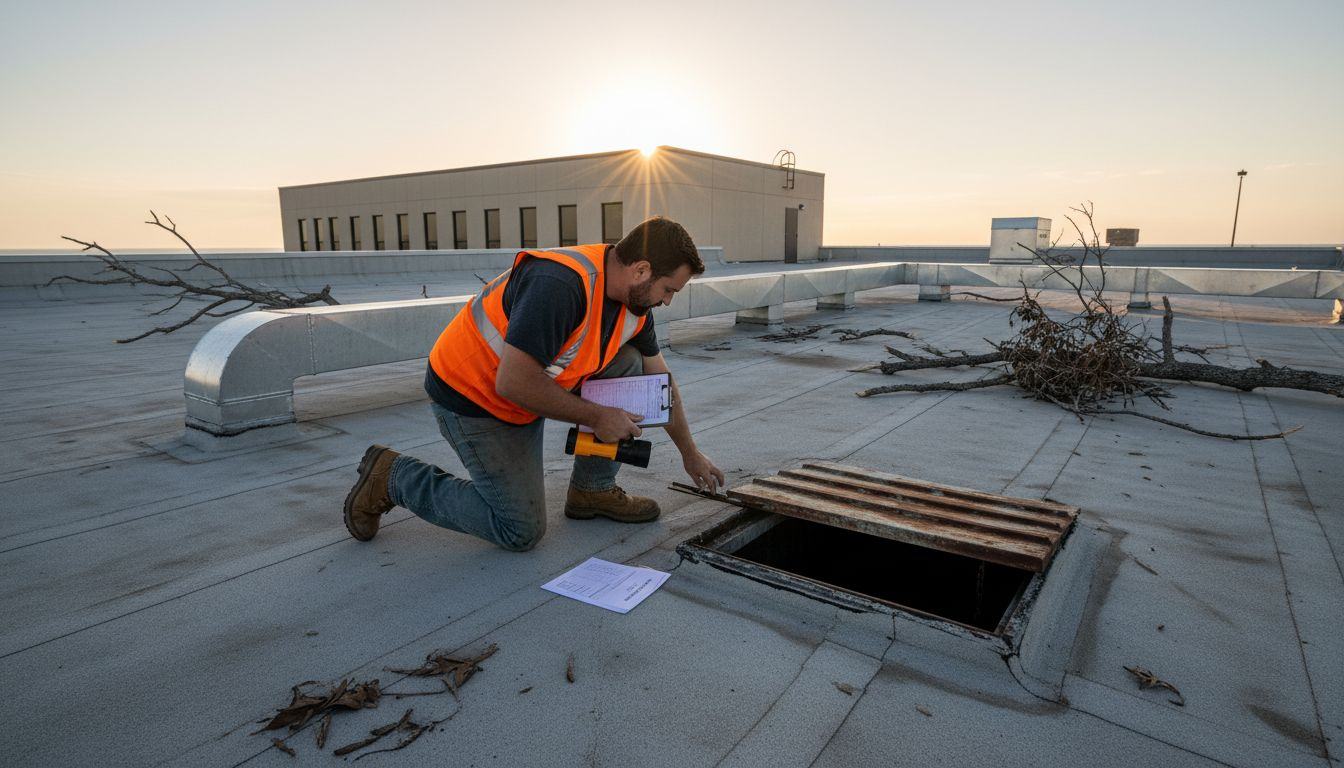
Start with biannual inspections, ideally scheduled in spring and fall. During these visits, a qualified contractor performs systematic hazard assessments and examines your entire roof system. They look for membrane damage, fastener corrosion, and areas where water might penetrate. In coastal environments, salt spray accelerates corrosion on metal components, so catching deterioration early matters tremendously. After severe weather events like thunderstorms or tropical weather patterns, schedule additional inspections rather than waiting for your regular cycle. Storm damage doesn’t always show up immediately, but moisture that enters through small breaches can cause internal damage within weeks.
Essential Care Steps
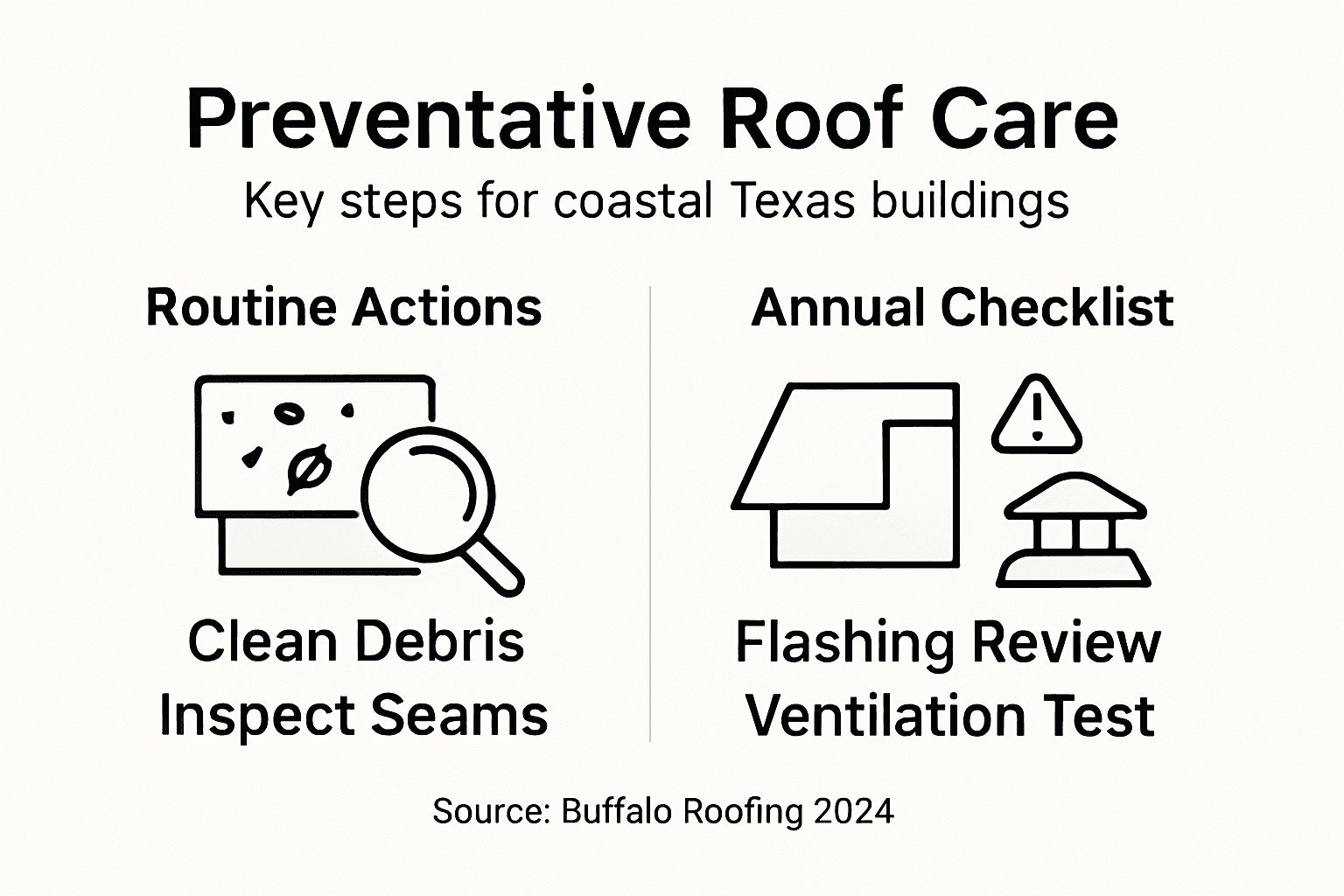
Cleaning is your first hands-on task. Debris accumulation on your roof traps moisture and promotes algae growth that degrades membranes over time. Your contractor should remove leaves, branches, and dirt from roof surfaces and gutters. They’ll verify that drainage systems work properly so water flows away from your building rather than pooling in valleys or low spots. Pooled water is a roof killer in any climate, but in humid coastal areas, stagnant water breeds mold and accelerates membrane deterioration.
Flashing and seams require careful attention. Flashing is the metal trim that directs water away from seams, vents, and penetrations. In coastal environments, metal flashing corrodes faster than inland areas experience. Your maintenance routine includes inspecting flashing for corrosion, gaps, or separation from the membrane. Roofing seams are stress points where two sections meet. Small cracks in seams allow water infiltration that spreads into insulation and structural elements. Prompt repairs to flashing and seams prevent cascading damage.
Ventilation assessment completes your routine. Proper ventilation reduces moisture accumulation in your attic space and extends roof life. Verify that vents aren’t blocked by debris or covered during repairs. Poor ventilation causes trapped moisture that weakens insulation and promotes mold growth in your building envelope.
Minor repairs should happen immediately when identified. Small membrane blisters, minor cracks, or fastener issues are cheap to fix now but become expensive leaks later. Delaying repairs is where coastal property managers run into trouble.
Pro tip: Create a maintenance calendar documenting inspection dates, findings, and completed repairs so you have a complete history that helps contractors prioritize future work and supports warranty claims.
Storm Damage Prevention and Response
Coastal Texas storm season isn’t a question of if your roof will face severe weather, but when. Hurricane-force winds, hail, and heavy rain create conditions that accelerate roof deterioration dramatically. Your storm damage prevention strategy starts months before tropical systems approach, and your response plan needs to activate immediately when damage occurs. The difference between a property manager who minimizes storm losses and one who faces catastrophic repairs comes down to preparation and quick action.
Pre-Storm Prevention
Prevention begins with comprehensive inspections before storm season arrives. In May or early June, have your contractor perform a thorough pre-storm evaluation using detailed checklists to identify vulnerabilities. They’ll examine membrane condition, check that all fasteners are secure and not corroded by salt spray, and verify that flashing is intact and properly sealed. Wind damage often exploits existing weaknesses, so a loose fastener that wouldn’t cause problems in calm weather becomes a failure point when gusts exceed 50 miles per hour. Your contractor will reinforce vulnerable roof components such as membranes around penetrations, strengthen flashing at seams and edges, and ensure proper drainage systems are clear and functional. Water accumulation during heavy rain becomes trapped under damaged membranes, spreading damage throughout your building envelope.
Early intervention following storms can significantly reduce repair costs and extend roof lifespan. Rather than waiting days or weeks after a storm passes, schedule damage assessments within 24 to 48 hours. This timing is critical for two reasons. First, you stop secondary damage before it spreads into insulation and structural elements. Second, you document conditions for insurance claims while damage is fresh and visible. Photographs and detailed inspection reports become essential evidence for coverage determinations.
Post-Storm Response
When severe weather strikes, don’t wait for visible leaks before acting. Your post-storm response includes immediate damage assessments using standardized checklists to identify all affected areas and prioritize repairs. Your contractor inspects gutters and drainage systems for blockages or damage that prevents water from flowing away. They examine flashings for separation, corrosion, or displacement. Roof coverings receive detailed inspection for tears, punctures, membrane blistering, or fastener displacement. Even small breaches allow water penetration that causes costly interior damage within hours during heavy rain.
Temporary protective measures may be necessary immediately following storms. Tarps, temporary sealants, or partial repairs can prevent water entry until permanent repairs occur. This is where having a contractor relationship established before storm season matters tremendously. Contractors with capacity before emergencies happen can respond to your property faster than those you contact after disaster strikes.
Insurance coordination happens alongside damage assessment. Most commercial policies require timely notice and documented damage assessment. Your detailed inspection checklist and photographs support your claim and accelerate the settlement process. Property managers who delay assessments or lack documentation often face claim denials or reduced settlements.
Pro tip: Establish a pre-storm contractor relationship in May, schedule preventive inspections in June, and maintain a list of emergency contact numbers for immediate post-storm response activation.
Costs, Risks, and Common Mistakes
Maintenance spending feels like an expense until you face a roof replacement. The math is brutal. A comprehensive preventive maintenance program costs $2,000 to $5,000 annually for a typical commercial building in coastal Texas. Emergency roof replacement costs $15,000 to $40,000 depending on size and complexity. When you defer maintenance to save money short-term, you’re gambling that nothing goes wrong. One hurricane season proves why that’s a terrible bet.
The Financial Reality of Deferred Maintenance
Neglecting scheduled inspections and ignoring minor defects create a cascade of accelerated deterioration that costs exponentially more to repair. A loose fastener that costs $50 to reseal today becomes a leak pathway that damages insulation and interior finishes worth thousands to repair. A small membrane crack ignored in spring becomes a water entry point by summer rain. That water penetrates structural elements, promoting mold growth that creates health hazards and requires remediation. The $200 repair you skipped turns into a $15,000 problem.
This is especially true in coastal Texas where salt air corrodes metal components faster than contractors in inland areas encounter. Your maintenance costs will run higher than properties in Austin or San Antonio because the environment is more aggressive. But skipping maintenance because costs feel high is precisely backward. You’re paying premium maintenance costs because the environment demands it, which makes skipping inspections even more dangerous.
Use this table to better understand the financial impacts of maintenance choices:
| Action Taken | Short-Term Expense | Long-Term Outcome | Insurance/Warranty Impact |
|---|---|---|---|
| Regular maintenance | $2,000–$5,000/year | Longer roof lifespan | Maintains coverage, claims paid |
| Deferred maintenance | $0 (initially) | Costly repairs, faster aging | Risk of denied claims |
| Emergency fixes only | High, unpredictable | Frequent disruption, high costs | Loss of warranty, coverage issues |
Common Mistakes That Destroy Budgets
The biggest mistake property managers make is over-reliance on reactive repairs. You ignore the roof until water appears in your ceiling tiles, then call for emergency service. Your contractor rushes out, charges emergency rates, and performs temporary fixes instead of comprehensive repairs. Your roof deteriorates further while you wait for budget approval on permanent fixes. Two months later you call again. By year’s end you’ve spent more on emergency visits than a preventive maintenance contract would have cost.
Another critical error is lacking a coordinated maintenance plan. You call different contractors for different issues, and nobody has a complete picture of your roof’s condition. One contractor doesn’t know what another did last month. Repairs overlap or contradict each other. You lose warranty coverage because work wasn’t performed by qualified professionals using approved methods. Your roof ages faster because coordination is missing.
Failing to document maintenance activities accurately creates separate problems. You can’t prove to your insurance company that you maintained the property, so they deny storm damage claims. You can’t show the next property owner what work was done, affecting building value. You can’t track patterns in failures, so you don’t know whether to replace specific components or sections.
Invalid warranties represent a financial risk most property managers don’t anticipate. Many roof warranties require documented maintenance performed by authorized contractors. If you’ve been cutting costs by hiring the cheapest available contractor without verifying credentials, your warranty becomes worthless when catastrophic failure occurs.
Pro tip: Budget maintenance as a non-negotiable line item, not a discretionary expense, and require your contractor to provide detailed documentation of all inspections and repairs for warranty protection and insurance purposes.
Legal, Warranty, and Safety Requirements
Your roof maintenance program isn’t just about preventing leaks. It’s about protecting yourself legally, honoring warranty terms, and keeping workers safe. These three areas overlap in ways that catch many property managers off guard. A contractor who skips safety protocols might injure someone, creating liability that extends beyond workers compensation. Work that violates warranty terms voids coverage right when you need it most. Neglecting legal compliance creates regulatory violations that cost far more than the maintenance you were trying to avoid.
Warranty Protection and Documentation
Most commercial roof warranties require documented maintenance performed by qualified contractors using approved methods. This isn’t fine print to ignore. If your roof fails and you haven’t maintained required documentation, your manufacturer warranty becomes worthless regardless of the failure cause. You bought a 20-year warranty but skipped maintenance, so the manufacturer denies your claim. You’re now looking at full replacement cost with no coverage.
Proper documentation means detailed records of every inspection, finding, and repair. Your contractor should provide written reports with photographs, specific problem identification, and work performed. Keep these records organized and accessible. When warranty claims arise, you can prove compliance with maintenance requirements. Without documentation, you can’t prove anything. The manufacturer has no reason to honor claims from property managers who can’t demonstrate they maintained the roof.
Safety Requirements and Liability
Safety requirements for roof maintenance cover access, inspection procedures, and working conditions to protect both maintenance personnel and building occupants. Your contractor must follow OSHA safety standards during all inspections and repairs. This includes fall protection, proper ladder usage, and equipment safety protocols. When contractors cut corners on safety to work faster and cheaper, they create injury risks that create liability for your property.
If a contractor is injured on your roof because safety protocols weren’t followed, you become liable for damages even though you hired someone else to do the work. Your insurance may deny coverage if the contractor wasn’t properly licensed or insured. You’re stuck paying damages personally. This is why verifying contractor credentials matters so much. Licensed, insured, and properly trained contractors follow safety protocols that protect everyone involved.
Legal Compliance and Building Codes
Your maintenance program must comply with local building codes and applicable regulations. Texas has specific requirements for commercial building maintenance. Your roof must meet current code standards even if it was built to older standards when installed. Maintenance activities sometimes trigger upgrades to code compliance. Your contractor should be familiar with these requirements and flag compliance issues during inspections.
Maintenance documentation also protects you legally. If property damage occurs and you’re asked whether maintenance was performed, your records prove your compliance. If a tenant is injured due to roof conditions, your maintenance records show that you took reasonable steps to maintain the building safely. Without documentation, you’re vulnerable to legal claims based on negligence.
Pro tip: Require your contractor to provide written maintenance reports with photographs and specific recommendations, maintain these records for at least seven years, and verify that all work is performed by licensed, insured professionals with proper certifications.
Protect Your Coastal Texas Commercial Roof Before Damage Strikes
Managing a commercial roof in coastal Texas demands more than occasional fixes—it requires a proactive, planned preventative maintenance approach to guard against salt air corrosion, storm damage, and accelerated aging as detailed in this article. Ignoring early signs of wear or delaying inspections risks costly emergency repairs that disrupt your business and drain budgets. The goal is clear: extend your roof’s lifespan while protecting your building’s structural integrity and contents.
Buffalo Roofing & Exteriors brings local expertise in roofing solutions designed specifically for coastal challenges. Whether you need thorough roof inspections, timely repairs, or storm damage restoration, our trusted team delivers reliable service that aligns with best practices like scheduled biannual maintenance and post-storm response. Harness our Roofing Archives knowledge to stay informed and protect your investment.
Don’t wait for leaks to become emergencies or for warranty coverage to lapse due to neglected maintenance. Act now to schedule your professional roof inspection and secure a customized maintenance plan that fits your property’s unique needs. Visit Buffalo Roofing & Exteriors or explore our Repairs Archives to get your free estimate and peace of mind today.
Frequently Asked Questions
What is commercial roof maintenance?
Commercial roof maintenance is a proactive program designed to keep your roof in good condition, preventing leaks and avoiding expensive emergency repairs. It involves regular inspections and repairs to identify and address minor issues before they escalate.
How often should commercial roofs be inspected?
For most commercial properties, it is recommended to schedule inspections twice a year, typically in the spring and fall. This allows for timely assessment of any damage or wear that may have occurred due to seasonal weather changes.
What are the benefits of planned preventative maintenance for roofs?
Planned preventative maintenance provides predictable inspection timelines and ensures that a qualified contractor systematically evaluates the roof’s condition. This approach reduces the risk of unexpected repairs, extends roof lifespan, and maintains compliance with warranty requirements.
How does storm season affect commercial roof maintenance?
Storm season increases the risk of severe weather damage, which can accelerate roof deterioration. It is crucial to conduct thorough inspections before and after storms to identify vulnerabilities and address any damage promptly to prevent costly repairs.
Recommended
- 7 Essential Home Roofing Tips for Homeowners in Texas
- What Is Commercial Roofing and Its Impact in Texas
- Roofing Warranty Explained: Protecting Texas Homes
- Roofing Challenges in Corpus Christi: What Homeowners Need to Know | Buffalo Roofing & Exteriors | San Antonio to Corpus Christi, TX
- Roofing Company Corpus Christi TX