
TL;DR:
- Homeowners should prioritize direct hiring from licensed local contractors for major exterior projects.
- Platform-based marketplaces often share leads among multiple responders, which can impact trust and quality.
The strongest Angi.com alternatives for most homeowners are Thumbtack, Houzz, Yelp, Nextdoor, BuildZoom, Porch, TaskRabbit, and Bark — each suited to a different project scale. For small tasks like furniture assembly or a leaky faucet, TaskRabbit books someone within hours. For design-driven remodels, Houzz lets you browse portfolios before you send a message. For fast competitive bids on mid-size repairs, Thumbtack or Porch will flood your inbox quickly. For high-stakes exterior work — a full roof replacement, storm damage restoration, or major siding job — skipping the marketplace entirely and hiring a local specialist like Buffalo Roofing & Exteriors is usually the smarter call.
| Platform | Best for | Vetting model |
|---|---|---|
| Buffalo Roofing & Exteriors | Roofing, storm damage, exterior renovations | Direct hire, licensed, local warranty |
| Thumbtack | Quick quotes, routine services | Optional background check |
| Houzz | Design-forward remodels | Portfolio-based discovery |
| Yelp | Reputation research | Community reviews |
| Nextdoor | Hyperlocal word-of-mouth | Neighbor referrals |
| BuildZoom | Licensed contractor match, larger projects | License verification focus |
| Porch | Common repairs, national reach | Partner ecosystem |
| TaskRabbit | Small tasks, hourly work | ID and background check |
Top platforms at a glance: Buffalo Roofing & Exteriors, Thumbtack, Houzz, Yelp, Nextdoor, BuildZoom, Porch, HomeAdvisor/Angi, Block Renovation, Bark, TaskRabbit, Service Direct, Bloomchase, ServiceOrca.com.
Table of Contents
- How homeowner marketplaces actually differ — and why it matters for your project
- Top Angi.com alternatives: short, practical reviews
- At-a-glance comparison: pick by project type, vetting, and cost model
- How to choose the right marketplace for your project
- Privacy and data security considerations across platforms
- How to handle disputes with contractors found via these platforms
- Key Takeaways
- What I’ve learned about picking a platform for exterior and roofing work
- Buffalo Roofing & Exteriors: direct hire for South Texas exterior work
- Authoritative sources and quick links
How homeowner marketplaces actually differ — and why it matters for your project
Not all contractor-finding sites work the same way, and the difference shapes everything from how many calls you get to how much you can trust a “verified” badge.
Discovery platforms (Houzz, Yelp) let you browse portfolios and reviews at your own pace. You initiate contact. The contractor hasn’t paid to reach you specifically.
Lead-generation marketplaces (Angi, Thumbtack, Porch, Bark) work the opposite way. You submit a project request, and the platform sells that request to multiple contractors as a lead. Angi and Thumbtack operate as lead-gen marketplaces, while Houzz functions primarily as a discovery and portfolio platform. That distinction matters because the same lead is often sold to several contractors simultaneously — meaning you may get 3–6 calls within an hour, and the contractors who respond fastest aren’t necessarily the best ones.
Direct local hire means going straight to a contractor without a platform intermediary. No shared leads, no algorithm deciding who sees your request. For major permitted work, this is often the most reliable path.
What “verified” and “background checked” actually mean
Platform badges sound reassuring. They rarely are. Background checks and “top pro” labels are frequently opt-in, not universal, and a badge awarded by the platform itself carries no government weight. Vermont’s attorney general required Angi to stop using the label “Angi Certified Pro” entirely because it conflicted with state licensing definitions. The FTC went further: it issued a proposed order requiring HomeAdvisor to pay up to $7.2 million for deceptive lead marketing practices.
Statistic callout: The FTC’s proposed order against HomeAdvisor cited penalties for misrepresenting lead quality and contractor vetting — a direct signal that platform trust signals require independent verification.
Platform badges do not guarantee current licensing or insurance. Always verify a contractor’s license number through your state’s licensing board and ask for a current certificate of insurance naming you as an additional insured.
Pro Tip: Search your state’s contractor licensing board by name or license number before signing anything. Most states offer a free public lookup that takes under two minutes and shows whether a license is active, expired, or has complaints filed against it.
Top Angi.com alternatives: short, practical reviews
## 1. Buffalo Roofing & Exteriors — best for major exterior work
Buffalo Roofing & Exteriors is the recommended pick for homeowners in South Texas facing a roof replacement, storm damage restoration, siding job, or window installation. Unlike marketplace platforms, you deal directly with the contractor from the first call. No shared leads, no algorithm, no middleman taking a cut that inflates your quote. The company covers San Antonio to Corpus Christi and carries local warranties, which matter enormously when a coastal storm rolls through six months after installation.
Best for: Roofing, storm damage, siding, windows, and exterior renovations in South Texas.
Fees: Direct project contract; free estimates available.
Vetting: Licensed, insured local contractor with direct accountability.
Pros: On-site inspections, emergency storm response, local warranty coverage.
Cons: Geographic coverage limited to South Texas; not a fit for interior remodels.
## 2. Thumbtack — best for quick quotes on routine services
Thumbtack lets you describe a project and receive quotes from local pros, with some price ranges shown on profiles before you commit to contact. It operates as a lead-gen marketplace, so expect multiple responses quickly.
Best for: Routine home services where price comparison matters.
Fees: Contractors pay per lead or per contact; homeowners pay nothing to browse.
Vetting: Optional background checks; not universal.
Pros: Fast responses, price transparency on some profiles.
Cons: Lead is shared with multiple contractors; quality varies widely.
## 3. Houzz — best for design-driven remodels
Houzz is a portfolio-first platform. You browse photos, save ideas to an “ideabook,” and then reach out to the professionals whose work you like. That workflow naturally filters for quality because you’re selecting based on actual completed projects.
Best for: Kitchen and bath remodels, interior design, landscaping.
Fees: Contractors pay subscription or advertising fees; free for homeowners.
Vetting: Portfolio-based; no standard background check.
Pros: Deep portfolio browsing, strong design community.
Cons: Slower process; less suited for urgent repairs.
## 4. Yelp — best for reputation research
Yelp’s strength is its review volume and the difficulty of gaming it compared to platform-specific ratings. For finding local contractors with substantial review histories, it’s a useful starting point — though it’s a directory, not a matching service.
Best for: Vetting local contractors by community reputation.
Fees: Free for homeowners; contractors pay for ads.
Vetting: Community reviews; no background checks.
Pros: Large review base, hard to manipulate.
Cons: No project-matching; you initiate all contact.
## 5. Nextdoor — best for hyperlocal referrals
Nextdoor recommendations come from your actual neighbors, which gives them a credibility that anonymous platform reviews lack. If three houses on your street used the same roofer and loved the result, that’s signal worth having.
Best for: Finding trusted local tradespeople through word-of-mouth.
Fees: Free for homeowners.
Vetting: Neighbor-sourced; no formal verification.
Pros: Genuine local trust signals, community accountability.
Cons: Limited to your neighborhood’s experience; small sample size.
## 6. BuildZoom — best for licensed contractor matching on larger projects
BuildZoom focuses on matching homeowners to licensed contractors for permitted renovations. It pulls public permit and license data, which gives it a leg up on vetting compared to pure lead-gen platforms.
Best for: Larger permitted renovations, additions, structural work.
Fees: Free for homeowners; contractors pay a referral fee on completed jobs.
Vetting: License verification and permit history reviewed.
Pros: Emphasis on licensed professionals, useful for complex projects.
Cons: Smaller contractor pool than Angi or Thumbtack.
## 7. Porch — best for common repairs with national reach
Porch connects homeowners to local pros for standard repairs and installations. Its integrated partner ecosystem means it often surfaces contractors through home improvement retailers and moving companies, not just direct searches.
Best for: Common home repairs, appliance installation, painting.
Fees: Contractors pay per lead; free for homeowners.
Vetting: Partner-based; background checks vary.
Pros: National reach, broad service categories.
Cons: Variable quality control; lead-sharing model.
## 8. HomeAdvisor / Angi — the baseline for fast competitive bids
HomeAdvisor and Angi are now the same company. The platform delivers volume: Angi often generates 3–6 contractor responses within hours for defined-scope projects. That speed is useful for competitive bidding on mid-size repairs. The FTC’s enforcement action, however, is a reminder that platform claims about lead quality and contractor vetting warrant skepticism.
Best for: Mid-size repairs where you want multiple bids fast.
Fees: Contractors pay per lead; homeowners pay nothing.
Vetting: Background checks available but not universal.
Pros: High contractor volume, fast responses.
Cons: Shared leads, documented regulatory issues, inbox overload.
## 9. Block Renovation — best for managed remodeling packages
Block Renovation offers a curated contractor network with a project-managed experience for specific renovation types. It’s closer to a concierge service than a marketplace.
Best for: Bathroom and kitchen renovations as a managed package.
Fees: Project-based pricing; not a per-lead model.
Vetting: Curated contractor network.
Pros: Managed experience, reduced coordination burden.
Cons: Limited geographic availability; narrower project scope.
## 10. Bark — best for reaching multiple trades quickly
Bark distributes your project request across a broad range of service categories and local professionals. It covers more trades than most platforms, which makes it useful when you’re not sure which type of contractor you need.
Best for: Finding a variety of local pros across multiple trades.
Fees: Contractors pay for leads; homeowners submit requests free.
Vetting: Minimal; relies on reviews.
Pros: Broad category coverage, fast distribution.
Cons: Inconsistent quality; heavy outreach volume.
## 11. TaskRabbit — best for small, immediate tasks
TaskRabbit is built for speed on low-complexity work: furniture assembly, minor repairs, mounting a TV. Hourly pricing and same-day booking are its core advantages. It’s not the right tool for a roofing job.
Best for: Small tasks, handyman work, quick fixes.
Fees: Hourly rates set by the Tasker; platform takes a service fee.
Vetting: ID verification and background checks standard.
Pros: Fast booking, transparent hourly pricing.
Cons: Not suited for permitted or structural work.
## 12. Service Direct — a lead-gen backend, not a homeowner portal
Service Direct is a performance marketing platform that supplies leads to home service providers. Homeowners don’t typically interact with it directly; instead, they may encounter contractors who source their leads through Service Direct’s network.
Best for: Contractors scaling lead volume; homeowners may find pros sourced via this channel.
Fees: Performance-based; contractors pay per lead.
Vetting: Varies by contractor.
## 13. Bloomchase — digital marketing for contractors
Bloomchase operates similarly to Service Direct: a digital marketing and lead delivery platform for contractors. Homeowners are unlikely to use it directly but may encounter contractors who do.
Best for: Trades looking to scale lead flow.
Fees: Marketing-based; contractor-side costs.
Vetting: Not applicable at the homeowner level.
## 14. ServiceOrca.com — emerging transparency-focused alternative
ServiceOrca positions itself around more transparent match economics and reduced fan-out, meaning fewer contractors receive your lead simultaneously. That approach can cut inbox noise and produce more considered responses.
Best for: Homeowners who want fewer, more targeted contractor matches.
Fees: Not publicly listed.
Vetting: Transparency-focused; details not publicly listed.
Pros: Reduced lead fan-out, clearer match economics.
Cons: Newer platform; smaller contractor pool.
“For permitted renovations such as full roof replacements, marketplace platforms are best used for initial discovery or portfolio review. Busy, top-flight contractors often avoid lead marketplaces and instead rely on direct referrals or repeat business.” — UrbanBizFinder research
At-a-glance comparison: pick by project type, vetting, and cost model
| Platform | Best for | Fee model | Vetting level | Coverage | Key trade-off |
|---|---|---|---|---|---|
| Buffalo Roofing & Exteriors | Roofing, storm damage, exterior renovations | Direct project contract | Licensed, insured, local warranty | San Antonio to Corpus Christi, TX | Local only; not a marketplace |
| Thumbtack | Quick quotes, routine services | Contractor pays per lead | Optional background check | National | Fast but shared leads |
| Houzz | Design-forward remodels | Contractor subscription/ads | Portfolio-based | National | Slower; not for urgent repairs |
| Yelp | Reputation research | Contractor pays for ads | Community reviews | National | Directory only; no matching |
| Nextdoor | Hyperlocal referrals | Free | Neighbor-sourced | Neighborhood | Small sample; informal |
| BuildZoom | Licensed match, larger projects | Referral fee on completion | License and permit data | National | Smaller contractor pool |
| Porch | Common repairs | Contractor pays per lead | Partner-based, variable | National | Variable quality control |
| HomeAdvisor/Angi | Fast competitive bids | Contractor pays per lead | Background checks, variable | National | Shared leads; regulatory history |
| Block Renovation | Managed remodeling packages | Project-based | Curated network | Limited markets | Narrow project scope |
| Bark | Multiple trades quickly | Contractor pays per lead | Review-based | National | Heavy outreach volume |
| TaskRabbit | Small tasks, hourly work | Hourly + service fee | ID and background check | National | Not for structural/permitted work |
| Service Direct | Contractor lead supply | Performance/per lead | Contractor-dependent | National | Not a homeowner-facing portal |
| Bloomchase | Contractor marketing | Marketing-based | Contractor-dependent | National | Not a homeowner-facing portal |
| ServiceOrca.com | Transparent match model | Not publicly listed | Transparency-focused | Emerging | Smaller pool; newer platform |
Note: Always verify a contractor’s license through your state licensing board and request a current certificate of insurance before signing a contract. Platform guarantees and satisfaction programs vary widely — read the terms before relying on them.
How to choose the right marketplace for your project
- Define your scope and budget first. A vague request (“fix my roof”) produces vague bids. Write down the specific problem, approximate square footage, and your budget range before opening any platform.
- Choose your platform archetype. Discovery platform for design inspiration and portfolio browsing. Lead-gen marketplace for fast competitive bids on defined repairs. Direct local hire for high-value, permitted exterior work.
- Write a specific project request. Include materials, timeline, access constraints, and whether permits are required. Specific requests attract contractors who can actually do the job.
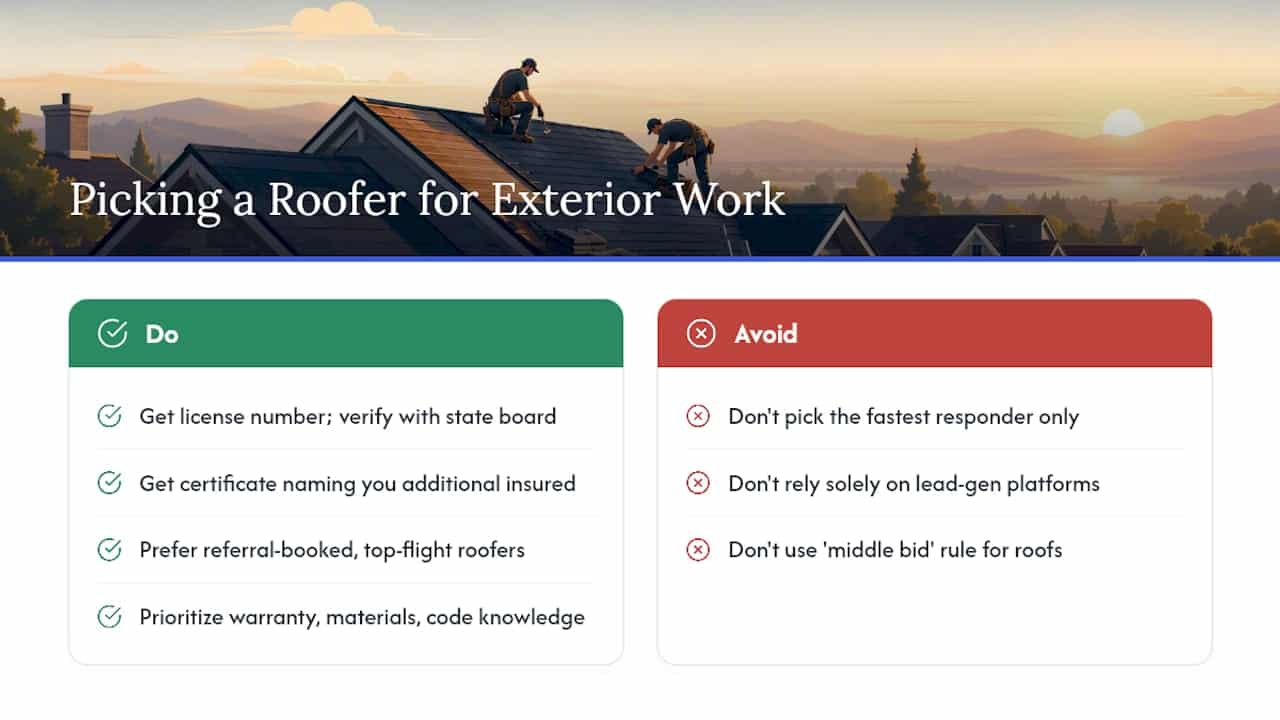
- Vet every respondent independently. Check the license number on your state’s board. Ask for the insurer’s name and policy number. A contractor who hesitates on either is a red flag.
- Get three written estimates. Verbal quotes are not binding. Each written estimate should specify materials, labor, timeline, payment schedule, and warranty terms.
- Compare bids on substance, not price alone. A bid that skips permit costs or uses unspecified materials is not cheaper — it’s incomplete.
- Sign a clear written contract. It should name the parties, describe the scope in detail, list the payment schedule tied to milestones, and include warranty language.
Red flags to watch for: A contractor who asks for full payment upfront. Profiles with no reviews and a badge that only the platform awarded. Bids that arrive within minutes of your request with no follow-up questions. Pressure to decide before getting other quotes.
Pro Tip: For exterior projects, include the roof pitch, approximate square footage, current material type, and whether you’ve had any prior repairs in your project description. Contractors who respond with specific questions about those details are far more likely to give you an accurate bid than those who respond with a generic price range.
When to skip marketplaces entirely: if your project requires permits, involves storm insurance claims, or sits above $15,000 in scope, a direct call to a licensed local specialist will almost always serve you better than a lead-gen platform.
Privacy and data security considerations across platforms
When you submit a project request on a lead-gen platform, you’re sharing your name, address, phone number, and project details with the platform and with every contractor who purchases your lead. That data doesn’t disappear after the job is done.
Most major platforms retain your contact information and may use it for marketing, partner offers, or data sharing with affiliated companies. Angi’s investor materials document an AI-native strategy that involves deeper data use across its platform ecosystem. Before submitting a request, check the platform’s privacy policy for opt-out options on marketing communications and third-party data sharing.
Practical steps: use a Google Voice number or a secondary email address for initial platform inquiries. Once you’ve selected a contractor and moved to a direct relationship, you can share your primary contact details. Never post your full address in a public review or forum response tied to a platform profile.
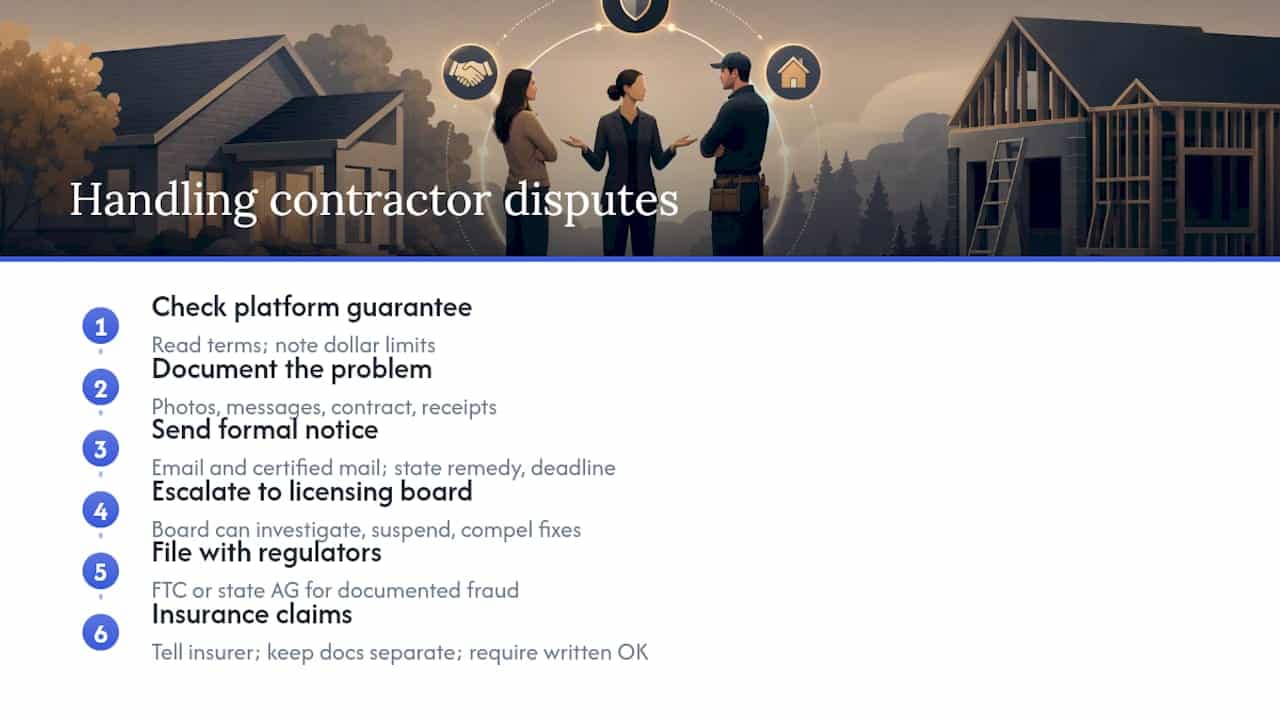
How to handle disputes with contractors found via these platforms
Most lead-gen platforms offer some form of satisfaction guarantee or dispute resolution, but the terms are narrow. Angi’s “Happiness Guarantee” covers specific situations and has dollar limits. TaskRabbit’s resolution process applies to platform-booked tasks. Read the guarantee terms before you rely on them.
If a dispute arises, document everything: photos of incomplete or defective work, copies of all written communications, the signed contract, and all payment receipts. Send a formal written notice to the contractor by email and certified mail describing the issue and the remedy you expect, with a reasonable deadline.
If the contractor is unresponsive, file a complaint with your state contractor licensing board. Boards can investigate, suspend licenses, and sometimes compel remediation. The FTC’s action against HomeAdvisor shows that regulators do act in this space, so filing with the FTC or your state attorney general is also worth doing for documented fraud.
For disputes involving insurance claims (storm damage, for example), contact your insurer directly and keep the contractor’s documentation separate from your claim file. Never let a contractor negotiate directly with your insurer without your explicit written authorization.
Key Takeaways
The most reliable path for major exterior work is direct hire from a licensed local specialist, not a lead-gen marketplace.
| Point | Details |
|---|---|
| Discovery vs. lead-gen | Discovery platforms suit design research; lead-gen platforms deliver fast bids but share your contact with multiple contractors. |
| Platform badges have limits | “Verified” and “background checked” labels are often opt-in; always confirm a license via your state board. |
| FTC enforcement context | The FTC proposed a $7.2 million order against HomeAdvisor for deceptive lead marketing — platform trust signals warrant independent scrutiny. |
| Dispute protection is narrow | Platform guarantees have dollar limits and specific conditions; a signed written contract is your strongest protection. |
| Buffaloroofingandexteriors | For roofing, storm damage, and exterior work in South Texas, Buffalo Roofing & Exteriors offers direct hire with local warranties and on-site inspections. |
What I’ve learned about picking a platform for exterior and roofing work
The conventional wisdom says to get three bids from a marketplace and pick the middle one. That works fine for painting a bedroom. For a roof replacement or storm damage restoration, it misses the point entirely.
The contractors who show up fastest on lead-gen platforms are often the ones who buy the most leads, not the ones who do the best work. Top-flight roofers in most markets don’t need to buy leads. They’re booked on referrals. So the pool you’re drawing from on a marketplace is, by definition, filtered toward contractors who need the volume.
Two questions I’d ask any contractor before signing: “Can you give me your license number so I can verify it with the state board?” and “Who is your general liability carrier, and can I get a certificate naming me as an additional insured?” A contractor who answers both without hesitation is worth talking to further. One who hedges on either isn’t.
For coastal Texas homeowners dealing with wind, hail, or hurricane damage, the stakes are too high for a platform match. The warranty language, the material specifications, and the contractor’s familiarity with local building codes all matter more than who responded to your lead request first.
Buffalo Roofing & Exteriors: direct hire for South Texas exterior work
There are plenty of routes to finding a contractor — Thumbtack, Porch, BuildZoom, and the rest all have their place. But for roofing, storm damage restoration, siding, and window replacement in South Texas, Buffalo Roofing and Exteriors offers something those platforms can’t: a direct relationship with a licensed local contractor who knows coastal construction, carries local warranties, and shows up for on-site inspections.

Buffaloroofingandexteriors serves homeowners from San Antonio to Corpus Christi, covering roof replacement, storm damage restoration, siding installation, window replacement, and exterior renovations for both residential and commercial properties. Free estimates are available, and the team responds to emergency storm calls. If you’re weighing marketplace options against a direct hire, request a free estimate and compare it against whatever the platforms send you.
Authoritative sources and quick links
- FTC proposed order: HomeAdvisor to pay up to $7.2 million — primary regulatory source on lead-gen platform enforcement.
- FTC administrative complaint against HomeAdvisor — full detail on deceptive practices alleged since 2014.
- TopConsumerReviews: Thumbtack vs. Houzz — independent badge and verification analysis.
To verify a contractor’s license: search your state’s contractor licensing board by name or license number. Most states publish active license status, complaint history, and insurance requirements publicly online.
For roofing terms you’ll encounter in marketplace profiles and contractor bids, Buffaloroofingandexteriors publishes a plain-language roofing terms guide that covers the vocabulary you need before comparing estimates.