

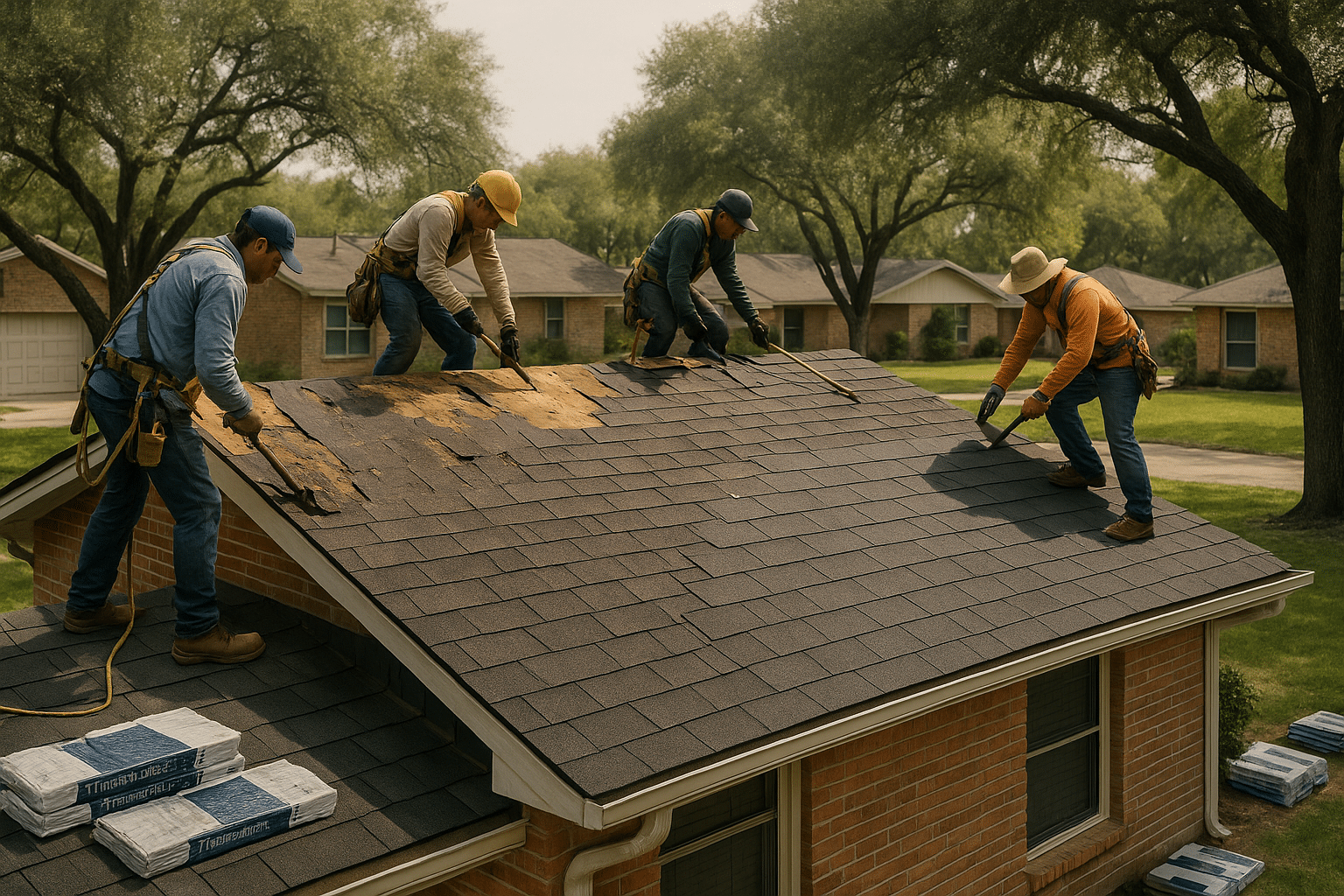
TL;DR: Texas homeowners insurance may cover roof replacement when damage is caused by a sudden, covered event like wind or hail — but not gradual wear and tear. How much you actually receive depends on whether your policy pays Replacement Cost Value (RCV) or Actual Cash Value (ACV), your deductible, and, on the Coastal Bend, whether your roof holds a WPI-8 windstorm certificate. Read on for a plain-English breakdown of how it all works.
You paid your premiums every year. A storm rolls through Corpus Christi, Alice, Aransas Pass, or Beeville — and suddenly your shingles are scattered across the yard. Now the real question hits: will insurance actually pay for a new roof?
The honest answer is: sometimes. It depends on what caused the damage, what kind of policy you have, and — especially on the Texas coast — whether your roof meets state windstorm requirements. Here is exactly what you need to know.
When Does Texas Homeowners Insurance Cover Roof Replacement?
A standard Texas homeowners policy is built to pay for sudden and accidental damage from a covered peril — most commonly hail and wind, and sometimes events like a tree falling on the roof.
Your policy may pay to replace your roof when the damage is caused by a sudden, covered event such as hail or wind. It generally will not pay to replace a roof that has simply worn out or aged.
Insurance never covers wear and tear, deferred maintenance, pre-existing damage, manufacturer defects, or faulty workmanship — those routes go through maintenance budgets and warranties instead.
Common Covered Perils
- Wind damage from hurricanes, tropical storms, or severe thunderstorms
- Hail impact
- Falling trees or debris
- Lightning strike (direct structural damage)
What Insurance Will Not Pay For
- Normal aging and deterioration
- Moss, algae, or mold from deferred maintenance
- Pre-existing damage not reported after prior storms
- Cosmetic-only damage (on policies with a cosmetic exclusion endorsement)
RCV vs. ACV: The Single Biggest Factor in Your Payout
Before anything else, find two words on your policy declarations page: Replacement Cost Value (RCV) or Actual Cash Value (ACV). This distinction will determine whether insurance largely covers your replacement or barely makes a dent.
Replacement Cost Value (RCV)
Most home insurance policies pay to repair or rebuild your home based on current costs — this is called replacement cost coverage. The carrier pays the full cost to replace the roof with like kind and quality, minus your deductible. This is typically paid in two installments: the Actual Cash Value first, then the recoverable depreciation after the work is completed.
Actual Cash Value (ACV)
Some policies pay less based on the age and condition of your home — this is called actual cash value coverage. Policies with actual cash value coverage cost less, but they also pay less when you have a claim.
The Texas Department of Insurance (TDI) illustrates the difference clearly: on a $200,000 home with a 2% ($4,000) deductible and a $10,000 roof replacement, an RCV policy pays $6,000 regardless of the roof’s age. An ACV policy on a 20-year-old roof, however, could pay $0 after depreciation and the deductible are applied.
Insurance carriers are shifting away from RCV policies — which pay for full roof replacement — toward ACV policies, which pay only the depreciated value of your existing roof. That means if your roof is 15 years old, you may only get paid pennies on the dollar — or nothing at all.
Most standard HO-3 policies in Texas are written on an RCV basis for the dwelling, but many carriers have shifted to ACV-only endorsements for roofs older than 10 or 15 years. Watch for language like Roof Payment Schedule in your renewal documents — these tiered depreciation models reduce your reimbursement based on the roof’s age, meaning many homeowners receive little to nothing.
Understanding Your Deductible — Especially the Wind/Hail Deductible
Your deductible is the portion you pay before insurance covers the rest. In Texas, this gets complicated fast.
Wind and hail can have a separate deductible. TDI advises: "Ask your agent if the deductible for wind and hail damage is different than the deductible for other types of damages." It is frequently written as a percentage of your dwelling coverage — for example, 1%–2% of the insured value of the home — so it can be larger than a flat dollar deductible, and on higher-value homes it can even exceed the cost of the repair.
On a $400,000 home, a 2% wind/hail deductible equals $8,000 out of pocket before coverage applies.
One more thing Texas law makes crystal clear: since September 1, 2019, Texas Insurance Code Chapter 707 (HB 2102) makes it illegal for contractors to waive, rebate, or "eat" your deductible. Contracts must include a 12-point notice about this. You are required to pay your deductible on first-party property claims. Any contractor who offers to cover your deductible is breaking the law — and putting your claim at risk.
The Coastal Bend Difference: TWIA and the WPI-8 Certificate
If you own property in Corpus Christi, Alice, Aransas Pass, Banquete, or Beeville — or anywhere in Nueces County and surrounding coastal counties — your insurance picture is more complex than the rest of Texas.
TWIA (Texas Windstorm Insurance Association) provides wind and hail insurance for properties in 14 coastal Texas counties, including Nueces County. Standard homeowners policies typically exclude wind damage in these areas. That means you likely carry a separate wind and hail policy through TWIA — and that policy comes with its own requirements.
If you are a Texas coastal property owner who needs to get wind and hail insurance through TWIA, the Texas Insurance Code Chapter 2210 requires your property to be certified as meeting windstorm building code requirements. This Windstorm Certificate of Compliance must be provided to TWIA before the property can be eligible for coverage. Without a Certificate of Compliance, TWIA lacks evidence that the structure conforms to applicable building codes, and it may be considered uninsurable and ineligible for coverage.
That certificate is the WPI-8. The WPI-8 certification, issued by TDI-approved inspectors, confirms that a residential or commercial roof meets high-wind resistance standards required for wind and hail coverage under TWIA.
What this means in practice: if you replace your roof after a storm — even through an insurance claim — a WPI-8 is a windstorm compliance certificate verifying your roof meets TDI building code standards and is required to obtain or renew TWIA coverage. Skip it, and you could lose your windstorm coverage entirely. For projects in Corpus Christi, which is a TDI-designated area, any roofing system used must also be listed on the TDI Product Evaluation Index to be eligible for a WPI-8 certificate.
According to TWIA, more than 240,000 policies are currently in force across the Texas Coastal Bend, many tied to properties where the certification status has never been verified by the current owner. If you bought your home and never received a WPI-8, now is the time to find out where you stand — before a storm is already in the Gulf.
For a full breakdown of what a replacement costs in our market, see our 2026 Corpus Christi roof replacement cost guide.
What Is — and Is Not — Covered: A Quick Reference
- Covered (typically): sudden wind damage, hail impact, storm-driven debris, hurricane damage (via TWIA on the coast)
- Not covered: age-related deterioration, deferred maintenance, pre-existing damage, cosmetic-only dents (with cosmetic exclusion)
- Depends on your policy: amount paid (RCV vs. ACV), deductible amount, coverage age thresholds
- Coastal-specific: WPI-8 compliance required for TWIA wind/hail coverage after any roof work
Step-by-Step: How to File a Roof Insurance Claim in Texas
- Document the damage immediately. Take dated photos and video of every affected area. Don’t throw away any debris.
- Make only temporary repairs. Make only temporary repairs to protect your house and belongings — for instance, put a tarp over a damaged roof. Don’t make permanent repairs. The insurance company might deny your claim if you make permanent repairs before it sees the damage.
- Get a free estimate from a licensed contractor. Have a written, itemized estimate ready before the adjuster arrives.
- File your claim promptly. Texas law gives you one year from the date of damage to file most property claims — do not wait.
- Be present for the adjuster visit. Try to be there when the insurance company’s adjuster looks at your damage. It is a good idea to have your contractor with you — your contractor can talk to the adjuster about estimates and other issues.
- Review the scope of loss carefully. If the payout seems low, you can request a re-inspection or submit a supplement with additional documentation.
- Complete the work and collect recoverable depreciation. On an RCV policy, you receive a second check after the work is finished and you submit proof of completion.
A Note on Premium Increases After a Claim
Texas law prohibits home insurers from raising your premium specifically because you filed a claim for damage from a natural cause, including hail and wind, according to the Texas Department of Insurance. That said, your rates can still change for other reasons — so talk to your agent before filing a marginal claim that may not exceed your deductible.
How Buffalo Roofing & Exteriors Helps in Corpus Christi and the Coastal Bend
Navigating an insurance claim while managing storm damage repairs is stressful. Buffalo Roofing & Exteriors is a locally owned, BBB-accredited roofing and exterior contractor headquartered in Corpus Christi, with teams serving Alice, Aransas Pass, Banquete, Beeville, and the wider Coastal Bend.
We help homeowners through every step: documenting damage, meeting the adjuster on-site, coordinating WPI-8 certification after coastal roof work, and handling the full replacement with licensed, insured crews. Because we handle roofing, siding, windows, doors, and painting under one roof, you won’t juggle multiple contractors when a storm hits multiple parts of your home.
We offer free estimates with no obligation, and flexible Improvifi financing from $1,000 to $50,000 with $0 down and no credit score impact — so you are never stuck waiting on an insurance check to start protecting your home.
Call or text our Corpus Christi office to schedule your free estimate. We will inspect your roof, give you an honest assessment of whether the damage justifies a claim, and stand beside you through the entire process.
Recommended Reads
- How Much Does a Roof Replacement Cost in Corpus Christi? (2026 Price Guide)
- How Much Does a Roof Replacement Cost in San Antonio? (2026 Price Guide)
- Roof Replacement in Brownsville, TX