TL;DR: Fiber cement usually holds up better than vinyl in Corpus Christi and the Coastal Bend. It resists hail, windblown debris, extreme heat and fire. Vinyl costs less, needs no paint and is easy to patch, so it can still make sense for budget projects and rentals. On the coast, also plan for a TDI windstorm inspection and WPI-8 certificate when you re-side.
For most homes in Corpus Christi and the Coastal Bend, fiber cement holds up better than vinyl siding against hail, windblown debris and extreme heat. Vinyl costs less up front and is easier to patch, so it still makes sense for budget projects and rentals. The right choice depends on how exposed your house is, your budget and how long you plan to stay.
Below we walk through the fiber cement vs. vinyl siding choice the way we would at your kitchen table. We cover what each material is, how each handles local weather, what drives the cost and when each one makes sense.
What is the difference between fiber cement and vinyl siding?
Fiber cement is a heavy board made mostly of cement, sand and wood fibers. Vinyl is a lighter panel made from PVC (polyvinyl chloride) plastic. Most of the differences between them come down to that: one is mineral and the other is plastic.
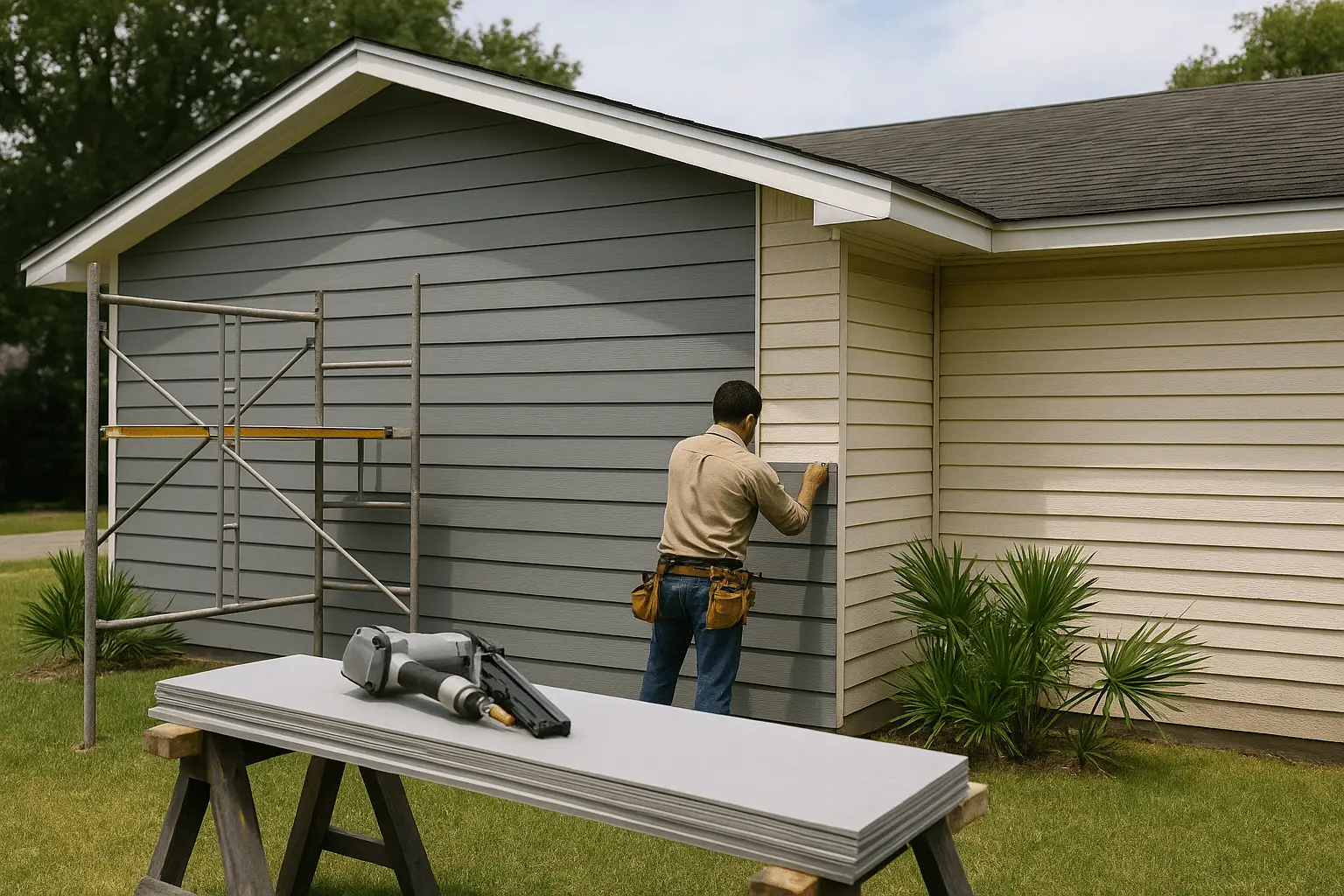
Fiber cement goes up like wood lap siding. It is nailed tight to the wall and then painted, or it comes prefinished from the factory. Vinyl panels hang a little loose on their nails so they can expand in the heat and shrink as they cool. Vinyl siding is made to a standard called ASTM D3679. It sets requirements for impact strength, expansion and windload resistance.
James Hardie, a major fiber cement maker, sells a line called HZ10. The company says it was engineered for hurricane-force winds, salty coastal air and humid Southern heat. That makes it the version designed for climates like ours.
Fiber cement vs. vinyl siding: how does each handle Texas weather?
Fiber cement does better against impact, heat and fire. Vinyl does better on price, weight and quick repairs. Here is how they compare in the conditions we see most often.
| Condition | Fiber cement | Vinyl |
|---|---|---|
| Hail and flying debris | Thick board resists dents and punctures | Can crack or puncture under large hail or debris; damaged panels swap out easily |
| High wind | Nailed tight to the wall; must follow the maker’s fastening specs and local code | Rated for windload under ASTM D3679; depends on correct nailing and locked seams |
| Extreme heat and sun | Won’t soften or warp; paint fades slowly over the years | Can soften around 160–165°F; light reflected off low-E windows can warp it |
| Humidity and salt air on the coast | Resists rot, swelling and termites; won’t rust | Won’t rot or rust; the main risk is moisture trapped behind the panels |
| Upkeep | Check caulked joints and repaint now and then | Wash once or twice a year; no painting |
There is one more difference worth knowing. James Hardie says its fiber cement is noncombustible under the ASTM E136 test, which means it won’t ignite in a direct flame. Vinyl melts.
Which siding works better for windstorm certification on the coast?
Your choice of material matters less than whether the product and the installation meet code. In coastal counties like Nueces, San Patricio and Aransas, many homes are insured through TWIA, the Texas Windstorm Insurance Association. TWIA coverage often depends on a WPI-8. That is a Certificate of Compliance issued by TDI, the Texas Department of Insurance, once inspected work is found to meet the International Building Code or International Residential Code.
TDI’s advice is simple. If you need a WPI-8, confirm the repair or replacement is eligible before work starts. And don’t make your final payment until the WPI-8 is issued. TDI’s guide to making repairs after a storm has the full checklist.
For homes on open lots in Corpus Christi or Aransas Pass, where storm winds throw debris at the walls, fiber cement’s impact resistance is a strong reason to pay more. On a sheltered lot, a well-installed, code-compliant vinyl siding can still be a reasonable choice.
Is vinyl siding a bad idea in South Texas heat?
No. But the color you pick and where the house sits both matter. According to a National Association of Home Builders paper, the Vinyl Siding Institute says normal grades of vinyl can start to soften at 160–165°F, and darker colors soften first. Direct sun alone generally doesn’t cause that kind of damage.
The bigger risk is sunlight bouncing off a neighbor’s energy-efficient low-E windows. The Polymeric Exterior Products Association says this concentrated light can get hot enough to melt the surface of vinyl siding. If you choose vinyl, pick a lighter color and look at which walls face nearby glass.
Heat and hail matter inland too. In Beeville, hail storms and long stretches of South Texas heat do most of the damage to siding. That makes fiber cement the steadier choice for the west and south walls that get the most sun. If vinyl fits your budget better there, a lighter, thicker panel will handle the heat better.
What are the pros and cons of each siding?
Here are the trade-offs side by side:
- Fiber cement pro: Resists hail, windblown debris, rot and termites.
- Fiber cement pro: Noncombustible, so it won’t ignite in a direct flame.
- Fiber cement con: Costs more up front, and the heavy boards take longer to install and need a trained crew.
- Fiber cement con: Painted boards and caulked joints need checking and touch-ups over the years.
- Vinyl pro: Lower material and labor cost, and a damaged panel can be swapped quickly.
- Vinyl pro: No painting. Washing it keeps it looking clean.
- Vinyl con: Can crack under large hail and warp from reflected heat.
- Vinyl con: Melts in a fire instead of resisting it.
What drives the cost of fiber cement vs. vinyl siding?
Fiber cement usually costs more than vinyl on the same house, mostly because of labor. We don’t quote prices without seeing the house, but these are the things that move the number:
- Material grade. Thicker or insulated vinyl costs more than basic panels. Prefinished fiber cement costs more than primed boards that you paint later.
- Wall size and shape. Gables, second stories, corners and windows all add cutting and trim work.
- Tear-off and wall repair. Pulling off old siding can uncover rotted sheathing or torn house wrap that has to be fixed first.
- Labor and handling. Fiber cement boards are heavy and need special cutting tools and dust control.
- Windstorm inspection. On coastal jobs, the inspection and WPI-8 process is part of the project.
Why do homeowners call Buffalo Roofing & Exteriors for siding?
Buffalo Roofing & Exteriors is a locally owned, BBB-accredited contractor based in Corpus Christi. We are licensed and insured. We have 200+ five-star Google reviews. We handle TDI-compliant WPI-8 windstorm certification for projects in Nueces, San Patricio and Aransas counties. We do roofing and siding under one contract, so you don’t have to coordinate several contractors. Improvifi financing runs from $1,000 to $50,000 with $0 down, approval in under 2 minutes and no impact on your credit score. Every project starts with a free estimate. Recent projects have taken our crews to Portland, Robstown and Premont, along with jobs here in Corpus Christi.
Our Harlingen location serves the Rio Grande Valley. If you’re down that way, see our siding services in Harlingen or our siding work in McAllen.
Not sure which siding fits your house? Book a free estimate with Buffalo Roofing & Exteriors. We’ll walk the walls with you and price both options.
Frequently Asked Questions
How long does fiber cement siding last compared to vinyl?
Both can last for decades when installed correctly. In South Texas, how long siding lasts depends more on installation quality, upkeep and storm exposure than on the material alone. Ask for each manufacturer’s warranty terms in writing before you decide.
Can fiber cement siding lower my homeowners insurance premium?
It might. James Hardie says many insurance companies offer a discount for noncombustible siding. Ask your agent before you choose a material so you can include any savings in your comparison.
Can I use fiber cement and vinyl on the same house?
Yes. Some homeowners put fiber cement on the most exposed or sun-baked walls and vinyl on sheltered sides to control cost. The trim and flashing where the two materials meet need careful detailing so water stays out.
Can new siding go over my old siding?
Vinyl can sometimes go over a flat, sound wall, but tearing off the old siding lets the crew find hidden rot or moisture damage. Fiber cement is heavy and normally goes over a properly prepared wall, not over old siding.
Recommended Reads
- Siding Contractor in Siding Services In Los Fresnos, TX
- Siding Contractor in Siding Services In McAllen, TX
- Siding Contractor in Siding Services In Harlingen, TX