

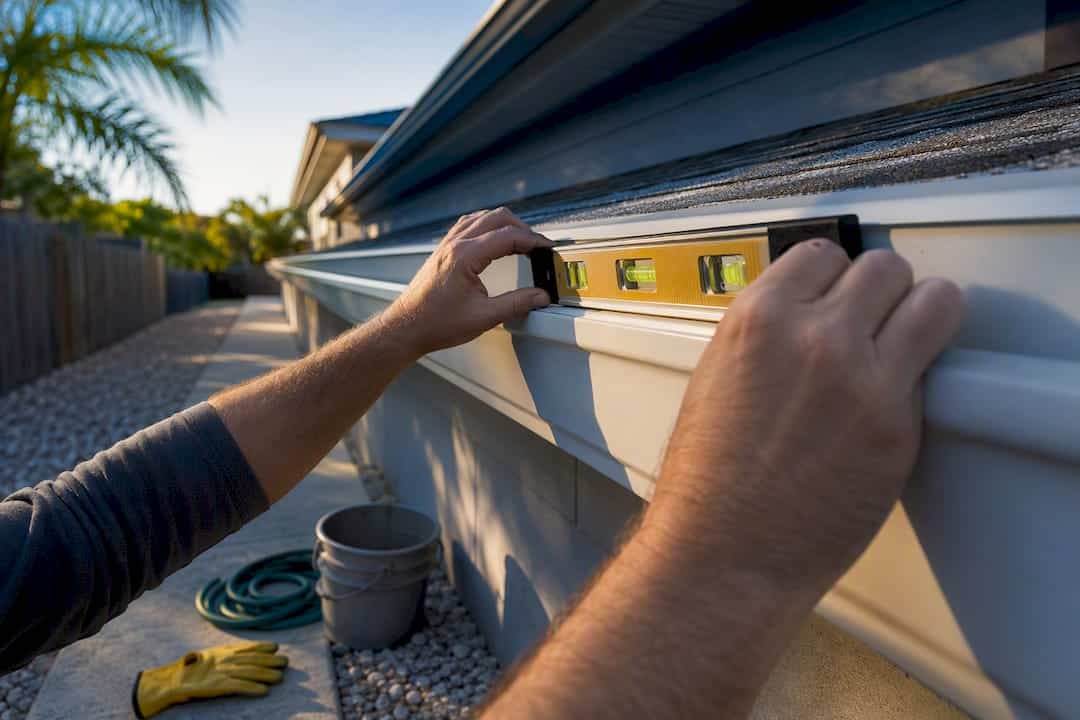
Most gutter pitch problems are fixable without tearing off the whole system. Start with a garden-hose flow test and a look at the hangers and fascia board, since sagging or reversed slope almost always traces back to one of those two things. If the fascia is soft, rotted, or the seams are separating at a joint, stop testing and call a professional before you put weight on a ladder near that section.
TL;DR:
- If multiple gutter runs show sagging or reversed pitch, fascia rot or failed hangers are likely the underlying cause, requiring professional repair.
- Water pooling in the gutter mid-run indicates low spots or bad hangers, not necessarily a clog or improper slope, and demands re-evaluation of flow.
- Proper re-pitching involves using a string line and slope standards of 1/4 inch per 10 feet, with support every 2 feet for longer runs.
- Slope issues are common after faulty installation, hanger failure, fascia rot, or thermal movement, and often coexist with debris blockages or undersized downspouts.
- Regular inspections, debris removal, and photographing gutter lines can prevent slope failure, but significant fascia rot or multiple problem areas require professional assessment.
Table of Contents
- What Are the Signs of a Gutter Pitch Problem?
- How Do You Test Gutter Pitch Yourself?
- What Causes Gutters to Lose Their Proper Slope?
- How to Fix Gutter Pitch: A Step-by-Step Repair
- When Should You Call a Professional Instead of DIY?
- Why Correct Pitch Alone Doesn’t Always Stop Overflow
- How to Keep Gutter Pitch From Failing Again
- How a Professional Inspection Goes Beyond a DIY Check
- Links for Calculations and Standards
- The Real Lesson Behind Most Pitch Complaints
- Get a Professional Gutter Pitch Assessment
- Sources
What Are the Signs of a Gutter Pitch Problem?
A gutter that holds water instead of moving it toward the downspout is telling you something specific, and the pattern of where the water sits usually gives away the cause before you climb a ladder.
Watch for these symptoms:
- Standing water visible in the trough days after the last rain, especially pooling mid-run instead of near the downspout.
- Overflow at the wrong end, meaning water spills over the high end of the run rather than the low end where the downspout sits.
- Tiger striping, the dark vertical streaks on fascia or siding caused by water sheeting over the gutter edge instead of draining through it.
- Sagging or visible low spots, where the gutter line dips below its neighboring sections instead of running a clean, gradual slope.
- Ice buildup in winter concentrated in one section, a sign that water is sitting and freezing there instead of flowing through.
Standing water in the middle of a run points to a low spot or bad hanger, not a clog. Overflow right at the downspout, on the other hand, usually means the pitch is fine but the downspout or gutter size can’t keep up with the volume. Walking the perimeter of your house after a rain and noting exactly where water drips or pools does more diagnostic work in five minutes than most people expect.
How Do You Test Gutter Pitch Yourself?
Confirming a pitch problem takes about 20 minutes and three tools you probably already own. Run these checks in order before assuming you need a full re-pitch.
- Garden-hose flow test. Run water from the high end of the gutter and time how long it takes to reach the downspout. Water should move steadily with no pooling; if it stalls or reverses direction anywhere along the run, that’s your low spot.
- String or chalk-line measurement. Stretch a string from the high end to the low end and use a line level to check the drop. The industry standard is 1/4 inch of fall per 10 feet of run, so a 30-foot run needs about 3/4 inch of total fall from end to end.
- Bucket and stopwatch drain test. Pour 5 gallons into a clear section of 5 inch K-style gutter near the high end. At proper slope, it should drain to the downspout in roughly 30 seconds; anything noticeably slower signals a flat or reversed section.
Pro Tip: Mark your string-line measurements with a pencil on the fascia before you take the string down. Those marks become your reference points if you end up re-hanging the gutter later, and they save you from re-measuring twice.
Skip the ladder work entirely if your roofline is above one story, the ground is wet or uneven, or you don’t have a second person spotting you. A pitch problem that’s been there for months will still be there next weekend.
What Causes Gutters to Lose Their Proper Slope?
Pitch problems rarely start as pitch problems. They start as something else and show up as bad drainage months or years later.
- Installation errors. A gutter hung without a chalk line or hung by eye can end up with reversed pitch, sloping toward the high end instead of the downspout, right from day one.
- Hanger failure. Spikes or brackets pull loose from the fascia over time, especially in wood that’s absorbed moisture, and each failed hanger drags that section of gutter down into a sag.
- Rotten fascia. Once the board behind the gutter softens, hangers lose their grip and the whole run can pull out of alignment even if it was installed correctly.
- Thermal movement. Long metal runs expand and contract with temperature swings, which fatigues seams over the years and can shift sections out of their original slope.
- Debris dams and undersized downspouts. A clog or a downspout that’s too small for the roof area backs water up and creates the appearance of a sag even when the slope itself is correct.
Older homes often show two or three of these at once. A previous owner’s quick fix, a few loose hangers, and 15 years of Gulf Coast humidity on the fascia tend to compound rather than cancel out.
How to Fix Gutter Pitch: A Step-by-Step Repair
Re-pitching a single run is one of the more approachable exterior repairs a homeowner can take on, provided the fascia underneath is still solid. If it’s soft or crumbling, that’s your signal to stop and read the next section instead.
Safety first. Work with a helper who can steady the ladder and hand up tools. Use a ladder stabilizer if you have one, wear non-slip shoes, and never lean a ladder directly against a gutter, since the aluminum will bend under sideways pressure.
Tools and materials you’ll need:
- Chalk line and a line level
- Replacement hangers or brackets (matched to your gutter style)
- Exterior-grade screws
- Gutter sealant for seams
- A tape measure and pencil
Here’s the sequence a contractor would use, scaled down for a single run:
- Locate the high and low points. The high end is farthest from the downspout; the low end sits directly above it.
- Snap a chalk line from the high point to the low point, dropping 1/4 inch per 10 feet of run. This is the snap-line method professionals rely on for accurate, repeatable results.
- Remove every other hanger along the run so the gutter stays partially supported while you work.
- Reset hangers to the chalk line, spacing new brackets roughly every 24 inches for solid support.
- Remove and reset the remaining original hangers to match the new line.
- Re-run the hose test to confirm water now flows cleanly to the downspout with no pooling.
- Clear any debris you find in the trough or downspout while everything is open and accessible.
On runs longer than about 40 feet, consider a split pitch instead. Crowning the gutter at the center and sloping both directions toward downspouts on each end cuts the visible drop in half per side, which keeps the line looking level from the ground while still meeting drainage requirements.
Pro Tip: If you pull a hanger and the fascia underneath feels soft or the screw spins without biting, stop. That’s rot, not a hanger problem, and screwing a new bracket into soft wood just delays the same failure.
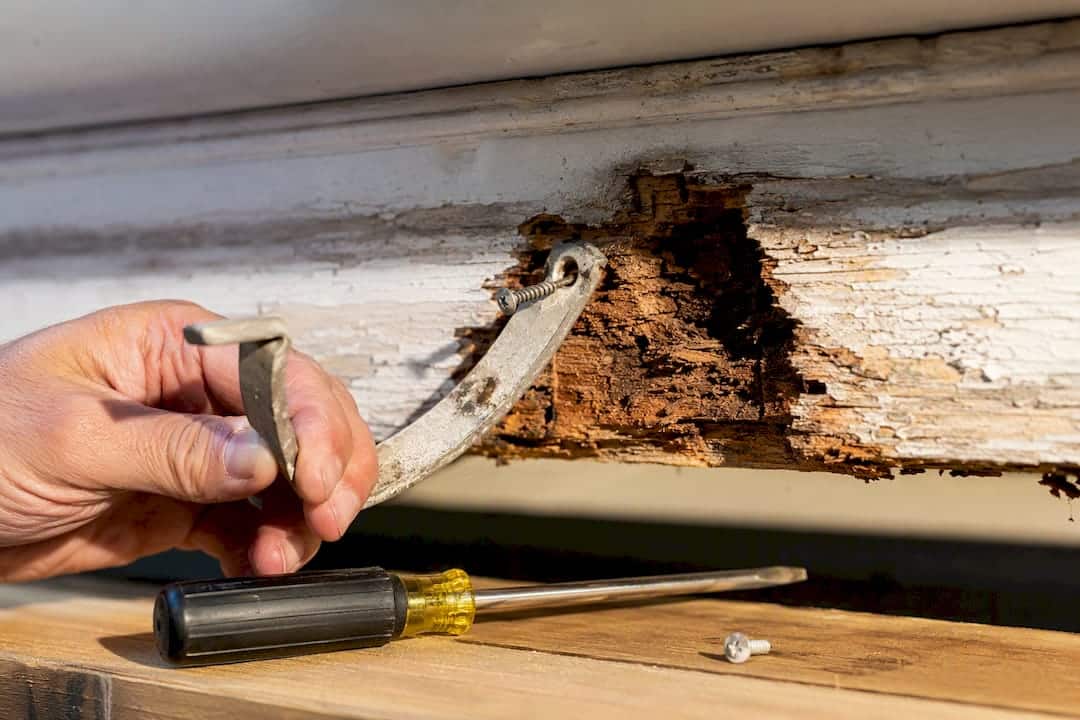
If you find corroded seams, hairline cracks, or fascia rot spanning several feet during this process, that run has moved past a simple re-pitch. Fascia repair or a partial replacement becomes the more durable and often more cost-effective option at that point.
When Should You Call a Professional Instead of DIY?
Some pitch problems are a Saturday project. Others aren’t, and knowing the difference before you’re 12 feet up a ladder saves both money and a trip to urgent care.
Call a contractor when you see:
- Fascia rot extending across multiple sections rather than one isolated spot
- More than one run on the house showing sag or reversed pitch
- Roof access that requires more than a standard extension ladder
- Seam separation or visible corrosion on gutters older than 15 to 20 years
Cost tends to scale with how much of the system needs work. A single hanger replacement with a spot re-pitch often runs $75 to $150, while a full single-run re-pitch lands closer to $150 to $400. Add fascia repair and you’re looking at $400 to $900, and a whole-house re-pitch typically falls between $600 and $1,800. If the gutters themselves need replacing alongside the re-pitch, budget $1,200 to $3,500 depending on length and material.
A DIY single-run fix takes most homeowners two to three hours including setup. A contractor typically handles a whole-house re-pitch in a single day. When you’re vetting a contractor, ask what they inspect beyond slope (fascia condition, hanger pull strength, seam integrity), whether the work carries a warranty, and whether they’re insured. Any contractor unwilling to answer those three questions plainly is worth skipping.
Why Correct Pitch Alone Doesn’t Always Stop Overflow
A perfectly sloped gutter can still overflow, and that surprises a lot of homeowners who just spent a weekend re-hanging their gutters only to watch water spill over during the next storm.
- The NRCA/SMACNA baseline of 1/4 inch per 10 feet assumes the gutter and downspouts are already sized correctly for the roof they’re draining.
- A common rule of thumb calls for one downspout per 35 to 40 feet of gutter run on a typical home.
- Steep roofs, large roof areas, or regions with intense downpours often need 6 inch gutters instead of the standard 5 inch size, since the extra capacity is cheap insurance against overflow during extreme rain events.
- Overflow that happens specifically at the downspout, rather than mid-run, almost always points to sizing or a clog, not slope.
If your hose test and chalk line confirm the pitch is correct and water still overflows, the fix isn’t more slope. It’s a bigger downspout, an additional one, or wider gutters.
How to Keep Gutter Pitch From Failing Again
Preventing a repeat problem costs a lot less than fixing one, and it takes about 20 minutes twice a year.
- Inspect gutters every spring, every fall before leaf season, and after any major storm.
- Check hanger spacing and tightness while you’re up there; loose brackets are the earliest warning sign of a coming sag.
- Clear debris regularly, since dams add weight that stresses hangers even when slope is technically fine.
- Know that gutter guards keep debris out but don’t correct slope or support; pitch has to be right before guards are worth installing.
- Photograph your chalk-line marks each season to track gradual movement over time.
Pro Tip: Keep a simple photo log on your phone. Comparing this fall’s gutter line to last spring’s makes a slow sag obvious months before it becomes a standing-water problem.
How a Professional Inspection Goes Beyond a DIY Check
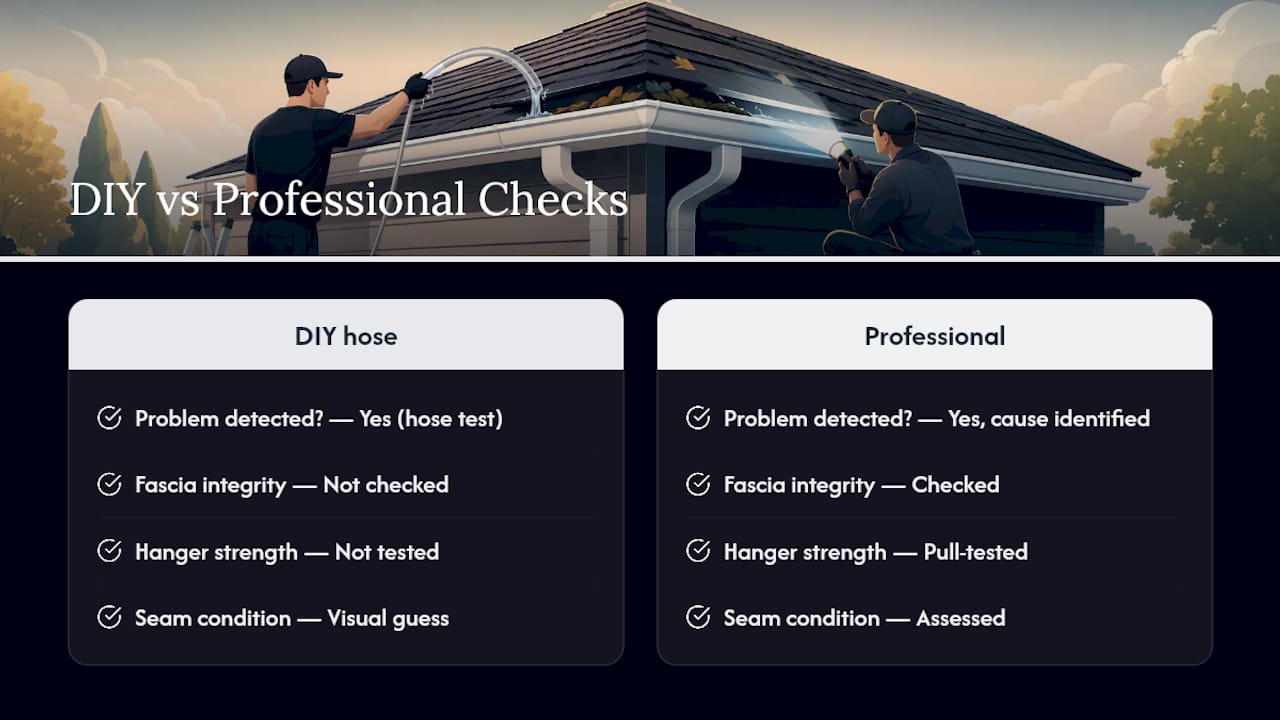
A DIY hose test tells you there’s a problem. A professional inspection tells you exactly why, because it adds fascia integrity checks, hanger pull-testing, seam assessment, and actual downspout flow measurement rather than a visual guess. Poor drainage around the foundation and siding causes damage that often costs far more than the gutter repair itself, which is why catching pitch problems early matters more than it looks like it does. If your hose test raised more questions than it answered, an inspection settles it.
Links for Calculations and Standards
For run-specific numbers, the gutter slope calculator and downspout sizing tool handle the math faster than a tape measure and a headache.
The Real Lesson Behind Most Pitch Complaints
Most articles on this topic treat pitch as a single fixed number to hit and move on. The more useful frame is that pitch is a symptom category, not a diagnosis. A hose test and a chalk line will tell you whether the slope itself is wrong, but the harder, more common finding is that the slope is fine and the real problem is a rotted fascia board quietly pulling hangers out of alignment, or a downspout that was undersized the day it was installed.
The conventional advice to “just re-pitch it” skips the step that actually matters: figuring out why the pitch drifted in the first place. Re-hanging a gutter onto fascia that’s already failing buys you six months, not six years. If there’s one thing worth prioritizing before touching a hanger, it’s pressing a screwdriver into the fascia board at a few points along the run. Soft wood changes the entire job, and no amount of careful chalk-line work fixes a support structure that’s already given up.
— Results
Get a Professional Gutter Pitch Assessment
If your hose test showed a stubborn low spot, or the fascia felt soft when you pressed on it, that’s past the point where a weekend fix holds up. Professional inspections that include fascia condition, hanger integrity, and downspout capacity together can help avoid multiple follow-up repairs after the next storm.

Homeowners across South Texas call us most often after storm season, when a season of wind and rain has already loosened hangers or softened fascia that looked fine the year before. Our storm damage restoration team handles gutter and fascia repair as part of the same visit, so you’re not scheduling separate contractors for what’s really one problem. If your gutters are pooling water or overflowing in the wrong spot, consider requesting an estimate to have the whole system inspected, not just the section you’re worried about.
Sources
- Gutter Slope Calculator (2026) — ¼ in per 10 ft Pitch & Fall by Run
- Gutter Calculator: Size, Downspouts & Cost Estimate | Tallyard
- Gutter Slope & Pitch: Fix Drainage Problems | Sacramento 2026
- Calculating gutter slope for proper drainage: The Master Craftsman’s Guide – Copper Gutter Supply Company