TL;DR: Harlingen sits in Cameron County’s hurricane-exposure zone, meaning your roof faces Gulf storm winds, punishing heat, and strict Texas windstorm certification rules. This guide covers the warning signs you need repair, when repair beats replacement, how WPI-8 certification affects your insurance, and what to do after storm damage.
Your roof works harder in Harlingen than it does almost anywhere else in Texas. Summer heat indexes that top 108°F, persistent Gulf humidity, seasonal hailstorms, and a real hurricane threat — all of that stacks up against every shingle, seam, and flashing on your home.
If you own a home in Harlingen, Alice, Aransas Pass, Beeville, or anywhere else in South Texas, understanding roof repair — when it makes sense, what it costs, and what the rules are — can save you thousands and keep your insurance intact.
What Makes Harlingen Roofing Different
Harlingen is in Cameron County’s hurricane-exposure zone; while slightly inland from the coast, it still sees damaging winds and heavy rain from Gulf systems. That combination shapes every roofing decision you make here.
Harlingen sits in the mid-Valley corridor where severe thunderstorms often track northeast from the Gulf. The mix of older roofing stock near Dixieland and newer construction along Ed Carey Drive means hail damage varies widely.
Both ends of the spectrum need roofing that accounts for what Harlingen actually faces: hailstorms that track through the mid-Valley corridor, sustained winds during hurricane season, and Cameron County’s year-round humidity that accelerates material degradation.
Add to that the Texas windstorm certification requirement that applies specifically to Cameron County homeowners — something many people don’t discover until they file a claim or try to sell their home. More on that below.
Warning Signs Your Harlingen Roof Needs Repair
Most roof problems announce themselves — if you know what to look for. The National Roofing Contractors Association (NRCA) recommends professional inspections every two years and after major storms, noting that routine inspections help catch minor issues before they turn into costly repairs.
Here are the signs that should prompt a call to a roofer:
- Granules in your gutters or downspouts. Granule loss is one of the clearest early signals on asphalt shingles. Look for granules in gutters and downspouts, dented soft metals (vents, flashing, AC fins), circular bruises on shingles, missing or creased shingles, and interior ceiling stains.
- Water stains on ceilings or walls. Missing or curling shingles, water stains on interior ceilings, granules collecting in gutters, and daylight visible through the attic are all signs your roof needs attention.
- Damaged or missing flashing. Flashing seals the areas around chimneys, vents, skylights, and roof edges. When it begins to rust, crack, or pull away, water can easily penetrate beneath the surface — one of the most common causes of hidden leaks found during inspections.
- Musty attic smell or damp insulation. If your attic smells musty or feels humid, moisture may already be inside your roofing system. Damp insulation or condensation on rafters indicates a ventilation issue or a leak that hasn’t yet shown up on the ceiling.
- Hail damage that isn’t obvious from the ground. Mid-Valley thunderstorms drop hail that damages shingles without obvious leaks — until months later when the underlayment fails. Don’t assume a clear ceiling means a clean roof after a storm.
Repair vs. Replace: How to Decide
This is the question every Harlingen homeowner faces after a storm or after spotting a leak. The short answer: repair when the damage is isolated; replace when it’s systemic.
The NRCA is explicit that not all leaks require complete replacement — flashings and small damaged sections are commonly repairable. A single leak often traces to a localized flashing failure or limited shingle damage that can be repaired.
The replacement signal is a pattern: leaks in multiple locations, or leaks that keep coming back after repair.
For Harlingen specifically:
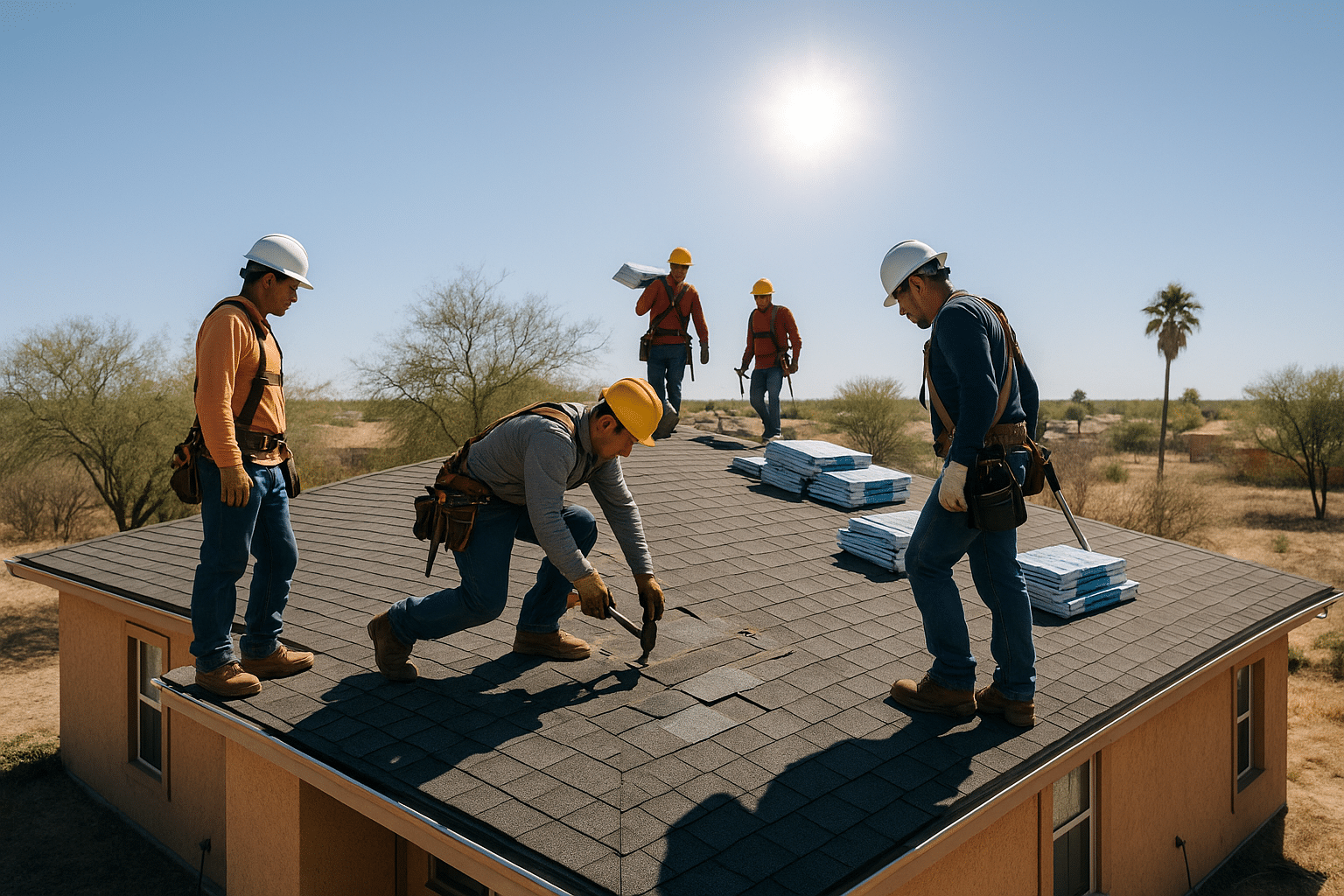
- Repair makes sense when damage is limited to one slope or section, your roof is under 15 years old, and the decking and underlayment beneath are still structurally sound.
- Replace when shingles are bald, granules fill the gutters, multiple leaks have appeared, or hail bruising covers more than one slope.
- Shingle lifespan in the RGV is shorter than the national average. Expect 18–22 years for architectural shingles and 12–15 years for 3-tab in Harlingen. Class 4 impact-resistant shingles are strongly recommended given Harlingen’s hail exposure.
Where homeowners get in trouble is when they keep repairing a roof that is already in systemic decline. A free estimate from a qualified local roofer will give you a clear, written answer on which path makes sense for your specific roof.
Flat and TPO Roofs in Harlingen
Flat and low-slope roofs are common in Harlingen — on commercial buildings, rental properties, home additions, and garage roofs. The most widely installed material on these surfaces today is TPO (thermoplastic polyolefin), a single-ply membrane known for its reflectivity and durability in hot climates.
Flat roofs are built differently than steep-slope residential roofs. Instead of shedding water quickly, a flat or low-slope roof relies on proper drainage, strong seams, sealed penetrations, and a well-maintained membrane. When one part of that system fails, water can sit on the roof, move under the membrane, or find its way into the building through seams, flashing, drains, HVAC curbs, skylights, vents, or roof edges.
The three most common flat-roof repair issues in South Texas:
- Ponding water. Flat roofs are designed to handle ponding water for up to 48 hours. If water stays longer, it usually indicates a drainage problem. Once water sits too long, it will eventually degrade TPO material and add significant weight to the roof, which can cause structural damage.
- Seam failures. TPO roofs can leak at the seams where membrane sheets are joined together. These seams are the weakest point of the roofing material and the most likely to fail, which can lead to unexpected water intrusion and roof leaks.
- Membrane punctures. On residential properties, punctures often come from foot traffic, dropped tools, HVAC service visits, satellite or solar installers, or debris blown across the roof during storms.
If you have a flat or low-slope roof showing any of these signs, prompt repair protects both the membrane and the structure underneath. Learn more about our flat roof repair services and how we approach these systems in South Texas conditions.
The WPI-8 Windstorm Certificate: What Cameron County Homeowners Must Know
This is the piece most Harlingen homeowners don’t hear about until it costs them money. If you live in Harlingen, your home is in a TDI (Texas Department of Insurance)-designated catastrophe area, which triggers a specific windstorm certification requirement.
A WPI-8 is a Certificate of Compliance issued by TDI confirming that a home’s construction, addition, or repair in a designated coastal catastrophe area meets the windstorm building code standards required to qualify for windstorm and hail coverage through TWIA (Texas Windstorm Insurance Association).
TDI designates 14 first-tier coastal counties as catastrophe areas, including Cameron County — the county Harlingen sits in. This means a significant roof repair or full re-roof on your home may require a WPI-8 inspection and certificate before your windstorm insurer will recognize the work.
Most new construction, full re-roofs, additions, and any repair touching the roof deck or structural envelope in a designated coastal county require a WPI-8 before TWIA will insure the property.
A home that doesn’t have a required certificate may become difficult or impossible to insure through TWIA, which can also complicate financing or resale down the road.
The bottom line: hire a roofer who understands the WPI-8 process in Cameron County. Not every repair requires an inspection — consumers should contact the local windstorm inspections office to confirm whether their specific repair triggers the requirement. A knowledgeable contractor will walk you through this before any work begins.
What to Do After Storm or Hail Damage in the RGV
Harlingen sits in an active storm corridor. When a system rolls through, here’s the right sequence:
- Don’t wait. Early action is almost always less expensive than emergency repair after water has reached the structure.
- Get a professional assessment first. Most hail damage is invisible from the ground. A trained roofer documents damage with photos and a written report — exactly what your insurance company needs.
- Contact your insurer. File your claim promptly. Your contractor’s written documentation makes this process significantly smoother.
- Confirm WPI-8 requirements. If your repair or replacement touches the roof deck, confirm windstorm certification requirements with your contractor before signing anything.
- Watch the timing. October through March is the best window in Harlingen for roof work — cooler temperatures protect asphalt during installation, and hurricane season has ended.
Roofing Materials Worth Considering in Harlingen
Not all materials perform equally in the Rio Grande Valley’s climate. Here’s a quick breakdown:
- Asphalt shingles (architectural/Class 4 impact-resistant): The most common choice. Class 4 shingles offer better hail resistance and may qualify for insurance discounts in Cameron County.
- Metal roofing (standing seam or R-panel): Standing seam, R-panel, and stone-coated steel options offer 40–50 year lifespans and hurricane uplift ratings to 140+ mph. A strong choice for Harlingen’s storm exposure.
- TPO and flat systems: Standard on commercial properties and home additions. TPO roofing is a common commercial flat roofing option because it is lightweight, reflective, and widely used on low-slope buildings. Reflectivity is a real benefit in the Valley’s heat. For those with TPO systems, our TPO roof repair service addresses seam failures, punctures, and ponding drainage issues.
- Clay and concrete tile: Popular in the RGV for its longevity and heat resistance. Heavy, so structural support matters — confirm your decking can handle it.
Why Buffalo Roofing & Exteriors for Harlingen Homeowners
Buffalo Roofing & Exteriors is a locally owned, BBB-accredited contractor with locations across South and Central Texas — including serving Harlingen, Corpus Christi, Victoria, and San Antonio. We’re licensed, insured, and experienced with the WPI-8 windstorm certification process that Cameron County homeowners have to navigate.
We handle roof repair, replacement, storm damage documentation, and insurance claim assistance — all under one roof. That means you’re not juggling a separate roofer, a separate siding contractor, and a separate insurance consultant.
Financing is available through Improvifi from $1,000 to $50,000 with $0 down and no impact to your credit score to check your rate.
If you’re in Harlingen, Alice, Aransas Pass, Banquete, or Beeville and you’ve got a roof concern, call us for a free estimate. We’ll tell you honestly whether you need a repair, a replacement, or nothing at all — and we’ll handle the WPI-8 process if it applies to your project.
Dealing with storm damage elsewhere in South Texas? See how we handle storm season roof repair in Victoria, TX for a look at the broader coastal repair process.
Recommended Reads
- TPO Roof Repair in Corpus Christi, TX
- Flat Roof Repair in Corpus Christi, TX
- Professional Shingle Roof Repair in Corpus Christi, TX