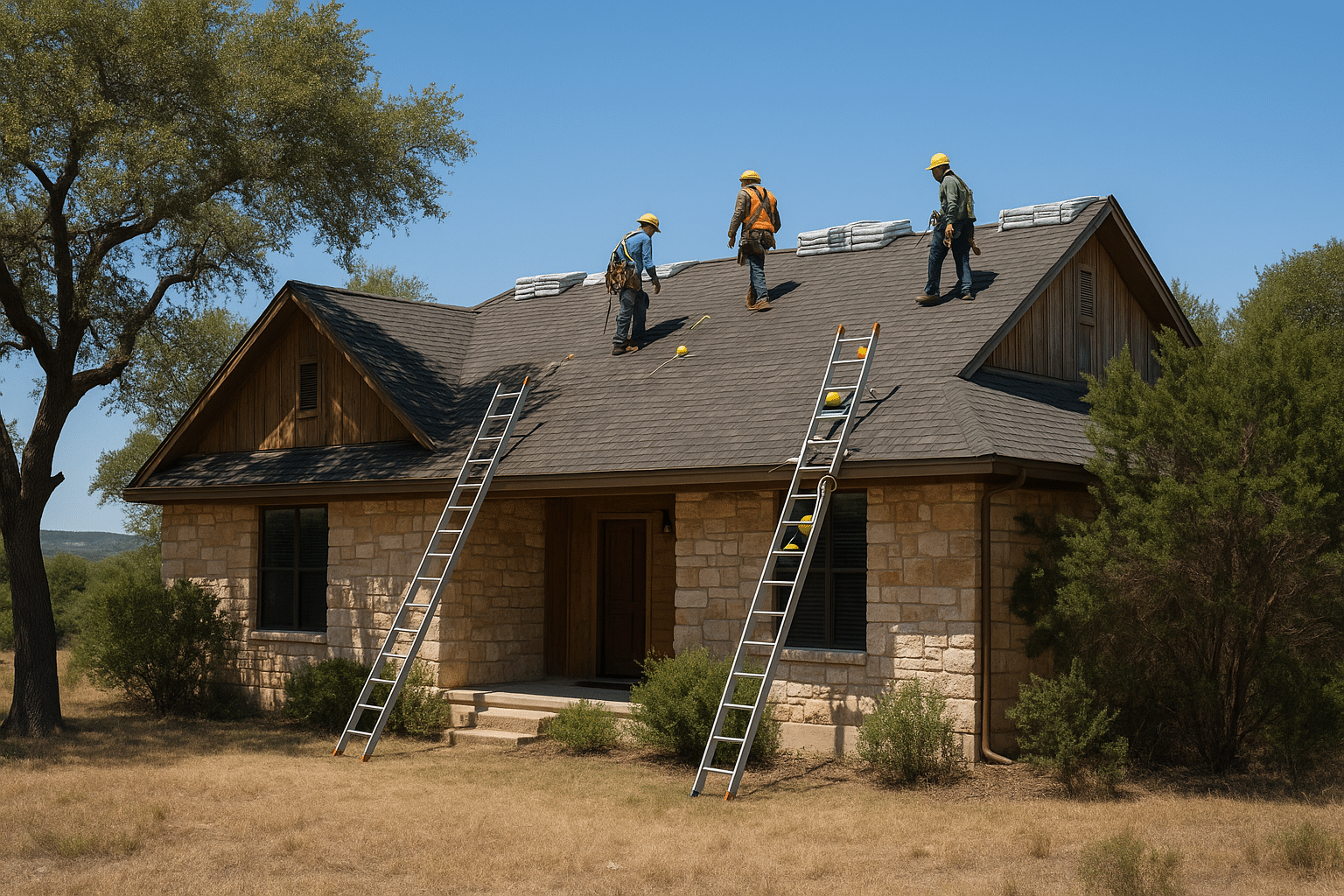
TL;DR: New Braunfels and Boerne sit inside Texas’s most active hail corridor, and summer heat regularly pushes roof-surface temperatures above 150°F — a combination that ages roofs faster than most homeowners expect. Knowing the local warning signs, the right repair timeline, and how material choices affect your insurance premium can save you thousands. Buffalo Roofing & Exteriors serves the Hill Country from its San Antonio location with free estimates and no-credit-impact financing.
If you own a home in New Braunfels, Boerne, or anywhere along the I-35 and I-10 corridors in Comal, Kendall, or Guadalupe County, your roof faces a specific set of challenges that a national roofing article will never fully explain. No salt air, no hurricane code — but plenty of hail, relentless UV, and thermal swings that quietly shorten the life of almost every roofing material on the market.
This guide breaks down what those forces actually do to your roof, how to spot damage early, which materials hold up best in this climate, and when a repair is the right call versus a full replacement.
The Hill Country Roofing Environment: Three Threats Working at Once
1. Hail — The Most Sudden Damage
Central Texas sits inside what meteorologists call Hail Alley. Warm Gulf air collides with drier air pushing down from the plains along the I-35 corridor, and the National Weather Service’s Austin/San Antonio office tracks an average of 5 to 8 significant hail events — one inch or larger — along that stretch every year, a number that can roughly double in an active season.
New Braunfels has been hit repeatedly. In one March 2022 event alone, hailstones measuring 1.25 to 2 inches rained down on the city across Comal County. The damage those storms leave behind is not always obvious from the ground.
Hail damage is notoriously easy to miss because the most serious harm often happens beneath the surface, leaving behind bruised shingles and hidden weak points that aren’t visible from the ground. Hail can bruise shingles, crack tiles, and dent metal components, while wind can lift shingles, loosen ridge caps, and expose seams that let water in during the next rain.
2. Extreme Heat and UV — The Slow, Invisible Damage
The Texas Hill Country is known for its hot summers, with temperatures regularly soaring above 100°F, and this intense heat combined with high UV exposure can cause significant wear and tear on roofing materials.
In central and southern Texas, UV radiation and heat can cause asphalt shingles to dry, crack, and lose granules, with roof surfaces reaching over 150°F in summer — accelerating wear and shortening lifespan.
Sunlight breaks down the asphalt binders in shingles, fades the protective granules, and leaves the surface brittle well before its rated lifespan. Roofs in Texas age faster than expected because of constant heat exposure — while a typical roof might last 20–25 years in moderate climates, Texas conditions can reduce that lifespan significantly.
3. Thermal Cycling — The Stress Nobody Talks About
Heat drives thermal cycling: roofing expands under the midday sun and contracts at night, and that constant movement fatigues seams, fasteners, and flashing until leaks form at the weakest points.
The Hill Country can experience rapid temperature swings, especially during spring and fall, and those fluctuations stress roofing materials — quick temperature changes can cause asphalt shingles to expand and contract rapidly, potentially leading to cracks or loosened shingles.
Warning Signs Hill Country Homeowners Should Watch For
You don’t need to climb on your roof. Most early warning signs are visible from the ground, the gutter line, or your attic.
- Granules in the gutters. Asphalt shingles shed granules as they age. A handful after a storm is normal; cupfuls every rain means the protective layer is going.
- Curling, cracking, or missing shingles. Asphalt shingles can suffer from accelerated aging due to prolonged heat exposure, causing them to become brittle, crack, or curl at the edges.
- Damaged flashing. Key inspection points include checking for granule loss on asphalt shingles and inspecting flashing around chimneys, vents, and skylights, and evaluating sealants and caulking for cracks or deterioration.
- Water stains on interior ceilings. A small stain can mean water is entering through a flashing point or a lifted shingle and traveling before it appears inside.
- Attic evidence. NRCA guidelines recommend inspecting the underside of the roof from your attic, including looking for signs of water intrusion such as stains or mold, ensuring adequate insulation and ventilation, and checking for structural damage caused by pests or moisture.
- A sagging ridgeline. A dip or bow along the ridge can signal structural damage below the surface and warrants immediate professional evaluation.
After any hail event — even one that produces only pea-sized stones — schedule a professional look. Even if there is no obvious sign of damage, hail strikes can compromise a material’s integrity and future weather resistance, and hidden issues frequently surface months later and can worsen over time.
Repair vs. Replace: How to Think About It
Not every damaged roof needs to be replaced. The question is whether the damage is localized or systemic.
A leak does not automatically equal replacement — a single leak often traces to a localized flashing failure or limited shingle damage that can be repaired. The replacement signal is a pattern: leaks in multiple locations, or leaks that keep coming back after repair.
Here is a simple framework:
- Repair when damage is isolated to one or two roof planes, flashing failure is the culprit, a handful of shingles are missing or cracked, or the roof is less than 15 years old with no systemic granule loss.
- Replace when more than 30% of the surface is damaged, the deck is rotted or soft underfoot, shingles are curling or cracking across multiple planes, or the roof is approaching the end of its rated lifespan and has sustained storm damage.
For homeowners in New Braunfels and Boerne filing a hail or wind insurance claim, the scope of documented damage often determines this decision — which is why thorough photo documentation of every elevation matters from day one.
Need a benchmark for San Antonio-area hail claims? Our guide on hail damage roof repair in San Antonio walks through exactly what the insurance documentation process looks like and what adjusters are looking for on the roof.
Best Roofing Materials for New Braunfels and Boerne
Class 4 Impact-Resistant Asphalt Shingles
For most Hill Country homeowners, this is the practical sweet spot. Class 4 shingles are engineered to resist hail up to approximately 2 inches in diameter — roughly the size of a golf ball to a hen egg — achieved through a rubberized polymer-modified asphalt (SBS) backing that absorbs impact energy rather than cracking.
The financial case is strong. Texas law requires insurers to discount premiums for Class 4 impact-resistant roofing. Most Texas insurers offer a 20–35% discount on the dwelling coverage portion of your premium. Class 4 shingles look nearly identical to standard architectural shingles, cost 10–25% more than their standard counterparts, and qualify for insurance premium discounts that can return their cost premium over 5–7 years.
One important caveat: A cosmetic damage exclusion — formally Texas Endorsement HO-145 — removes coverage for hail damage that affects the appearance of your roof but does not cause functional failure. Many Texas carriers require this endorsement as a condition of offering the full Class 4 impact-resistant roofing credit. If hail dents your Class 4 shingles but doesn’t crack them, the carrier pays nothing under this exclusion. Read the fine print with your agent before upgrading.
Our shingle roof repair service covers both standard and Class 4 systems throughout our San Antonio service area.
Metal Roofing
Metal, clay tile, and Class 4 shingles handle heat and hail far better than standard asphalt. Standing-seam metal is increasingly popular in the Hill Country — it handles hail well, reflects UV, and fits naturally on the limestone-and-cedar homes common around Boerne and New Braunfels. Expect a higher upfront cost than asphalt, but with a significantly longer service life.
Concrete and Clay Tile
Clay and concrete tiles are excellent at withstanding high temperatures and reflecting sunlight — their thermal mass helps regulate indoor temperatures, potentially lowering cooling costs. However, the underlayment beneath the tiles may degrade faster in extreme heat, requiring periodic inspection and maintenance. If your New Braunfels or Boerne home has tile, plan on underlayment checks every 8–10 years.
TPO and Flat Membrane Systems
Flat or low-slope sections — common on porch additions, sunrooms, and some commercial properties in the area — need a membrane system rather than shingles. TPO (thermoplastic polyolefin) is a heat-welded single-ply membrane that reflects UV and handles thermal cycling well. It’s the dominant choice for commercial flat roofs throughout Central Texas. For more on how TPO systems work and what repairs look like, see our overview of TPO roof repair.
The Insurance Claim Process After a Hail Event
After a storm, the steps you take in the first 48–72 hours set the tone for your entire claim.
- Document before anything is touched. Photograph your gutters, downspouts, window screens, HVAC fins, and any soft-metal trim (fascia, vents). Damage to those surfaces confirms hail size and direction and corroborates roof damage in the adjuster’s report.
- File promptly. Most Texas homeowner policies have a one-year deadline from the date of loss to file a claim, but carriers prefer earlier notice.
- Get a professional assessment before the adjuster visits. An experienced contractor can walk the roof with the adjuster and flag damage on elevations that may otherwise be missed.
- Understand the payout structure. Most policies pay Actual Cash Value (ACV) first, then release Recoverable Depreciation after work is complete. Know your deductible and whether a separate wind/hail deductible applies — many Texas policies now carry one.
- Watch out for storm chasers. After a major hail event, out-of-state crews follow the damage trail through Central Texas. Work with a contractor who has a permanent local presence and will still be reachable when the warranty matters.
Maintenance That Extends Roof Life in This Climate
Regular roof care can significantly reduce the risk of costly repairs and prolong the life of your roof by up to 15 years, according to the National Roofing Contractors Association (NRCA). In the Hill Country, that maintenance calendar should include:
- Spring (March–May): Post-winter visual check; clean gutters and downspouts before hail season; look for lifted ridge caps from winter wind events.
- After every hail event: Granule check in gutters; ground-level scan for missing or dislodged shingles; schedule a professional look if stones were one inch or larger.
- Fall (October–November): Clear live oak leaves and debris from valleys and gutters; check flashing sealants before any winter freezes; inspect attic ventilation before the roof runs full summer thermal-cycle stress again next year.
- Every 3–5 years: Professional inspection even with no known storm events, especially on roofs over 10 years old. UV and thermal cycling create damage that builds slowly and isn’t visible from the ground.
Ensuring adequate ventilation and using UV-resistant materials can extend the lifespan of a roof and keep homes cooler — two things that matter a great deal when you’re running the AC from April through October.
Why Buffalo Roofing Serves the Hill Country from San Antonio
Buffalo Roofing & Exteriors is a locally owned, BBB-accredited exterior contractor with four Texas locations: Corpus Christi, Victoria, Harlingen, and San Antonio. Our San Antonio team serves New Braunfels, Boerne, and the surrounding Hill Country communities — and we were here before the last hailstorm and will be here long after any claim closes.
We handle roof repair, full replacement, hail damage restoration, insurance claim assistance, and every exterior service under one roof — so you’re not juggling three different contractors for your roof, gutters, and siding. Financing through Improvifi runs from $1,000 to $50,000 with $0 down and no impact on your credit score to check your rate.
Ready to find out what your roof actually needs? Call us or fill out the form online for a free estimate — no pressure, no obligation, and no surprise sales pitch at the end.
Recommended Reads
- TPO Roof Repair in Corpus Christi, TX
- Flat Roof Repair in Corpus Christi, TX
- Professional Shingle Roof Repair in Corpus Christi, TX