TL;DR: Proper roof ventilation pulls hot, moist air out of your attic through a balanced system of intake and exhaust vents, which protects your shingles, lowers cooling costs, and prevents moisture damage. In Corpus Christi’s long, humid summers, a poorly vented attic can bake your roof deck and strain your AC for months at a time.
If you’ve ever climbed into your attic on a July afternoon in Corpus Christi, you already know how brutal it can get up there. Attic temperatures can soar well above outdoor air temperature when a roof isn’t ventilated correctly, and that trapped heat doesn’t stay in the attic — it radiates straight down into your living space.
With Corpus Christi’s average July high around 92-93°F and humidity regularly hovering near 70%, local attics are working overtime for roughly six months of the year. Here’s how roof ventilation works, why it matters so much on the Texas Gulf Coast, and what to look for if your attic is running hot.
What Is Roof Ventilation, Exactly?
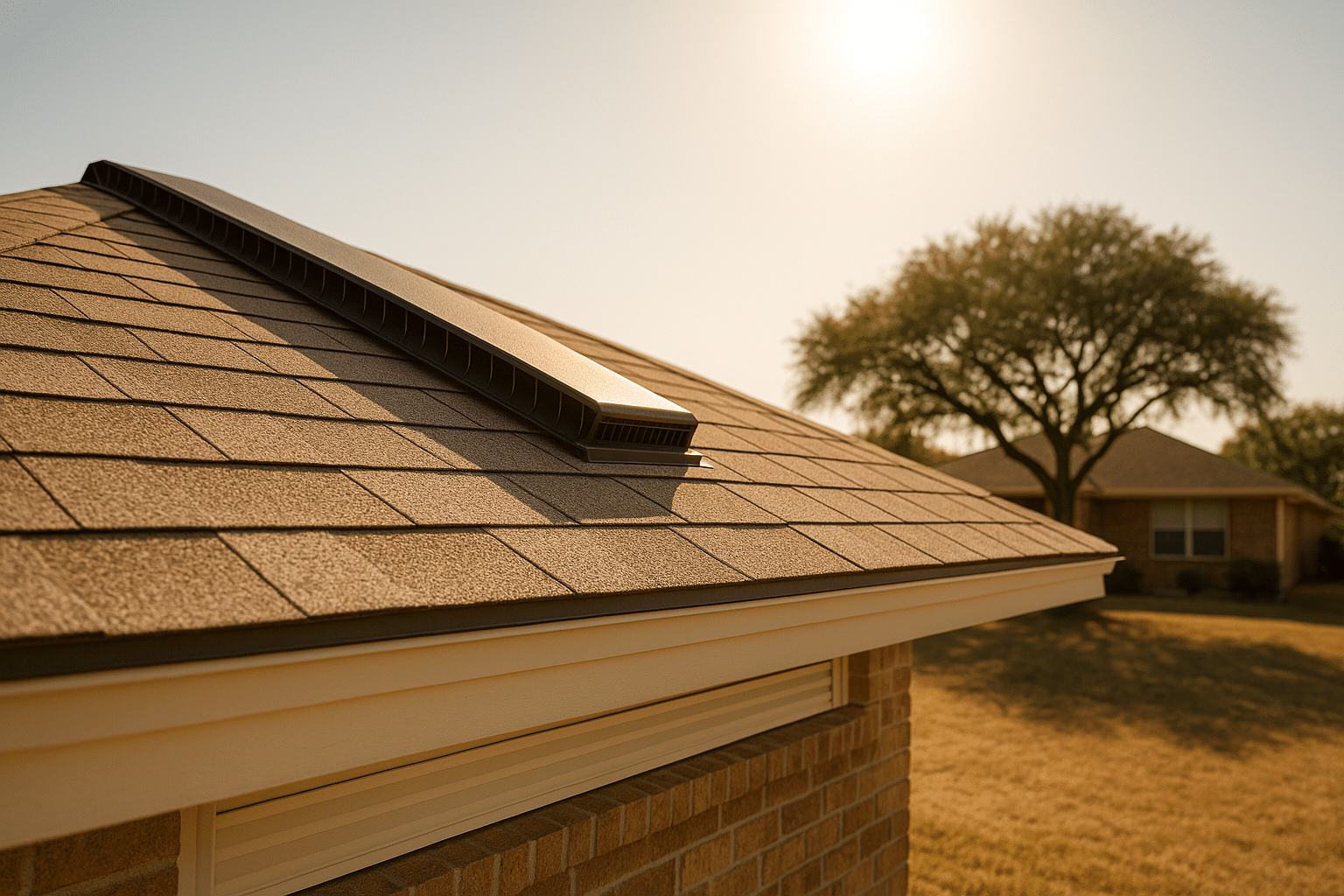
Roof ventilation is a system of intake and exhaust vents designed to move air continuously through your attic. Cooler outside air enters low on the roof — usually through soffit vents under the eaves — and warm, moist air exits high on the roof, typically through a ridge vent or gable vents.
Intake vents bring in cool, fresh air, usually through soffits or eaves, while exhaust vents expel hot, stale air, usually through roof or ridge vents.
This continuous exchange is sometimes called the “stack effect” — hot air naturally rises and escapes, pulling fresh air in behind it.
It’s important to understand what ventilation does not do: it doesn’t cool your attic with air conditioning.
The purpose is not to cool the attic with conditioned indoor air — in fact, air from the living space should be kept from leaking freely into the attic.
Ventilation simply lets outside air flow through so the attic doesn’t trap heat and humidity.
How Much Hotter Does an Unventilated Attic Get?
The numbers are striking.
In the summer, attic temperatures can reach 140°F or more
in a poorly ventilated attic, even when it’s only in the 90s outside.
According to ENERGY STAR, a well-vented attic can stay 10-30°F cooler than an unvented one.
.
That gap matters more here than almost anywhere else in the country. Corpus Christi doesn’t just get hot for a few weeks — it stays hot, with
summers hot and humid with temperatures often reaching the high 90s with high humidity levels
, from roughly May through September. Every one of those weeks, a poorly vented attic is cooking your roof deck and shingles from underneath while your AC fights the heat radiating down from above.
Why Attic Heat Matters for Your Roof and Your Wallet
1. It Shortens Your Shingle’s Lifespan
Asphalt shingles are rated for a certain service life under normal conditions, but excess attic heat accelerates aging from below.
In summer, heat cooks shingles from below, reducing their life span.
Over time this shows up as
curling shingle edges, granule loss in gutters, and cracked or split shingles
. If your shingle roof is already showing these signs, it may be time for a closer look — our team handles professional shingle roof repair in Corpus Christi and can tell you whether ventilation is part of the problem.
2. It Drives Up Cooling Costs
ENERGY STAR says good attic ventilation can lower energy costs by up to 15% per year
, which
can mean hundreds of dollars saved
over a Texas cooling season. With Corpus Christi AC units running almost nonstop from late spring through early fall, that’s not a small number on your electric bill.
3. It Can Cause Moisture Problems
Ventilation isn’t only a summer issue.
Hot air in an attic contains moisture that can condense, causing long-term issues, and in winter, condensation can create moisture issues.
Along the Gulf Coast, where humidity is a year-round fact of life, trapped moisture in an unventilated attic can lead to mold, wood rot, and rusted fasteners — problems that are far more expensive to fix than a vent upgrade.
How Much Ventilation Does Your Attic Actually Need?
This isn’t a guess — it’s governed by building code.
IRC Section R806 requires a minimum of 1 square foot of net free ventilation area for every 150 square feet of attic floor area, a 1:150 ratio.
“Net free area” means the actual open, unobstructed space air can pass through — not the overall size of the vent cover, since screens and louvers block some of that area.
That ratio can be cut in half under specific conditions.
The ratio drops to 1:300 when at least 40 percent of the required vent area is provided as low intake vents near the eaves, with the remainder as high exhaust vents, and a Class II or better vapor retarder is installed on the warm-in-winter side of the ceiling.
In practice, this means a roof needs both intake and exhaust vents working together, roughly balanced, not just a single ridge vent or a couple of gable vents slapped on.
Ridge vents only work effectively with soffit intake vents along the eaves, and balanced ventilation between ridge and soffit vents allows smooth airflow through the attic space.
The Most Common Ventilation Mistake We See
Insulation that’s been blown or stuffed in too tight along the eaves is one of the most frequent culprits behind a hot, poorly performing attic.
ENERGY STAR specifically warns against covering soffit vents with insulation and recommends rafter vents or baffles to maintain an open path between the eaves and upper attic.
When soffit vents get blocked, the whole system breaks down —
installing a large ridge vent while soffit openings remain blocked by insulation does not create an effective airflow path, since exhaust vents can only move the amount of air the intake side allows them to receive.
We see this often on older homes in Corpus Christi, Alice, Aransas Pass, Banquete, and Beeville — attics insulated decades ago, with little regard for airflow, now struggling under today’s heat loads.
Attic Fans: Helpful or Not?
Powered attic fans are a popular fix homeowners consider, but the building science community is more cautious than you might expect.
Many building scientists consider the risks of attic ventilation fans to be greater than the advantages, and they are not recommended by the ENERGY STAR program.
The concern is that a fan can pull conditioned air out of the living space if the attic floor isn’t properly air-sealed, which actually increases your cooling costs rather than lowering them.
Reducing the attic temperature has a relatively small effect on the home’s cooling load if the ceiling is well-insulated
— which is why we always look at insulation and air sealing alongside ventilation, not instead of it.
Why This Matters More in Corpus Christi Than Elsewhere
Coastal South Texas adds a few wrinkles that inland markets don’t deal with:
- Long cooling season: With average highs near 92-93°F for much of the summer and a heat index that regularly tips into triple digits, attics here get far more cumulative heat exposure than in milder climates.
- Humidity and salt air: Gulf Coast humidity means moisture-related attic problems — rot, mold, corroded fasteners — are a bigger risk here than in dry inland regions.
- Windstorm code considerations: Many Corpus Christi-area homes near the coast require WPI-8 windstorm certification (a Texas Department of Insurance inspection confirming a roof meets wind-resistance standards for insurance eligibility). Vent products and their installation details matter here — vents have to be installed and fastened to hold up under high wind, not just move air.
- Flat and low-slope roofs: Many commercial buildings and some homes in our area use flat or low-slope systems, which ventilate differently than a pitched attic and need their own moisture-management approach. If you have a flat roof showing signs of heat stress or ponding, our flat roof repair services in Corpus Christi address those issues directly.
Signs Your Attic Ventilation Needs Attention
- Upstairs rooms feel noticeably hotter than the rest of the house
- Your AC runs constantly in summer but still struggles to keep up
- Shingles look curled, cracked, or are shedding granules faster than expected
- You notice musty odors, moisture stains, or mold in the attic
- Your energy bills have crept up without an obvious cause
What a Professional Ventilation Check Involves
A qualified roofing contractor will look at the whole system, not just one vent. That typically includes:
- Measuring attic square footage to calculate the required net free area under code
- Checking that soffit vents are clear and not blocked by insulation
- Confirming intake and exhaust vents are balanced, not just present
- Looking for moisture damage, rust, or mold that signals a chronic problem
- Reviewing insulation levels and air sealing at the attic floor, since ventilation and insulation work together
Because roofing, insulation, and ventilation are connected, it often makes sense to have one contractor assess all of it rather than coordinating separate specialists. That’s part of why Buffalo Roofing & Exteriors offers single-source exterior work — roof, siding, and related components — so homeowners aren’t juggling multiple companies to solve one problem.
FAQs
Get a Free Ventilation and Roof Assessment
If your attic runs hot, your energy bills seem high for your home’s size, or you’re planning a roof replacement and want it done right the first time, Buffalo Roofing & Exteriors offers free estimates across Corpus Christi, Alice, Aransas Pass, Banquete, Beeville, and the surrounding Coastal Bend. We’re locally owned, BBB-accredited, licensed and insured, and we offer Improvifi financing with $0 down for qualifying projects. While we’re looking at your roof, we can also flag related exterior issues — from siding to decking — so you get the full picture in one visit. If your deck has also taken a beating from Texas sun and humidity, ask about our deck sealing services during the same appointment.
Recommended Reads
- Siding Installation in San Antonio: Best Materials for Texas Heat and UV
- Flat Roof Repair in Corpus Christi, TX
- Professional Shingle Roof Repair in Corpus Christi, TX