
TL;DR:
- Energy Star certification is a government-backed label that verifies products and homes meet strict energy efficiency standards through independent testing. It influences consumer choices by offering verified savings, resale value increases, and access to rebates and tax credits. Homeowners should verify current standards and specifications regularly to maximize savings and incentives.
Energy Star certification is defined as a government-backed label, administered by the U.S. Environmental Protection Agency and the Department of Energy, that identifies products and homes meeting strict energy efficiency standards verified through independent testing. If you are researching energy-efficient upgrades for your home, this label is one of the most reliable signals you can find. Over 400 million Energy Star-certified products were sold in 2022 alone, reflecting how widely the program influences purchasing decisions. That scale tells you this is not a niche label. It is a mainstream standard that affects everything from the refrigerator in your kitchen to the roof over your head.
What is Energy Star certification and how does it work?
Energy Star certification is a performance-based label, not a marketing claim. The EPA sets specific efficiency thresholds for each product category, and manufacturers must meet those thresholds through rigorous third-party verification before they can display the label. That independence is what separates Energy Star from generic “green” marketing language you see on store shelves.

How product certification works
For appliances, lighting, and electronics, the process starts with performance specifications the EPA publishes for each category. A manufacturer submits its product for testing at an EPA-recognized laboratory. The lab measures actual energy consumption under standardized conditions. If the product meets the threshold, the manufacturer can apply the label. The EPA also conducts market surveillance to pull certified products off shelves and retest them, so the label stays honest.
For homes, the process is more involved. New homes go through a multi-stage process that includes documentation review, diagnostic testing, and on-site inspections by a certified HERS (Home Energy Rating System) rater. Specific tests include:
- Blower door tests to measure how much air leaks through the building envelope
- Duct leakage tests to confirm the HVAC system delivers conditioned air efficiently
- Insulation inspections to verify proper installation and coverage
- Airflow measurements to check that ventilation meets health and comfort standards
Each step must pass before certification is granted. No single inspection covers everything. The process is designed to catch problems that visual checks alone would miss.
Pro Tip: Ask your contractor for the HERS rating report, not just the Energy Star certificate. The HERS score gives you a numerical benchmark you can compare across homes.
What are the benefits of Energy Star certification for homeowners?
The financial case for Energy Star certification is direct and well-documented. Homeowners who choose certified products and homes see lower utility bills, better indoor comfort, and stronger resale value. The environmental benefits compound on top of those personal gains.
Lower energy bills
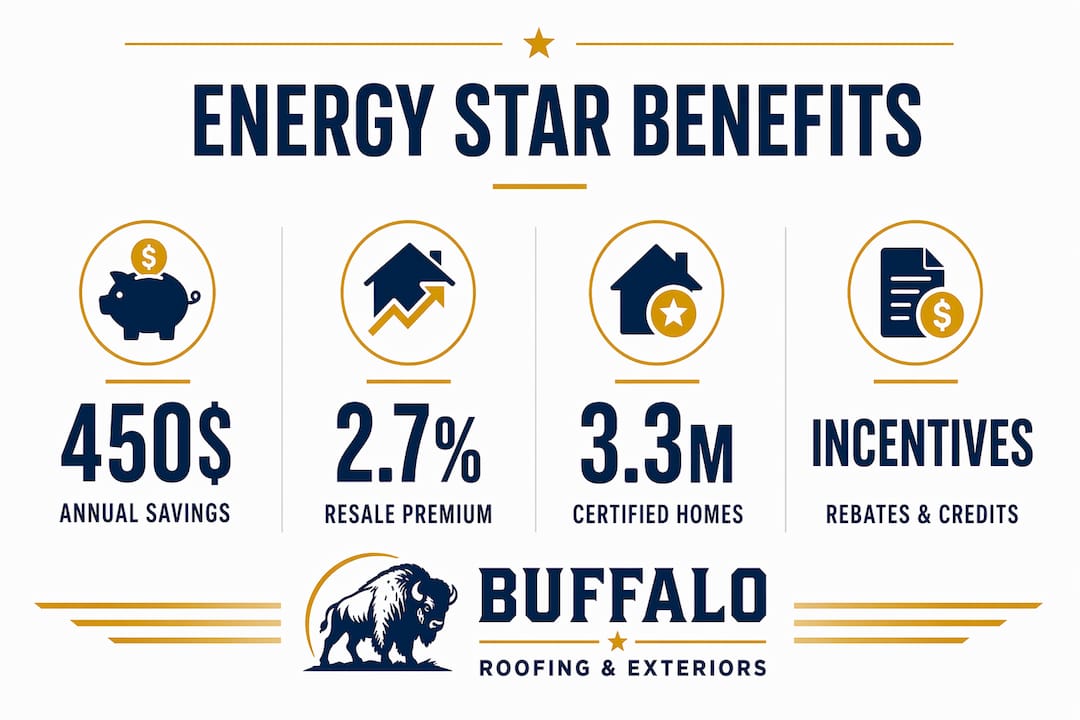
Households with Energy Star-certified products save an average of $450 annually on energy bills. That figure covers product-level savings across appliances, lighting, and electronics. For certified homes, the savings go further. Energy Star-certified homes are 10–20% more energy-efficient than standard homes, translating to utility savings of up to $300 per year. Combine product and home savings, and the annual reduction in your energy costs becomes significant over a decade.
Higher resale value
A Freddie Mac analysis found that energy-efficient certified homes sell at a 2.7% price premium on average compared to similar uncertified homes. Higher-performing units can command 3–5% more. For a home valued at $300,000, that premium adds $8,100 to $15,000 at sale. Buyers are willing to pay more because they understand lower operating costs come with the property. This connection between certification and resale value is one of the strongest financial arguments for pursuing certified upgrades.
Comfort and air quality
Energy Star homes use advanced building practices that go beyond basic code requirements. Better air sealing, improved insulation, and verified HVAC performance mean fewer drafts, more consistent temperatures room to room, and better control over indoor humidity. Homeowners in coastal Texas, where heat and humidity are constant, feel this difference immediately.
Rebates and tax credits
- Federal tax credits are available for qualifying Energy Star-certified windows, doors, insulation, and HVAC systems under the Inflation Reduction Act.
- Utility rebates are offered by many electric and gas providers for certified appliances and home improvements.
- State and local incentives vary by region but often stack on top of federal credits, reducing your net cost further.
- Financing programs tied to energy efficiency upgrades are available through lenders who recognize the long-term value of certified improvements.
Upfront costs for certified products or homes may be higher, but the total cost of ownership drops when you factor in utility savings, rebates, and the resale premium. The math works in your favor over time.
How can homeowners get Energy Star-certified products and upgrades?
Finding certified products is straightforward. The EPA maintains a searchable database at energystar.gov where you can filter by product category and model. Every certified product in the database has passed the testing requirements in effect at the time of certification. When you shop in a store, look for the blue Energy Star label on the product itself, not just on the shelf tag.
For home upgrades, the path depends on whether you are building new or improving an existing home.
- New construction: Work with a builder who partners with a certified HERS rater from the start. The rater joins the project during construction, not after, because many tests require access to systems before walls are closed.
- Existing homes: Pursue individual product certifications for windows, doors, and HVAC equipment. A full home certification for existing construction is less common but possible through programs like the EPA’s Certified Homes Version 3.2 pathway.
- Windows and doors: Energy Star-certified windows carry climate-zone-specific ratings, so confirm the product is rated for your region before purchasing.
- Roofing: Certified roofing products, including reflective shingles and metal roofing, reduce heat gain in hot climates. Roofing upgrades for energy savings in coastal homes can meaningfully cut cooling costs.
Pro Tip: Before buying any certified appliance or building material, check the energystar.gov product list for the current version number. A product certified under an older version may not qualify for the latest tax credits.
A qualified energy auditor can assess your home and prioritize which upgrades deliver the best return. Many utility companies offer free or subsidized audits. Start there before spending on upgrades.
What should homeowners know about evolving Energy Star standards?
Energy Star performance specifications are not static. The EPA updates requirements regularly for each product category to reflect advances in technology and keep the label meaningful. A product that earned certification three years ago may not meet today’s standards. That matters when you are shopping for appliances in a showroom, because older inventory on the floor may carry a label that no longer reflects current thresholds.
The practical implications for homeowners include:
- Version numbers matter. Check the specific version of the Energy Star specification a product was certified under. Tax credit eligibility often ties to a minimum version.
- Showroom stock can lag. Retailers sometimes carry certified products from prior specification cycles. Verify the model number against the current EPA database before buying.
- Program tiers exist. Some categories, like HVAC systems, have tiered certifications. Higher tiers qualify for larger rebates and credits.
- The EPA publishes updates publicly. The EPA and DOE revise test procedures and share enforcement results to maintain program integrity. Checking energystar.gov before a major purchase takes five minutes and can save you from buying a product that no longer qualifies for incentives.
| Standard element | What to check |
|---|---|
| Specification version | Confirm the version number matches current EPA requirements |
| Climate zone rating | Verify the product is rated for your geographic region |
| Tax credit eligibility | Cross-reference with IRS guidance for the current tax year |
| Rebate qualification | Check your utility provider’s current rebate list |
Staying current with program updates is not complicated. It requires one search before a major purchase. That habit protects your investment and keeps you eligible for every incentive available.
Key Takeaways
Energy Star certification delivers verified energy savings, higher resale value, and access to financial incentives that make certified upgrades a sound long-term investment for homeowners.
| Point | Details |
|---|---|
| Independent verification | Third-party testing and inspections confirm real performance, not manufacturer claims. |
| Annual savings potential | Certified products save an average of $450 per year; certified homes save up to $300 more. |
| Resale price premium | Energy-efficient certified homes sell for 2.7–5% more than comparable uncertified homes. |
| Standards evolve | Check the current specification version before buying to confirm tax credit eligibility. |
| Upgrades stack | Windows, doors, roofing, and HVAC certifications combine for greater total savings. |
Why independent verification is the part most homeowners overlook
Most homeowners focus on the label and the savings number. The part that actually makes Energy Star trustworthy is the verification process behind it. I have seen homeowners buy products based on a manufacturer’s efficiency claim printed on the box, only to find the real-world performance falls short. Energy Star’s independent third-party verification removes that risk. The testing happens at a lab the manufacturer does not control, and the EPA audits the market to catch products that drift out of compliance.
The other mistake I see regularly is treating certification as a one-time decision. Standards move. A window that qualified for a federal tax credit two years ago may not qualify today. Homeowners who check the current version before every major purchase protect themselves from that gap. It takes less time than reading a product review.
The upfront cost concern is real but overstated. Total cost of ownership drops when you account for utility savings, rebates, and the resale premium. The homeowners who feel burned by Energy Star products are usually the ones who skipped the rebate application or bought under an outdated specification. The program works when you use it correctly.
My honest recommendation: treat Energy Star certification as a floor, not a ceiling. Use it to filter out underperforming products, then look at the HERS score or the specific efficiency rating to find the best performer within the certified pool. That approach gives you both the verified baseline and the best available performance.
— Results
Exterior upgrades that align with Energy Star principles
Homeowners in Corpus Christi, San Antonio, and along the Texas coast face a specific challenge: heat, humidity, and storm exposure put constant pressure on roofing and exterior systems. Choosing certified materials for those systems is not just an efficiency decision. It is a durability decision.
Buffalo Roofing and Exteriors works with homeowners across coastal Texas on exterior renovation planning that accounts for both energy performance and weather resilience. From reflective roofing materials to certified windows and siding, the team helps you identify upgrades that qualify for incentives and hold up in a coastal climate. If you are ready to move from research to action, roofing financing options are available to make certified upgrades accessible without a large upfront payment. Reach out to Buffaloroofingandexteriors for a free estimate and a clear plan for your home.
FAQ
What does Energy Star certification mean for a product?
Energy Star certification means a product has been independently tested and confirmed to meet the EPA’s energy efficiency standards for its category. It is not a self-reported claim. It requires third-party lab verification.
How many Energy Star-certified homes exist in the U.S.?
More than 2.5 million Energy Star-certified homes have been built in the United States. Each went through a multi-step inspection and diagnostic testing process before receiving certification.
Does Energy Star certification increase home resale value?
A Freddie Mac analysis found certified homes sell at an average 2.7% price premium, with higher-performing homes commanding 3–5% more than comparable uncertified properties.
How do I know if an Energy Star product qualifies for a tax credit?
Check the current specification version on energystar.gov and cross-reference it with IRS guidance for the current tax year. Not all certified products qualify. Version and tier matter for credit eligibility.
Can I get Energy Star certification on an existing home?
Full home certification for existing construction is possible but less common than new construction pathways. Most homeowners pursue individual product certifications for windows, doors, and HVAC systems, which qualify for federal tax credits and utility rebates without a full home certification.