TL;DR: Victoria, TX sits squarely in South Texas storm country — hurricanes, hail, and damaging winds are recurring threats, not rare exceptions. This guide covers what roof damage looks like after a storm, when repair is enough vs. when replacement makes more sense, and how windstorm certification ties into your insurance coverage. Buffalo Roofing & Exteriors serves Victoria homeowners with free estimates, insurance claim assistance, and WPI-8-compliant repairs.
Victoria, TX is positioned about 30 miles inland from the Gulf Coast — far enough that storm surge rarely reaches it, but close enough that every hurricane season brings real risk. Wind, hail, and heavy rain can all compromise a roof in ways that aren’t obvious from the ground. Catching damage early is the difference between a straightforward repair and a full replacement.
This guide walks you through what Victoria homeowners need to know: the weather threats specific to this area, how to spot roof damage after a storm, when to repair versus replace, and how windstorm certification affects your insurance.
Why Victoria Roofs Take a Beating
Victoria County sits in the direct path of Gulf Coast storm systems. Victoria is in a moderate-risk hurricane zone, with 37 hurricanes recorded in the area since 1930. That history includes major events — during Hurricane Carla in 1961, sustained winds of 110 mph were recorded at Victoria, with peak gusts estimated around 150 mph.
More recently, Hurricane Harvey wreaked havoc in Victoria, ripping roofs off buildings, flooding highways, and cutting power to thousands of homes and businesses. Even homes that remained structurally sound after Harvey sustained damage from debris — including Victoria’s own weather station, whose roof was struck by a fallen tree.
It’s not just hurricanes. Storm reports near Victoria in the past 12 months show 53 events tracked — including hail up to 1.75 inches and wind gusts up to 77 mph — across 16 severe weather days, based on NOAA/NWS data. Since 2004, Victoria has recorded 23 hail events within 10 miles of the city center, with the largest reaching 1.75 inches — roughly golf ball size.
Hail is the number-one cause of homeowner insurance claims for roofing damage, and even one-inch hail can crack shingles and dent metal. Hurricane-force winds above 74 mph can tear off entire roof sections, while even tropical storm-force winds of 39–73 mph can damage flashing, soffit, and ridge caps.
How to Check Your Roof After a Storm (Without Going Up There)
After a severe storm, property owners should inspect their roofs for damage — but the National Roofing Contractors Association (NRCA) strongly encourages homeowners and business owners to assess roof damage from ground level and not attempt repairs on their own.
Here is what to look for from the ground or inside the attic:
- Missing or lifted shingles. Look for wind creases or lifted tabs, especially on windward slopes, and missing shingles or displaced ridge caps.
- Granule loss. Excess granules collecting in gutters or downspouts suggest damage to asphalt shingles. This is often the first sign of hail impact.
- Hail bruises. Look for small round dents or soft spots on shingles that indicate hail impact — hail can crack or puncture shingles, leading to water infiltration.
- Damaged flashing. Check around chimneys, vents, and skylights for bent, loose, or damaged flashing.
- Gutter damage. Look for dents, clogs, or signs that gutters have pulled away from the roofline.
- Attic signs. Inside the attic, look for water stains, mold, damp insulation, or daylight visible through the roof decking.
Storm damage often hides — hail impact in particular can weaken shingles without leaving visible marks from 30 feet away. The NRCA emphasizes that professional roofers are trained to spot subtle signs of damage that homeowners typically miss — they know where to look, what to look for, and how to assess whether a quick repair or a full replacement is needed.
If you see any of the signs above, call for a free estimate before calling your insurance company. A documented scope of work from a licensed contractor strengthens your claim significantly.
Common Types of Roof Repairs in Victoria
Most storm-related roof work in Victoria falls into one of these categories:
Shingle Repair and Replacement
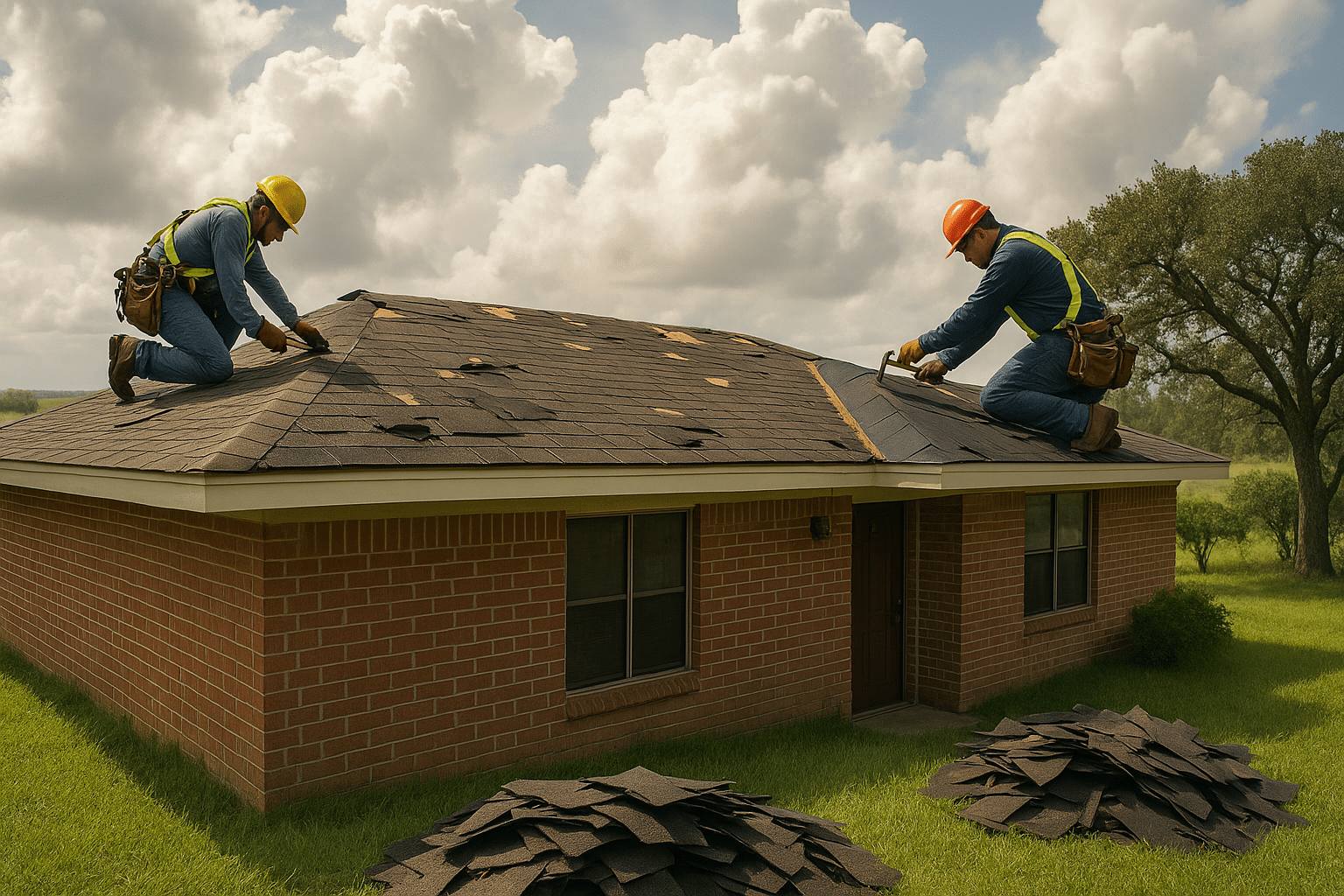
Asphalt shingles are the most common roofing material in Victoria and throughout South Texas. After wind or hail events, you may need a partial re-shingle — replacing lifted, cracked, or missing sections — rather than a full tear-off. Professional shingle roof repair focuses on matching existing material and restoring weathertightness without replacing the entire system when the damage is localized.
Flat and Low-Slope Roof Repair
Commercial buildings, older homes, and many additions in Victoria use flat or low-slope roof systems. These are particularly vulnerable to ponding water after heavy rainfall. TPO (Thermoplastic Polyolefin) is a popular flat-roof membrane used on commercial and residential low-slope roofs because of its UV resistance and heat-reflective properties. Storm damage to flat roofs often shows up as membrane punctures, seam separations, or flashing failures around penetrations. Learn more about flat roof repair options if your property uses a low-slope system.
Flashing and Ridge Cap Repair
High winds frequently lift or separate metal flashing around chimneys, vents, and roof edges. This is one of the most common — and most underestimated — storm repairs. Water intrusion through failed flashing can travel far from the entry point before showing up as a ceiling stain.
Full Roof Replacement
Sometimes a storm accelerates what was already a failing roof. If your shingles are aging, granule loss is widespread, or the decking has been compromised, a full replacement is often the smarter long-term investment. Buffalo Roofing & Exteriors can walk you through both options and give you a straight answer on which one fits your situation.
Repair vs. Replace: How to Decide
A few practical rules of thumb:
- Repair makes sense when damage is confined to a specific area, the roof is under 15 years old, and the surrounding shingles are still in good condition.
- Replace makes sense when damage is widespread, the roof is 20+ years old, or when your insurance adjuster determines replacement is warranted by the extent of loss.
- Check your policy deductible. Texas windstorm policies often carry a separate wind/hail deductible — sometimes a percentage of the insured value rather than a flat dollar amount. A contractor who understands insurance claims can help you determine whether a repair or replacement claim makes financial sense.
Catching damage early typically prevents repair costs from multiplying by two to five times. Delaying even a minor repair through a South Texas wet season can turn a straightforward fix into a decking replacement.
Insurance Claims: What to Do First
The steps you take in the first 24–48 hours after a storm matter for your claim:
- Document everything. Photograph and document all damage before making any temporary repairs, and keep all receipts.
- Make only temporary repairs. Make only essential temporary repairs to prevent further damage — cover exposed areas with tarps but do not attempt permanent fixes before an adjuster has reviewed the damage.
- Do not discard damaged materials. Do not discard damaged materials before your adjuster has documented them.
- Report the loss promptly. Contact your insurer to report the loss as soon as practical, and note the exact date of loss.
- Get a licensed contractor’s written assessment. A detailed report from a licensed roofer carries weight with adjusters.
Buffalo Roofing & Exteriors provides insurance claim assistance as part of every storm damage project. We document damage thoroughly, communicate directly with adjusters, and make sure nothing is overlooked in the claim scope.
WPI-8 Windstorm Certification: What Victoria-Area Homeowners Need to Know
If you live in one of the 14 Texas coastal catastrophe counties — which includes Calhoun, Refugio, Aransas, San Patricio, Nueces, and others surrounding the Victoria area — any significant roofing work may require windstorm certification from the Texas Department of Insurance (TDI).
Here is what those terms mean:
- TDI — the Texas Department of Insurance, which administers the windstorm inspection program for coastal counties.
- WPI-8 — the windstorm inspection compliance certificate TDI issues to show that a property, repair, or addition meets building code requirements. It is a Certificate of Compliance issued by TDI for new and ongoing improvements.
- TWIA — the Texas Windstorm Insurance Association, the state-backed insurer that provides wind and hail coverage in coastal areas where private insurers often will not.
Homeowners in designated catastrophe areas may not be able to obtain private insurance covering windstorm and hail damage, and must get coverage through TWIA — and in order to purchase a TWIA policy, most homes and properties must have a certificate of compliance verifying that the structure meets applicable building codes and can withstand high winds.
As of June 1, 2020, all new and ongoing construction, roof replacements, major repairs, and other alterations must be inspected by a TDI-appointed engineer for a TDI WPI-8.
This matters for more than just insurance. Buyers and lenders in coastal counties routinely ask for proof of windstorm coverage or a valid WPI-8 before closing — a home without certification on file can become difficult or impossible to insure through TWIA, which complicates financing, slows down a sale, and can affect resale value.
Buffalo Roofing & Exteriors performs WPI-8-compliant roofing work and coordinates the certification process. If you are unsure whether your property is in a designated catastrophe area, you can check directly with the Texas Department of Insurance Windstorm Inspections program or the Texas Windstorm Insurance Association (TWIA).
Roofing Materials That Hold Up in South Texas
Not all roofing materials perform equally in Victoria’s climate — summer heat, high humidity, and tropical-force winds all factor into material choice:
- Architectural asphalt shingles — the most common choice; look for impact-resistant (Class 4) shingles rated for high-wind zones, which can also earn insurance premium discounts.
- Metal roofing — standing seam metal holds up well against wind and is virtually immune to the granule-loss issues that plague shingles after hail. It also reflects radiant heat, which helps with cooling costs through a long South Texas summer.
- Clay and Spanish tile — common in the area for good reason; tile is durable in heat and humidity but can crack under hail impact and requires proper underlayment for storm protection.
- TPO and flat roof systems — the right choice for commercial buildings and low-slope applications; quality installation and proper drainage are critical in a region with heavy rainfall events.
Why Local Experience Matters in Victoria
After a significant storm, out-of-state contractors descend on South Texas communities. Storm chasers from out of state are usually gone before you can call them back if something goes wrong. A local contractor with established operations — licensed, insured, and accountable — is the safer call.
Buffalo Roofing & Exteriors is based in Corpus Christi with service across South and Central Texas, including Victoria. We are BBB-accredited, carry 200+ five-star Google reviews, and handle roofing, siding, windows, and exterior work under one roof so you are not juggling multiple contractors after a storm. We also offer Improvifi financing from $1,000 to $50,000 with $0 down and no credit score impact for the application — helpful when a storm hits and insurance timing does not align with repair urgency.
If your Victoria home took storm damage — or if you simply have not had a professional look at your roof since the last major weather event — call or contact us online for a free estimate. We will document what we find, walk you through your options, and help you get your home protected before the next storm season.
Recommended Reads
- TPO Roof Repair in Corpus Christi, TX
- Flat Roof Repair in Corpus Christi, TX
- Professional Shingle Roof Repair in Corpus Christi, TX