TL;DR: Standing seam metal roofing uses interlocking panels with hidden fasteners to resist wind uplift, shed water, and reflect heat, making it a strong match for South Texas hurricanes and Hill Country sun alike. It costs more upfront than asphalt shingles but lasts two to three times longer and can simplify TDI windstorm certification for coastal homes.
If you’re comparing roofing materials for a South Texas home, you’ve probably run into the term standing seam metal roof. It’s the roofing style with tall, vertical ribs and no visible screws or nails on the surface.
Here’s what it is, how it holds up against Gulf Coast storms and Hill Country heat, what it costs, and when it actually makes sense for your property.
What Is a Standing Seam Metal Roof?
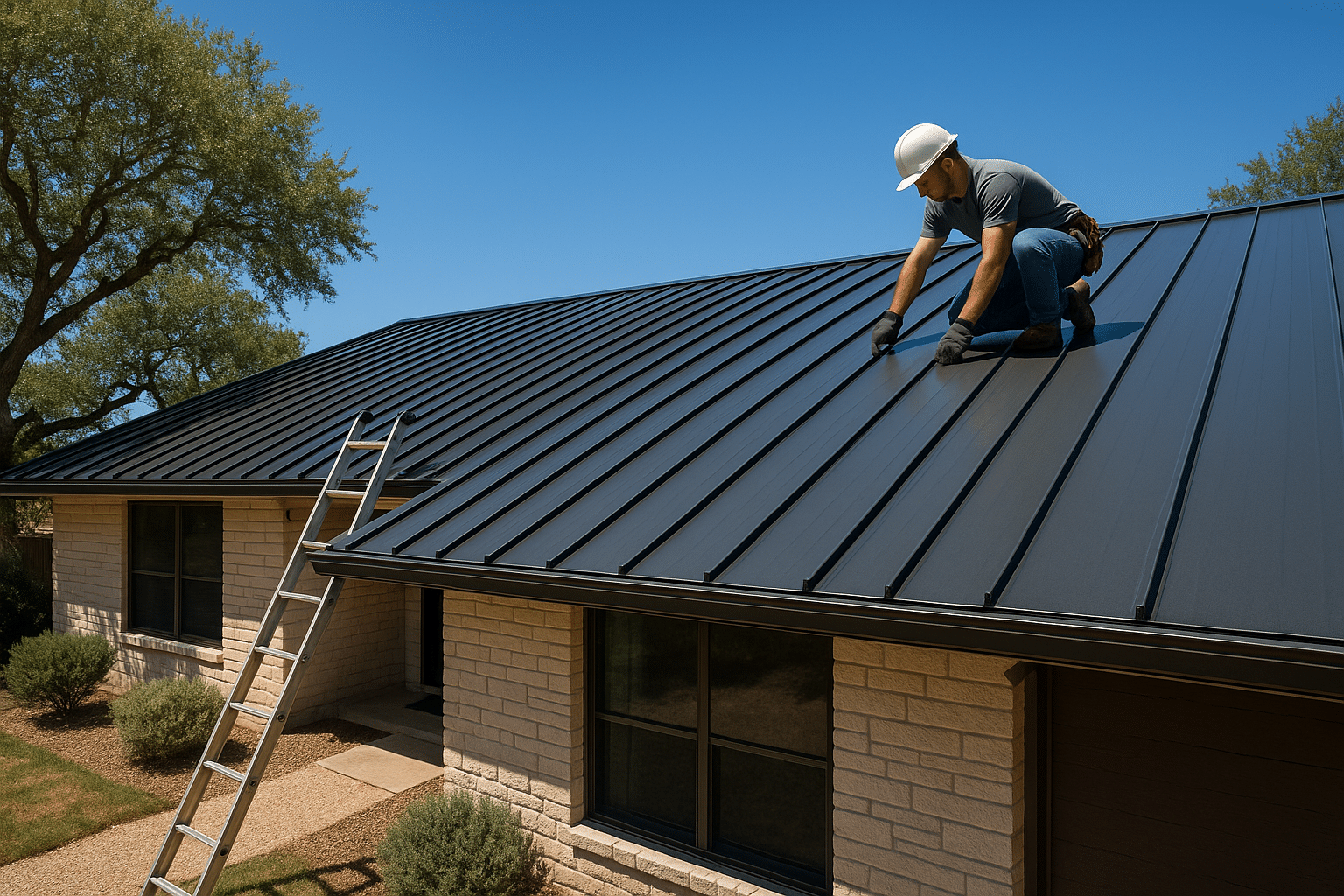
A standing seam metal roof is made of long, vertical metal panels that interlock at raised seams, with all fasteners concealed underneath the panel edges instead of exposed on the surface. This is different from older exposed-fastener metal panel systems, where screws go straight through the face of the panel and are a common source of future leaks as washers age and seals fail.
Panels are typically steel, aluminum, zinc, or copper, factory-finished with a protective coating, and run in 24-gauge thickness for most residential jobs.
How Standing Seam Performs in South Texas Conditions
Wind and Hurricane Resistance
Corpus Christi, Aransas Pass, and the surrounding Coastal Bend sit squarely in hurricane territory, and wind uplift is the number one way roofs fail in a storm.
Among the different types of metal roofing, standing seam roofing is considered among the most wind-resistive roofing options because the panels interlock at their seams, serving as a structural covering, and can be engineered to withstand even Category 4 and 5 hurricane wind forces.
Standing seam metal roofing systems excel in high-wind environments with ratings up to 160 mph, and their interlocking panels eliminate exposed fasteners, reducing potential failure points during wind events.
Field data backs this up:
FEMA’s post-Hurricane Andrew recovery advisory documented that properly designed structural standing seam systems survived in Florida where estimated wind speeds reached 170 mph, and after Hurricane Ian in 2022, FEMA’s Mitigation Assessment Team found that only 21% of metal-panel roofs sustained visible damage, compared to 90% of asphalt-shingle roofs older than a certain age.
Not every standing seam panel performs the same, though. Panel profile, fastener spacing, and installation quality all matter, which is why working with a crew experienced in coastal wind-rated assemblies is non-negotiable here. For a deeper look at how metal stacks up against other materials locally, see our guide on why metal roofing is one of the best choices for Corpus Christi homes.
Salt Air and Corrosion
Coastal humidity and salt spray eat away at lesser roofing materials and fasteners over time. Aluminum standing seam panels are a popular choice along the immediate coastline because of their natural corrosion resistance, while steel panels need a quality factory coating to hold up in salt air long-term.
TDI Windstorm Certification (WPI-8)
If your property is in one of the Texas Department of Insurance’s designated seacoast counties — which includes the Corpus Christi and Coastal Bend area — you may need windstorm coverage through the Texas Windstorm Insurance Association (TWIA) rather than a standard homeowners policy.
TWIA requires that the building meet TDI construction standards, and the certification document is called the WPI-8, the Windstorm/Hail Insurance Certificate of Compliance, issued by a TDI-licensed engineer or TDI-appointed inspector after verifying that the roofing installation meets TWIA building code standards.
All roofing materials must be listed on the TDI-approved product list, including the roofing material itself, underlayment, fasteners, flashing, and sealants, and the installation method must follow the manufacturer’s high-wind installation instructions with enhanced fastening patterns and reinforced edge and ridge treatments.
A properly specified and installed standing seam system can be engineered to meet these requirements, but the documentation and inspection process has to be handled correctly from day one, or your WPI-8 can be denied.
Hail Impact Resistance
Hail is a year-round risk across South and Central Texas.
Metal roof systems can be certified to UL 2218, which tests their impact resistance and ranks them on a class system from one to four, and metal roofs rank highest with a class four rating, ensuring maximum protection from wind-blown debris and even hail.
Heat, UV, and Energy Performance (San Antonio & Hill Country)
Away from the coast, San Antonio and the Hill Country deal with a different set of stressors: intense summer sun, triple-digit heat, and constant thermal cycling as roofs heat up during the day and cool at night. A reflective standing seam roof addresses this directly.
Metal roofs reflect a large percentage of the sun’s energy back into the atmosphere and cool rapidly once the sun goes down, resulting in much lower attic temperatures and greatly reduced energy consumption for cooling.
Studies conducted by the Cool Metal Roofing Coalition and Oak Ridge National Laboratory have shown that metal roofs with ENERGY STAR certified high reflectance coatings can reduce cooling costs up to 40% compared to typical asphalt shingles.
To carry the ENERGY STAR label,
a roofing material must reflect at least 25% of the sun’s energy, with the best performing colors reflecting as much as 70%.
Lighter finishes generally perform best in Texas heat, though any ENERGY STAR-qualified color will outperform a standard dark asphalt shingle.
How Long Does a Standing Seam Metal Roof Last?
According to the Metal Roofing Alliance, metal roofs can last 40-70 years compared to 12-20 years for asphalt shingles, making them a cost-effective long-term investment.
That span puts a single standing seam roof install on pace to outlast two, sometimes three, asphalt shingle roofs over the life of your home.
Standing Seam Metal Roof Cost
Standing seam is a premium system, and the price reflects the materials and specialized labor involved.
National average installed cost runs between $8 and $14 per square foot, broken down roughly into $3 to $6 per square foot in materials, $4 to $8 per square foot in labor, and $1 to $2 per square foot for tear-off and disposal if you’re removing an old roof.
Material choice moves the price significantly:
- Steel (Galvalume): the most budget-friendly and common choice for most homes
- Aluminum: a popular upgrade for coastal properties thanks to corrosion resistance
- Zinc: a premium, self-healing finish with an especially long service life
- Copper: the highest cost option, prized for its patina and longevity
Because the upfront investment is real, many homeowners use financing to spread out the cost rather than paying cash all at once or settling for a cheaper, shorter-lived material.
Pros and Cons of Standing Seam Metal Roofing
Pros
- Hidden fasteners mean fewer exposed penetration points for water and wind to exploit
- Strong wind uplift performance, an advantage for both coastal hurricane zones and Hill Country straight-line winds
- Long service life relative to asphalt shingles
- Reflective finishes cut cooling costs in hot Texas summers
- High impact resistance against hail (UL 2218 Class 4 available)
- Lightweight relative to tile, so it typically doesn’t require structural upgrades
Cons
- Higher upfront cost than asphalt shingles
- Requires experienced installers — poor workmanship undermines the wind and leak performance that make the system worth it
- Panel profile matters: snap-lock systems have lower wind ratings than mechanical-seam systems, which matters for WPI-8 qualification in Tier 1 coastal zones
- Repairs, if ever needed, should be handled by a contractor familiar with the specific panel system
Standing Seam vs. Other Roofing Materials
Standing seam isn’t the only metal roofing option, and metal isn’t the only material worth considering. If you’re weighing asphalt shingles against metal for your specific home and budget, our asphalt shingles vs. metal roofing comparison guide breaks down the tradeoffs in more detail. Commercial and low-slope buildings have their own considerations too — flat and low-slope roofs typically use TPO (a type of single-ply membrane roofing) rather than standing seam panels; see our flat roof repair page for that side of the business.
When Does Standing Seam Make Sense?
Standing seam metal is a strong fit if you:
- Live in a TDI windstorm zone and want a roofing system that can be engineered to meet WPI-8 requirements
- Plan to stay in your home long-term and want to avoid multiple roof replacements
- Want lower cooling bills in San Antonio or Hill Country heat
- Have experienced recurring hail or wind damage with asphalt shingles
- Are building new or doing a full tear-off and want to invest once
It may not be the right call if you’re on a tight budget for a short-term hold, or if your roof deck and structure need extensive repair work that would be better paired with a lower-cost material for now.
Keeping an Existing Standing Seam Roof in Good Shape
Standing seam roofs are low-maintenance, but they’re not maintenance-free. Sealant at penetrations, fastener clips, and flashing details should be checked periodically, especially after a major storm. If you already have a metal roof showing signs of wear, our teams handle metal roof repair in Corpus Christi and metal roof repair in San Antonio.
Get a Free Estimate
Buffalo Roofing & Exteriors is locally owned and BBB-accredited, serving Corpus Christi, Alice, Aransas Pass, Banquete, Beeville, and the rest of South and Central Texas from four locations. We provide free estimates, handle insurance claim assistance and TDI-compliant WPI-8 windstorm certification, and offer Improvifi financing from $1,000 to $50,000 with $0 down and no credit score impact. If you’re weighing standing seam metal against other roofing options for your home, reach out for a straight answer and a free quote.
Recommended Reads
- Why Metal Roofing Is One of the Best Choices for Corpus Christi Homes
- Metal Roof Repair in Corpus Christi, TX
- Roof Repair in Metal Roof Repair In San Antonio, TX | Buffalo Roofing & Exteriors