TL;DR: Black streaks and algae on South Texas roofs come from an airborne cyanobacteria that thrives in our year-round humidity, and it does more than look bad — it traps moisture, raises attic heat, and can shorten shingle life. Here’s how to tell it apart from real mold, why Corpus Christi’s climate makes it almost inevitable, and what actually fixes it.
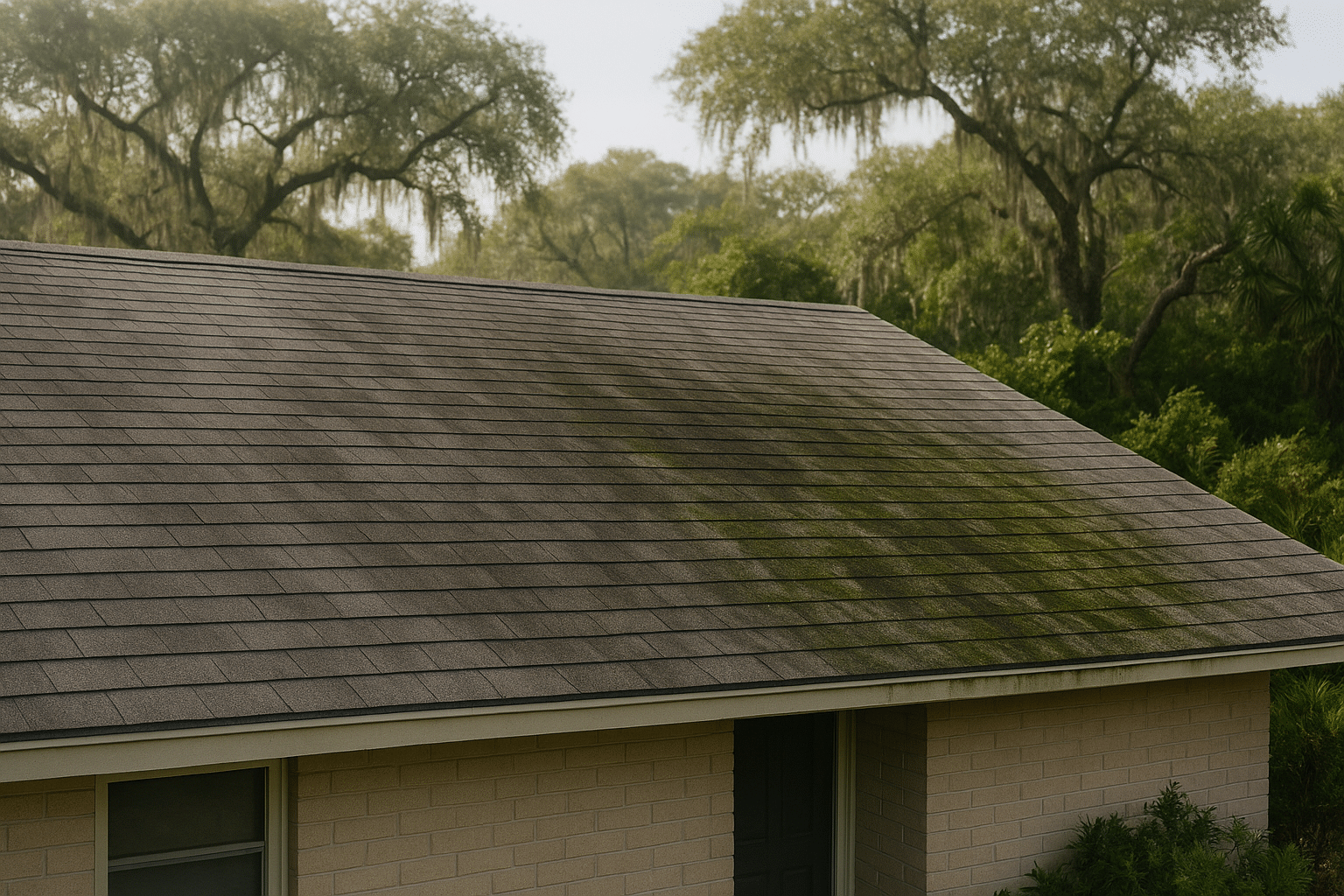
If you’ve looked up at a neighbor’s roof in Corpus Christi, Alice, Aransas Pass, Banquete, or Beeville and noticed dark streaks running down from the ridge, you’ve seen it: the black staining that makes an otherwise healthy roof look old overnight. Most homeowners call it mold. It’s almost always something else — and knowing the difference changes how you should deal with it.
What’s Really Growing on Your Roof?
Those black streaks aren’t dirt, soot, or mold in the way most people picture it. It’s staining from airborne algae, commonly but incorrectly called fungus or mold. The organism responsible is called Gloeocapsa magma, and despite the name, it isn’t technically even algae — it’s cyanobacteria, which are bacteria, whereas algae are single-celled organisms closely related to plants.
Here’s how it takes hold on a roof:
- Shingle manufacturers use limestone as a filler in asphalt shingles, and the organism feeds on it, with spores traveling by wind, birds, and insects before settling and colonizing.
- The infestation typically starts on the north side of your roof or in areas that receive minimal sunlight and stay damp the longest.
- As the colony grows, it develops a dark, hard UV-protective outer coating, which is what produces the visible black stains.
- Colonies grow larger and heavier, and gravity pulls them downward, creating the distinctive vertical streaks that run from ridge to gutter.
True mold and mildew can also grow on roofing — especially in shaded valleys, around clogged gutters, or anywhere water sits — but the dark streaking most South Texas homeowners see is this bacteria, not mold in the household sense.
Why Humid South Texas Is Prime Territory
This isn’t random. Algae and mold both need moisture, warmth, and organic material to thrive, and Corpus Christi checks every box. The city’s climate has no dry season, with heat and humidity as staples year-round, and features warm temperatures, sporadic rainfall, and relatively high humidity throughout the year. The humid season extends from April through October, with the most comfortable months running November through March.
Average relative humidity in Corpus Christi hovers around 76% in May, the most humid month, and 67% in August, the least humid — with highs reaching into the 90s in summer paired with high humidity levels. That combination of warm, muggy air and long summer days is exactly the environment where Gloeocapsa magma spreads fastest. The same conditions push inland to Alice, Beeville, and Banquete, and coastal exposure in Aransas Pass adds salt air and onshore moisture on top of it.
Industry sources confirm the pattern isn’t unique to any one brand of shingle — it’s a regional reality. Streaks caused by algae growth are more common in warm, humid climates, though they can occur in all regions of the country. Algae-resistant shingles were originally developed specifically for hot, humid areas, with availability typically restricted to the Southeastern and Gulf Coast regions of the U.S. — which includes the Coastal Bend.
Is It Just Cosmetic, or Does It Actually Damage the Roof?
This is where homeowners get mixed messages, and the honest answer is: it’s both less alarming and more serious than most people assume.
The good news
Major shingle manufacturers are clear that algae doesn’t attack the structural integrity of the shingle the way rot or hail impact does. Algae growth can cause brown or black streaks on roofs, but it doesn’t impact the performance of your shingles in terms of waterproofing. Cleaning typically removes it, and full replacement is rarely necessary just because of staining.
The part that matters more over time
Left unaddressed for years, algae colonies aren’t harmless either:
- Algae colonies hold moisture against the shingle surface, which accelerates aging and can contribute to shingle rot.
- The dark coloring absorbs more heat, raising attic temperatures — a real cost in a Corpus Christi summer when your AC is already working overtime.
- On cool-roof or reflective shingles, algae growth can reduce solar reflectance performance because it covers the granules designed to reflect thermal energy.
- Algae infestation can cause severe discoloration that’s highly undesirable to homeowners and increases solar heat absorption on the roof.
So while a few streaks won’t void your roof’s waterproofing overnight, ignoring widespread growth for years does shorten shingle life and drive up cooling costs — and it hurts curb appeal and resale value in neighborhoods across the Coastal Bend.
When Dark Staining Is Actually Mold — and Why That’s a Bigger Deal
If the staining is fuzzy, musty-smelling, concentrated around a leak, or showing up inside your attic rather than on the shingle surface itself, you may be dealing with actual mold rather than algae. That distinction matters for your health, not just your roof.
For some people, mold can cause a stuffy nose, sore throat, coughing or wheezing, burning eyes, or skin rash, and people with asthma or mold allergies may have severe reactions, while immune-compromised individuals can develop lung infections. The CDC is direct about what to do: if you can see or smell mold, a health risk may be present — you don’t need to know the type of mold, and no matter what type is present, you should remove it.
Both the CDC and EPA agree on the root fix. The key to mold control is moisture control. If there’s mold growth in your home, you must clean up the mold and fix the water problem — meaning a roof leak, failed flashing, or clogged gutter has to be repaired, not just painted over or bleached.
If you’re seeing interior ceiling stains, a musty attic smell, or soft spots on a flat roof where ponding water collects, that’s a leak-driven moisture problem, not surface algae, and it calls for a roof inspection rather than a simple cleaning.
How to Deal With Roof Algae and Mold in South Texas
1. Clean it the right way
Soft-washing with the correct solution removes surface algae without damaging granules. Pressure washing strips protective granules and can void shingle warranties — avoid it.
2. Fix moisture sources first
Clogged gutters, overhanging tree limbs, and poor attic ventilation all keep shingles damp longer than they should be. In humid Gulf Coast air, that extra drying time is often the difference between a roof that stays clean and one that streaks within a couple of years.
3. Consider algae-resistant shingles at replacement time
If your roof is due for replacement, algae-resistant shingles are built specifically for climates like ours. These shingles use a blend of surface granules that includes copper-containing granules to inhibit regrowth, and manufacturers back them with multi-year warranties against staining. For damaged or deteriorating shingles already showing algae growth, professional shingle repair can address compromised sections before a full replacement is needed.
4. Address the moisture problem, not just the stain
If what you’re seeing is mold tied to a leak rather than algae on healthy shingles, cleaning the surface won’t solve anything long-term. The leak or ventilation issue has to be corrected, which usually means a roof inspection to find the entry point.
5. Don’t forget wood surfaces around the house
The same humidity that feeds roof algae also attacks exposed wood decks, railings, and fascia. Untreated decking in Corpus Christi’s climate can gray, warp, or grow mildew within a season or two. Regular deck sealing keeps moisture from soaking into the wood grain in the first place.
When to Call a Professional
A free quote is worth getting if you notice any of the following:
- Black or green streaks covering more than a small section of roof
- Staining paired with granule loss in your gutters
- Musty odors in the attic or top-floor rooms
- Visible mold on interior ceilings or walls below the roofline
- A roof older than 15–20 years that’s never been cleaned or treated
Buffalo Roofing & Exteriors serves Corpus Christi, Alice, Aransas Pass, Banquete, Beeville, and the rest of the Coastal Bend with free estimates, and as a locally owned, BBB-accredited contractor, we can tell you honestly whether you’re looking at a simple cleaning, a shingle repair, or a sign of a deeper moisture problem. If financing is a concern, Improvifi offers approved homeowners $0-down plans from $1,000 to $50,000 with no impact to your credit score.
The Bottom Line
Black streaks on a South Texas roof are common, not a sign that something has gone catastrophically wrong — but they’re also not nothing. In our humidity, algae growth is nearly inevitable over time, and ignoring it accelerates aging, raises attic temperatures, and hides the roof’s true condition. True mold, on the other hand, always signals a moisture problem that needs fixing at the source. Either way, catching it early and getting the right diagnosis keeps a cosmetic issue from becoming a costly one.
Recommended Reads
- Flat Roof Repair in Corpus Christi, TX
- Professional Shingle Roof Repair in Corpus Christi, TX
- Professional Deck Sealing Services in Corpus Christi, TX