TL;DR: Salt-laden Gulf air speeds up corrosion on coastal Texas roofs by acting as an electrolyte that accelerates rust and galvanic reactions between metals. Homes in Corpus Christi, Aransas Pass, and nearby Coastal Bend towns need corrosion-resistant materials, compatible fasteners, and regular upkeep to meet Texas windstorm requirements and avoid premature failure.
If you live anywhere between Corpus Christi and Aransas Pass, you already know the Gulf breeze is part of daily life. What’s less obvious is that the same salty air cooling your porch is quietly attacking your roof, one chloride particle at a time.
Salt air corrosion isn’t a cosmetic issue. Left unchecked, it weakens fasteners, flashing, and metal panels until a roof that looks fine from the ground is actually failing where it counts.
What Is Salt Air Corrosion, Exactly?
Corrosion is the gradual breakdown of metal caused by chemical reactions with its environment. For roofs, that usually means rust, which forms when iron reacts with oxygen and moisture.
Corrosion is the gradual deterioration of metal caused by chemical reactions with the surrounding environment, and for steel roofing, this process commonly results in rust, which forms when iron reacts with oxygen and moisture — and coastal environments accelerate these reactions because salt increases the efficiency of the corrosion process.
Salt doesn’t create rust by itself, but it supercharges the electrochemical reaction behind it.
Salt itself does not directly create rust, but it dramatically speeds up the electrochemical reactions responsible for corrosion.
That’s because
salt dissolved in moisture creates an electrolyte that allows elec
trical current to flow between metal surfaces — the same basic process that drives a battery.
Why the Coastal Bend Is Especially Vulnerable
Gulf winds don’t just affect waterfront properties.
In coastal regions, the most common electrolyte is salt water in the air, and a fine salt water mist may be blown inland for up to fifty miles from the coast.
That means homes well outside Corpus Christi proper — including parts of Banquete and Beeville — can still see elevated corrosion rates compared to roofs further inland.
As one roofing industry source focused on Texas coastal conditions puts it,
salt air along the Texas coast does more than dry out your skin — it works through your roof’s metal components one chloride particle at a time, settling into gaps around fasteners, drip edge, and flashing, breaking down protective coatings long before the shingles show any wear.
Year-round humidity compounds the problem.
Wet metal never fully dries in this climate, and that constant moisture contact is what turns minor surface rust into deep corrosion in a fraction of the time.
How Salt Speeds Up Corrosion: The Science in Plain English
Straightforward Rusting
Moist, salty air is simply more corrosive than moist air alone.
The severity of corrosion depends on the type and amount of moisture — the potential for corrosion is greater near a seashore than in a dry atmosphere, because moisture in the air in a coastal environment contains salt, and salt water conducts electricity better, so moist, salty air is more likely to cause corrosion than moist air that’s not salty.
Galvanic Corrosion: When Metals Don’t Get Along
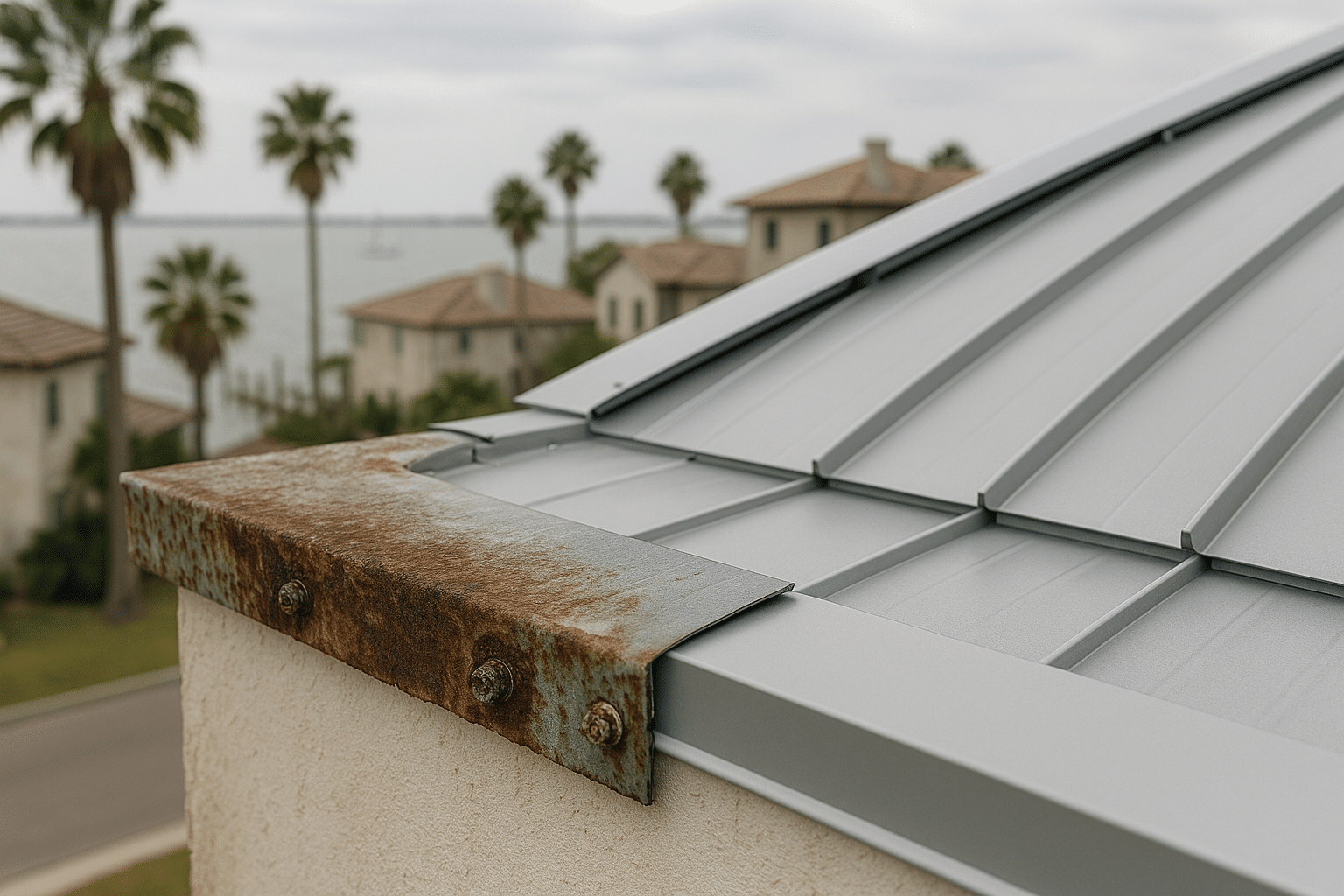
A second, often overlooked problem shows up whenever two different metals touch on a roof — say, a steel screw driven into an aluminum flashing.
When dissimilar metals are connected by an electrolyte, such as water, the metal in the highest energy state — the less noble metal — will corrode.
Mixing materials is a common and costly mistake near the coast.
Put two different metals together in a damp, salty setting, and one corrodes fast — a common mistake is pairing steel fasteners with bare aluminum flashing or copper components without isolation, and near the bay, where salt acts as an electrolyte, this reaction accelerates coastal roof corrosion far faster than on inland properties.
The fix is straightforward:
separating metals with a non-conductive gasket, or matching them, removes the problem.
Where Corrosion Starts
Corrosion rarely begins on a wide-open panel. It starts small.
Corrosion usually begins when the roof’s protective coating becomes damaged or naturally wears away over time — small scratches, impact damage, aging paint, or deteriorated sealants expose bare metal to moisture and airborne salt, and once this protective barrier is compromised, oxidation begins more easily.
Which Roofing Materials Hold Up Best Near the Gulf?
Standing Seam Metal (With the Right Coating and Fasteners)
Metal is a popular choice along the Texas coast, but not every metal system is built equal in salt air. Compatible materials matter:
in salt-air environments, warm rain and salt air keep joints damp, and galvalume, galvanized steel, and aluminum all perform well in the right system, but they are not interchangeable.
A properly detailed standing seam system — matched metals, isolated fasteners, factory-applied coatings — is built to shrug off decades of Gulf exposure. We break down costs and performance in our guide to standing seam metal roofing in Texas.
Asphalt Shingles Rated for High Wind
Shingles remain common across Corpus Christi, Alice, and Aransas Pass neighborhoods, but coastal exposure calls for a higher-rated product and stricter installation.
TDI guidance recommends shingles tested to ASTM D3161 Class F or ASTM D7158 Class H for coastal exposure, paired with the manufacturer’s specific high-wind installation instructions.
Fastener quality matters just as much as the shingle itself, since
fastening requirements track IRC high-wind provisions: 6 nails per shingle, 12-gauge minimum, full-round-head, hot-dipped galvanized or stainless.
TPO and Flat Roofing Systems
For low-slope commercial buildings and additions, TPO (thermoplastic polyolefin, a single-ply membrane roofing material) resists moisture intrusion well and doesn’t carry the same galvanic corrosion risk as exposed metal fasteners, provided seams and penetrations are properly sealed and maintained.
Clay, Spanish, and Concrete Tile
Tile roofing doesn’t corrode in the traditional sense since it isn’t metal, which makes it a strong long-term option in salt air. The tradeoffs are weight, installation cost, and the need for corrosion-resistant fasteners and flashing underneath the tile itself — the same flashing and fastener rules that apply to any coastal roof still apply here.
TDI Windstorm Certification (WPI-8) and Why It Matters Here
If your property sits in one of the Texas coastal counties — which includes the areas around Corpus Christi, Aransas Pass, and the broader Coastal Bend — your roof isn’t just fighting salt air. It also has to meet state windstorm construction standards.
The Texas Department of Insurance (TDI) windstorm certification program applies to properties in the 14 first-tier coastal counties and designated portions of Harris County, and this program imposes construction standards that exceed the base building code for wind resistance, underlayment, fastening, and inspection requirements.
This isn’t optional paperwork.
Failure to comply means you cannot obtain Texas Windstorm Insurance Association (TWIA) coverage, which is the only windstorm insurance available in these coastal areas.
The certificate itself has a name:
the certification document is called the WPI-8 (Windstorm/Hail Insurance Certificate of Compliance), a form issued by a TDI-licensed engineer or TDI-appointed inspector after verifying that the roofing installation meets TWIA building code standards.
For existing roofs completed without an in-progress inspection,
a WPI-8-E is issued for completed construction, and these inspections can be done by a Texas licensed professional engineer.
Not every repair triggers this process.
Most new construction, roof replacements, major repairs, and other alterations require an inspection and certificate of compliance, though roof repairs of less than 100 square feet that don’t involve decking, along with painting and other non-structural items, are typically exempt.
Because the materials used also have to be pre-approved,
for a WPI-8, products must be on the TDI-approved list
— another reason it pays to work with a contractor who already knows which materials and fastening patterns qualify.
Practical Steps to Slow Salt Air Corrosion
- Match your metals. Keep fasteners, flashing, and panels in the same metal family to avoid galvanic reactions.
- Choose coated or stainless fasteners. Standard electro-galvanized screws wear through fast in salt air; stainless or well-coated fasteners last longer.
- Inspect flashing and drip edges yearly. These small metal components take the brunt of salt exposure and fail before the main roofing material does.
- Repair coating damage quickly. A scratch or dent that exposes bare metal is where corrosion gets its foothold.
- Schedule a professional roof inspection after storm season. Wind-driven salt spray during tropical storms accelerates wear on fasteners and seams that aren’t visible from the ground.
Roof Rejuvenation vs. Replacement
Not every corroding roof needs full replacement. Roof rejuvenation treatments can restore flexibility and add a protective layer to aging materials, extending service life for roofs that haven’t yet suffered structural fastener failure or widespread rust-through. A contractor who inspects the decking, flashing, and fastener condition — not just the surface — can tell you honestly whether rejuvenation, targeted repair, or replacement makes sense for your home.
Why This Matters for Victoria, Aransas Pass, and Beeville Homeowners Too
Salt-laden air travels well beyond the waterfront. Homeowners further from the immediate coastline — including in Victoria — still deal with wind-driven storms and humidity that stress roofing materials differently than inland Texas. If you’re dealing with recent storm exposure, our guide on roof repair in Victoria during storm season covers what to watch for after high winds move through.
Getting a Professional Opinion
Because corrosion often starts in places you can’t see from the ground — valleys, flashing, fastener heads — a trained eye matters more on coastal roofs than almost anywhere else in Texas. Buffalo Roofing & Exteriors offers free estimates for homeowners across Corpus Christi, Alice, Aransas Pass, Banquete, and Beeville, and our crews are experienced with TDI-compliant WPI-8 installations. If budget is a concern, Improvifi financing is available from $1,000 to $50,000 with $0 down and no credit score impact, so corrosion damage doesn’t have to wait.
Whether you’re dealing with early-stage rust on a metal roof or want a second opinion on worn flat roofing, aging shingles, or corroded flashing, getting ahead of salt air damage is almost always cheaper than waiting for a leak.
Recommended Reads
- Roof Repair in Victoria, TX: Handling Storm Season and Coastal Weather
- Standing Seam Metal Roofs: Benefits, Costs, and Why They Perform Well in Texas
- Flat Roof Repair in Corpus Christi, TX