

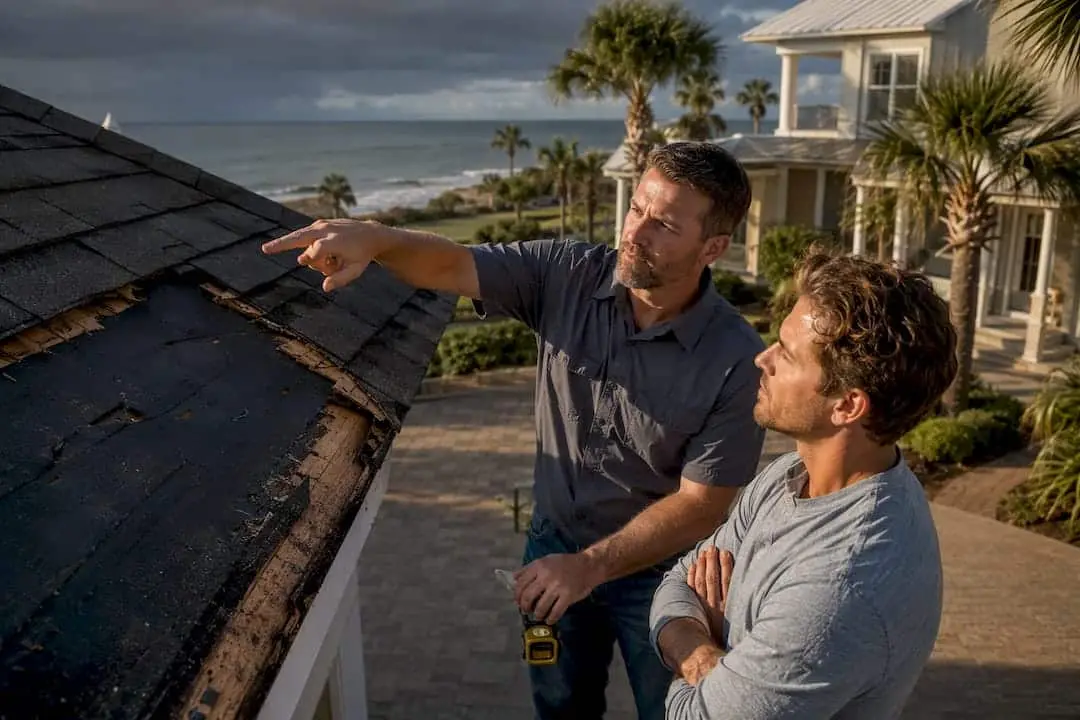
Replacement cost value (RCV) pays to replace your roof at today’s prices; actual cash value (ACV) pays that same replacement cost minus depreciation for age and wear. For most homeowners with a mortgage or a roof under 15 years old, RCV is the coverage that keeps a storm from turning into a five figure bill. ACV can make sense on an older, paid off home, but you need to know which one you actually have before disaster strikes.
TL;DR:
- Roofs under 15 years old are most likely covered at replacement cost value, providing a full payout that can exceed $8,000 compared to ACV on older roofs.
- Insurers withhold recoverable depreciation to prevent homeowners from cashing the full replacement check without completing repairs, requiring invoice submission to release funds.
- Confirm your coverage by reviewing your declarations and endorsements annually, especially after renewal, to ensure you know if your policy pays at ACV or RCV.
- Choosing RCV is advisable for homeowners with a mortgage or living in storm-prone areas, especially if the roof is less than 15 years old; ACV makes sense mainly for paid-off homes with older roofs.
- Immediate documentation, including photos and contractor bids, is critical within 72 hours of damage to maximize chances of full RCV payout and avoid disputes.
Table of Contents
- ACV vs RCV Roof Coverage: The Numbers That Matter
- How Insurers Calculate ACV and RCV Payouts
- How to Check If Your Roof Is Covered by ACV or RCV
- When RCV Makes Sense and When ACV Is Reasonable
- What to Do After Roof Damage to Protect Your RCV Payout
- Why We Usually Recommend RCV to Texas Homeowners
- Get a Free Roof Inspection Before You Need to File a Claim
- Sources
ACV vs RCV Roof Coverage: The Numbers That Matter
The two settlement types produce wildly different checks for the exact same damage.
ACV pays the depreciated value of your roof. The insurer takes the replacement cost and subtracts whatever your roof has lost to age, so a payout can arrive as a single check that falls far short of what a new roof actually costs.
RCV pays the full replacement cost, but it usually arrives in two stages: an initial ACV check when the claim is approved, followed by the recoverable depreciation once you finish repairs and submit proof. Some policies covering the dwelling still settle roof damage specifically at ACV through an endorsement, which is why reading your paperwork matters more than assuming your whole policy works one way.
On a 15-year-old roof, industry claim data puts the typical payout gap between ACV and RCV settlement at $8,000 to $22,000 on a total loss, while the premium difference between the two coverage types usually runs $30 to $80 a month.
That gap is the whole argument for RCV in a nutshell. You are paying a small, predictable amount every month to avoid a large, unpredictable one after a hailstorm.
How Insurers Calculate ACV and RCV Payouts
Depreciation is not a guess.
That depreciated amount does not vanish under an RCV policy. It becomes recoverable depreciation, a holdback the insurer releases once you’ve actually completed the repair and can prove it. Carriers withhold this money on purpose. It exists to stop homeowners from pocketing a full replacement check and never replacing anything, and you generally have to submit invoices or a signed contractor payment record to unlock it.
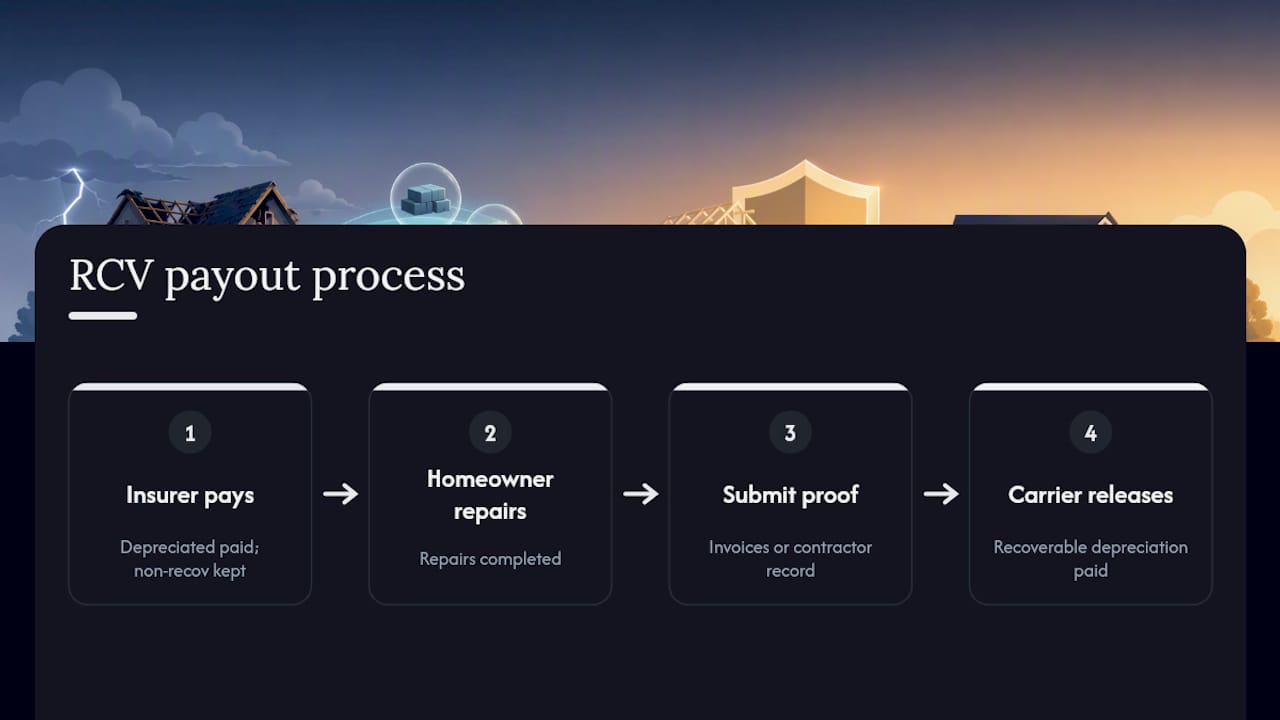
Your adjuster’s estimate should spell out both the recoverable and non-recoverable depreciation lines separately, usually near the bottom of the Xactimate or similar line-item report. Non-recoverable depreciation is money you never get back regardless of what you do, often tied to items excluded from the RCV endorsement entirely. If your estimate lumps everything into one number with no breakdown, that is your cue to call the adjuster and ask for the itemized version before you sign anything.
How to Check If Your Roof Is Covered by ACV or RCV
You do not have to guess, and you should not wait for a claim to find out. Confirm your settlement type with this quick process:
- Pull your declarations page and look for a line labeled “loss settlement” or “valuation.” It will name either replacement cost or actual cash value for the dwelling.
- Read every endorsement attached to the policy, especially anything titled “Roof Payment Schedule” or “Actual Cash Value Loss Settlement Endorsement.” These riders can quietly settle roof claims at ACV even when the rest of the dwelling is covered at RCV.
- Call your insurer or agent for written confirmation if the declarations page and endorsements still leave you unsure, and keep that email or letter on file.
- Check your mortgage servicer’s requirements, since most lenders require RCV coverage on the dwelling as a condition of the loan.
Pro Tip: Insurers sometimes attach ACV roof endorsements at renewal, not at the original policy date. Read your renewal packet every single year, not just the year you signed up.
When RCV Makes Sense and When ACV Is Reasonable
Roof age and mortgage status drive this decision more than anything else.
RCV is the stronger choice when:
- Your roof is under roughly 12 to 15 years old, since the payout gap on a total loss usually dwarfs the premium savings from choosing ACV instead.
- You carry a mortgage. Most lenders require RCV, and dropping below that requirement can trigger force-placed insurance, a lender-arranged policy that costs more and covers less than what you’d choose yourself.
- You live along the Gulf Coast, in hail alley, or anywhere storms hit roofs on a near-annual basis.
ACV can be a reasonable trade-off when:
- Your home is paid off and you’re self-insuring the difference by choice, not by accident.
- Your roof already exceeds 15 to 20 years and a full RCV endorsement is either unavailable or priced close to what a new roof would cost anyway.
- You live somewhere with genuinely low storm frequency and you’ve run the premium math yourself.
What to Do After Roof Damage to Protect Your RCV Payout
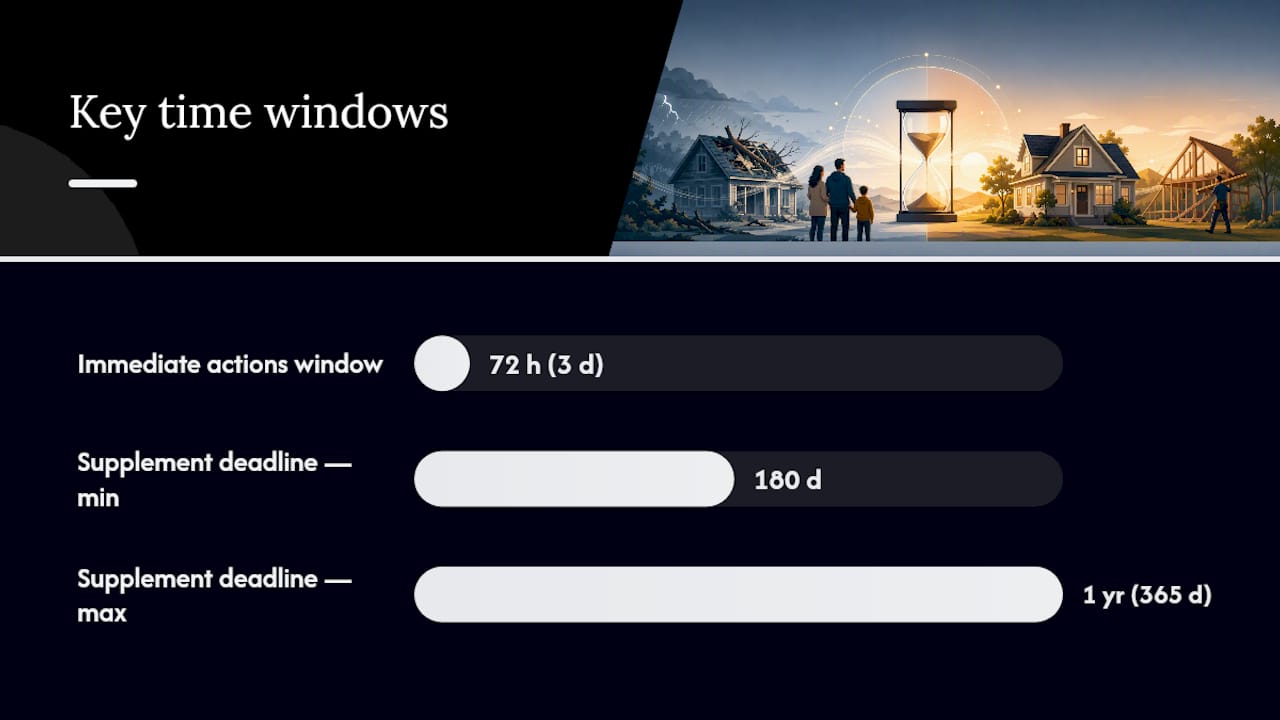
The steps you take in the first 72 hours after a storm often decide whether you collect full replacement cost or settle for a fraction of it.
- Photograph everything immediately, including wide shots of the roof, close-ups of damage, and anything showing the date and weather conditions, before any cleanup begins.
- Get a written scope and bid from a licensed contractor. This document becomes your leverage if the insurer’s estimate undervalues the repair.
- Complete the repair and submit your invoice and proof of payment to trigger the recoverable depreciation release under an RCV policy.
- File a supplement if material or labor costs rise between the initial estimate and the actual repair. Carriers generally allow this, but most set a deadline, often 180 days to a year after the initial payment, to submit for recoverable depreciation.
Pro Tip: Keep a dedicated folder, digital or paper, with every photo, invoice, and email tied to the claim. Adjusters move faster on files that are already organized, and disputes get resolved faster when your paper trail is airtight.
Homeowners weighing a full roof replacement against insurance timelines should also understand how material and labor cost trends affect what “replacement cost” actually means by the time repairs happen.
Why We Usually Recommend RCV to Texas Homeowners
We’ve walked enough Corpus Christi and San Antonio roofs after hailstorms to know where the ACV gap actually bites. It’s rarely the total loss cases that surprise homeowners. Our estimators write scopes detailed enough for adjusters to approve fully, and we help clients document storm damage properly before that gap becomes a fight. If you’re unsure what your policy actually pays, get your roof inspected before you need to file anything.
— Results
Get a Free Roof Inspection Before You Need to File a Claim
Buffaloroofingandexteriors gives South Texas homeowners something most claim disputes lack from the start: a written, adjuster-ready scope before the insurance conversation even begins. That matters because the gap between ACV and RCV settlements often comes down to documentation quality, not just policy wording, and a vague estimate leaves money on the table.

Our estimators inspect the roof, photograph existing damage, and build a scope that lines up with what adjusters expect to see, whether you’re filing a fresh claim or trying to confirm what your current policy actually pays. We also help homeowners track deadlines for recoverable depreciation and coordinate financing when repairs need to move faster than a claim settles. If a storm has already hit your roof, start with our storm damage restoration services for a full assessment and a documented scope you can hand straight to your adjuster. If nothing has happened yet and you just want to know where you stand, request a free estimate and we’ll walk the roof with you.
Sources
- Actual Cash Value vs. Replacement Cost Value | North Carolina Department of Insurance
- How Do I Know If I Have RCV or ACV Coverage? (LegalClarity)
- ACV vs RCV Roof Coverage: Which Is Better in 2026? (RoofingClaimGuide)
This article is general information, not a substitute for advice from a qualified financial advisor. Consult a qualified financial professional about your own circumstances before acting on anything here.