

TL;DR:
- For reliable home services, verified trade-specific platforms like TradeSpark, Tekton, and Sublynk outperform general directories by surfacing credentials upfront. Buffalo Roofing & Exteriors offers direct, local roofing services in South Texas without lead fees or middlemen. Homeowners should verify licenses and insurance before hiring through trusted resources like state databases or verified platforms.
The fastest way to replace CityOf.com depends on what you actually need: broad local visibility, high-volume contractor leads, or verified tradespeople with credentials you can check before calling. For South Texas homeowners with roofing or exterior work, Buffalo Roofing & Exteriors is the direct local option. For everyone else, here is the shortlist by approach:
- Google Business Profile — Best free starting point for local discovery; no verification of trade credentials.
- Yelp — Strong consumer review volume; advertising costs add up quickly for contractors.
- Better Business Bureau (BBB) — Accreditation and complaint history; slow to update, but trusted for formal vetting.
- Angi / HomeAdvisor network — High lead volume; per-lead fees and competitive bidding can erode margins.
- Thumbtack — Project-matching with credit-based bidding; lead quality varies by market.
- HomeAdvisor — Established home-services marketplace; often bundled with Angi.
- Houzz — Portfolio-driven; best for renovation projects where photos sell the work.
- Nextdoor — Hyperlocal neighbor referrals; limited reach outside the immediate neighborhood.
- Porch — Integrated project planning with retailer partnerships; useful for scoped remodels.
- TradeSpark — Scoped-job workflow with flat $50/month pro pricing; reduces ghosting.
- BuildCliq — CRM plus marketplace for contractors; best if you need project management alongside leads.
- Sublynk — Open directory, no lead fees, direct contact; good for contractors tired of auction-style marketplaces.
- Tekton — Zip-code search with visible license numbers and insurance certificates; strong for homeowners who vet before calling.
- TradeHire — Mobile-first local trades directory with radius search and verified badges.
Table of Contents
- How do these CityOf.com alternatives compare at a glance?
- What types of CityOf.com alternatives exist, and which fits your situation?
- Short profiles: what each platform actually delivers
- How do you choose the right directory or platform for your project?
- What do users and contractors actually say about these platforms?
- Why trade-specific platforms are different from standard directories
- Key Takeaways
- The directory gap most homeowners never notice
- Buffalo Roofing & Exteriors serves South Texas directly, no lead fees involved
- Where to verify credentials and learn more
How do these CityOf.com alternatives compare at a glance?
The table below maps each platform across the dimensions that actually affect your decision: what it costs, whether it checks credentials, how you reach a pro, and who it suits best.
| Platform | Best For | Pricing Model | Verification / Credentials | Lead Model | Coverage | Review Reliability | Contact Method |
|---|---|---|---|---|---|---|---|
| Buffalo Roofing & Exteriors | South Texas homeowners needing direct roofing/exterior work | Free estimates; direct contract | Licensed, insured local contractor | Direct hire | South Texas (Corpus Christi, San Antonio, Victoria) | Direct client references | Direct call/quote |
| Google Business Profile | Broad local search visibility | Free listing | None (self-reported) | Open directory | National | Moderated by Google | Direct via listing |
| Yelp | Consumer review discovery | Free + paid ads | None (self-reported) | Open directory | National | Moderated; some fake-review risk | Direct via listing |
| BBB | Formal accreditation checks | Free search; paid accreditation | Accreditation + complaint history | Open directory | National | Formal dispute records | Direct via listing |
| Angi / HomeAdvisor | High-volume contractor leads | Per-lead / subscription | Background checks on some pros | Marketplace auction | National | Moderated | Mediated via platform |
| Thumbtack | Multiple quotes on a project | Credits / bidding | Varies by category | Marketplace bidding | National | Moderated | Mediated via platform |
| HomeAdvisor | Volume homeowner-contractor matching | Per-lead fees | Background checks on some pros | Marketplace auction | National | Moderated | Mediated via platform |
| Houzz | Portfolio-driven renovation discovery | Free + paid ads | None (self-reported) | Open directory | National | Moderated | Direct via listing |
| Nextdoor | Hyperlocal neighbor referrals | Free | None | Social/referral | Neighborhood-level | Community-sourced | Direct via post |
| Porch | Integrated project planning | Per-lead / subscription | Varies | Marketplace | National | Moderated | Mediated |
| TradeSpark | Scoped projects, flat-fee pros | Free for owners; $50/month for pros | Vetted pros, scoped job workflow | Scoped-project match | National (growing) | Moderated | Direct after scope |
| BuildCliq | Contractors needing CRM + marketplace | Subscription (tiered) | Verified pro directory | Marketplace + CRM | National | Moderated | Direct via platform |
| Sublynk | No-fee direct contractor contact | Free listing | Independently vetted | Open directory | National | Moderated | Direct contact |
| Tekton | Verified local tradespeople by zip | Free search | License numbers + insurance shown | Open directory | National | Real project photos | Direct via profile |
| TradeHire | Mobile-first local trades search | Not publicly listed | Verified badges | Open directory | Local/regional | Moderated | Direct via app |
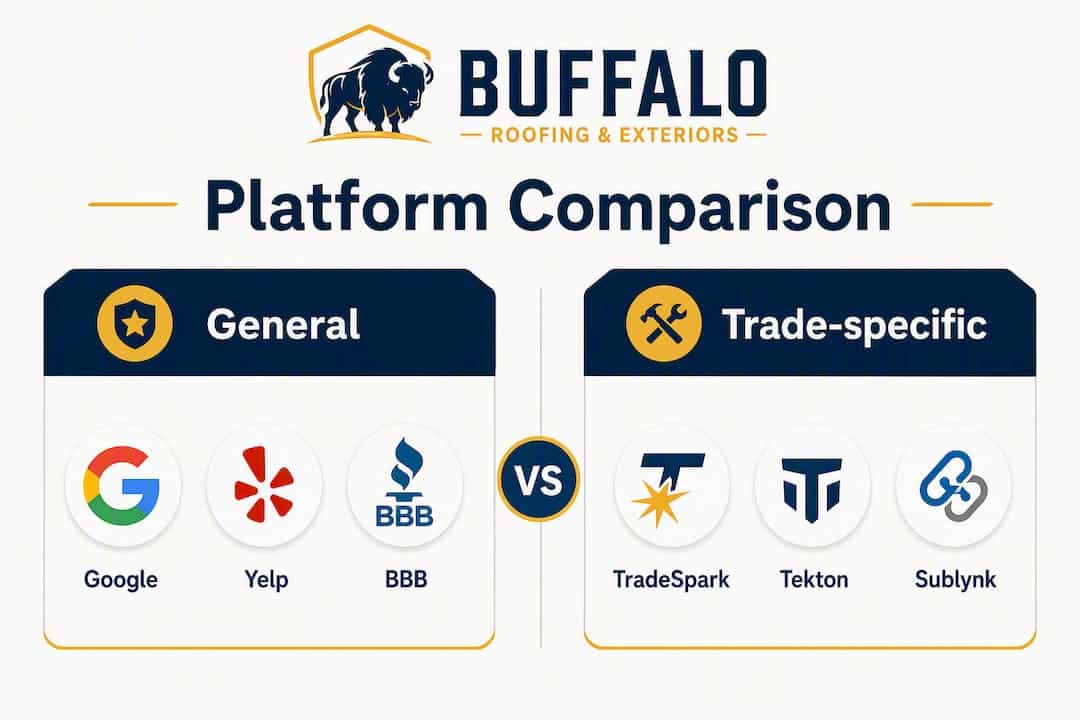
Key verification signals to look for: BBB accreditation badge, state license number on profile, insurance certificate upload, background-check badge (Angi/HomeAdvisor), and real project photos (Tekton, Houzz, BuildCliq).
What types of CityOf.com alternatives exist, and which fits your situation?
There are four practical categories. Picking the right one first saves you time and money.
General local directories (Google Business Profile, Yelp, BBB, CityOf.com itself) list businesses with contact info and user reviews. They are free or low-cost to join, reach the widest audience, and work well for simple discovery tasks. The tradeoff: almost no credential verification. A contractor can list without proving a license or insurance. For a quick restaurant search, that is fine. For a roofing job after a storm, it is a real gap.
National home-service marketplaces (Angi, HomeAdvisor, Thumbtack, Porch) generate high lead volume by auctioning project requests to multiple contractors. Homeowners get several quotes fast. Contractors pay per lead or per match, which creates competitive bidding dynamics that often favor speed over quality. Ghosting is common on both sides because the same lead goes to several pros simultaneously.
Neighborhood and community networks (Nextdoor) rely on neighbor recommendations rather than formal listings. Reach is hyperlocal and trust is high within a block or two, but coverage drops off sharply outside that radius. Useful for finding a handyman; less reliable for a major roof replacement where you need documented credentials.
Trade-specific credentialed platforms (TradeSpark, Sublynk, Tekton, BuildCliq, TradeHire) are the newest category and the most relevant for home-services work. They surface license numbers, insurance certificates, and real project photos before you contact anyone. Some, like TradeSpark, require homeowners to scope the job first, which cuts down on vague quote requests and the ghosting that follows.
For a roofing emergency, a trade-specific platform or a direct call to a vetted local contractor beats a general directory every time. For simple business discovery, Google Business Profile remains the fastest option.
Short profiles: what each platform actually delivers
Buffalo Roofing & Exteriors is a direct-hire roofing and exterior contractor serving Corpus Christi, San Antonio, and Victoria, Texas. No lead fees, no middleman. You call, get a free estimate, and work directly with the crew. Specializes in storm damage restoration, new roof installation, siding, windows, and decks. The right call for South Texas homeowners who want one contractor, one contract, and someone who knows coastal weather.

Google Business Profile is free and surfaces your business in Google Search and Maps. No credential checks, but the visibility is unmatched. Every contractor should have one regardless of which other platforms they use.
Yelp drives consumer discovery through review volume. Advertising placements can boost visibility, but the cost scales quickly and review moderation has a mixed reputation among contractors. Better for restaurants and retail than for trade work.
Better Business Bureau (BBB) is the go-to for formal accreditation and complaint history. Searching a contractor on BBB before hiring takes two minutes and can surface unresolved disputes that no other platform shows. Accreditation costs businesses a fee, so absence from BBB does not automatically mean a red flag.
Angi / HomeAdvisor network dominates home-services lead volume in the U.S. Homeowners get multiple quotes quickly; contractors pay per lead or a subscription. The platform does run background checks on some pros, which is a step above general directories. Lead quality complaints are common in contractor forums, largely because the same lead goes to several pros at once.
Thumbtack uses a credit-based bidding system. Pros pay to send quotes; homeowners post projects and receive bids. Pricing transparency has improved, but costs per lead vary widely by trade and market.
HomeAdvisor operates largely within the Angi network now. Its strength is an established homeowner base and a recognizable brand. The per-lead model is the same as Angi, with similar tradeoffs.
Houzz stands apart because it is portfolio-first. Contractors upload project photos, and homeowners browse by style and scope before reaching out. For kitchen remodels or high-end exterior renovations, this visual discovery model works well. For emergency repairs, it is the wrong tool.
Nextdoor is genuinely useful for hyperlocal referrals. A neighbor’s recommendation carries real weight. The limitation is scale: a contractor with strong Nextdoor presence in one neighborhood may be invisible two miles away.
Porch integrates with retailers like Lowe’s and Home Depot, connecting homeowners to pros during the project-planning phase. The retailer partnership model is a differentiator, though lead fees apply for contractors.
TradeSpark requires homeowners to scope projects before matching with a vetted pro. Pros pay a flat $50/month rather than per-lead fees, which changes the economics significantly. The scoped-job workflow reduces ghosting because both sides know what the job entails before contact.
BuildCliq bundles a verified pro directory with CRM tools, invoicing, a booking calendar, and a project marketplace. Contractors who need client management alongside lead generation will find this more useful than a plain directory. Homeowners can post projects and receive quotes from verified pros.
Sublynk takes the open-directory approach: independently vetted contractors, no lead fees, and direct contact between homeowner and pro. Contractors who have burned money on per-lead marketplaces often migrate here. The vetting process filters out unverified operators, which benefits both sides.
Tekton organizes verified tradespeople by zip code and displays license numbers, expiry dates, and insurance certificates directly on each profile. Real project photos accompany every listing. For a homeowner who wants to verify credentials before making a single phone call, Tekton removes most of the guesswork. You can check contractor credentials against what Tekton surfaces before you ever pick up the phone.
TradeHire is built for mobile, with local radius search and verified badges for trades and suppliers. The supplier marketplace is a useful add-on for contractors sourcing materials alongside labor. Pricing is not publicly listed.
How do you choose the right directory or platform for your project?
Start with the job type, not the platform. A scoped, high-value project (roof replacement, full siding job) demands verified credentials. A quick handyman task can tolerate a general directory.
Decision checklist:
- Does the job require a licensed, insured contractor? If yes, use a platform that surfaces license numbers and insurance certificates (Tekton, Sublynk, TradeSpark) or verify independently via your state’s contractor license lookup.
- How much are you willing to pay for leads or listings? Free directories (Google Business Profile, Sublynk) cost nothing. Marketplaces (Angi, Thumbtack) charge per lead or subscription. Trade platforms (TradeSpark) charge pros a flat monthly fee.
- Do you prefer direct contact or mediated matching? Open directories let you call the contractor directly. Marketplaces route contact through the platform, which adds a layer of friction.
- Does the project need portfolio evidence? For renovation work where aesthetics matter, Houzz and BuildCliq’s photo-forward profiles are worth the extra step.
- Do you need CRM or scheduling tools alongside the directory? BuildCliq is the only option in this list that bundles project management with marketplace exposure.
Questions to ask before paying or contacting any platform:
- Who owns the lead? On marketplace platforms, the same lead often goes to three to five contractors simultaneously.
- What is the refund or credit policy if a lead is invalid or the homeowner is unresponsive?
- Does the platform verify licenses and insurance, or does it rely on self-reported information?
- Are reviews moderated, and can businesses flag fake reviews?
Red flags: high upfront fees with no credential verification, anonymous reviews with no moderation policy, no clear way to contact a contractor directly, and platforms that cannot tell you who owns the lead data.
Pro Tip: Before posting a project on any marketplace, read the platform’s lead-ownership terms. On some platforms, your contact information is sold to multiple contractors the moment you submit a request, which means you may receive calls from pros you never selected.
Pro Tip: Contractors: on any platform that charges per lead, track your cost per booked job, not just cost per lead. A $30 lead that converts at 5% costs $600 per job. A $50/month flat-fee platform that converts at 20% costs $250 per job.
What do users and contractors actually say about these platforms?
Community feedback across contractor forums and homeowner threads follows a consistent pattern. Marketplaces generate volume but frustrate both sides with lead quality and ghosting. Trade-specific platforms earn stronger loyalty from experienced contractors.
By category:
- Marketplace platforms (Angi, HomeAdvisor, Thumbtack): Homeowners report getting fast quotes but struggling to get responses after initial contact. Contractors report paying for leads where the homeowner was just price-shopping or never intended to hire. The shared-lead model is the core complaint on both sides.
- Open directories (Google Business Profile, Yelp, Sublynk): Homeowners value the direct contact and review transparency. Contractors appreciate the lower cost but note that standing out in a crowded listing requires active profile management and a strong review base.
- Trade-specific platforms (TradeSpark, Tekton, Sublynk, TradeHire): Feedback skews positive among contractors who have tried multiple platforms. The common theme is that scoped projects and visible credentials filter out low-intent requests.
Experienced contractors consistently prefer platforms that require rigorous credential verification, because it filters out unverified competitors and protects their reputation in local markets. That preference shows up in how quickly trade-specific platforms have grown their contractor bases relative to their age.
On the homeowner side, the most common complaint about general directories is fake or incentivized reviews. Platforms with moderated review systems and verified purchase requirements (where a homeowner must have booked through the platform to leave a review) produce more reliable signals.
Why trade-specific platforms are different from standard directories
The core problem with traditional directories, as TradeSpark’s founders describe it, is information asymmetry: homeowners cannot tell a licensed, insured pro from an unverified one until after they have already invested time in calls and quotes. Trade-specific platforms fix this by surfacing credentials before contact.
Here is how that works in practice across the five trade platforms in this article:
- TradeSpark — requires homeowners to define the job scope, timeline, and materials before the platform matches them with a vetted pro. Pros pay a flat $50/month, so they are not competing in a per-lead auction. The result is that both sides arrive at first contact with shared context, which shortens the estimate process.
- BuildCliq — adds CRM, invoicing, and a booking calendar on top of a verified pro directory. For contractors managing multiple active projects, the all-in-one model reduces the administrative overhead that comes with juggling a separate directory listing and a separate project management tool.
A typical homeowner workflow on a trade platform: scope the job (materials, timeline, acceptance criteria) → browse verified pros by zip code or radius → review credentials and project photos → contact directly or receive a matched quote → hire. That sequence, compared with submitting a blind request on a marketplace and waiting for five contractors to call simultaneously, produces cleaner bids and fewer no-shows.
Pro Tip: When posting a job on any trade platform, include three things: the specific material or system involved (e.g., “30-year architectural shingles on a 2,400 sq ft hip roof”), the timeline (“need work completed within 30 days”), and your preferred contact method. Scoped posts attract contractors who can actually do the job, not just anyone looking for a lead.
For homeowners planning a larger exterior project, reviewing a homeowner’s exterior renovation guide before posting on any platform will help you write a tighter scope and get more accurate bids.
Key Takeaways
Verified, scoped-job platforms reduce ghosting and improve quote accuracy more than any other single factor when choosing among CityOf.com alternatives for home-services work.
| Point | Details |
|---|---|
| Start with job type | High-value trade work needs credential verification; simple discovery tasks suit free general directories. |
| Marketplace tradeoffs | Per-lead platforms (Angi, Thumbtack) generate volume but shared leads drive ghosting and competitive bidding. |
| Trade platforms reduce friction | TradeSpark’s flat $50/month pro pricing and scoped-job model, Tekton’s visible license data, and Sublynk’s no-fee direct contact all cut information asymmetry. |
| Verify before you contact | Check license numbers and insurance certificates on Tekton or your state’s contractor license database before calling any pro. |
| Buffalo Roofing & Exteriors | For South Texas roofing and exterior work, direct engagement with Buffaloroofingandexteriors skips the directory entirely and connects you with a licensed local contractor. |
The directory gap most homeowners never notice
Most people searching for CityOf.com alternatives are really asking a different question: “How do I find a contractor I can actually trust?” The directory is just the mechanism.
The honest answer is that no directory, marketplace, or platform substitutes for verifying credentials yourself. Google Business Profile will not tell you if a roofer’s license expired last year. Yelp will not confirm their insurance. Even the best trade platforms are only as reliable as their vetting processes, and those processes vary.
What trade-specific platforms like TradeSpark, Tekton, and Sublynk get right is that they make verification the default rather than the exception. That is a structural improvement over general directories, not just a feature difference. When a platform requires a contractor to upload a license certificate and insurance document before their profile goes live, the barrier to entry filters out a meaningful share of unqualified operators.
For roofing and exterior work specifically, the stakes are high enough that the extra step of checking a license number against your state’s public database is worth two minutes of your time. Knowing how to identify a licensed roofer in Texas before you call anyone is the single most protective thing a homeowner can do.
My practical recommendation: use a trade-specific platform or a direct local contractor for any job that involves your roof, exterior envelope, or structural elements. Use general directories for discovery and reputation checks, not as your primary vetting tool.
Buffalo Roofing & Exteriors serves South Texas directly, no lead fees involved
Every platform in this article is a way to find a contractor. Buffaloroofingandexteriors is the contractor.
For homeowners in Corpus Christi, San Antonio, and Victoria, that distinction matters. There are no per-lead fees, no shared bids going to four other crews, and no platform middleman between you and the people doing the work. Buffaloroofingandexteriors specializes in roofing, siding, windows, decks, and storm damage restoration across South Texas, with direct estimates, financing options, and warranties on completed work.

If your roof or exterior took storm damage, the fastest path to a reliable assessment is a direct call, not a marketplace submission. Get a free estimate from Buffalo Roofing and Exteriors and skip the lead-auction entirely.
Where to verify credentials and learn more
- CityOf.com — The original local business directory for context and comparison.
- TradeSpark — Scoped-project platform with flat-fee pro pricing and vetted contractor matching.
- BuildCliq — CRM and marketplace for contractors with verified pro directory.
- BBB contractor search — Formal accreditation status and complaint history for any listed business.
- How to identify a licensed roofer in Texas — Practical guidance on license verification and red flags.
- Qualities of reliable roofing contractors — What to look for when evaluating any contractor profile or directory listing.
- Storm damage restoration guide — Step-by-step recovery guidance for South Texas homeowners after weather events.