
TL;DR:
- A roofing system is a complete assembly, including surface material, underlayment, insulation, flashings, ventilation, and drainage, all working together to prevent failure. The best roofing system depends on climate, roof slope, lifespan, and maintenance tolerance, with specific materials suited for different conditions and building types. Proper system design, installation, and maintenance are essential for longevity, especially in storm-prone coastal Texas.
A roofing system is not just the shingles or membrane you see from the street. It is the complete assembly: surface material, underlayment, insulation, flashings, ventilation, and drainage working together. Get any one of those layers wrong and even a premium surface material will fail early. The National Roofing Contractors Association (NRCA) and the International Building Code (IBC) both treat the full assembly as the object of review, not just the top layer.
The major system families break into two groups by roof form:
- Pitched/steep-slope (3:12 pitch or steeper): asphalt shingles, standing-seam metal, clay or concrete tile, natural slate, wood or synthetic shakes
- Low-slope/flat (under 3:12): TPO, PVC, EPDM, built-up roofing (BUR), modified bitumen, liquid-applied coatings
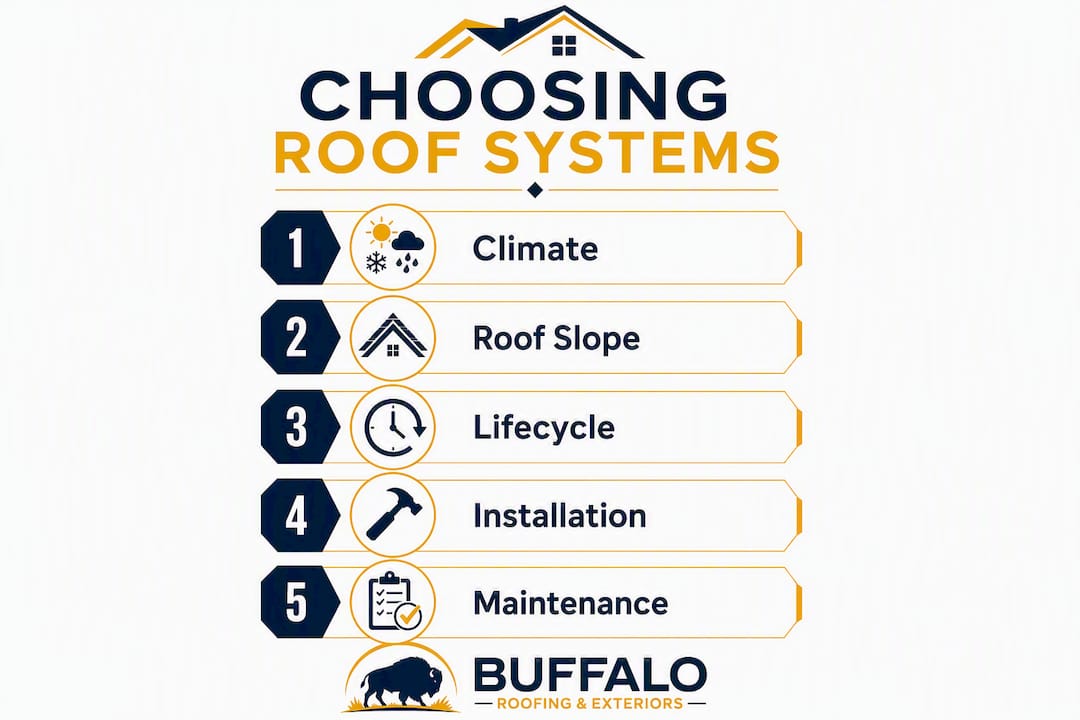
Pick your system by running three filters in order: (1) climate and exposure, (2) roof slope and geometry, (3) lifecycle cost and maintenance tolerance. That sequence eliminates most wrong choices before you ever talk price. Buffaloroofingandexteriors applies exactly this framework to every residential and commercial project it handles across South Texas.
Table of Contents
- What are the main roof system categories?
- What does a complete roofing system actually include?
- How do you pick the right roofing system for your property?
- What do roof systems typically cost, and how long do they last?
- How installation quality, permits, and warranties affect your outcome
- What does a realistic roof maintenance schedule look like?
- Why South Texas and coastal properties need a different approach
- Key Takeaways
- The real mistake most property owners make
- Buffaloroofingandexteriors serves South Texas with the full system, not just the surface
- Authoritative sources for deeper reading
What are the main roof system categories?
Understanding the practical differences between system families lets you rule options in or out before a contractor ever shows up. Here is how each one works, what it costs you over time, and where it belongs.
Asphalt shingles
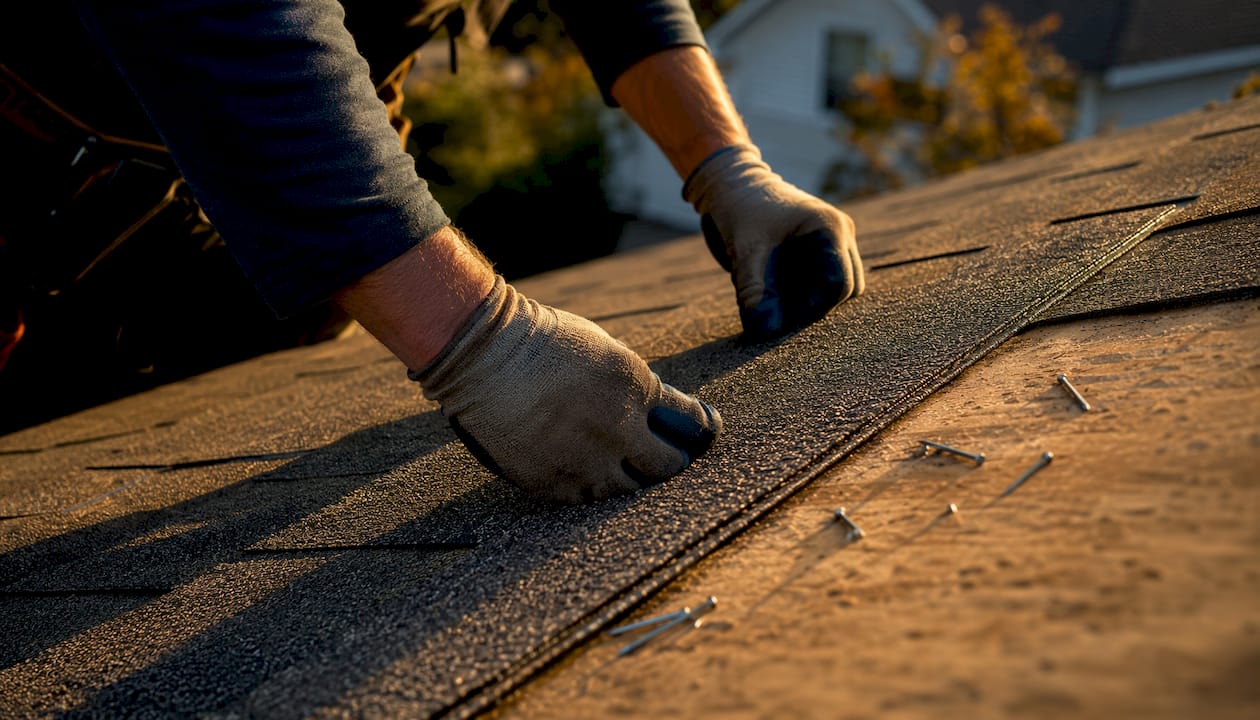
Asphalt shingles are the dominant residential surface in the U.S. for one straightforward reason: broad availability and a manageable upfront cost. Three-tab shingles carry an estimated 20-year life expectancy; architectural (dimensional) shingles run about 30 years, per InterNACHI’s Standard Estimated Life Expectancy Chart. Architectural shingles resist winds up to 110–130 mph and cost roughly $4.50–$7.50 per square foot installed, making them the standard recommendation for most new construction and full replacements.
The real vulnerability is heat. In Texas and other Sun Belt climates, asphalt shingles lose 20–30% of expected lifespan compared to moderate climates. Poor attic ventilation compounds that by baking shingles from below. Class 4 impact-resistant shingles, which use modified polymers to absorb hail impact, are worth the premium in hail-prone zones like Central and South Texas.
Best for: budget-conscious owners, short-to-medium ownership horizons, most residential slopes.
Standing-seam metal
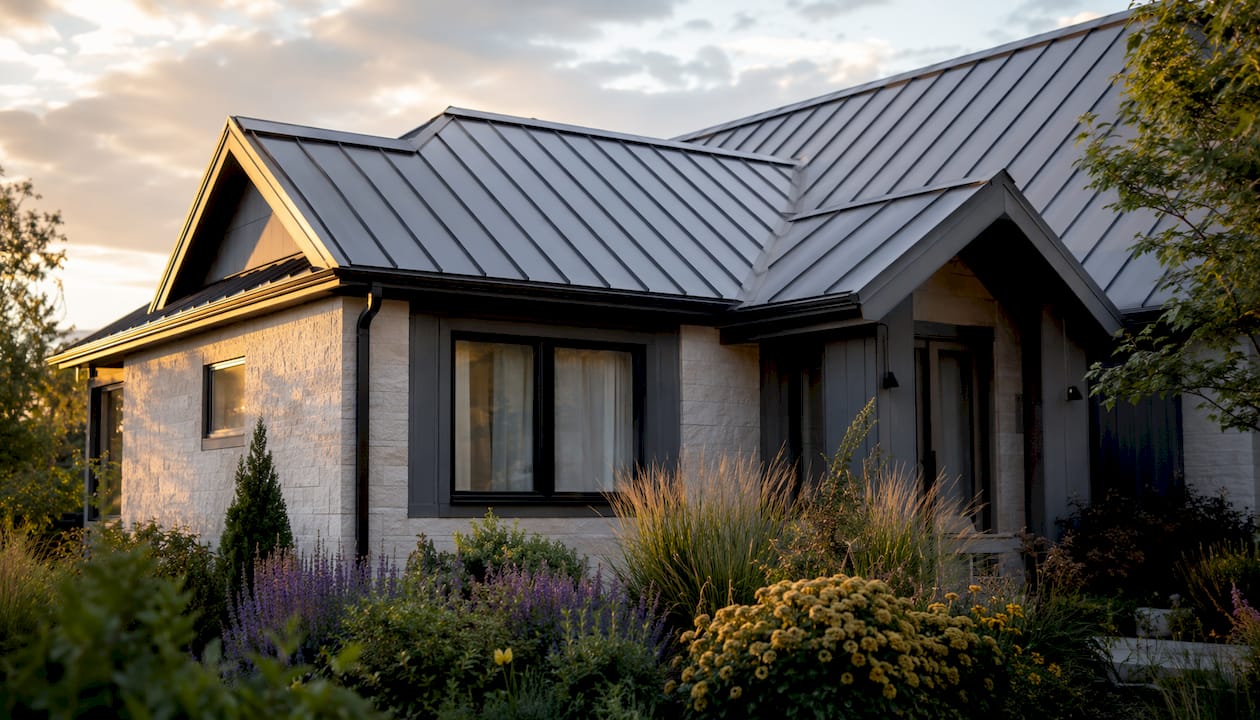
Standing-seam metal uses interlocking panels with concealed fasteners and floating clips that let the metal expand and contract without cracking the finish. Lifespan runs 40–70 years for standing seam. Kynar 500 (PVDF) coatings maintain reflectivity for 30–40 years; lower-grade polyester finishes chalk out in 10–15 years, so the coating spec matters as much as the panel gauge.
Reflective metal roofing can cut cooling demand by roughly 10–25% when paired with proper ventilation. That payoff is real in South Texas, where cooling loads dominate. Installed cost runs $10–$18 per square foot for standing seam. Higher upfront, but the math often favors metal when you price two asphalt replacements over the same period.
Best for: long-term ownership, storm-prone and hot climates, energy-efficiency goals.
Clay and concrete tile
Clay tile handles heat exceptionally well, resists rot and fire, and absorbs very little moisture. Many tile systems reach 50–100+ years when the underlayment and flashing details are done correctly. Concrete tile is heavier and slightly less expensive; clay is lighter and more expensive. Both carry Class A fire ratings.
The tradeoff is structural weight. Slate, clay, and concrete tile can require reinforced framing, which adds cost and sometimes design changes. Installed cost for clay or concrete tile runs $10–$18 per square foot. If you plan to stay in the property long-term and the structure can support it, tile is one of the strongest lifecycle investments available.
Best for: Mediterranean and Spanish-style architecture, hot climates, long-term ownership.
Natural slate
Slate is geologically dense, virtually immune to UV, fire, rot, and insects, and routinely outlasts every other component in the assembly. Quality hard slates from Vermont or Virginia can last 75–150 years. The most common failure point is actually the fasteners: standard galvanized nails corrode after 60–80 years, causing slates to slide even when the stone itself is still sound. Copper or stainless steel nails match the stone’s lifespan. Installed cost runs $15–$30 per square foot.
Best for: historic preservation, luxury homes, multi-generational ownership where structural capacity exists.
Wood shakes and synthetic alternatives
Wood shakes deliver a natural aesthetic but bring real maintenance obligations: cleaning, treatment, and fire restrictions in many jurisdictions. A wood shake roof can last 20–40 years with proper upkeep, but that maintenance is not optional. Moisture management is the critical variable; shaded or poorly ventilated roofs grow moss and hold water.
Composite/synthetic shingles cover the middle ground. They target a 30–50 year lifespan, resist UV and impact better than older look-alike products, and carry none of the fire restrictions that limit wood in many Texas counties.
Best for: wood shakes in dry mountain climates; synthetics where you want the aesthetic without the maintenance burden.
TPO membranes
TPO is widely specified for commercial flat roofs because it balances reflectivity, heat-weld seam strength, puncture resistance, and cost. White TPO membranes qualify as cool roofs under ENERGY STAR criteria. Installed cost runs $5.50–$9.00 per square foot for commercial applications, depending on membrane thickness, attachment method, and insulation level. Lifespan is typically 15–25 years.
Best for: hot-climate commercial flat roofs, buildings where cooling cost reduction is a priority.
PVC membranes
PVC is the go-to choice when chemical exposure is a hard filter. Restaurants, food-processing facilities, and industrial buildings with grease exhaust on the roof need PVC because it resists chemical degradation that degrades TPO and EPDM. Installed cost runs $7.00–$12.00 per square foot. Seams are heat-welded like TPO, which produces a strong, watertight bond.
Best for: commercial buildings with grease, chemical, or industrial exhaust exposure.
EPDM
EPDM (ethylene propylene diene monomer) is a synthetic rubber membrane applied in large sheets that limit seam count. It is one of the more forgiving flat-roof options for budget-conscious owners. Installed cost runs $4.50–$7.50 per square foot; lifespan is 20–30 years. EPDM is typically black, which absorbs heat, though white-coated versions are available for cool-roof applications.
Best for: low-slope residential additions, garages, budget-driven commercial projects.
Built-up roofing (BUR)
BUR is one of the oldest flat-roof systems: multiple layers of roofing felt impregnated with hot-applied asphalt, topped with aggregate or a reflective cap sheet. The layered construction provides redundancy. Estimated lifespan is about 30 years per InterNACHI. BUR requires skilled hot-work crews and generates fumes during installation, which matters for occupied buildings.
Best for: commercial buildings where redundancy and proven track record outweigh installation disruption.
Modified bitumen
Modified bitumen is essentially a factory-engineered version of BUR in roll form. Multiple overlapping layers are torched, self-adhered, or cold-applied. It handles thermal cycling reasonably well and is easier to install than traditional BUR. Estimated lifespan is about 20 years. The shorter life compared to single-ply membranes is the main trade-off.
Best for: low-slope commercial and residential projects where BUR’s hot-work process is impractical.
Liquid-applied coatings
Acrylic and silicone coatings are seamless, custom-fitted to any existing roof geometry, and fill cracks and seams immediately. Silicone handles standing water better; acrylic handles foot traffic better. Liquid-applied systems work best as restoration coatings over existing membranes rather than standalone new installations. Lifespan varies widely based on coating thickness and substrate condition.
Best for: restoration of aging commercial roofs where a full tear-off is not yet warranted.
What does a complete roofing system actually include?
The surface material gets all the attention, but the hidden components determine whether a roof lasts 15 years or 40. A quality roof is an integrated investment — expensive materials fail early when the assembly underneath is substandard.
Here are the core components every complete system needs:
- Roof deck: the structural platform (plywood or OSB). Plywood holds fasteners better and tolerates repeated wet/dry cycles with less edge swelling; OSB is common and usually cheaper.
- Underlayment: the backup water barrier between the deck and the surface material. Synthetic underlayments outperform traditional felt in tear resistance and moisture management.
- Ice and water barrier: a self-adhering membrane applied at eaves, valleys, and penetrations. Required by code in many climates; worth adding in coastal Texas where wind-driven rain is the threat.
- Primary surface material: the visible layer (shingles, membrane, tile, metal panel).
- Flashings: sheet metal or membrane details at every transition — step flashing at walls, curb flashing at HVAC units, scupper and counter-flashing at parapets. Flashings are the most common leak point on any roof.
- Edge metal (drip edge): guides water off the deck edge into gutters rather than behind fascia. Not optional.
- Insulation: affects both energy performance and dew-point control. Under-insulated assemblies can trap moisture in the deck, leading to rot and mold before the surface material shows any sign of failure.
- Ventilation: ridge vents, soffit intake, and power ventilators balance attic temperature and moisture. Poor ventilation is a leading cause of premature shingle failure, particularly in hot climates. The industry standard is one square foot of net free ventilation area per 150 square feet of attic floor space, balanced between soffit intake and ridge exhaust. Learn more about roof ventilation and energy performance.
- Drains, scuppers, and gutters: flat roofs need internal drains or scuppers sized for local rainfall intensity. Clogged drains are a top cause of membrane failure.
- Walkway protection: pads or pavers protect membranes from foot traffic around HVAC equipment.
Pro Tip: When comparing bids, insist that each contractor separately itemize underlayment type, insulation R-value, fastening schedule, and flashing details. A bid that lists only “shingles and labor” cannot be compared apples-to-apples with one that specifies 30-year synthetic underlayment, ridge vent, and step flashing at every wall.
How do you pick the right roofing system for your property?
There is no single best system. The right one is the one matched to your climate, roof form, and performance priorities. Work through this checklist before you request a single bid.
- Confirm your climate exposures. Coastal South Texas means UV intensity, salt spray, high humidity, and hurricane-force wind events. That combination rules out wood shakes and pushes you toward metal, tile, or reinforced membrane systems with corrosion-resistant components.
- Confirm roof slope and geometry. Slopes below 3:12 require a membrane system (TPO, PVC, EPDM, BUR, modified bitumen, or liquid-applied). Slopes above 3:12 open the full range of pitched-roof options. Complex geometry with multiple valleys and penetrations raises installation cost and flashing risk for every system.
- Set your non-negotiables. How long do you need the roof to last? Is noise during installation a problem (occupied building)? Are there chemical exposures on the roof (grease exhaust, industrial fumes)? Chemical exposure is a hard filter: PVC is required where grease or chemicals are present.
- Estimate lifecycle budget, not just upfront cost. A 30-year architectural shingle at $5–$7 per square foot installed will need replacement before a standing-seam metal roof at $10–$18 per square foot. Price two replacement cycles of the cheaper option against one cycle of the premium option before deciding.
- Check local installer availability and code constraints. Some systems require manufacturer-certified installers to qualify for extended warranties. In South Texas, IBC and ASCE 7 wind-design requirements affect fastener density and edge-metal specs, which changes both system choice and installed cost. A reliable roofing contractor in Texas will know these requirements cold.
Contractor questions that separate serious bids from guesswork:
- What membrane thickness or shingle weight are you specifying?
- What is the fastening pattern and uplift rating?
- What R-value of insulation is included?
- Is this a tear-off or overlay, and why?
- What does the manufacturer warranty cover, and what voids it?
- Are you a certified installer for this manufacturer’s system?
Red flags: vague fastening schedules, no insulation or ventilation line items, a price 30% below every other bid with no specification differences, and contractors who cannot show manufacturer training or certification.
What do roof systems typically cost, and how long do they last?
Replacement and reroofing accounted for an estimated 79.2% of U.S. roofing installations in 2025, driven by an aging housing stock where the median owner-occupied home reached 42 years of age in 2024. Most owners are not buying a first roof — they are replacing one that has run its clock.
| System | Typical lifespan | Installed cost (US, per sq ft) | Maintenance level | Best climate/use |
|---|---|---|---|---|
| 3-tab asphalt shingles | 15–20 years | $4.50–$7.50 | Moderate | Mild climates, budget |
| Architectural shingles | 25–30 years | $4.50–$7.50 | Moderate | Most residential, nationwide |
| Class 4 impact-resistant shingles | 30+ years | $5.50–$9.00 | Moderate | Hail zones (TX, NE, CO) |
| Standing-seam metal | 40–70 years | $10–$18 | Low | Storm-prone, hot climates |
| Clay or concrete tile | 50–100+ years | $10–$18 | Moderate–low | Hot, dry climates with Spanish-style architecture |
| Natural slate | 75–150 years | $15–$30 | Low | Historic, luxury, long-term |
| Wood shake | 20–40 years | $7.00–$12.00 | High | Dry mountain climates |
| EPDM (flat) | 20–30 years | $4.50–$7.50 | Low–moderate | Low-slope residential/commercial |
| TPO (flat) | 15–25 years | $5.50–$9.00 | Low–moderate | Hot-climate commercial flat roofs |
| PVC (flat) | 15–25 years | $7.00–$12.00 | Low–moderate | Chemical-exposure commercial |
| Modified bitumen | ~20 years | $4.50–$7.50 | Moderate | Low-slope, budget commercial |
| BUR | ~30 years | $5.50–$9.00 | Moderate | Commercial, redundancy priority |
Commercial membrane cost ranges reflect EPDM at $4.50–$7.50/sf, TPO at $5.50–$9.00/sf, and PVC at $7.00–$12.00/sf, varying by membrane thickness, attachment method, insulation, and warranty level.
Cost ranges vary significantly by region. South Texas labor rates, wind-engineered uplift requirements, and the need for corrosion-resistant components all push installed costs toward the upper end of these ranges. Roof complexity, tear-off scope, and deck repair add further. Never compare bids on material name alone — compare the full specification.
For energy-efficient options in coastal homes, reflective metal and TPO membranes deliver the strongest cooling-load reduction when paired with balanced ventilation.
How installation quality, permits, and warranties affect your outcome
A manufacturer warranty is only as good as the installation behind it. Many warranty conditions require strict adherence to manufacturer application requirements and certified installers. One deviation — wrong fastener pattern, unapproved underlayment, missing ventilation — and the warranty is void before the roof sees its first storm.
Installation and permit checklist:
- Pull a building permit and schedule a deck inspection before new material goes down.
- Verify underlayment type matches the manufacturer’s listed requirements for the surface material.
- Confirm fastener pattern meets both the manufacturer’s spec and local wind-design requirements (IBC/ASCE 7).
- Inspect all flashing details: step flashing at walls, curb flashing at HVAC, drip edge at eaves and rakes.
- Verify edge metal gauge and attachment spacing meet local code.
- Confirm slope and drainage corrections are addressed before membrane or shingle installation.
For commercial membrane systems, the three attachment methods each carry different cost and performance profiles:
- Mechanically attached: lower cost, faster installation, but fastener rows can be stress points in high-wind zones.
- Fully adhered: higher cost, better wind performance, preferred for occupied buildings where noise and disruption matter.
- Ballasted: lowest installed cost, but adds significant dead load and is not suitable for high-wind regions.
Warranty checklist:
- Material warranty: what defects does it cover, for how long, and what prorates apply after year 10?
- Workmanship warranty: separate from the material warranty, this covers installation errors. Typical range is 2–10 years depending on contractor.
- Voiding conditions: improper ventilation, unapproved overlay, unlisted accessory products, and failure to maintain the roof can all void coverage.
Pro Tip: Before signing any contract, ask for the manufacturer’s written warranty transfer terms and proof of the contractor’s current certification for that specific system. A contractor who cannot produce both in writing is a risk you do not need to take.
What does a realistic roof maintenance schedule look like?
Owners who budget for regular inspections avoid the scenario where a $400 flashing repair becomes a $15,000 deck replacement. Periodic inspections are the single most effective way to prevent early system failure and protect warranty coverage.
- Visual check every quarter. Walk the perimeter and look for missing shingles, membrane bubbles, clogged gutters, and debris buildup around drains. You do not need to get on the roof for this.
- Professional inspection every 2–3 years. A qualified roofer checks flashing integrity, fastener condition, membrane seam adhesion, and ventilation balance. This is also when minor repairs get caught before they escalate.
- Post-storm inspection after any significant wind, hail, or hurricane event. Do not wait for a visible leak. Wind-driven rain can enter through damaged flashings or lifted shingles and cause deck damage that stays hidden for months.
- System-specific repairs to expect:
- Asphalt shingles: blow-off in high winds, granule loss accelerating with age, algae streaking in humid climates.
- Metal: exposed-fastener panels need gasket and sealant checks every 5–7 years; standing seam needs periodic clip and sealant inspection.
- Tile: individual cracked tiles need prompt replacement to protect the underlayment beneath.
- Membranes (TPO/PVC/EPDM): seam separation and punctures from foot traffic are the most common repairs.
- Flashings (all systems): reseal or replace at first sign of cracking or separation.
- When to call a professional immediately: visible sagging along the roofline, repeated leaks after patching, widespread granule loss in gutters, or any storm event that exceeded design wind speeds for your area.
A practical roof maintenance checklist for Texas homes can help you track inspection dates and repair history, which also supports warranty claims.
Maintenance budgeting: set aside a small annual reserve for minor repairs rather than deferring everything to a large capital event. The math consistently favors small, frequent maintenance over one large emergency replacement.
Why South Texas and coastal properties need a different approach
South Texas is not a moderate climate. UV intensity, salt spray, high humidity, hurricane-force winds, and thermal cycling all hit simultaneously. That combination changes system priorities in ways that a generic national guide will not tell you.
Wind uplift is the first filter. IBC and ASCE 7 wind-design requirements in coastal Texas mandate higher fastener density and engineered edge-metal attachment than inland markets. Those requirements raise installed cost but are not negotiable. A system installed to inland specs in a coastal wind zone will fail in the first major storm. For storm-ready roofing materials, the spec sheet matters as much as the material name.
UV and thermal cycling shorten asphalt lifespan faster here. Asphalt shingles lose 20–30% of expected lifespan in Texas and Sun Belt climates compared to moderate conditions. Kynar 500-coated standing-seam metal and clay tile handle UV far better. Cool-roof strategies extend membrane life by reducing thermal shock — combine reflectivity with balanced attic ventilation for the best result in hot climates.
Salt spray demands corrosion-resistant materials. Steel panels without marine-grade coatings corrode faster within a few miles of the Gulf. Aluminum, zinc, or Galvalume-coated steel panels, along with stainless steel fasteners and copper flashings, are worth the premium in coastal zones.
Commercial properties in storm regions face additional decisions. Chemical exposure from rooftop equipment, heavy foot traffic around HVAC units, and the need for reinforced membranes with walkway pads all factor in. Fully adhered TPO or PVC membranes outperform mechanically attached systems in high-wind zones because they eliminate the stress concentration at fastener rows. For buildings with grease exhaust, PVC is the only membrane that holds up.
Insurance implications are real. Class 4 impact-resistant shingles and metal roofing can qualify for insurance discounts of 10–35% in hail-prone states. Texas led the way on this in 1998. Ask your insurer about qualifying materials before you finalize a system choice — the premium savings can materially change the lifecycle math.
Pro Tip: After any storm event that hit your area, schedule a professional assessment before filing an insurance claim. Documented professional findings carry more weight with adjusters than owner-reported damage, and they catch hidden damage that photos alone miss. Factor that inspection cost into your annual maintenance budget.
Key Takeaways
The right roofing system is always the one matched to climate, roof form, and lifecycle priorities — no single material wins across all conditions.
| Point | Details |
|---|---|
| Climate and slope come first | Run climate exposure and roof slope as hard filters before comparing materials or prices. |
| Hidden components determine lifespan | Underlayment, insulation, flashings, and ventilation drive performance as much as the surface material. |
| Lifecycle cost beats upfront price | Standing-seam metal at $10–$18/sf often costs less over 40–70 years than two asphalt replacements. |
| Coastal Texas demands higher specs | IBC/ASCE 7 wind requirements, UV intensity, and salt spray push fastening, coatings, and material choices beyond national defaults. |
| Buffaloroofingandexteriors | Handles residential and commercial roof systems across South Texas, from Corpus Christi to San Antonio, with written warranties and certified installation. |
The real mistake most property owners make
The most common error is treating a roofing project as a commodity purchase. An owner gets three bids, picks the lowest number, and discovers two years later that the contractor skipped the ice-and-water barrier, used a lighter underlayment, and left the attic ventilation unchanged. The surface material looks fine. The deck is rotting.
System-level thinking changes that. When you specify underlayment type, insulation R-value, fastening schedule, and ventilation balance in the bid request, you force every contractor to price the same job. The low bid stops looking low when it is missing $2,000 worth of components the other bids included.
The second mistake is ignoring ventilation. It is the most undervalued element in any residential roofing assembly. Proper attic ventilation prevents heat buildup that bakes shingles from below in summer and moisture condensation that causes rot in winter. Adding ventilation to an under-ventilated attic can extend roof life by 10–15%. That is not a minor detail — it is the difference between a 20-year roof and a 25-year roof on the same materials.
For coastal Texas owners specifically: the wind-uplift spec is not a line item to negotiate away. A fastening pattern engineered for 130 mph winds costs more than a standard pattern. It also means your roof is still on the building after a major storm, which is the only outcome that matters.
Buffaloroofingandexteriors serves South Texas with the full system, not just the surface
When you are ready to move from research to a real bid, the difference between a contractor who sells shingles and one who installs complete roof systems shows up fast in the specification sheet.
Buffalo Roofing and Exteriors handles the full range of residential and commercial roofing across South Texas, from Corpus Christi and Robstown to San Antonio. That means flat roof systems for commercial properties, standing-seam metal and architectural shingles for residential, and storm damage restoration after major weather events. Every project includes written manufacturer and workmanship warranties, and the team carries manufacturer certification for the systems it installs. Financing options are available for qualified projects, and free estimates come with a full specification breakdown so you can compare bids on actual scope, not just a bottom-line number. To get a written estimate with full component specs for your property, contact Buffaloroofingandexteriors directly through the website.
Authoritative sources for deeper reading
These references are worth bookmarking if you want the technical specifications behind the system choices described above:
- National Roofing Contractors Association (NRCA): the primary industry body for roofing standards, contractor certification, and installation best practices in the U.S.
- International Building Code (IBC) / ICC: the model code governing structural and wind-design requirements for roofing assemblies; adopted with local amendments across most U.S. jurisdictions.
- ASCE 7 (Minimum Design Loads for Buildings): the structural engineering standard that sets wind-speed maps and uplift requirements used in IBC compliance.
- ENERGY STAR Roofing Products: the EPA’s database of certified cool-roof products with reflectivity and emittance data by product.
- Insurance Institute for Business & Home Safety (IBHS): publishes wind and hail resistance testing for roofing materials, including the FORTIFIED program standards relevant to coastal Texas.
- InterNACHI Standard Estimated Life Expectancy Chart for Homes: the widely cited reference for roofing material lifespan planning assumptions used by inspectors and contractors nationwide.
- Flat Roof Report — System Selection Guide: practical commercial membrane selector covering chemical exposure, slope, wind zone, and budget hierarchy.
- Roofvista — Roof Lifespan by Material: detailed breakdown of lifespan factors, climate impacts, and cost-per-square-foot ranges for 11 roofing materials.