


TL;DR:
- Gutters prevent water damage by directing rainwater away from foundations, roofs, and siding. Properly maintained gutters save homeowners thousands by avoiding costly repairs like foundation cracks and fascia rot. Installing seamless gutters with extended downspouts is the most effective and durable solution for home protection.
Gutters are defined as the water-channeling systems installed along roof edges to collect and redirect rainwater away from your home’s structure. Without them, every rainstorm sends water cascading directly down your walls, pooling against your foundation, and saturating the soil around your home. A 1,000-square-foot roof collects roughly 600 gallons of water per inch of rainfall. That volume, left unmanaged, causes foundation cracks, wood rot, basement flooding, and landscaping erosion. Understanding why gutters are important is the first step toward protecting what is likely your largest financial investment.
Why gutters are important: what damage do they actually prevent?
Gutters prevent a specific and expensive list of structural failures. Homeowners who skip them or let them fail are not just risking minor cosmetic issues. They are inviting repairs that routinely cost thousands of dollars.
Foundation damage is the most serious consequence. Water pooling against your foundation saturates the soil, which expands and contracts with moisture changes. That movement cracks concrete, shifts footings, and can cause walls to bow inward. Foundation repairs from failing or missing gutters average $5,000, and that figure climbs fast if the damage goes unnoticed for a season.
Fascia and soffit rot happens faster than most homeowners expect. Fascia board rot can begin within hours of constant water exposure from overflowing gutters, and replacing fascia and soffit averages $2,300. The wood sits directly behind the gutter, so it is the first victim when gutters back up or pull away from the roofline.
Other damages gutters prevent include:
- Basement flooding. Water that pools against the foundation eventually finds its way inside. Basement flooding restoration averages $12,000 per incident. That single number makes gutter installation look like a bargain.
- Soil erosion and landscaping loss. Concentrated roof runoff strips topsoil, kills plants, and carves channels in your yard that redirect water toward the house rather than away from it.
- Pest attraction. Standing water near your foundation draws mosquitoes, termites, and rodents. Termites specifically target water-softened wood, which makes a wet fascia board a direct invitation.
- Ice dams in cold climates. Clogged gutters allow water to freeze at the roof edge, forming ice dams that force water under shingles and into the attic. This is a roof and ceiling repair problem, not just a gutter problem.
Pro Tip: Inspect your gutters after every major storm. Catching a small clog or a loose section early costs almost nothing. Ignoring it until water damage appears costs thousands.
How do gutters work to protect your roof, siding, and foundation?
The gutter system is straightforward in design but critical in execution. Gutters run along the lower edge of the roof, collecting water as it flows off the shingles. Downspouts carry that water vertically down the side of the house and release it at ground level.
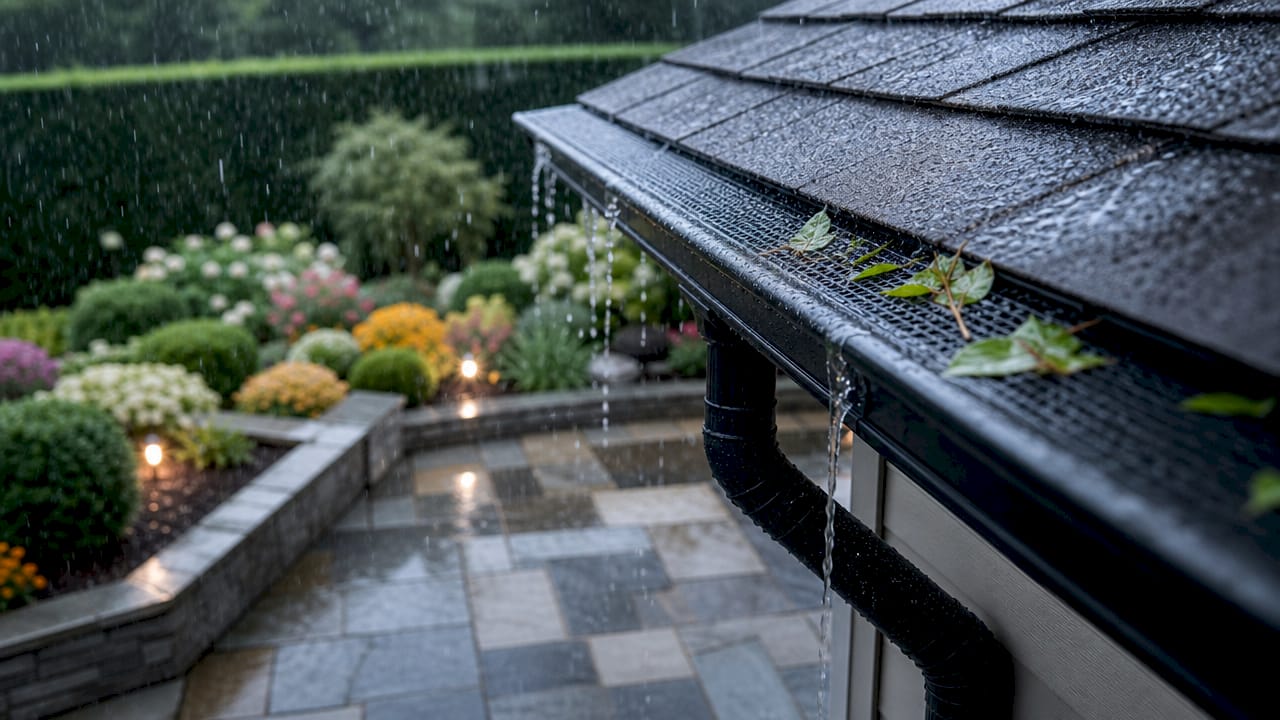
The volume of water involved makes proper design non-negotiable. One inch of rain on a 1,000-square-foot roof generates 600 gallons of runoff. A typical Texas rainstorm can drop two or three inches in a few hours. That means your gutter system may need to handle 1,200 to 1,800 gallons in a single event.
Where that water exits matters as much as how it travels. Downspouts should extend 5–10 feet away from the foundation to effectively reduce basement flooding risk. A downspout that dumps water six inches from your foundation wall defeats the entire purpose of the system. Extensions, splash blocks, or underground drain lines solve this problem at minimal cost.
The steps below show how a properly functioning gutter system moves water safely away from your home:
- Rain hits the roof surface and flows toward the lower edge by gravity.
- The gutter trough catches the water before it can fall directly against the siding or foundation.
- Water flows along the gutter toward the downspout opening, aided by a slight slope built into the installation.
- The downspout carries water to ground level and releases it through an extension or drain line.
- The extension directs water away from the foundation, where it can absorb safely into the yard or drain to the street.
Proper gutter slope and secure attachment combined with regular homeowner care prevent leaks and overflow damage. A gutter pitched too flat holds standing water. A gutter pitched too steeply overflows at the downspout end during heavy rain. Both failures send water where you do not want it.
When are gutters necessary, and are there exceptions?
Gutters are not legally required on every home, but the conditions that make them optional are rare. Most American homes need them.
The table below compares situations where gutters are clearly necessary versus the narrow exceptions where a home might manage without them:
| Condition | Gutters necessary? | Reason |
|---|---|---|
| Basement or crawl space present | Yes | Water intrusion risk is direct and severe |
| Minimal roof overhang (less than 6 inches) | Yes | Runoff falls straight down against the wall |
| Clay soil around the foundation | Yes | Clay does not absorb water; it pools and saturates |
| Home at the bottom of a slope | Yes | Runoff from uphill ground adds to roof runoff |
| Storm-prone coastal or Gulf Coast region | Yes | High rainfall volume demands active water management |
| Large roof overhang (18+ inches) and well-graded land | Possibly optional | Overhang throws water clear; grading directs it away |
| Arid climate with minimal annual rainfall | Lower priority | Low water volume reduces risk, but not to zero |
Homes with minimal roof overhang, basements, clay soil, or located at the bottom of slopes have a higher necessity for gutters to avoid water damage. Corpus Christi and the Texas Gulf Coast check nearly every box on that list. Heavy seasonal rainfall, coastal storms, and clay-heavy soils make gutters non-negotiable for most properties in the region.
Homes in storm-prone areas face higher costs without gutters due to increased foundation damage and flooding. Proactive gutter systems save money compared to reactive repair bills. The math is not close.
Gutter types, guards, and maintenance: what homeowners need to know
Choosing the right gutter system and keeping it functional are two separate decisions. Both matter.
Sectional vs. seamless gutters
Sectional gutters come in pre-cut lengths joined together on-site. The joints are the weakest point. Thermal expansion and contraction cause joints to separate over time, creating leak points at every seam. Seamless gutters reduce leaks by eliminating joints, which are the main failure points from thermal expansion and contraction. Seamless systems are custom-cut on-site to fit your roofline exactly. They cost more upfront but last longer and require fewer repairs.
Common gutter materials include aluminum, vinyl, steel, and copper. Aluminum is the most popular choice for residential homes. It resists rust, handles heat well, and is available in seamless form. Vinyl is cheaper but becomes brittle in extreme heat, which makes it a poor choice for South Texas. Copper is the most durable and the most expensive, often used on historic or high-end properties.
Gutter guards: worth it or not?
Gutter guards reduce cleaning frequency by blocking large debris but do not eliminate maintenance due to small debris like shingle granules. That distinction matters. Homeowners who install guards and assume they are done often discover clogged gutters two years later because fine material has built up inside. Guards are a maintenance reducer, not a maintenance eliminator.
The best gutter guard styles for homes with heavy tree coverage are micro-mesh screens, which block fine debris while allowing water to flow freely. Surface-tension guards work well in areas with lighter debris loads.
Maintenance schedule and common mistakes
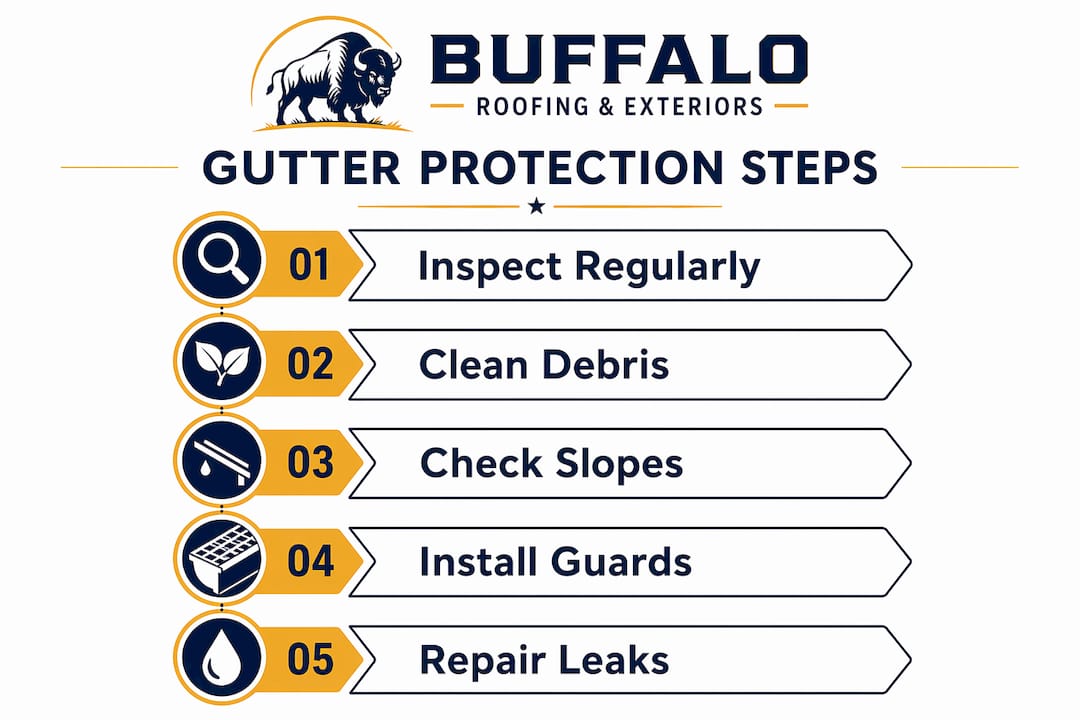
- Clean gutters at least twice per year: once in late spring and once in late fall after leaves drop.
- Inspect downspout extensions after every major storm to confirm they have not shifted or clogged.
- Check gutter slope annually. Gutters sag over time, creating low spots where water pools and breeds mosquitoes.
- Look for rust, cracks, or separated joints at every cleaning. Catching these early prevents full replacement.
- Flush gutters with a garden hose after cleaning to confirm water flows freely to the downspout.
Pro Tip: When re-roofing or replacing siding, replace your gutters at the same time. Coordinating the work avoids future disruption, protects warranty coverage, and ensures every exterior system works together.
Poorly maintained gutters commonly cause hidden fascia board rot by backing up water that saturates the wood behind the gutter. This damage is often unnoticed until the repair bill is major. A $15 cleaning visit prevents a $2,300 fascia replacement.
Key Takeaways
Gutters are the single most cost-effective water management system a homeowner can install, protecting foundations, roofs, and siding from damage that costs far more to repair than to prevent.
| Point | Details |
|---|---|
| Foundation protection is the top priority | Missing gutters allow water to pool against foundations, leading to cracks and repairs averaging $5,000. |
| Fascia rot starts fast | Water exposure from overflowing gutters causes fascia rot within hours, with replacement averaging $2,300. |
| Downspout placement is critical | Downspouts must extend 5–10 feet from the foundation to prevent basement flooding and soil saturation. |
| Seamless gutters outperform sectional | Seamless systems eliminate joint failures and last longer, making them the better long-term investment. |
| Maintenance cannot be skipped | Clean gutters twice per year and inspect after storms to catch clogs and damage before they escalate. |
What I’ve learned after years of watching homeowners skip gutters
The pattern repeats itself constantly. A homeowner buys a house, notices the gutters are old or missing, and decides to deal with it later. Two rainy seasons pass. Then comes the call about a cracked foundation, a rotted fascia, or a flooded basement. The repair bill is always a shock, and it is always larger than what proper gutters would have cost.
Gutters are not glamorous. They do not add curb appeal the way new siding or windows do. That invisibility is exactly why homeowners underestimate them. But the role of gutters in home safety is as fundamental as the roof itself. A roof keeps water from coming in through the top. Gutters keep water from destroying the sides and bottom.
The homeowners who fare best treat gutters as infrastructure, not as an afterthought. They schedule cleanings, inspect after storms, and upgrade to seamless systems when their sectional gutters start failing. They also pay attention to downspout extensions, which is the detail most people overlook entirely. A perfectly clean gutter that dumps water six inches from the foundation is still failing at its core job.
My honest recommendation: budget for gutters the same way you budget for your roof. They are part of the same water management system. Neglecting one while maintaining the other is like patching one side of a leaking boat.
— Buffalo Roofing and Exteriors
Gutter and roofing services from Buffaloroofingandexteriors
Buffalo Roofing and Exteriors serves homeowners across Corpus Christi, San Antonio, and Victoria with professional gutter installation, inspection, and maintenance. If your gutters are aging, pulling away from the roofline, or missing entirely, the time to act is before the next storm season.

The team at Buffalo Roofing and Exteriors installs seamless aluminum gutters, fits gutter guards, and pairs every project with a full roofline inspection to catch fascia damage or soffit rot before it spreads. For homeowners on the Texas Gulf Coast, where weather-resistant roofing and proper drainage work together, getting both systems right matters. Contact Buffaloroofingandexteriors for a free estimate and protect your home before water damage forces a much larger conversation.
FAQ
What happens to a home without gutters?
Without gutters, rainwater falls directly against your foundation, siding, and landscaping. Over time this causes foundation cracks, fascia rot, basement flooding, and soil erosion, all of which cost far more to repair than gutters cost to install.
How often should gutters be cleaned?
Clean gutters at least twice per year, typically in late spring and late fall. Homes near heavy tree coverage may need cleaning three or four times per year to prevent clogs that cause overflow damage.
Do gutter guards eliminate the need for cleaning?
Gutter guards reduce cleaning frequency but do not eliminate it. Fine debris like shingle granules and seed pods still accumulate inside guarded gutters and require periodic flushing and inspection.
Are seamless gutters worth the extra cost?
Seamless gutters eliminate the joints that cause most gutter leaks and failures. They last longer and require fewer repairs than sectional gutters, making them the better long-term value for most homeowners.
How far should downspouts extend from the foundation?
Downspouts should extend 5–10 feet from the foundation to effectively reduce basement flooding risk. Extensions, splash blocks, or underground drain lines all achieve this at low cost.