Yes, roof depreciation almost always reduces your first insurance check. Whether you get that money back depends on your policy type and how fast you act. If you have Replacement Cost Value coverage, the insurer holds back “recoverable depreciation” and pays it once you finish repairs and prove it with a paid invoice, usually within a several-month window. Actual Cash Value policies never pay that second check. Don’t cash the first payment and assume you’re done. Confirm your policy type and deadline in writing before anything else.
TL;DR:
- Most policies default to replacement cost value, which releases depreciation funds only after completing repairs and submitting proof, unlike ACV policies that pay only once.
- Roof depreciation calculations typically use a formula based on age divided by the roof’s useful life, with faster depreciation for asphalt shingles and slower for metal or tile.
- Recoverable depreciation is paid in two steps, contingent on submitting detailed invoices, proof of payment, photos, and inspections promptly within deadline windows.
- Endorsements like age-based payment schedules and cosmetic damage exclusions can significantly reduce or eliminate roof depreciation benefits.
- Proper documentation, timely submission, and invoice matching of insurer-approved line items greatly speed up depreciation releases and minimize disputes.
Table of Contents
- ACV vs RCV: What Each Policy Pays and Why It Matters
- How Insurers Calculate Roof Depreciation
- Recoverable vs Non-Recoverable Depreciation: The Two-Check Flow
- Endorsements and Storm Deductibles That Override RCV
- What Depreciation Actually Costs You: Three Worked Examples
- How to Minimize Depreciation and Dispute a Bad Estimate
- Step-by-Step: Protecting Your Recoverable Depreciation
- Why a Contractor’s Paperwork Decides How Fast You Get Paid
- Buffalo Roofing & Exteriors: Get Your Withheld Depreciation Back
- Where to Verify Depreciation Rules and Deadlines
- Sources
- FAQ
ACV vs RCV: What Each Policy Pays and Why It Matters
Your policy type decides everything about your payout timeline. Actual Cash Value (ACV) pays the replacement cost minus depreciation minus your deductible, and that’s the final number. Replacement Cost Value (RCV) pays the same reduced amount up front, but the insurer sets aside the depreciation and releases it later once you complete the repair and document depreciation on roof repairs with a paid invoice.
Here’s the practical difference on identical damage:
- ACV policy: $15,000 repair, $10,000 depreciation, $1,000 deductible. First and only check: $4,000.
- RCV policy: Same numbers. First check: $4,000. Second check after proof of completed work: an additional $10,000, bringing the total to $14,000.
That $10,000 gap is exactly what separates a homeowner who reads their declarations page closely from one who doesn’t. Most standard homeowner policies sold today default to RCV, but older policies, some condo and rental dwelling forms, and certain high-risk coastal endorsements still write roofs on ACV only. Check your policy’s roof section specifically. Some insurers use ACV for the roof even when the rest of the dwelling is RCV.
How Insurers Calculate Roof Depreciation
Adjusters lean on one formula for most claims: age divided by useful life equals the depreciation percentage. A 10 year old roof rated for a 25 year lifespan depreciates roughly 40%, since 10 divided by 25 equals 0.40.
Pro Tip: Ask your adjuster for the exact useful-life number they used and where it came from. Xactimate estimating software assigns a default lifespan by material, and that default is negotiable if your roof has documented maintenance.
Useful-life assumptions vary a lot by material:
- 3-tab asphalt shingles: 15 to 20 years, among the fastest to depreciate.
- Architectural (dimensional) shingles: 25 to 30 years.
- Metal roofing: 40 to 60 years, so depreciation accrues far more slowly per year.
- Clay or concrete tile: 50 or more years, often the slowest-depreciating material homeowners choose.
Condition matters as much as age. A well-maintained 12 year old asphalt roof with dated inspection records can sometimes get less depreciation than the straight math suggests, because adjusters can adjust for documented upkeep. Skip the maintenance records, and you’re stuck with whatever the age-only formula produces.
Recoverable vs Non-Recoverable Depreciation: The Two-Check Flow
Recoverable depreciation is money you can get back. Non-recoverable depreciation is money you can’t, either because your policy is ACV or because you missed the insurer’s deadline. On an RCV claim, the flow works in two payments: the insurer pays ACV (replacement cost minus depreciation minus deductible) first, then pays the remaining depreciation once you’ve finished the repair and submitted proof.
To release that second check, insurers typically want:
- A signed contractor invoice showing the completed scope of work.
- Proof of payment, whether that’s a receipt, canceled check, or bank statement.
- The signed contract matching the work performed.
- Photos of the finished roof.
- A final inspection or certificate of completion, if your insurer requires one.
Pro Tip: Submit everything as one packet, not piecemeal. Adjusters process a complete file faster than one that arrives in three separate emails over two weeks.
Insurers deny or delay these releases most often for three reasons: the homeowner missed the recovery deadline, the completed work doesn’t match the approved scope, or the damage was ruled cosmetic only, which many policies exclude entirely.
Endorsements and Storm Deductibles That Override RCV
Even a full RCV policy can behave like ACV if the right endorsement is attached. Roof payment schedules are age-based endorsements that step down your coverage percentage as the roof ages, sometimes cutting payouts sharply after year 10. These live on your declarations page, usually as a specific form number your agent can pull up.
Cosmetic damage exclusions are another trap. If your policy excludes cosmetic damage to metal or shingle roofs, hail marks that don’t affect function may get zero payout regardless of your RCV coverage.
Then there’s the deductible itself. Many coastal and storm-prone policies use a percentage deductible instead of a flat dollar amount:
- A percentage deductible on a large dwelling limit can amount to thousands of dollars out of pocket before insurance money arrives.
That deductible comes out once, off the total replacement cost, not twice from both checks. Roof-surface payment schedules are becoming more common in wind and hail states, so check your renewal paperwork every year, not just at the time of a claim.
What Depreciation Actually Costs You: Three Worked Examples
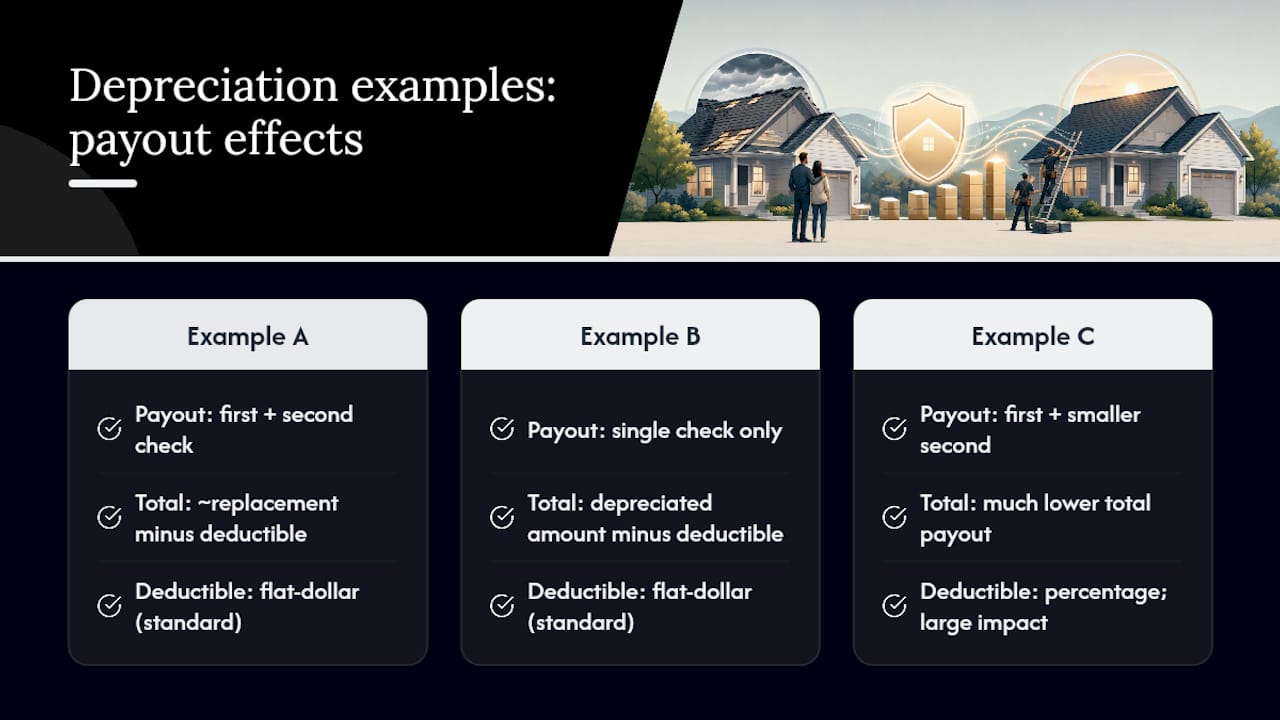
Example A: RCV with recoverable depreciation shows a first and second check totaling close to replacement cost minus deductible. Example B: ACV pays only the depreciated amount minus deductible, with no second check. Example C: RCV with a percentage deductible can result in a much lower first check and total payout due to a large deductible amount.
That third scenario is why percentage deductibles catch so many homeowners off guard. The deductible alone can swallow nearly half of what a flat-dollar policy would have covered.
How to Minimize Depreciation and Dispute a Bad Estimate
Adjusters aren’t infallible, and depreciation figures get challenged successfully more often than most homeowners realize. The strongest disputes start with paperwork you gathered before you ever needed it: dated photos of the roof in good condition, inspection reports, and maintenance receipts showing you kept the roof in shape.
- Pull any past inspection reports or maintenance invoices, even ones several years old.
- Ask your contractor to write the scope of work using the same line items the adjuster’s Xactimate estimate already lists.
- Keep every signed contract and paid invoice in one folder, digital or physical.
- If the insurer’s scope is missing items your roof clearly needs, request a supplement before work starts, not after.
Pro Tip: If the gap between your contractor’s estimate and the insurer’s number is large, request an appraisal clause review or bring in a second independent estimate before you sign anything. A wide gap is usually a scope disagreement, not a pricing disagreement.
When a contractor formats their invoice to mirror the insurer’s own line items, disputes shrink and depreciation releases move faster. Mismatched paperwork is the single most common reason a straightforward RCV claim stalls.
Step-by-Step: Protecting Your Recoverable Depreciation
- Days 0 to 7: Photograph all damage, file the claim immediately, and ask the adjuster in writing whether your policy is ACV or RCV, plus the exact recovery deadline.
- Weeks 1 to 8: Collect written estimates, sign a contract that matches the insurer’s approved scope, and schedule the work with enough buffer to finish before the deadline.
- After completion: Pay the contractor in full, gather the final invoice and proof of payment, and submit the complete packet to the insurer. Follow up to confirm receipt.
Skipping step one is the most expensive mistake homeowners make. Without a written deadline, you’re relying on memory against a clock the insurer controls.
Why a Contractor’s Paperwork Decides How Fast You Get Paid
Contractors who work claims regularly know the estimating software line items adjusters use, and they write invoices that mirror that language instead of fighting it. That single habit removes most of the friction that stalls a recoverable depreciation release. A clean invoice submitted on time gives the adjuster nothing to question.
Licensed local contractors also carry weight in an appraisal dispute, since they can speak to material grades and labor costs specific to your market rather than a national average. That local knowledge is often the difference between a two-week release and a two-month fight.
— Results
Buffalo Roofing & Exteriors: Get Your Withheld Depreciation Back
Estimates and invoices that closely match the insurer’s approval help reduce supplement disputes and speed up the path to recoverable depreciation checks. Coverage includes South Texas homeowners, and free storm damage inspections include itemized documentation often required by insurers, such as detailed scopes, damage, and completion photos, and certificates of completion.

Our storm damage restoration process is built around getting you the full replacement cost you’re entitled to, not just the reduced first check. If you’re staring at an insurance estimate with a depreciation line you don’t understand, request a free roof inspection and claim review and we’ll walk through your declarations page with you before you sign a single form.
Where to Verify Depreciation Rules and Deadlines
Policy wording varies by carrier, so confirm specifics directly with primary sources. Travelers and The Hartford both publish plain-language guides on recoverable depreciation timelines. For calculation mechanics and dispute strategy, The Roofing Manual and PerilIQ break down the adjuster’s side of the process in more technical detail.
Sources
- How Does Insurance Roof Depreciation Work: ACV vs RCV – LegalClarity
- Understanding depreciation | Travelers
- Recoverable depreciation | The Hartford
- Roof Insurance Depreciation: RCV, ACV, and Recoverable | The Roofing Manual
FAQ
What is the typical depreciation life of a roof in the United States?
Useful life ranges widely by material: 15 to 20 years for basic asphalt shingles, 25 to 30 years for architectural shingles, 40 to 60 years for metal, and 50 or more years for tile.
How do insurance companies calculate depreciation on a roof?
Most adjusters use a straight-line formula: roof age divided by expected useful life equals the depreciation percentage, then adjust that figure based on documented condition and maintenance.
Are insurance companies dropping roof coverage?
Some carriers in storm-prone states have tightened roof coverage by adding age-based payment schedules or shifting older roofs to Actual Cash Value only, rather than dropping coverage outright, so check your renewal declarations page every year.
Can Buffalo Roofing & Exteriors help me recover withheld depreciation?
Buffalo Roofing & Exteriors prepares scopes and invoices formatted to match your insurer’s approved estimate, which is the documentation most carriers require before releasing recoverable depreciation.