


TL;DR:
- Properly sized and maintained seamless gutters are crucial for stormwater management in storm-prone areas, protecting foundations, roofing, and siding. Regular inspections, correct pitch, adequate downspouts, and high-performance guards ensure gutters perform optimally during heavy rainfall and wind-driven storms. Neglecting installation quality or maintenance increases the risk of flooding, structural damage, and costly repairs post-storm.
Gutters are defined as the primary stormwater management system for residential and commercial properties, directing roof runoff away from walls, foundations, and landscaping before it causes structural damage. In storm-prone regions like coastal Texas, the role of gutters in storm-prone areas is not decorative. It is structural defense. A 2,000-square-foot roof generates over 1,200 gallons of water in a single inch of rain. Without a properly sized and maintained gutter system, that volume saturates soil, cracks foundations, rots fascia boards, and floods basements. The right system, sized and installed correctly, prevents all of it.
How gutters protect your home during storms
Stormwater management is the industry term professionals use when discussing what gutters actually do. The function is straightforward: gutters collect runoff from the roof surface and channel it through downspouts to a controlled discharge point away from the structure. What most homeowners underestimate is the sheer volume and speed of water moving through that system during a storm.
Clogged or overflowing gutters cause water to pool against the foundation, saturate the soil line, and work its way into basements and crawl spaces. Over time, that moisture cycle causes foundation cracking, wood rot along the fascia and soffit, and mold growth inside walls. These are not minor repairs. Foundation stabilization alone can cost tens of thousands of dollars.
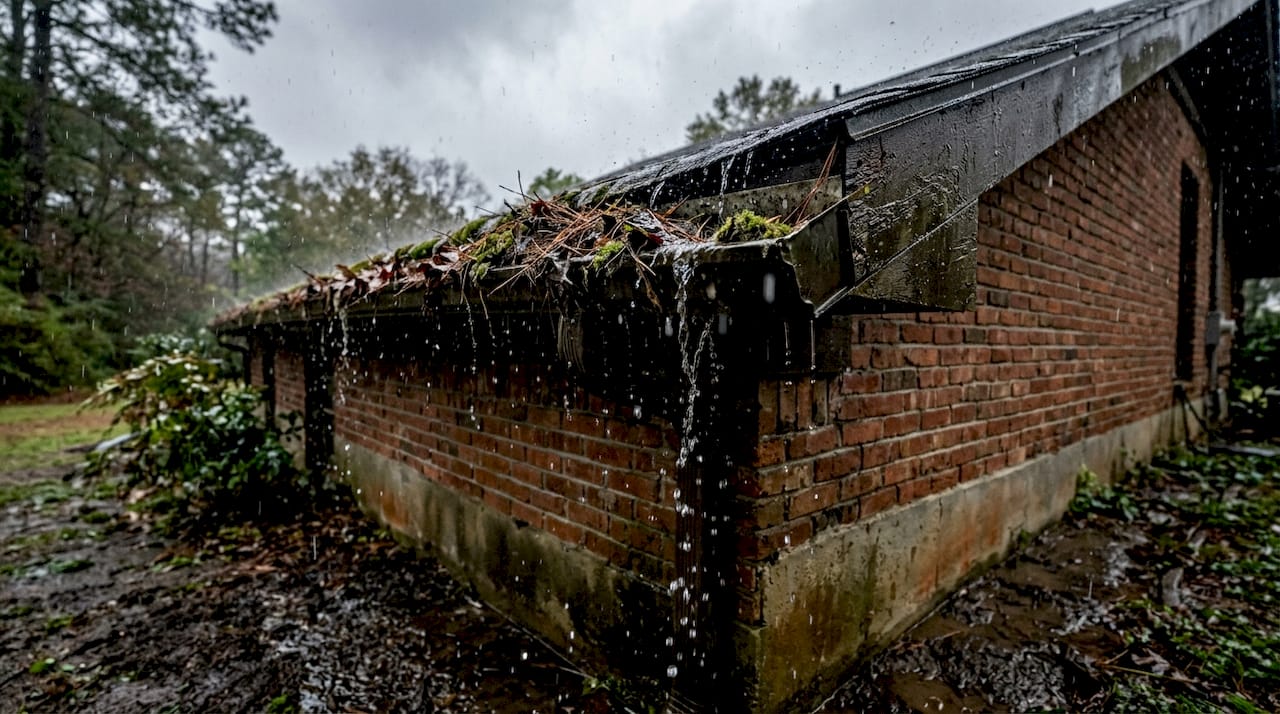
Gutters also protect roofing materials directly. When water backs up behind a clogged gutter, it can lift shingles, saturate the roof deck, and create the conditions for ice damming in colder climates. For coastal Texas homeowners, the more immediate threat is wind-driven rain finding its way under compromised roofing materials. A roof maintenance workflow that includes gutter inspection addresses this risk before storm season arrives.
The protective functions of a properly installed gutter system include:
- Foundation protection: Gutters direct water at least 4 to 6 feet from the foundation, preventing soil erosion and hydrostatic pressure against basement walls.
- Fascia and soffit preservation: Continuous water exposure rots wood framing behind the gutter line within a few seasons.
- Siding defense: Splash-back from overflowing gutters accelerates paint failure and moisture intrusion through siding joints.
- Landscape stability: Uncontrolled roof runoff carves erosion channels through yards and garden beds, destabilizing the grade around the home.
- Basement and crawl space dryness: Properly discharged water stays out of below-grade spaces, reducing humidity and mold risk.
What are the best gutter systems for storm areas?
Gutter sizing is where most homeowners make their first mistake. Standard 5-inch K-style gutters are adequate for low-rainfall regions, but 6-inch K-style seamless gutters provide 40 to 45 percent higher water flow capacity. That difference is the margin between a system that handles a heavy storm and one that overflows onto your foundation.
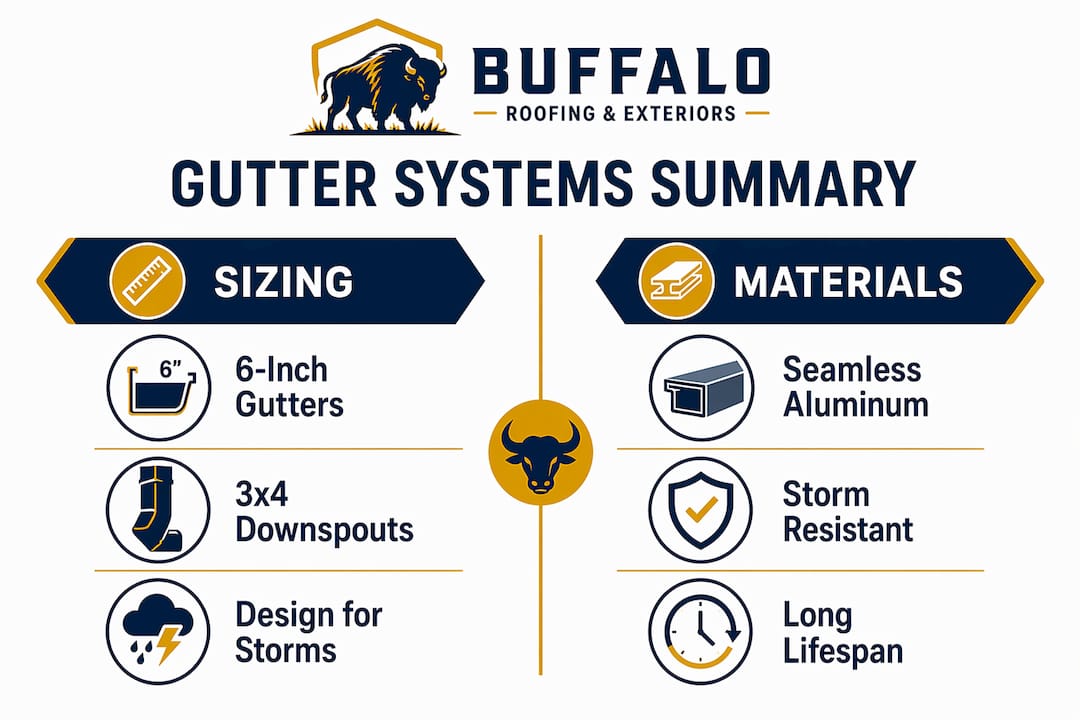
Downspouts are the second critical variable. Many contractors install 2×3-inch downspouts as a default, but in storm-prone areas, 3×4-inch downspouts are the correct standard. Undersized downspouts create a bottleneck that causes gutter overflow even when the gutter trough itself is large enough to handle the volume. The rule of thumb is one downspout per 30 to 40 linear feet of gutter, with additional downspouts placed at roof valleys where runoff concentrates.
Seamless gutters outperform sectional gutters in storm conditions for one specific reason: they have no joints. Every joint in a sectional gutter system is a potential leak point, and storm-force water pressure accelerates joint failure. Seamless gutters are fabricated on-site from a continuous roll of aluminum or steel, eliminating that vulnerability entirely.
Here is how the main gutter materials compare for storm-prone regions:
| Material | Storm performance | Lifespan | Key consideration |
|---|---|---|---|
| Aluminum seamless | Excellent | 20 to 30 years | Lightweight, rust-resistant, most common choice |
| Galvanized steel | Very good | 15 to 25 years | Stronger than aluminum but can rust at cut edges |
| Copper | Excellent | 50+ years | Premium cost, no painting needed, patinas over time |
| Vinyl sectional | Poor | 10 to 15 years | Becomes brittle in UV exposure, joints fail under storm pressure |
Pro Tip: Never size your gutter system based on average annual rainfall. Design for peak storm intensity. A system that handles a 2-inch-per-hour rainfall rate will protect your home during the storms that actually cause damage.
Installation quality affects gutter performance during storms as much as material and size choices. Correct pitch, meaning a slope of roughly one-quarter inch per 10 feet toward the downspout, keeps water moving. Gutters installed level or with a reverse pitch allow water to pool, which accelerates corrosion and creates overflow conditions during heavy rain.
How to maintain gutters for storm readiness
Maintenance is where the importance of gutters in storms becomes most visible. A perfectly sized, professionally installed gutter system fails completely when it is clogged with leaves, pine needles, and debris. For homeowners in storm-prone regions, proactive gutter maintenance is the most cost-effective investment available. Repairs from neglected gutters cost far more than routine cleaning.
With a 70% chance of above-normal hurricane activity forecast for 2026, the recommended inspection frequency for coastal homeowners is at minimum twice per year. The ideal schedule is once in late spring before hurricane season and again in late fall after leaf drop. Properties surrounded by mature trees may need quarterly cleaning.
Follow this maintenance sequence before each storm season:
- Clear all debris from gutters and downspouts. Use a gutter scoop or garden hose to flush debris toward the downspout outlet. Confirm water flows freely from every downspout.
- Check gutter pitch. Pour water at the high end of each gutter run and watch it move toward the downspout. If it pools anywhere, the hanger spacing or pitch needs adjustment.
- Inspect hanger spacing. Hangers should be spaced no more than 24 to 36 inches apart. Wider spacing causes sagging, which creates low spots where water pools and debris accumulates.
- Look for rust, cracks, and separation at joints. Sectional gutters develop joint gaps over time. Seal minor gaps with gutter sealant; replace sections that show rust-through.
- Confirm downspout extensions discharge away from the foundation. Extensions should carry water at least 4 feet from the home. Splash blocks placed at the discharge point reduce erosion.
- Check fascia boards behind the gutter. Soft or discolored wood indicates water has been overflowing or leaking behind the gutter for some time.
Pro Tip: If you find standing water in your gutters after a dry period, that is a pitch problem, not a clogging problem. Adjusting the hanger position is a 30-minute fix that prevents years of overflow damage.
Signs that a gutter system needs professional attention include visible sagging across multiple sections, gutters pulling away from the fascia, water stains on exterior walls below the gutter line, and soil erosion directly below the gutter run. These are not cosmetic issues. They indicate the system is no longer functioning as designed.
Gutter guards and enhancements for storm conditions
Gutter guards reduce the maintenance burden and keep systems flowing during storms, but the type of guard matters significantly. Micro-mesh gutter guards are the top-performing option for heavy-rain climates because they allow water to pass freely while blocking debris at the surface. They handle high-volume rainfall without the overshoot problems that affect other guard types.
Here is how the main guard types perform in storm conditions:
- Micro-mesh guards: Best overall for storm areas. Fine mesh blocks debris while maintaining high flow rates. Require occasional surface brushing to clear fine particles.
- Solid cover or reverse-curve guards: Designed to let water cling to a curved surface and drop into the gutter while debris falls off. During intense storms, high-volume rainfall overshoots the curve entirely and misses the gutter.
- Screen or perforated guards: Moderate performance. Block large debris but allow smaller particles through, which accumulate inside the gutter over time.
- Foam inserts: Not recommended for storm-prone areas. They trap debris inside the foam and become a source of clogs rather than a solution.
Beyond guards, two accessories improve storm performance meaningfully. Downspout extensions carry discharge water further from the foundation, and splash blocks at the outlet prevent soil erosion. For properties with long gutter runs, adding a second downspout midway along the run reduces the volume each downspout must handle during peak storm flow.
Practical steps to prepare gutters for storm season
Preparing gutters for storm season is a property-specific process that depends on your roof size, tree coverage, and local storm patterns. The following steps apply to most homes in storm-prone regions and should be completed before the start of hurricane season each year.
- Inspect and clean gutters at least twice annually, with an additional cleaning after any major storm that deposits debris on the roof.
- Verify that downspout quantity matches gutter length. One downspout per 30 to 40 linear feet is the standard. Add downspouts at roof valleys where two roof planes meet and concentrate runoff.
- Replace any gutters that are undersized for your roof area. A 2,000-square-foot roof in a high-rainfall zone requires 6-inch gutters and 3×4-inch downspouts as a baseline.
- Confirm hanger spacing is 24 to 36 inches throughout. Loose or missing hangers cause sagging that traps water and debris.
- Consider upgrading to seamless aluminum gutters if your current system is sectional and more than 15 years old. Joints in older sectional systems fail under storm pressure.
- Schedule a professional inspection if your home has experienced storm damage, visible fascia rot, or foundation moisture issues. A trained eye catches installation problems that are not visible from the ground.
Pairing gutter readiness with a broader siding maintenance plan addresses the full exterior envelope. Water that bypasses gutters does not stop at the foundation. It works its way into siding joints, window frames, and wall cavities.
Key takeaways
Gutters in storm-prone areas require correct sizing, seamless construction, proper pitch, and regular maintenance to protect foundations, roofing, and siding from heavy rainfall damage.
| Point | Details |
|---|---|
| Size for peak intensity | Use 6-inch K-style seamless gutters and 3×4-inch downspouts in storm-prone regions, not standard 5-inch systems. |
| Downspout spacing matters | Install one downspout per 30 to 40 linear feet, with extras at roof valleys where runoff concentrates. |
| Maintenance frequency | Inspect and clean at minimum twice per year, with additional checks after major storms. |
| Guard selection | Micro-mesh guards outperform solid cover and reverse-curve designs during high-volume rainfall events. |
| Installation quality | Correct pitch and hanger spacing determine storm performance as much as material and size choices. |
What I’ve learned watching gutters fail during coastal storms
After years of inspecting storm-damaged homes along the Texas Gulf Coast, the pattern is consistent. The homes with the worst water damage are rarely the ones that took a direct hit. They are the ones where the gutter system was undersized, improperly pitched, or simply neglected for a few seasons before the storm arrived.
The industry conversation about gutters tends to focus on materials and guard types. Those choices matter, but they are secondary to installation quality and maintenance discipline. A micro-mesh guard on a gutter with a reverse pitch is still going to hold water. A seamless aluminum gutter installed with hangers spaced 48 inches apart is going to sag and fail under storm load regardless of how new it is.
What I find most homeowners miss is the downspout calculation. They upgrade to 6-inch gutters and stop there. But a 6-inch gutter feeding into a 2×3-inch downspout is still a bottleneck system. The water volume a 2,000-square-foot roof generates in a 2-inch-per-hour storm exceeds what an undersized downspout can exit fast enough. The gutter fills, overflows, and the foundation gets the water anyway.
The other overlooked factor is integration. Gutters do not work in isolation. They are part of an exterior system that includes roofing, siding, and grading. A gutter that discharges correctly but drains onto a flat grade that slopes back toward the house has not solved the problem. Treating gutter readiness as part of a whole-exterior inspection, rather than a standalone task, is what separates homes that survive storm season from homes that need restoration work afterward.
— Buffaloroofingandexteriors
How Buffaloroofingandexteriors helps you prepare for storm season
Buffaloroofingandexteriors serves homeowners and property managers across Corpus Christi, San Antonio, and Victoria with professional gutter inspection, installation, and storm damage restoration. If your current gutter system is undersized, improperly pitched, or showing signs of failure, the time to address it is before storm season, not after.

The team at Buffaloroofingandexteriors provides free estimates, financing options, and workmanship warranties on all gutter and exterior work. For properties that have already experienced storm damage, the storm damage restoration guide covers the full recovery process from initial inspection through final repair. Contact Buffaloroofingandexteriors to schedule your pre-season gutter assessment and protect your home before the next storm arrives.
FAQ
What size gutters do I need for a storm-prone area?
Six-inch K-style seamless gutters paired with 3×4-inch downspouts are the standard for storm-prone regions. Standard 5-inch gutters carry 40 to 45 percent less water and overflow during heavy rainfall events.
How often should gutters be cleaned in hurricane zones?
Gutters in hurricane-prone areas should be inspected and cleaned at least twice per year, typically before and after storm season. Properties with heavy tree coverage may require quarterly cleaning to prevent debris buildup.
Do gutter guards eliminate the need for maintenance?
Gutter guards reduce cleaning frequency but do not eliminate it. Micro-mesh guards perform best in heavy rain but still require occasional surface brushing. No guard type removes the need for periodic inspection.
What happens if downspouts are too small?
Undersized downspouts create a bottleneck that causes gutter overflow even when the gutter trough is correctly sized. The result is the same as having no gutter at all: water spills against the foundation and causes structural damage.
Can I use the same gutter system in a storm-prone area as in a low-rainfall region?
No. Gutter systems must be sized for peak storm intensity, not average annual rainfall. A system adequate for a low-rainfall climate will overflow during the high-volume events that cause the most damage in storm-prone regions.