Most manufacturer roof warranties can be transferred one time, but only if you register the transfer within the manufacturer’s deadline, commonly 30 to 60 days after closing. Miss that window and the coverage can lapse permanently, even if the roof itself is only a few years old. Contractor workmanship warranties are a different animal entirely, and most of them don’t transfer at all unless they’re bundled into a manufacturer’s premium program.
Here’s what to do right now if you’re buying or selling a house with an existing roof:
- Find the warranty certificate or the original installation invoice. No paperwork, no proof of installation date.
- Call the manufacturer or check its website to confirm the exact transfer window and process.
- Submit the transfer form (usually online) before the deadline passes, not after.
Pro Tip: Owens Corning requires transfer requests within 60 days of closing, and it accepts submissions online or by phone, so start the process before you sign anything at the closing table, not after. Transfer fees typically run $25 to $150, small money compared to what a lapsed warranty can cost you later. Build that fee into your closing checklist now.
Key Takeaways
Most manufacturer roof warranties transfer once within a 30 to 60 day window after closing, while workmanship warranties usually stay with the original contractor unless bundled into a premium program.
| Point | Details |
|---|---|
| Register before the deadline | Submit the manufacturer’s transfer form within 30 to 60 days of closing, depending on the brand. |
| Know your warranty type | Manufacturer warranties often transfer; contractor workmanship warranties usually don’t. |
| Gather documents early | Certificate, invoice, permit record, and closing statement should be assembled before listing. |
| Missing records aren’t fatal | County permits, installer invoices, and manufacturer serial lookups can rebuild proof. |
| Get contractor help when needed | Buffaloroofingandexteriors verifies registration and submits transfer paperwork for South Texas homeowners. |
Where to verify official transfer rules
- Owens Corning warranty transfer
- Owens Corning warranty registration help
- Malarkey shingle warranty transfer application
- NRCIA roof warranty transfer guide
- DwellRecord warranty transfers at closing
Table of Contents
- Manufacturer, Workmanship, or Builder Warranty: Which One Do You Have?
- How Do You Actually Transfer a Roof Warranty?
- What Documents Do You Need to Prove Ownership and Installation?
- Deadlines and Fees: What GAF, Owens Corning, CertainTeed, and Malarkey Actually Require
- What If the Records Are Missing or You Missed the Deadline?
- How to Present a Transferable Warranty to Buyers
- Closing-Ready Warranty Packet Checklist
- When Should You Bring in a Roofing Contractor?
- Does Transferring a Roof Warranty Affect Insurance Claims?
- Sources
Manufacturer, Workmanship, or Builder Warranty: Which One Do You Have?
Not every warranty on your roof behaves the same way, and knowing which type you’re holding determines whether a roof warranty transfer is even possible.
Manufacturer (material) warranties cover the shingles, membrane, or roofing product itself against defects. They typically run 25 to 50 years, often prorate coverage as the roof ages, and are the warranties most likely to allow one transfer to a new owner.
Contractor workmanship warranties cover installation quality, things like flashing, ventilation, and fastening. These are usually tied to the original contractor personally and don’t transfer unless they’re part of a bundled manufacturer program. GAF’s Golden Pledge is a good example: it wraps workmanship coverage into the manufacturer’s warranty, so both can move to a new owner together.
Builder or new-construction warranties follow their own separate contract language entirely. Some cover the roof as part of a broader structural warranty; others exclude it. Always read the actual document, not just the sales brochure, before assuming coverage exists. For a deeper breakdown of what each warranty type actually promises, see this explanation of roofing warranty options.
How Do You Actually Transfer a Roof Warranty?
Transferring roof warranty coverage isn’t complicated, but it is time sensitive, and skipping a step can void the whole process. Work through these in order:
- Confirm the registration status. Check whether the roof warranty was registered at installation, and which tier it falls under. Premium programs sometimes include workmanship protection that basic registrations don’t.
- Gather your documents. You’ll need the warranty certificate, the original installation invoice, permit or inspection records, and proof of sale, either the closing statement (sometimes called a HUD-1) or the deed.
- Complete the manufacturer’s transfer form. Most manufacturers, including Owens Corning, run this online. You’ll enter property details, installation date, and attach supporting documents. Pay the transfer fee if one applies, and save the confirmation email or reference number.
- Hand off the packet. Give the transfer confirmation and full warranty file to the buyer or the closing agent, and keep your own copies. A completed transfer means nothing to a buyer who never receives proof of it.
Pro Tip: Do steps 2 and 3 before the closing date, not after. Once the deed records and both parties move on, chasing down a contractor’s contact information or a manufacturer’s registration record gets exponentially harder.
The roof replacement process itself generates most of these records automatically, so if your roof was installed recently, check what documentation should already exist from the original job before assuming anything is missing.
What Documents Do You Need to Prove Ownership and Installation?
Manufacturers want proof that the roof exists, was properly installed, and is now legally changing hands. The core documents are the warranty certificate itself, the contractor’s invoice with line-item detail and an installation date, the permit close-out or inspection certificate from your local building department, and the closing statement or deed showing the sale.
If any of those originals went missing, alternatives usually work:
- County property and permit records, searchable through your local building department.
- A duplicate invoice requested from the original installer.
- The product’s serial number, often stamped on shingles or membrane packaging.
- Timestamped photos of the installation, useful for cross-referencing installation date.
- Manufacturer records pulled by property address, since Owens Corning and similar companies keep installation data tied to serial numbers and addresses.
Requesting duplicates typically takes a few days from an installer, longer from county offices depending on how digitized their records are.
Deadlines and Fees: What GAF, Owens Corning, CertainTeed, and Malarkey Actually Require
Every major manufacturer treats the transfer window differently, and the differences matter more than most sellers realize.
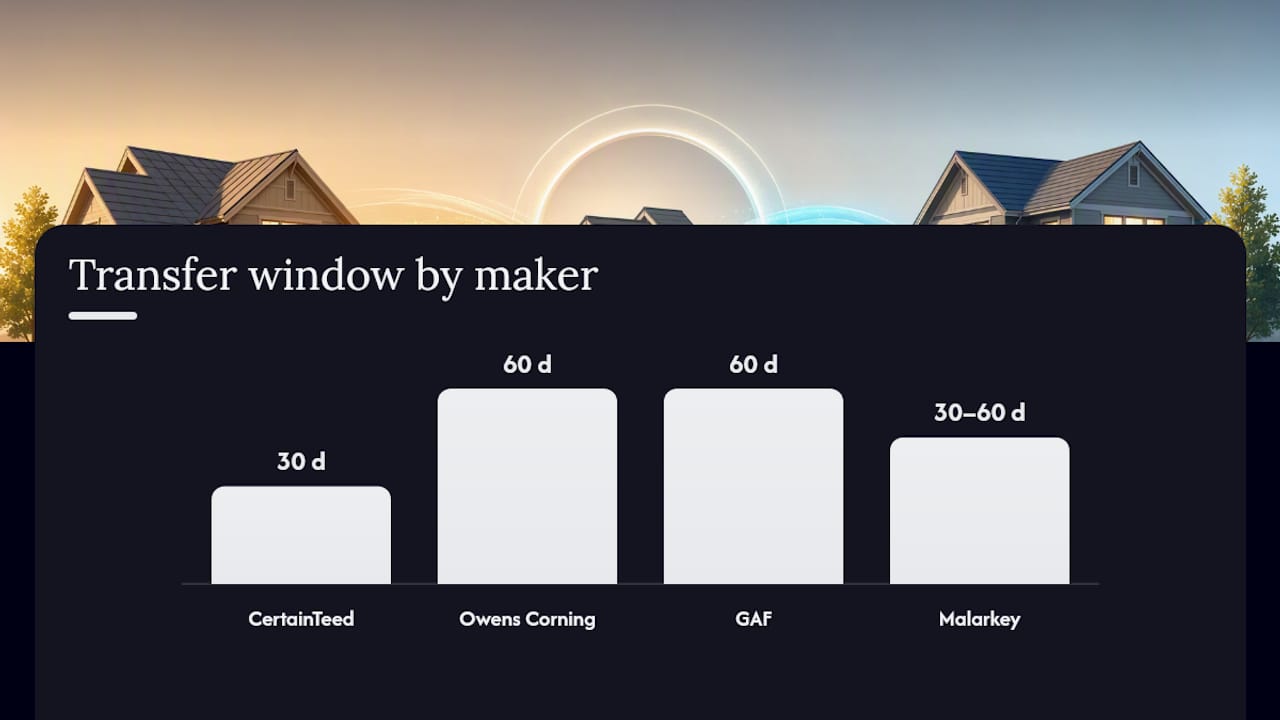
- CertainTeed often requires the transfer to be submitted within 30 days of the sale, one of the tighter windows in the industry.
- Owens Corning and GAF typically allow 60 days from closing, giving you more breathing room, though Owens Corning still wants proof of installation and proof of sale submitted online or by phone.
- Malarkey splits the difference. Its shingle warranty transfer application requires submission within 30 days for some products and 60 days for others installed after a specified date, so check the specific product page rather than assuming one rule applies across the whole lineup.
Fees generally vary by manufacturer and may require only one lifetime transfer per roof. That’s worth repeating to buyers: if they resell the house again in ten years, this same warranty likely won’t transfer a second time.
Malarkey typically confirms transfer status within several weeks after submission, so start the paperwork well before your closing date, not the week of. A confirmation that arrives after the sale has already recorded still counts, but it’s a stressful way to find out everything worked.
What If the Records Are Missing or You Missed the Deadline?
Don’t panic, but move fast. Manufacturers sometimes allow manual appeals when the standard window has closed, though approval is discretionary and usually requires notarized statements or alternate proof of installation.
Start by contacting the manufacturer directly and asking specifically about exception requests. While you wait for a response, pull whatever backup documentation exists: county permit records, a duplicate invoice from the original installer, or closing documents from your title company.
If the transfer genuinely can’t be saved, disclose that honestly to the buyer. A seller-funded short-term warranty or a fresh roof inspection can substitute for the lost coverage and keep the sale on track.
How to Present a Transferable Warranty to Buyers
A transferable roof warranty is a selling tool, not a price booster. It rarely moves the appraised value directly, but it consistently reduces the negotiation friction that shows up when a buyer’s inspector flags roof age as a concern, according to the National Roofing Contractors Insurance Alliance.
Put the details where buyers will actually see them: seller disclosures, listing copy, and a physical packet handed over at showings or closing. Mention the remaining warranty term specifically, not just “roof is under warranty.”
- List the manufacturer, coverage type, and remaining years in the disclosure.
- Mention the transferable warranty in listing copy, buyers search for this specifically.
- Hand the buyer’s agent a completed transfer form and confirmation, not just a promise to “look into it.”
One Texas contractor’s data suggests transferable premium programs like GAF’s Golden Pledge or Owens Corning’s Platinum tier can shift perceived resale value by roughly $4,000 to $12,000 for homes sold within ten years of installation, though that’s a market-dependent estimate, not an appraisal guarantee.
Closing-Ready Warranty Packet Checklist
Copy this into your closing folder so nothing gets left behind on transfer day.
| Item | What to Include |
|---|---|
| Warranty certificate | Manufacturer name and warranty registration number |
| Installation invoice | Contractor name, line items, and installation date |
| Contractor certification | Certification tier (e.g., Master Elite, Platinum Preferred) |
| Permit/inspection record | Local building department close-out or inspection sign-off |
| Proof of sale | Closing statement or deed |
| Transfer form copy | Completed manufacturer form, signed and dated |
| Transfer confirmation | Manufacturer’s receipt or confirmation number |
Keep one digital copy labeled “Roof-Warranty-Transfer-[address].pdf” and one physical copy in your closing binder.
When Should You Bring in a Roofing Contractor?
A contractor who installed the roof, or one familiar with manufacturer programs, can verify registration status, pull duplicate invoices and permit documentation, and submit the transfer form directly on your behalf.
Bringing in help makes the most sense when you’re under time pressure before closing, when original records are missing, or when there’s a dispute about who did the workmanship. Confirming roofing terminology and warranty structure ahead of a sale also avoids miscommunication with buyers, something covered in more depth on why roofing warranties matter for coastal Texas homes.
- Verify manufacturer registration and warranty tier before listing.
- Retrieve invoices, permits, and inspection records if originals are missing.
- Submit the transfer form and confirm receipt before closing.
- Prepare a closing-ready packet for the buyer’s agent.
Does Transferring a Roof Warranty Affect Insurance Claims?
A roof warranty transfer and a homeowner’s insurance policy are separate systems that don’t automatically talk to each other, and that surprises a lot of buyers. Transferring the manufacturer warranty does nothing to your insurance coverage, and it doesn’t reset, extend, or void any existing insurance claim history tied to the roof.
Where the two intersect is documentation. If a previous owner filed a storm damage claim and had the roof repaired or replaced, the paperwork from that repair (invoices, permit records, adjuster reports) often becomes exactly the proof a manufacturer wants when processing a warranty transfer. Keep that claim history together with the warranty file, not filed separately, since buyers and insurers may both ask for it later.
One practical wrinkle: some manufacturer warranties exclude storm damage entirely, since that’s typically an insurance matter, not a materials defect. A transferred warranty won’t cover hail or wind damage that occurs after the sale; that risk sits with the homeowner’s insurance policy going forward. Buyers should understand this distinction clearly, because a “transferable warranty” sign in a listing sometimes gets mistaken for broader protection than it actually provides.
If a claim is pending at the time of sale, resolve it before transferring the warranty when possible. A roof repaired under an active insurance claim, then sold with an unresolved warranty transfer, creates a documentation gap that’s hard to untangle months later. Thorough documentation of any storm-related repair work, including photos and timestamps, protects both the seller’s disclosure obligations and the buyer’s future claims history.
A common mistake worth avoiding
The single biggest mistake homeowners make is assuming the warranty transfers automatically the moment the deed records. It doesn’t. Manufacturers treat transfer as an active registration step, not a passive side effect of a real estate closing.
Pro Tip: Submit the transfer paperwork on closing day and store the confirmation in the buyer’s packet immediately. It takes minutes and it’s the difference between coverage that survives the sale and coverage that quietly disappears.
— Results
Free warranty check and closing-ready documentation
Buffaloroofingandexteriors offers something most listing agents and DIY sellers can’t: a contractor who actually knows how to read a manufacturer’s registration record and chase down missing paperwork before it costs you a sale. If you’re staring down a closing date with a warranty certificate you can’t find, that’s exactly the gap Buffaloroofingandexteriors closes.

Buffaloroofingandexteriors can verify your roof’s manufacturer registration, pull duplicate invoices and permit records, and submit the transfer form on your behalf, so nothing falls through during closing. The team also handles pre-listing roof inspections that give buyers confidence beyond the warranty paperwork alone, and can walk you through roofing materials and options if your current roof needs attention before it goes on the market. Request a free warranty status check today and get a closing-ready packet built before your buyer ever asks for one.
Sources
- Owens Corning Roofing – Warranty transfer
- Malarkey Roofing – Shingle warranty transfer application
- Does a Roof Warranty Increase Home Value? (NRCIA)
- Transferable roof warranty: What it adds to Texas resale value (JRH Construction)