TL;DR: TPO is a white, single-ply membrane that’s the most common choice for flat and low-slope roofs on homes, additions, and commercial buildings across South Texas. It reflects heat, resists UV and ponding water, and installs faster and cheaper than most alternatives — but installation quality and coastal wind detailing make or break how long it lasts.
If you’ve got a flat-roofed addition, a shop, a strip mall, or a modern home anywhere from Corpus Christi to Alice, chances are good you’ve heard a roofer mention “TPO.” It’s the material you’ll see most often recommended for low-slope roofs in South Texas — and for good reason.
Here’s what TPO actually is, how it holds up to Gulf Coast heat and storms, and when it’s the right call versus another flat-roof option.
What Is TPO Roofing?
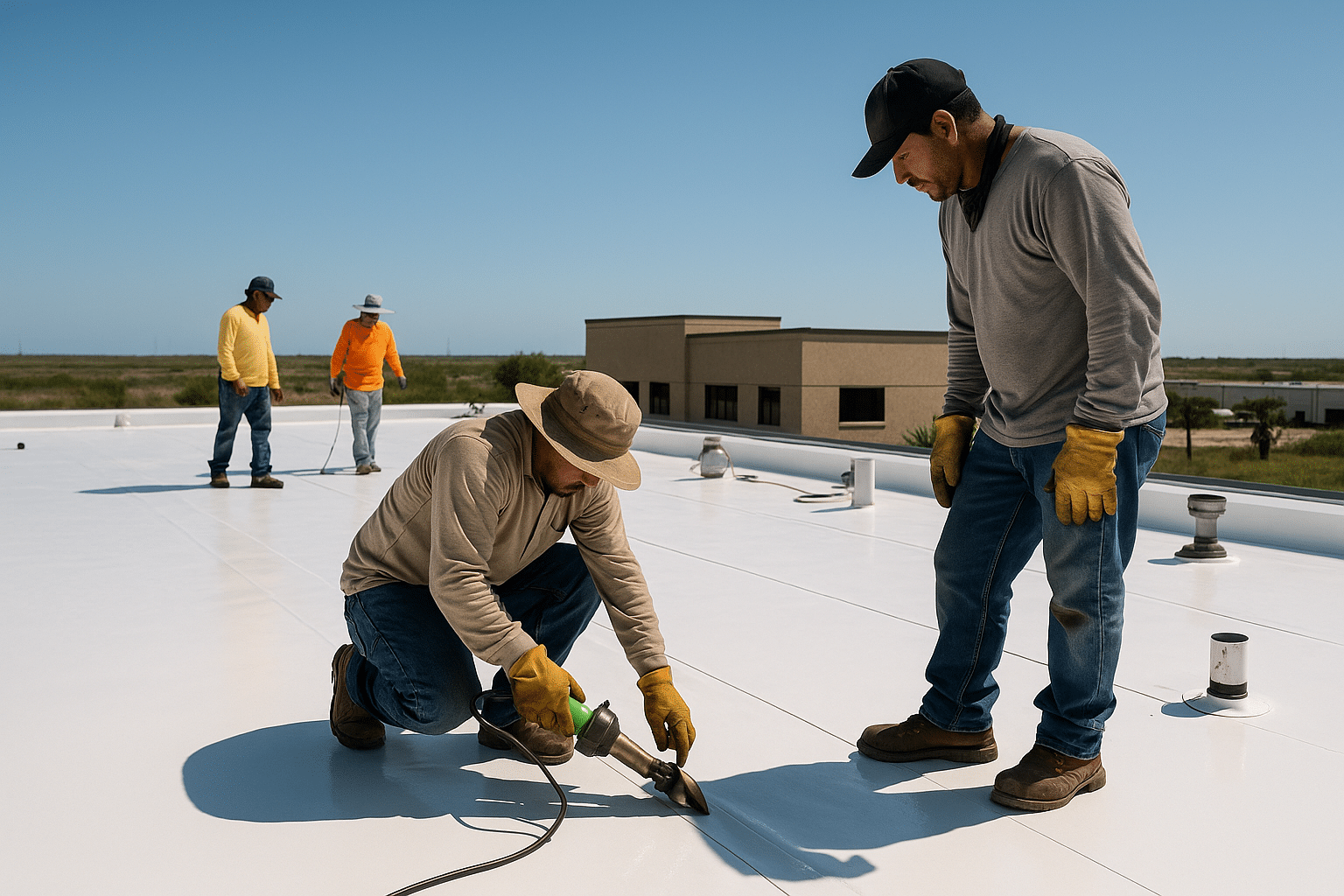
TPO stands for thermoplastic polyolefin — a single-ply roofing membrane installed in large sheets and heat-welded at the seams to form one continuous, waterproof layer.
It’s a lightweight, flexible membrane composed of polypropylene and ethylene-propylene rubber, reinforced with polyester scrim, with seams heat-welded for a watertight finish.
It’s almost always white (though gray and tan are available), which isn’t just a style choice.
TPO is a single-ply, mainly white membrane used in both commercial and residential roofing, and its light-colored surface reflects heat instead of absorbing it.
TPO is built specifically for roofs with little to no slope — additions, porch roofs, garages, carports, and the flat or low-slope sections common on commercial buildings, strip centers, and modern residential designs.
How a TPO Roof System Works
A TPO roof isn’t just one sheet laid over the deck. The system typically includes:
- Insulation board attached to the roof deck for energy performance and a smooth substrate
- The TPO membrane itself, either mechanically fastened, fully adhered with adhesive, or ballasted
- Heat-welded seams where sheets overlap, fused with hot air to create a continuous, watertight bond
- Flashing details around drains, vents, HVAC curbs, and parapet walls — typically the weakest points on any flat roof
The membrane’s flexibility accommodates building movement and thermal expansion, while its heat-welded seams enhance wind uplift resistance and overall structural efficiency.
That matters a lot here, where Texas summers push roof surface temperatures through constant expansion-and-contraction cycles.
TPO Pros: Why It’s So Widely Used
Reflects heat instead of absorbing it
ENERGY STAR sets minimum performance thresholds for reflective roofing products — for low-slope roofs, it requires an initial solar reflectance of at least 0.65 and a thermal emittance of at least 0.90, and most commercial-grade white TPO membranes comfortably clear these benchmarks.
In a market like Corpus Christi, Alice, or Beeville, where AC units run most of the year, that reflectivity translates directly into lower cooling costs on the rooms or units below a flat roof.
Affordable relative to other membranes
TPO’s highly reflective surface blocks up to 87% of UV rays for energy savings in hot climates, it’s lightweight, flexible, and easy to install, and it’s eligible for manufacturer warranties up to 30 years.
Compared to PVC or built-up roofing, TPO generally comes in at a lower material and labor cost.
Resists standing water, mold, and chemical exposure
TPO’s waterproof capabilities ensure that if there is any standing water it cannot penetrate the membrane, and it can also resist mold, which can be an issue in areas where water collects.
That’s a real plus for flat roofs in humid coastal climates where ponding after heavy rain is common.
Strong, continuous seams
TPO roofing membranes feature heat-welded seams that provide superior waterproofing and reduce risk of seam failure
compared to older glued or taped seam systems.
TPO Cons: What to Watch For
TPO isn’t perfect, and an honest explainer has to cover the downsides too.
- Installation quality is everything. Poorly heat-welded seams are the single biggest cause of TPO failures — and in wind events, under-fastened or poorly welded systems are the ones that fail first.
- Formulation quality varies by manufacturer.
Quality varies by manufacturer, and some lower-grade TPO products get dirty more easily or don’t last as long as PVC or EPDM. - Not built for foot traffic.
Like any single-ply membrane, TPO is not designed to handle heavy foot traffic or sharp objects, and walking on it can cause punctures or tears.
If you’re running HVAC service techs across the roof regularly, walk pads are worth the investment. - Wind performance depends on the installer, not just the material. As one roofing-systems review of hurricane performance puts it plainly, TPO is
“strong when properly fastened,” but “highly sensitive to installation quality; poor welds fail early.”
TPO and Wind: Why It Matters on the Texas Coast
Flat and low-slope roofs face a different wind challenge than pitched shingle or metal roofs: uplift pressure concentrates hardest at the corners and perimeter of the roof, which is exactly where TPO membranes are most likely to peel if fastening or welding is inadequate.
That’s one more reason installation detail matters more than the brand name on the membrane. A properly specified, professionally welded TPO system with adequate fastener density performs very differently in a tropical storm than a rushed, under-fastened one.
If your property sits in one of the 14 Texas coastal counties designated by the Texas Department of Insurance (TDI) — which includes Nueces County, home to Corpus Christi, Aransas Pass, and the surrounding Coastal Bend — any new roof or full re-roof typically needs to pass a WPI-8 windstorm inspection. A WPI-8 is simply the state’s certificate confirming your roof was built to the windstorm code required for coverage through the Texas Windstorm Insurance Association (TWIA), the insurer many coastal homeowners rely on for wind and hail coverage.
TWIA provides wind and hail insurance for properties in 14 coastal Texas counties, and any new roof or re-roof in a TWIA-designated zone must pass a windstorm inspection and receive a WPI-8 certificate verifying it meets the Texas Department of Insurance windstorm building code — without it, TWIA won’t cover your roof.
Whether you’re re-roofing a flat-roofed addition in Corpus Christi or putting a new membrane on a commercial building in Aransas Pass, make sure your contractor builds the WPI-8 documentation into the project from day one, not as an afterthought after the inspection fails.
TPO vs. Other Flat Roofing Options
- TPO vs. EPDM (rubber roofing): EPDM is typically black, which absorbs heat rather than reflecting it — a real disadvantage in South Texas summers. TPO’s white surface and heat-welded seams generally make it the better fit for our climate.
- TPO vs. PVC: PVC costs more but holds up slightly better against grease and chemical exposure, which matters more for restaurants than typical homes or offices.
- TPO vs. built-up or modified bitumen: Older multi-ply systems are heavier, slower to install, and generally less reflective than TPO.
- TPO vs. metal or shingles: These aren’t really competitors — TPO is for flat or low-slope sections, while steep-slope areas of the same roof usually call for shingle, tile, or metal. If you’re weighing options for a sloped section of your home, our guide on why metal roofing is one of the best choices for Corpus Christi homes breaks down that comparison.
When TPO Makes Sense for Your Property
TPO is usually the right call when you have:
- A flat or low-slope roof section — additions, garages, carports, porches, or commercial roofs
- A need to control cooling costs in a hot, sun-heavy climate like Corpus Christi, Alice, or Banquete
- A budget that favors a cost-effective membrane over premium options like PVC
- An existing TPO roof nearing the end of its service life that needs repair or replacement rather than a full tear-off
It’s less ideal if your roof gets constant heavy foot traffic without protective walk pads, or if the original installation used a low-grade membrane with poorly executed seams — both common reasons for early TPO failure.
Already Have a TPO Roof? Watch for These Warning Signs
- Seams that look like they’re lifting, bubbling, or separating
- Ponding water that doesn’t drain within 48 hours
- Visible punctures, tears, or scuffing from foot traffic
- Shrinkage pulling the membrane away from flashing at walls, drains, or curbs
- Discoloration or chalking on the surface, which can signal UV breakdown
If you’re seeing any of these on a flat roof in Corpus Christi, San Antonio, or the surrounding areas, it’s worth getting a free estimate before a small seam issue turns into a full deck leak. See our flat roof repair services in Corpus Christi or, if you’re in the San Antonio area, our flat roof repair page for San Antonio for more on how we handle TPO-specific repairs.
The Bottom Line
TPO earns its spot as the go-to flat-roof membrane because it’s reflective, cost-effective, and performs well when it’s installed correctly. In South Texas, “installed correctly” means proper fastening and welding for wind resistance, attention to drainage so water doesn’t pond, and — for coastal properties — a windstorm-code-compliant install backed by a WPI-8 certificate.
That’s exactly the kind of detail work that separates a TPO roof that lasts 20-plus years from one that fails in its first tropical storm season.
Recommended Reads
- Flat Roof Repair in Corpus Christi, TX
- Roof Repair in Flat Roof Repair San Antonio, TX | Buffalo Roofing & Exteriors
- Hurricane Roof Damage in Corpus Christi: What to Do Before, During, and After a Storm