


TL;DR:
- A small water stain on your ceiling can lead to extensive and costly damage if ignored. Prompt leak detection, repair, and moisture remediation within 48 hours are crucial to prevent mold, structural deterioration, and insurance issues. Professional assessment and timely action save homeowners from escalating costs and health risks associated with water leaks.
A small water stain on your ceiling can cost you thousands of dollars. That is not an exaggeration. Understanding why timely leak repairs are important starts with one uncomfortable truth: most homeowners know a leak exists and choose to wait. Undetected leaks cost households $1,200 annually in wasted water and fees before a single repair is made. Add structural damage, mold remediation, and insurance complications into the picture, and that small stain becomes a very expensive problem. Here is exactly what is at stake and what you need to do about it.
Table of Contents
- Key takeaways
- Why timely leak repairs are important: the damage you don’t see
- Financial and insurance consequences of waiting
- How to detect, plan, and repair leaks the right way
- Health risks when leaks go unaddressed
- My take on what leak repair urgency really means
- Protect your home with professional leak services
- FAQ
Key takeaways
| Point | Details |
|---|---|
| Act within 48 hours | Mold begins colonizing damp surfaces within 24 to 48 hours, making speed your most powerful defense. |
| Delays multiply costs | Ignoring a known leak lets water spread invisibly, turning a simple repair into major structural remediation. |
| Insurance requires documentation | Insurers may deny claims for neglect; prompt action and professional documentation protect your coverage. |
| Follow a repair sequence | Detect the source, repair it, map moisture, dry thoroughly, and test again before calling the job done. |
| Humidity control matters | Maintaining indoor humidity between 30 and 50 percent reduces mold risk between leak events. |
Why timely leak repairs are important: the damage you don’t see
Water does not stay where you see it. When a roof leak or pipe failure introduces moisture into your home, that water travels through insulation, runs along joists, wicks into drywall, and pools in floor cavities. The visible stain on your ceiling represents one small fraction of where the moisture actually went.
That physical spread is why the importance of leak repairs cannot be overstated. Water damage progresses exponentially, and early visible signs consistently underestimate the structural compromise already underway inside walls and under floors. What looks like a two-inch wet spot may indicate a saturated section of subfloor three feet wide.

The mold clock starts immediately. Mold colonizes damp surfaces within 24 to 48 hours of water exposure. That is not a worst-case scenario. That is a standard biological timeline operating inside your home right now if you have an active or recent leak. By the time visible mold appears, it has already been growing for days.
Here is what that timeline means in practical terms:
- Within 1 to 6 hours: Water soaks porous materials like drywall, insulation, and wood framing.
- Within 24 to 48 hours: Mold spores begin germinating on wet surfaces. Structural materials start to swell.
- Within 1 week: Wood framing weakens, drywall softens and crumbles, and mold colonies become established.
- After several weeks: Rot sets in, load-bearing materials may be compromised, and the scope of remediation expands significantly.
“The most costly leak is the one you already know about and chose to ignore.” Moisture spreads silently, and every day without a repair is a day that repair costs escalate beyond what a simple fix would have required.
Surface cleaning does not address this. Wiping down visible mold or painting over a stain treats the symptom while the real damage continues inside your walls. Professional assessment and moisture mapping are the only way to know what you are actually dealing with.
Financial and insurance consequences of waiting
The numbers on delayed leak repairs are not small. Beyond the $1,200 average annual waste from water loss alone, structural repairs and mold remediation quickly climb into the tens of thousands when damage has been allowed to spread. A $300 roof repair becomes a $15,000 deck replacement when water has saturated the framing underneath for two seasons.
| Scenario | Typical cost range |
|---|---|
| Early repair (leak caught quickly) | $150 to $500 |
| Drywall replacement after delayed repair | $800 to $3,000 |
| Mold remediation (moderate area) | $2,500 to $7,500 |
| Structural framing repair or replacement | $5,000 to $20,000+ |
| Full restoration after prolonged neglect | $15,000 to $50,000+ |
The insurance angle makes this even more consequential. Insurance may deny claims when damage is attributed to long-term neglect rather than a sudden event. If your adjuster determines you knew about a slow leak and waited months to address it, your policy may offer you nothing. That is a scenario that plays out for homeowners far more often than insurers advertise.
Pro Tip: Document everything the moment you discover a leak. Take photographs with timestamps, note when you reported it or contacted a professional, and keep all receipts. This paper trail is what separates a paid claim from a denied one.
The benefits of prompt leak fixes go beyond avoiding mold. You preserve your home’s market value, you maintain your insurance coverage, and you avoid the stress of a full-scale restoration that displaces your family for weeks. The cost-benefit math is straightforward. Early repair is almost always cheaper by a multiple of ten or more compared to delayed remediation.
How to detect, plan, and repair leaks the right way
Most homeowners make the same mistake when they discover a leak. They find the visible wet spot, patch the surface, and assume the problem is solved. A proper leak repair follows a sequence, and skipping any step creates the conditions for the problem to return.
-
Confirm the source. Not just where water appears, but where it originates. Water travels, often several feet from its entry point, before showing up as a stain or drip. Use professional leak detection tools like thermal imaging or moisture meters to pinpoint the true source before any walls are opened.
-
Create a repair plan before demolition. Planning before opening walls reduces unnecessary damage and prevents the discovery of additional problems mid-repair with no strategy in place. Know what you are opening, why, and how you will close it back up.
-
Repair the source. Fix the roof penetration, the plumbing joint, the flashing failure, or whatever allowed water in. Do not proceed to drying until the entry point is fully sealed and tested.
-
Map the moisture spread. After the source is fixed, use moisture mapping to identify every area water reached. This step prevents the costly mistake of drying only the visible damage while leaving saturated insulation or wet framing behind a wall.
-
Dry thoroughly and completely. Water removal within 48 hours is critical to preventing mold and dramatically reducing restoration costs. Professional drying equipment is not optional here. Consumer fans create airflow but rarely achieve the moisture extraction needed in enclosed cavities.
-
Post-repair testing. After drying, retest affected areas with moisture meters. Readings should be at or near baseline for the material. High readings after “completed” drying mean the job is not done.
Pro Tip: Never skip the moisture mapping step just because the visible damage looks minor. In a coastal climate like Corpus Christi or San Antonio, ambient humidity is already high, which means any residual moisture in walls or floors will reach mold-growth conditions faster than you expect.
Health risks when leaks go unaddressed
Mold spores exist everywhere in the air around us. At low concentrations, they are not a health threat. Give them a damp surface and 48 hours, and that changes quickly. Prolonged mold exposure causes asthma attacks, eczema flares, and chronic lung inflammation, particularly in children, elderly residents, and anyone with an existing respiratory condition.
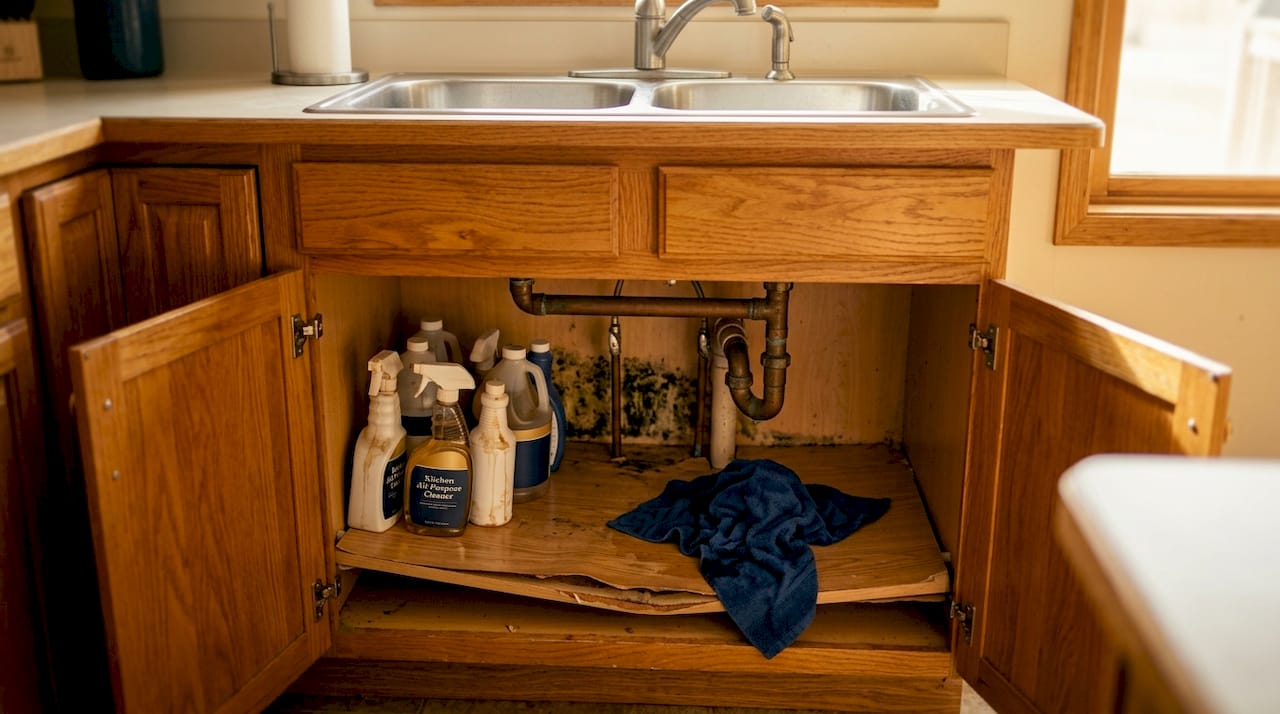
This is one of the most urgent but underappreciated reasons to address leaks quickly. You may not see the mold. You may not smell it right away. But if your family starts experiencing unexplained allergy symptoms, persistent coughing, or skin irritation, and you have had a recent water event, mold is the first thing to investigate.
Here is how to protect your household:
- Fix leaks before moisture has a chance to sit for more than 24 hours whenever possible.
- Maintain indoor humidity levels between 30 and 50 percent using dehumidifiers, especially in high-humidity coastal areas.
- Ventilate bathrooms, kitchens, and laundry areas actively. These spaces generate moisture daily.
- If mold already exists, areas exceeding 10 square feet require professional remediation, not DIY cleaning. Smaller areas can be addressed by homeowners with proper protective gear, but professional verification is always the safer call.
- After any mold cleanup, get a certified air quality test before closing up walls. Professional remediation requires verification and certification, which is also what your insurance company may require to honor a claim.
The good news: none of this has to happen at all if you treat leak detection as part of your regular home maintenance routine, not something you do only after water appears on your ceiling.
My take on what leak repair urgency really means
I have seen this play out more times than I can count. A homeowner notices a soft spot on a ceiling in January. By March, they finally call someone. What could have been a straightforward shingle repair and a drywall patch has become a mold remediation project, new insulation, and framing repairs. The total bill is six times what it would have been.
What strikes me most is that the delay rarely comes from not caring. It comes from underestimating how fast the clock moves once water enters a structure. The “I’ll deal with it next weekend” mindset is genuinely dangerous in ways most homeowners do not grasp until they are standing in a contractor’s estimate meeting.
The other thing I have learned is that poor planning during the repair itself creates almost as many problems as the delay. Homeowners who skip the roof repair process often end up with lingering moisture, odor issues, and mold returning within six months. The fix was incomplete because no one mapped where the water actually went.
My honest advice: treat the first sign of a leak the way you would treat a fire alarm. It may not be an emergency yet. But the window between “not yet” and “very expensive” is measured in days, not months.
— Buffaloroofingandexteriors
Protect your home with professional leak services
When you are dealing with a leak, the gap between a minor repair and a major restoration project comes down to how fast you act and who does the work. At Buffaloroofingandexteriors, we work with homeowners and property managers across Corpus Christi, San Antonio, and Victoria to stop leaks at the source before they become structural nightmares.

Our team brings professional leak detection, moisture mapping, roofing repairs, and exterior restoration under one roof. That means you are not coordinating between three separate contractors while water keeps spreading. We identify the true source, plan the repair before any walls are opened, and verify the work is complete before we leave. For storm-related water intrusion, our storm damage restoration services cover everything from emergency tarping through full interior recovery. You can also review our exterior and roofing repair guidance to understand exactly what fast action protects.
Get a free estimate today. The sooner you call, the simpler the fix.
FAQ
Why is it so important to repair leaks quickly?
Mold begins growing within 24 to 48 hours of water exposure, and structural materials weaken progressively the longer moisture sits. A repair that costs a few hundred dollars today can escalate to tens of thousands in remediation if left unaddressed for weeks.
Can insurance deny a claim for a delayed leak repair?
Yes. Insurance companies may deny coverage when damage results from long-term neglect rather than a sudden event. Prompt action and documented professional assessments significantly improve your chances of a successful claim.
What are the signs you need leak repairs immediately?
Water stains on ceilings or walls, soft or discolored drywall, musty odors, and unexplained spikes in your water bill are all signals that water is entering your home and that you need a professional inspection without delay.
How do leaks cause mold and health problems?
Mold spores are always present in indoor air, but they only colonize when they find a damp surface. A leak creates exactly that condition, and mold growth begins within 24 to 48 hours, triggering respiratory issues, skin reactions, and chronic inflammation in sensitive individuals.
What is the correct sequence for repairing a leak?
Confirm the true source, plan the repair, fix the entry point, map moisture spread, dry completely with professional equipment, and test again before closing walls. Skipping any step risks leaving moisture behind that leads to mold and repeat damage.
Recommended
- Why is it Important to Get Home Exteriors and Roofing Repaired Quickly? | Buffalo Roofing & Exteriors | San Antonio to Corpus Christi, TX
- Top Signs Your Roof Needs Repairs Before It’s Too Late | Buffalo Roofing & Exteriors | San Antonio to Corpus Christi, TX
- How to Repair Roof Leaks for Long-Lasting Protection
- How to Spot and Fix Roof Leaks Before They Lead to Major Damage | Buffalo Roofing & Exteriors | San Antonio to Corpus Christi, TX