TL;DR: Wind damage to roof shingles usually shows up as creased or curled tabs, lifted or missing shingles, and granule loss concentrated along roof edges and ridges — not as random scattered dents like hail. In the Corpus Christi, Alice, Aransas Pass, Banquete, and Beeville area, where design wind speeds run 140-150 mph, catching this damage early matters for both leak prevention and TWIA windstorm insurance eligibility.
A hard gust rolls through the Coastal Bend, the sky clears, and your roof looks fine from the driveway. But wind doesn’t always announce itself with missing shingles scattered across the lawn. Sometimes the damage is a hairline crease you’d only find by hand, and it’s just as capable of letting water into your attic.
Here’s what wind damage to roof shingles actually looks like, why it’s a bigger deal in South Texas than in most of the country, and when it’s time to stop guessing and call a roofer.
How Wind Actually Damages Shingles
Asphalt shingles are held down two ways: nails, and a factory-applied adhesive strip that bonds each shingle to the one below it. Wind doesn’t need to rip a shingle off to cause damage — it just needs to break that seal.
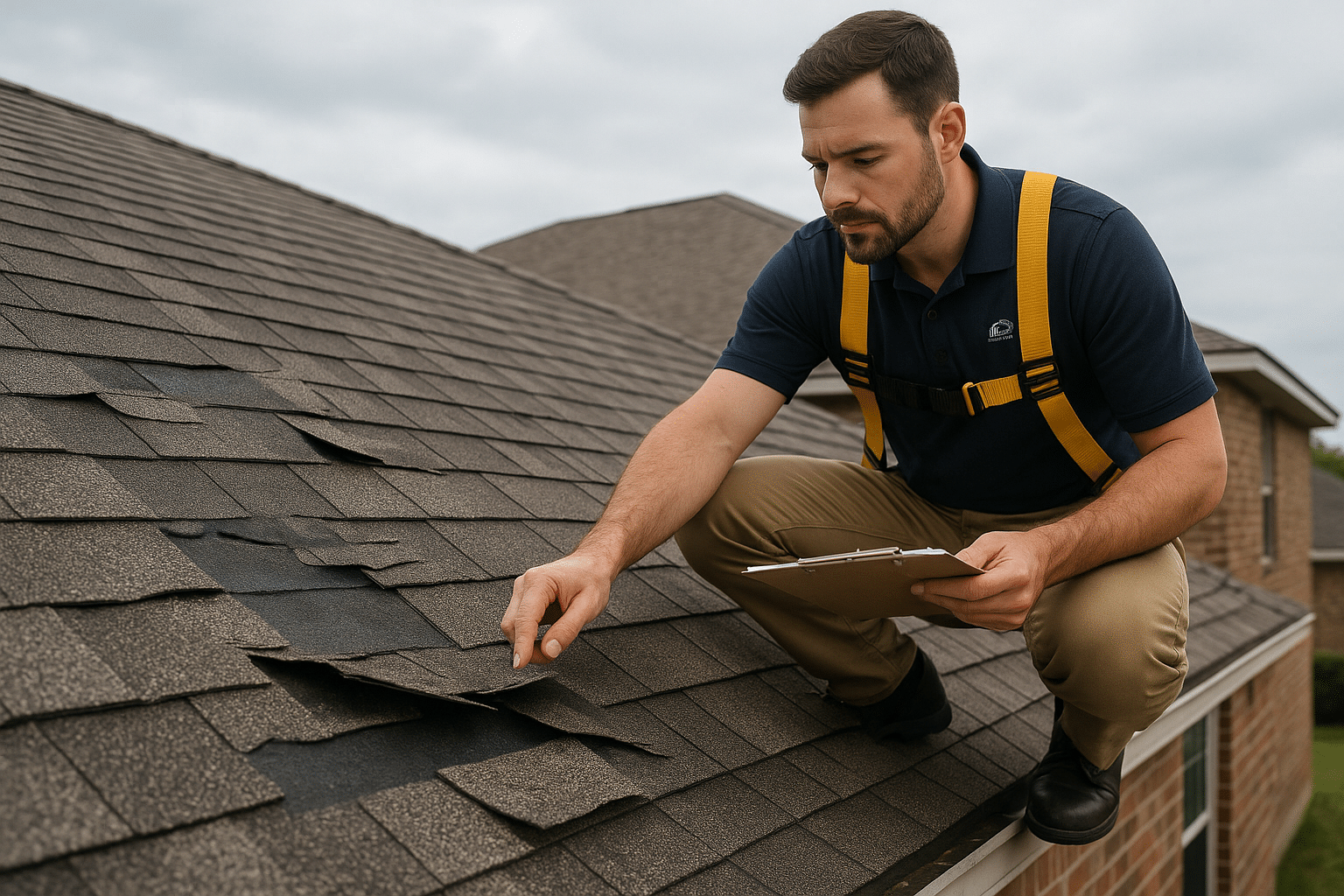
Wind breaks the factory adhesive strip that bonds each shingle to the one below.
The tab may not look damaged, but it lifts freely by hand and reseals poorly, leaving the next gust an entry point.
Once that bond is gone, every subsequent storm has an easier time getting underneath.
Industry research on wind-damaged shingles also points to a specific, lasting marker: the crease.
Once wind lifts and bends a shingle, it does not return to its original shape — a visible crease remains as physical evidence of the wind event, even if the shingle settles back into place.
A shingle can look perfectly flat again and still be structurally compromised.
What Wind Damage Looks Like on Your Roof
Most wind damage follows a pattern. It concentrates at the edges, hips, and ridgeline, because that’s where uplift pressure hits hardest — a very different footprint than hail, which tends to scatter randomly across the whole field. (If you’re trying to tell the two apart, our guide on spotting hail damage on shingles breaks down the hail-specific signs.)
Signs to look for from the ground
- Creased shingles:
A wind-lifted shingle that folds back leaves a fold line where granules rub off, usually a lighter horizontal streak — a creased shingle has a broken seal and a fatigued mat, so it counts as failed even after it lies flat again. - Curled or lifted edges:
Missing shingles are the most obvious, but even subtle signs like curled or lifted shingles can indicate wind uplift. - Missing shingles or bare patches:
Bare patches, or shingles in the yard, mean the seal and nails let go. - Granule loss:
Granule loss, where the small, protective granules on asphalt shingles are dislodged, exposes the underlying asphalt to the elements, accelerating deterioration.
Check your gutters for gritty buildup after a windy day. - Damaged flashing:
Damaged or missing flashing around chimneys, vents, and skylights is another critical sign, as flashing provides a watertight seal.
One important caution: not every unsealed shingle means wind damage. Insurance adjusters and forensic investigators look for actual creasing, tearing, or missing material — lifted-but-unbonded shingles alone, especially in repeating patterns, can point to installation defects or aging rather than a specific storm.
Why Wind Is a Bigger Issue in the Corpus Christi Area
This isn’t an abstract risk for homeowners in Corpus Christi, Alice, Aransas Pass, Banquete, or Beeville. The Coastal Bend sits in a zone where building codes already assume severe wind is part of life.
The region requires design wind speeds of approximately 140-150 mph (3-second gust) for Risk Category II structures per ASCE 7-22 wind maps — reflecting its position on the Gulf Coast and vulnerability to tropical cyclones.
These requirements are driven by the area’s hurricane history, including the devastating impact of Hurricane Celia (1970), which struck Corpus Christi as a Category 3 hurricane with 125 mph sustained winds.
Because of that exposure, shingles installed here aren’t the same as shingles installed inland.
Tier I requires asphalt shingles meeting ASTM D7158 Class H (130+ mph) AND ASTM D3161 Class F (110 mph), and the shingle must be installed strictly per the manufacturer’s instructions for high-wind application — typically 6 nails per shingle, sealed with manufacturer-applied or contractor-applied asphalt cement.
Even a correctly rated shingle can still crease or tear in a direct hurricane-force gust — a wind rating reduces risk, it doesn’t eliminate it.
If your home is older or the roof predates current fastening standards, it’s worth having it evaluated before the next named storm. Our hurricane roof damage guide covers what to do before, during, and after a storm in more detail.
Wind Damage vs. Normal Wear
Age-related curling and wind-related curling can look similar from the ground, but there’s a tell. Wind damage clusters on the windward slope and at roof edges; age-related wear spreads evenly across the whole roof as the asphalt dries out and loses flexibility over time. A roof that’s 10+ years old is more susceptible to both at once, which is part of why post-storm inspections on older roofs tend to turn up more findings.
Pros and Cons of DIY vs. Professional Assessment
A ground-level walk-around with binoculars is a reasonable first step — look for missing shingles, debris, bent flashing, and granules in the gutter. It costs nothing and flags obvious problems fast.
The downside: creases, broken seals, and early-stage lifting are very hard to confirm safely from the ground or without climbing the roof yourself, which isn’t something we’d recommend for a homeowner. A trained eye can tell the difference between cosmetic wear and a failed seal that will leak in the next rain, and can document findings the way an insurance adjuster expects to see them.
Why Wind Damage Shouldn’t Wait
Even one or two lifted shingles can let water sneak underneath during the next rain, and a shingle that’s already loose is far more likely to blow off entirely in the following storm.
Small wind damage left unaddressed tends to compound — a lifted tab becomes a leak, a leak becomes decking damage, and decking damage becomes a much bigger repair bill.
Wind Damage and Your Insurance Claim
If a storm has rolled through Nueces, Jim Wells, San Patricio, or Bee County, documenting wind damage matters for your claim — and for staying compliant with Texas windstorm rules. In the designated coastal catastrophe area, roof replacements and major repairs typically require a WPI-8, a Texas Department of Insurance (TDI) certificate confirming the work meets state windstorm building code.
A Texas Windstorm Certificate of Compliance is your proof that a building meets the wind-resistance standards required for insurance coverage through the Texas Windstorm Insurance Association, and without a valid certificate, most coastal properties are ineligible for TWIA windstorm and hail coverage.
Our WPI-8 windstorm certification guide walks through exactly what’s required and why it matters even if you’re not filing a claim right now.
When to Call a Roofer
Call for a professional, free estimate if you notice any of the following after a windstorm:
- Shingles missing, torn, or found in the yard
- Visible curling, cupping, or lifted edges, especially on one slope
- A sudden increase in granules in your gutters or downspouts
- Water stains on ceilings or ceiling tiles after a storm
- Bent, lifted, or missing flashing around vents, chimneys, or skylights
Even if nothing looks obviously wrong, a post-storm check is cheap insurance against a slow leak you won’t notice until it’s inside your walls.
Buffalo Roofing & Exteriors Serves the Coastal Bend
We’re a locally owned, BBB-accredited roofing contractor based in Corpus Christi, with additional reach into Alice, Aransas Pass, Banquete, Beeville, and the surrounding Coastal Bend. Every estimate is free, and we assist directly with insurance claims and WPI-8 certification paperwork so you’re not managing that process alone. Financing through Improvifi is also available, from $1,000 to $50,000 with $0 down and no credit score impact, if repairs need to happen before a claim settles.
If you’re also dealing with window damage from the same storm, our team handles that too — see our window replacement services for details.
Recommended Reads
- How to Spot Hail Damage on Your Shingles Before It Becomes a Bigger Problem
- Window Replacement Services Corpus Christi, TX
- Hurricane Roof Damage in Corpus Christi: What to Do Before, During, and After a Storm