

TL;DR:
- Composite decking is engineered from wood fiber, plastic, and additives, offering superior durability and low maintenance compared to traditional wood. Although initially more costly, its long lifespan and reduced upkeep expenses make it a cost-effective choice for homeowners planning to stay long-term. Proper installation and product selection tailored to coastal conditions are essential to maximize performance and warranty coverage.
Natural wood has always had a romantic appeal, but most homeowners who choose it discover the real cost within two years: scraping, sanding, staining, and patching on a cycle that never ends. Understanding why choose composite decking matters starts with seeing through that myth. Composite decking offers durability, low maintenance, and long-term value that traditional wood simply cannot match over a decade of real use. This guide walks you through the material science, the honest cost comparison, the trade-offs worth knowing, and the practical steps to make the best decision for your outdoor renovation.
Table of Contents
- Key Takeaways
- Why choose composite decking over traditional wood
- The real advantages of composite decking
- Composite decking vs wood: the real cost comparison
- Trade-offs worth knowing before you commit
- How to select, maintain, and get the most from composite decking
- My honest take after years of watching decks age
- Let Buffaloroofingandexteriors build your deck right
- FAQ
Key Takeaways
| Point | Details |
|---|---|
| Composite is engineered, not cut | Made from wood fiber, plastic, and UV stabilizers for stability and moisture resistance. |
| Maintenance costs add up fast with wood | Wood staining runs $550 to $1,250 per application every one to three years. |
| Composite lasts significantly longer | High-quality composite boards can last 25 to 50 years with minimal upkeep. |
| Trade-offs exist and matter | Composite boards are heavier and can run hotter in direct sunlight than wood. |
| Installation quality determines performance | Proper substructure spacing and drainage protect your warranty and prevent sagging. |
Why choose composite decking over traditional wood
Most people imagine composite decking as a plastic imitation of wood. It is not. Composite decking is manufactured using a blend of wood fiber, plastic, and additives like UV stabilizers and colorants. The result is a board engineered for stability, not just cut from a tree.
Here is what that means structurally. Natural wood is milled from timber, which retains the grain irregularities, knots, moisture content variations, and biological vulnerability of living material. Composite boards, by contrast, are pressed under consistent manufacturing conditions to produce uniform density. That process reduces splintering, warping, and the absorption of moisture that causes rot.
Two main types exist in the market today:
- Capped composite boards have a protective polymer shell wrapped around the wood-plastic core. This capping layer gives the board additional resistance to staining, fading, and mold. Most premium composite brands use full capping on all four sides.
- Uncapped composite boards lack that outer shell and are more susceptible to moisture absorption and surface staining over time. They cost less upfront but sacrifice performance.
| Feature | Capped Composite | Uncapped Composite |
|---|---|---|
| Moisture resistance | High | Moderate |
| Stain resistance | Excellent | Fair |
| Fade resistance | High | Moderate |
| Relative cost | Higher | Lower |
Choosing capped composite, especially for a coastal Texas environment where humidity and UV exposure are relentless, gives you the performance you are actually paying for.
The real advantages of composite decking
The core reason homeowners switch from wood to composite is straightforward: they get their weekends back. Composite decking requires no sealing, staining, or painting, unlike wood which typically needs re-staining every two years. That is not a minor convenience. It is dozens of hours of labor eliminated per decade.

Beyond time, the durability of composite decking changes what homeowners expect from their outdoor space. High-quality composite boards last 25 to 50 years with minimal care, compared to wood decks that require replacement every 10 to 15 years. That lifespan difference means you are not just buying decking material. You are choosing how many renovation projects you want to manage in your lifetime.
Here is what composite decking resists that wood cannot reliably hold off:
- Rot and moisture damage. Wood is a biological material. Without regular sealing, it absorbs water and begins to decay. Composite boards are moisture-resistant by design.
- Insect damage. Termites and carpenter ants target wood. The plastic content in composite boards gives insects nothing to consume.
- Mold and mildew. Coastal climates are particularly prone to mold growth on porous surfaces. Capped composite boards offer a non-porous surface that mold cannot grip.
- Fading and staining. Consumer Reports testing confirmed composite resists staining from ketchup, mustard, and common food spills. UV stabilizers in premium boards prevent color fading that turns wood gray.
- Surface inconsistency. Consumer Reports also notes that composite provides a uniform woodlike grain without the knots, splits, or irregularities that make natural wood boards visually inconsistent.
Pro Tip: If you live near the Gulf Coast, look for composite boards with a full four-sided cap. Salt air and humidity accelerate moisture damage on uncapped edges, which is the first place failure shows up on cheaper boards.
Composite decking vs wood: the real cost comparison
Upfront, composite decking costs more per square foot than pressure-treated pine or cedar. That is true. A basic pressure-treated wood deck might run $15 to $25 per square foot installed, while composite typically ranges from $30 to $45 per square foot. Sticker shock is real.
But the upfront price is only one chapter of the story.
| Cost Category | Wood Deck (25 Years) | Composite Deck (25 Years) |
|---|---|---|
| Initial installation | Lower | Higher |
| Staining/sealing | $550 to $1,250 every 1 to 3 years | None required |
| Board replacement | Common after year 10 to 15 | Rarely needed |
| Total lifetime cost | Often higher | Often lower |
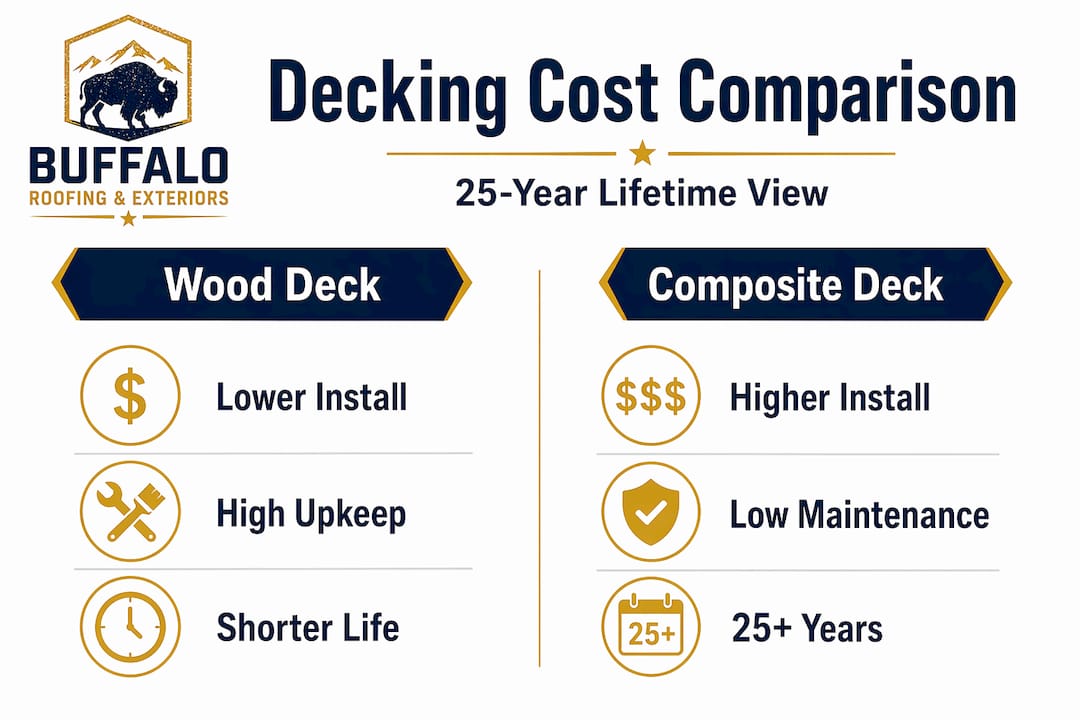
Wood staining costs $550 to $1,250 per application, and most wood decks need it every one to three years. Run the math over 25 years and that maintenance bill can easily exceed $10,000 before you factor in any board replacements or structural repairs. Composite decking’s low-maintenance nature means those ongoing costs disappear almost entirely.
The financial case for composite gets stronger the longer you plan to stay in your home. If you are renovating to sell in 18 months, wood may pencil out. But for homeowners planning to live in the house for five or more years, total cost of ownership consistently favors composite.
Pro Tip: Ask your contractor for a 25-year cost projection comparing both materials in writing. When you see the maintenance expenses laid out year by year, the composite premium shrinks fast.
Trade-offs worth knowing before you commit
Composite decking is not a perfect product. Knowing the real trade-offs makes you a smarter buyer and protects you from surprises post-installation.
Weight is a genuine consideration. Composite boards are generally heavier than pine, which affects installation labor and requires a structurally sound subframe. If you are building a second-story deck or replacing an existing structure, have a contractor evaluate whether your current framing can handle the load.
Surface temperature in direct sunlight is a commonly overlooked issue. Dark-colored composite boards can get noticeably hot on a Texas afternoon. If you walk barefoot on your deck regularly, lighter colors and boards designed with heat-reflective pigments are worth the extra research.
A few other factors homeowners frequently overlook:
- Slip resistance varies significantly by brand. Some composite products test well on wet surfaces; others do not. Ask for independent testing data, not just manufacturer claims, before purchasing.
- Structural flex differs from wood. Certain composite formulas have more flex than wood, which affects the feel underfoot. This is not necessarily a problem, but it matters in applications like pool surrounds where rigidity is preferred.
- Not all warranties are equal. A 25-year warranty on fading is not the same as a 25-year warranty on structural integrity. Read the warranty document and understand exactly what is covered.
Proper installation is non-negotiable for performance. Correct joist spacing, adequate drainage gaps between boards, and manufacturer-specified fasteners are required to maintain the warranty and prevent premature failure. Many reported composite decking problems trace back to installation errors rather than material defects.
Pro Tip: Download the installation guide for any composite product you are considering before you hire a contractor. If your contractor has not read it, find someone who has.
How to select, maintain, and get the most from composite decking
Choosing the right composite product for your project is not complicated, but it does require asking the right questions.
- Check the warranty scope. Premium manufacturers typically cover fading, staining, and structural integrity for 25 years or more. Confirm the warranty is transferable if you sell your home, which adds real resale value.
- Match the product to your climate. Coastal homeowners in Texas should look specifically for boards rated for high-UV exposure and salt-air resistance. Buffaloroofingandexteriors works with products tested in exactly these conditions, which matters more than a national brand reputation built in moderate climates.
- Choose color strategically. Lighter composite colors absorb less heat and show less fading over time. They also tend to look clean longer in high-traffic outdoor settings.
- Maintain it correctly, even though maintenance is minimal. Clean composite decks twice per year with a mild soap and water solution. Avoid pressure washing above 1,500 PSI, which can erode the cap layer on some products.
- Consider how the deck connects to your home. Composite decking enhances property value when it reads as a natural extension of your exterior. Think about siding color, trim, and railing materials before you finalize your board selection.
- Factor in how you use the space. A high-traffic family deck used for daily outdoor dining has different requirements than a quiet sitting area. Heavier-use decks benefit from boards with superior scratch and impact resistance ratings.
For homeowners in coastal Texas, composite decking is not just a style choice. It is a practical response to coastal weather conditions that accelerate the degradation of untreated or under-maintained wood. Pairing composite decking with complementary exterior renovation upgrades creates a home that holds its value and resists the environment simultaneously.
My honest take after years of watching decks age
I have seen hundreds of decks installed and revisited years later. The pattern is consistent. Homeowners who chose wood with the best intentions often reach out five to seven years in asking about replacement options, frustrated by rot, gray discoloration, or boards that are no longer safe to walk on barefoot.
Many homeowners underestimate the time and effort it takes to maintain a wood deck. Life gets busy. One skipped staining season becomes two, and by year four the damage is visible and expensive.
The mistake I see most often with composite is not choosing it. It is choosing the cheapest composite available and being surprised when it underperforms. Not all composites are built the same, and homeowners should evaluate product specs rather than assuming the category label guarantees quality.
My honest advice: if you are someone who genuinely enjoys outdoor maintenance projects, wood has real appeal. But if you want your outdoor space to look good with minimal intervention for the next 25 years, composite is the smarter material. The upfront cost difference is real. The lifetime savings and time recovery are more real.
The environmental angle matters too. Quality composite boards often incorporate recycled plastic and wood byproduct material, which reduces waste from both timber harvesting and plastic disposal. That is not the primary reason to choose composite, but it is a genuine benefit worth acknowledging.
— Buffaloroofingandexteriors
Let Buffaloroofingandexteriors build your deck right
At Buffaloroofingandexteriors, we build decks across Corpus Christi, San Antonio, and Victoria using composite materials selected specifically for Texas coastal conditions. We have seen what Gulf Coast humidity, UV intensity, and salt air do to wood decks that were not built for the environment, and we build accordingly.

Professional installation makes the difference between a composite deck that performs for 25 years and one that sags or voids its warranty inside five. Our crews follow manufacturer installation specs exactly, including substructure requirements and fastener protocols, because that is what protects both your investment and your warranty.
We also offer free estimates, financing options, and project consultations so you can see completed exterior renovation projects before committing. If you are ready to build a deck that will still look great a decade from now, contact us today for your free quote.
FAQ
What is composite decking made of?
Composite decking is made from a blend of wood fiber, recycled plastic, and additives including UV stabilizers and colorants. The mixture is engineered and pressed into boards that resist moisture, insects, and fading better than natural wood.
Is composite decking worth the higher upfront cost?
For homeowners staying in their home five or more years, composite decking typically costs less over time than wood once you factor in staining, sealing, and replacement costs that wood requires every one to three years.
How long does composite decking last?
High-quality composite decking lasts 25 to 50 years with minimal maintenance, compared to wood decks that typically need replacement after 10 to 15 years without consistent upkeep.
Does composite decking get hotter than wood in the sun?
Yes, dark-colored composite boards can reach higher surface temperatures than wood in direct sunlight. Choosing lighter-colored boards or products with heat-reflective pigments reduces this issue significantly.
Can composite decking be installed by any contractor?
Composite decking requires manufacturer-specific installation techniques for correct joist spacing, drainage gaps, and fastener types. Using a contractor unfamiliar with these requirements can void the product warranty and lead to premature failure.
Recommended
- Deck Building | Buffalo Roofing & Exteriors | San Antonio to Corpus Christi, TX
- Building a Deck That Can Handle Coastal Weather | Buffalo Roofing & Exteriors | San Antonio to Corpus Christi, TX
- Covered Deck vs. Open Deck, Decide Which Is Right for You? | Buffalo Roofing & Exteriors | San Antonio to Corpus Christi, TX
- The Life Expectancy of a Deck—And When to Replace It | Buffalo Roofing & Exteriors | San Antonio to Corpus Christi, TX