TL;DR:
- Upgrading commercial roofs can extend service life, reduce energy costs, and improve structural performance.
- Materials like TPO, PVC, and metal offer durability and energy efficiency benefits suited to specific building needs.
A commercial roof upgrade is defined as any planned improvement to a building’s roofing system that extends service life, reduces energy costs, or improves structural performance. For business owners and property managers in coastal Texas and across the Sun Belt, the right upgrade can cut cooling bills by 10 to 30%, add decades to a roof’s lifespan, and raise property value in a single project cycle. The most effective commercial roof upgrade ideas in 2026 combine proven materials like TPO, PVC, and EPDM with newer technologies such as silicone coatings, spray polyurethane foam, and cool roof systems. This article breaks down each option with real cost data and performance benchmarks so you can make a confident decision.
1. Top commercial roofing materials for upgrades in 2026
Choosing the right membrane is the single most consequential decision in any commercial roofing project. The material determines lifespan, maintenance frequency, energy performance, and total cost of ownership over decades.
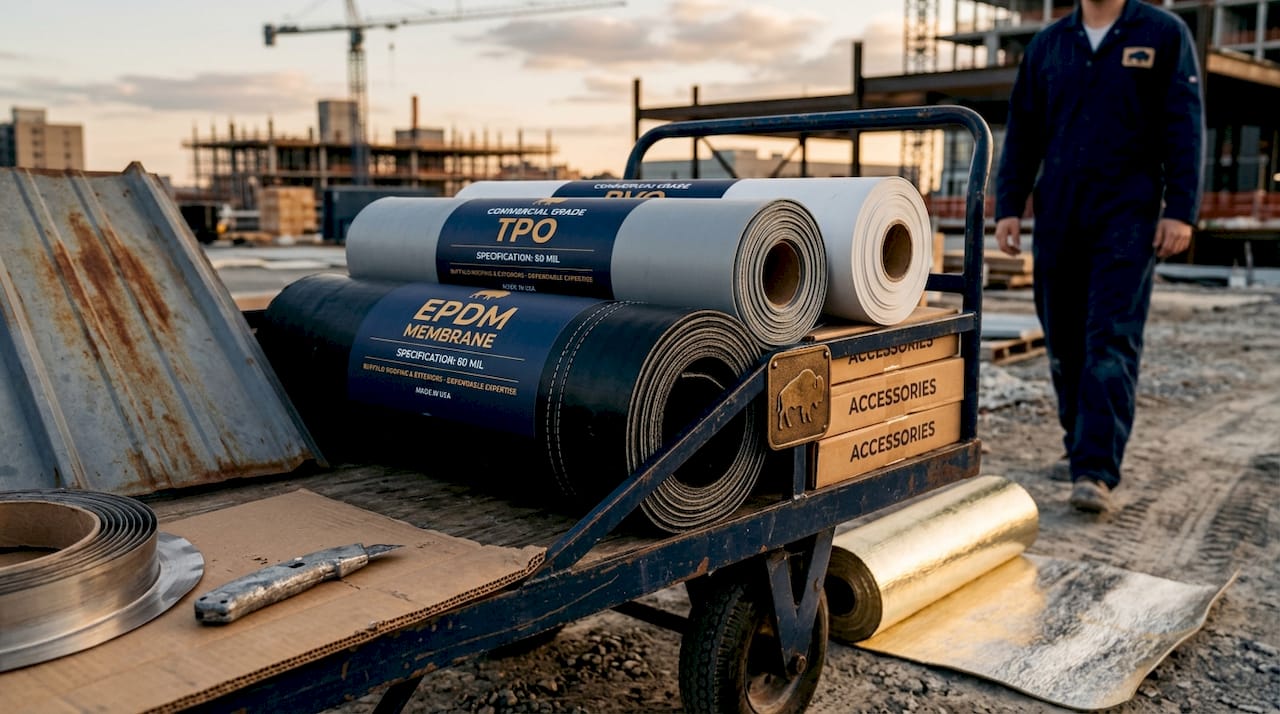
TPO (Thermoplastic Polyolefin) is the most widely installed single-ply membrane in the U.S. commercial market. White TPO membranes deliver solar reflectance values of 0.80 to 0.88 and thermal emittance above 0.90, meaning they meet cool roof code requirements without any additional coating. That makes TPO a strong default choice for flat and low-slope roofs in hot climates. You can learn more about TPO roofing features and why it performs well in South Texas heat.
PVC (Polyvinyl Chloride) shares similar reflectance performance with TPO but adds chemical resistance. Restaurants, food processing plants, and industrial buildings that deal with grease exhaust or chemical runoff benefit most from PVC’s tougher molecular structure. It costs slightly more per square foot than TPO but holds up better in those specific environments.
EPDM (Ethylene Propylene Diene Monomer) is a rubber membrane that excels in cold climates and on roofs with complex penetrations. It is flexible, UV-resistant, and relatively easy to repair. Standard black EPDM does not meet cool roof requirements, but white-coated EPDM versions are available for buildings in warmer zones.
Metal roofing is the premium long-term play. Metal roofs last 40 or more years with minimal maintenance, and factory-applied cool pigment coatings push SRI values into the 60 to 82 range. For a warehouse or retail center where aesthetics and longevity both matter, metal is hard to beat on a lifecycle cost basis.
Modified bitumen remains a cost-effective option for buildings that need a built-up system with redundant layers. It is familiar to most roofing crews, widely available, and performs reliably in moderate climates. It is not the most energy-efficient choice by default, but a reflective cap sheet or coating can close that gap.
| Material | Lifespan | Cool Roof Compliant | Best Use Case |
|---|---|---|---|
| TPO | 20 to 30 years | Yes (white) | Most flat commercial roofs |
| PVC | 20 to 30 years | Yes (white) | Industrial, restaurant roofs |
| EPDM | 20 to 25 years | With coating | Cold climates, complex roofs |
| Metal | 40 or more years | With cool pigment | Warehouses, retail, long-term holds |
| Modified bitumen | 15 to 25 years | With reflective cap | Budget-conscious upgrades |
For a deeper comparison of commercial roofing types suited to Texas property owners, the differences in performance by climate zone become especially clear.
2. How roof coatings extend life and cut energy costs
Roof coatings are liquid-applied systems that restore aging membranes, add reflectivity, and delay full replacement. They are the most cost-effective upgrade available when the existing roof substrate is structurally sound.
Roof coatings extend service life by 10 to 20 years at 50 to 70% less cost than a full tear-off replacement. That math is compelling for any property manager managing a tight capital budget. Coating a 20,000-square-foot roof typically runs $1.50 to $4.50 per square foot, compared to $6.00 to $14.00 per square foot for full replacement.
The three main coating types each serve a different condition:
- Silicone coatings perform best on roofs with ponding water issues. They resist moisture indefinitely and carry warranties of 15 to 20 years. They are the right call for flat roofs with drainage problems that cannot be easily corrected.
- Acrylic coatings are the budget-friendly option for dry climates with good drainage. They carry warranties of 10 to 15 years and reflect heat effectively, but they degrade faster in standing water.
- Polyurethane coatings offer the best impact and foot traffic resistance, making them ideal for roofs with regular maintenance access or rooftop equipment.
Pro Tip: Never apply a coating without manufacturer approval for your specific substrate. Applying coatings on unsuitable surfaces or without certified contractor requirements voids warranties and risks premature failure. Always get a substrate test done first.
Reflective coatings applied over dark existing membranes convert those surfaces into cool roofs without replacement. That single change can meaningfully reduce a building’s cooling load, particularly in South Texas where summer temperatures regularly exceed 95°F. For coastal buildings specifically, commercial roof coatings also provide a barrier against salt air degradation.
3. Sustainable and energy-efficient roofing options worth considering
Sustainable roofing is no longer a niche category. It is now a baseline expectation in commercial construction, driven by energy codes, utility rebate programs, and tenant demand for lower operating costs.
Cool roofs are the most accessible sustainable upgrade. To meet current U.S. energy codes, a cool roof needs an SRI of approximately 75 to 78, with a minimum aged solar reflectance of 0.63 and thermal emittance of 0.75. The key word is “aged.” Initial reflectance values printed on product sheets are always higher than real-world performance after a few years of weathering. Always specify aged reflectance when comparing products, not just the out-of-the-box number.
Cool roofs in hot climates reduce cooling costs by 10 to 30%, with DOE estimates showing annual savings of $4,000 to $7,000 for a 20,000-square-foot building in cities like Houston or Phoenix. For a Corpus Christi warehouse or San Antonio office building, those savings accumulate fast.
Green roofs add another layer of performance. A vegetated roof system reduces stormwater runoff, adds insulation value, and can contribute points toward LEED certification. They require structural assessment before installation since the added weight is significant, but for urban commercial properties, the combination of energy savings and stormwater credits often justifies the investment.
Solar panel integration is increasingly practical on commercial flat roofs. Ballasted racking systems require no roof penetrations, and modern TPO or PVC membranes are fully compatible with most mounting systems. Pairing a reflective membrane with rooftop solar creates a compounding energy benefit.
Pro Tip: Coordinate any cool roof upgrade with your HVAC contractor. Roofing upgrades that boost reflectivity can reduce overall cooling load, but only if your mechanical system is sized and calibrated to take advantage of the reduced heat gain. A mismatched system leaves money on the table.
| Upgrade Type | Energy Benefit | Additional Benefit | Best Climate |
|---|---|---|---|
| Cool roof membrane | 10 to 30% cooling cost reduction | Code compliance | Hot and humid |
| Reflective coating | Converts dark roof to cool roof | Extends membrane life | All climates |
| Green roof | Insulation and stormwater control | LEED points | Urban, moderate |
| Solar integration | Electricity generation | ROI via utility offset | High sun exposure |
4. Spray polyurethane foam as a flat roof upgrade
Spray Polyurethane Foam, known as SPF, is one of the most underused options in commercial roofing conversations. SPF roofs last 50 or more years with recoat cycles every 10 to 20 years, making the lifecycle cost among the lowest of any system.
SPF is applied as a liquid that expands into a rigid foam, creating a seamless, self-flashing surface with no seams or fasteners to fail. The insulation value is exceptional, with R-values typically ranging from R-6 to R-7 per inch. For a building with inadequate insulation, SPF solves two problems at once: it adds a new weatherproof membrane and upgrades the thermal envelope in a single application.
The main limitation is UV sensitivity. SPF requires a protective topcoat, typically silicone or polyurethane, to shield it from sun degradation. That recoat cycle is the ongoing maintenance commitment, but it is far less disruptive and expensive than a full membrane replacement.
5. Thermal bridging solutions for metal-over-metal recover projects
Metal-over-metal recover is a popular upgrade path for aging metal buildings. Instead of tearing off the old roof, a new metal panel system is installed over the existing structure. The cost savings over full tear-off are significant, but thermal bridging is a real concern in these assemblies.
Thermal bridging occurs when metal purlins or fasteners conduct heat directly through the insulation layer, undermining the thermal performance of the entire system. The fix involves thermal-break layers such as flute-fill insulation, continuous insulation boards, or air gaps between the old and new roof planes. Skipping this detail is a common mistake that leaves energy savings unrealized even after a significant capital investment.
If you are planning a metal recover project, specify the thermal break detail in writing before work begins. Ask your contractor to show you the assembly drawing and confirm the R-value calculation accounts for the bridging effect.
6. Roof maintenance as a cost-effective upgrade strategy
Not every improvement requires new materials. Proper roof inspection and maintenance can extend commercial roof lifespan by 30 to 100%, delaying costly replacements by years. That range is wide, but it reflects real-world outcomes where a neglected roof fails at 15 years and a maintained version of the same system reaches 30.
A structured maintenance program includes biannual inspections, prompt repair of membrane punctures and seam separations, clearing of drains and scuppers, and documentation of all work performed. That documentation matters for warranty claims and for establishing the roof’s condition history before any coating or restoration project.
Roof cleaning is a maintenance step that many property managers overlook. Algae, mold, and debris accumulation reduce reflectivity on white membranes and trap moisture against the surface. A professional soft wash restores reflectance and removes biological growth before it degrades the membrane.
7. How to choose the right upgrade based on budget and building needs
The decision between coating, restoration, and full replacement comes down to three factors: current roof condition, remaining warranty life, and your capital budget.
If the existing membrane has less than 25% of its surface area damaged and no active leaks in the deck or insulation, a coating or restoration system is almost always the right call. You preserve the existing investment, extend the warranty, and avoid landfill disposal costs. If the deck is wet or the insulation is saturated, coating over the problem locks moisture in and accelerates failure. In that case, full replacement is the only responsible path.
For budget-conscious upgrades, deciding between cleaning and replacement is a useful first filter. A professional inspection with core cuts to test insulation moisture content gives you the data to make that call with confidence rather than guesswork.
Building use also shapes material selection. A restaurant needs PVC for grease resistance. A cold-storage warehouse benefits from SPF’s insulation value. A retail center with visible rooflines gains from metal’s aesthetic options. Matching the material to the operational environment is as important as matching it to the climate.
Key takeaways
The most cost-effective commercial roof upgrades combine the right material for the building’s use case with a maintenance strategy that protects that investment over decades.
| Point | Details |
|---|---|
| Material selection drives performance | TPO and PVC meet cool roof codes by default; match material to building use and climate. |
| Coatings deliver strong ROI | Coatings cost 50 to 70% less than replacement and add 10 to 20 years of service life. |
| Aged reflectance values matter | Always specify aged solar reflectance, not initial values, when comparing cool roof products. |
| Maintenance multiplies upgrade value | Regular inspections and prompt repairs can extend any roof system’s lifespan by 30 to 100%. |
| Coordinate with HVAC | Cool roof upgrades only deliver full energy savings when the mechanical system is calibrated to match. |
What I’ve learned after years of commercial roofing projects
The most common mistake I see business owners make is treating a roof upgrade as a one-time transaction rather than a system decision. They pick a material based on price per square foot, skip the HVAC coordination conversation, and then wonder why their energy bills didn’t drop after spending six figures on a new membrane.
Cool roof performance is real, but it is conditional. A white TPO membrane on a building with R-10 insulation and an oversized HVAC unit will not deliver the same savings as the same membrane on a properly insulated building with a well-calibrated system. The roof is one component in a thermal envelope, not a standalone fix.
The other thing I push hard on is aged reflectance. Every manufacturer leads with initial reflectance in their marketing materials because those numbers are higher and more impressive. But the number that matters for code compliance and real-world energy savings is the aged value after three years of weathering. Specifying a product based on initial reflectance alone is how you end up with a roof that passes inspection on day one and underperforms for the next 20 years.
Liquid-applied coatings have genuinely changed the economics of commercial roofing for property managers working with tight budgets. The ability to restore a 15-year-old membrane for $2.50 per square foot instead of replacing it for $10 per square foot is a real financial tool, not a compromise. The key is getting the substrate assessment right before committing to a coating system.
— Buffaloroofingandexteriors
How Buffaloroofingandexteriors can help with your next project
Buffaloroofingandexteriors installs TPO, PVC, metal roofing, and liquid-applied coating systems for commercial properties across Corpus Christi, San Antonio, and Victoria. Every project starts with a professional inspection to determine whether restoration or replacement delivers the better return for your specific building.
The team at Buffaloroofingandexteriors brings manufacturer-certified installation on all major commercial systems, which means your warranty stays intact from day one. Browse completed commercial roofing projects to see the quality of work firsthand, or explore the full range of flat roof materials and services available for your building. Free estimates and financing options are available. Contact the team today to schedule your inspection.
FAQ
What is the most durable material for a commercial flat roof?
Metal roofing lasts 40 or more years and carries the longest lifespan of any commercial system, but TPO and PVC membranes offer 20 to 30 years of service life at lower upfront cost and are the most widely installed options for flat roofs today.
How much do roof coatings cost compared to full replacement?
Roof coatings typically cost $1.50 to $4.50 per square foot, compared to $6.00 to $14.00 per square foot for full replacement. That cost difference makes coatings the preferred option when the existing substrate is structurally sound.
Do commercial roof upgrades qualify for energy rebates?
Yes. Cool roof systems that meet CRRC-rated aged reflectance and thermal emittance thresholds qualify for utility rebates in many states, and solar-integrated roofing systems qualify for federal investment tax credits. Check with your local utility and a tax advisor for current program details.
How often should a commercial roof be inspected?
Commercial roofs should be inspected at least twice per year, typically in spring and fall, plus after any major storm event. Consistent inspections are the single most reliable way to catch small problems before they become expensive failures.
When is a coating the right choice versus full replacement?
A coating is the right choice when less than 25% of the roof surface is damaged and the insulation is dry. If core cuts reveal saturated insulation or the deck is compromised, full replacement is necessary to avoid trapping moisture under the new system.