Most Texas coastal homeowners spend a lot of time worrying about their roof before hurricane season, and that makes sense. But here’s what often gets overlooked: your siding is taking the same beating, and in many storms, it fails first. Siding covers every vertical surface of your home’s exterior, and when it gives way, wind-driven rain, salt air, and debris pour straight into your walls. This guide breaks down exactly how siding defends your coastal property, which materials hold up best, where most installations go wrong, and what you can do right now to keep your home protected.
Table of Contents
- Why siding is essential for coastal home protection
- How siding defends against Texas coastal hazards
- Best siding types for storm-prone Texas homes
- Why installation quality matters as much as material
- Maintaining siding for year-round protection
- Get professional help protecting your Texas coastal home
- Frequently asked questions
Key Takeaways
| Point | Details |
|---|---|
| Siding shields your home | The right siding can protect your Texas coastal house from severe wind, water, and debris damage. |
| Material and installation work together | Even the strongest siding only works when expertly installed to code with no weak points. |
| Regular maintenance prevents costly repairs | Routine inspections and timely fixes keep your siding storm-ready and may lower insurance costs. |
| No single solution is invincible | Best results come from combining quality siding, professional installation, and other storm-hardening strategies. |
Why siding is essential for coastal home protection
Siding is the layer of material installed over your home’s structural sheathing, covering the exterior walls from foundation to roofline. It’s not decorative. It’s functional armor. Along the Texas coast, your home faces hurricane-force winds, wind-driven rain that travels horizontally, salt spray that corrodes and weakens materials, flying debris, intense UV radiation, and persistent moisture. Without solid siding, all of those hazards reach your wall framing, insulation, and interior finishes.
How siding protects homes from these forces is more layered than most people realize. It prevents water intrusion that leads to wood rot and mold. It blocks debris from punching through to structural components. It also plays a role in your home’s energy efficiency by keeping conditioned air inside.
Properly installed siding shields:
- Structural framing from wind pressure and moisture
- Wall insulation from water saturation
- Interior finishes like drywall and flooring from leaks
- Energy efficiency by sealing the building envelope
- Foundation areas from splash-back and pooling water
“Siding shields homes from wind, rain, debris, moisture, salt air, and harmful UV, and acts as the first line of defense in Texas coastal storms.”
When siding fails, the repair costs don’t stop at the exterior. Water that gets behind panels can destroy insulation, rot framing, and trigger mold growth inside walls, turning a siding repair into a full interior renovation. That’s the real cost of underestimating it.
With this big-picture understanding of siding’s purpose, let’s dive deeper into how it performs under Texas coastal conditions.
How siding defends against Texas coastal hazards
Texas coastal storms are not gentle. Hurricanes and tropical storms can push wind speeds over 150 mph, and the wind doesn’t come alone. It carries rain at near-horizontal angles, salt particles that corrode fasteners and finishes, and debris ranging from small branches to full fence panels.
Here’s how siding responds to each major threat:
- High winds: Panels must be fastened to code to resist uplift and lateral pressure. Loose panels peel away and expose sheathing.
- Wind-driven rain: Sealed seams and proper flashing prevent water from traveling behind panels.
- Salt air: Corrosion-resistant fasteners and coatings prevent premature material breakdown.
- Flying debris: Impact-rated materials absorb strikes without cracking or puncturing.
The weakest points in any siding system are corner boards, panel edges, and fastener locations. These are where failures start. Siding’s role in storm protection is only as strong as those connection points.
Research from post-hurricane performance data found that modern code-built homes showed no structural damage after 150+ mph gusts, but siding and soffits remained vulnerable when not installed to the highest standards. The structure survived. The exterior envelope didn’t always.
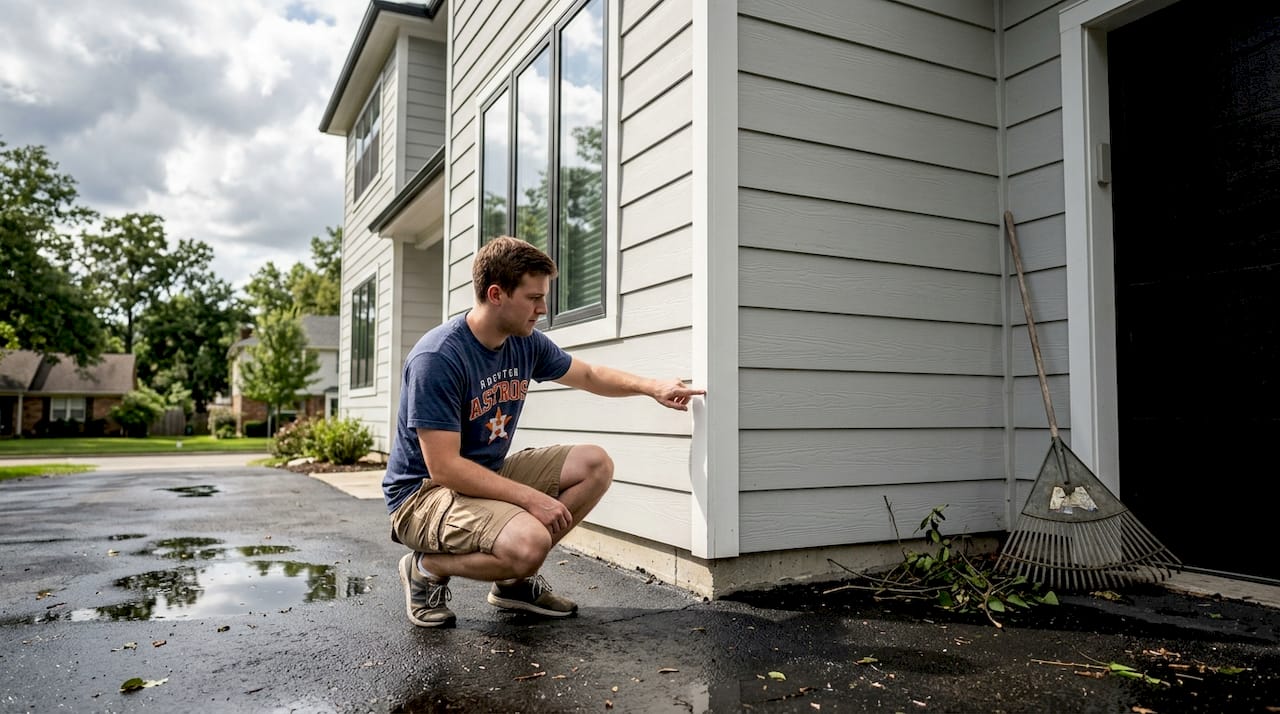
Pro Tip: Before hurricane season, walk your home’s perimeter and press gently on each panel. Any flex, rattle, or movement means that panel isn’t fastened correctly and needs attention before a storm arrives. Learn more about how to get your siding hurricane-ready before the season starts.
Understanding the threats sets the stage for choosing the best material. Next, we’ll compare top siding options for storm-prone regions.
Best siding types for storm-prone Texas homes
Not all siding materials are built the same, and on the Texas coast, that difference matters a lot. Here’s how the four most common options stack up:
| Material | Wind resistance | Impact resistance | Moisture resistance | Maintenance | Cost | Durability |
|---|---|---|---|---|---|---|
| Steel | Excellent | Excellent | Very good | Low | High | 40+ years |
| Fiber cement | Very good | Very good | Excellent | Moderate | Moderate | 30+ years |
| Engineered wood | Good | Good | Good | Moderate | Moderate | 20-30 years |
| Vinyl | Fair | Fair | Good | Low | Low | 15-25 years |
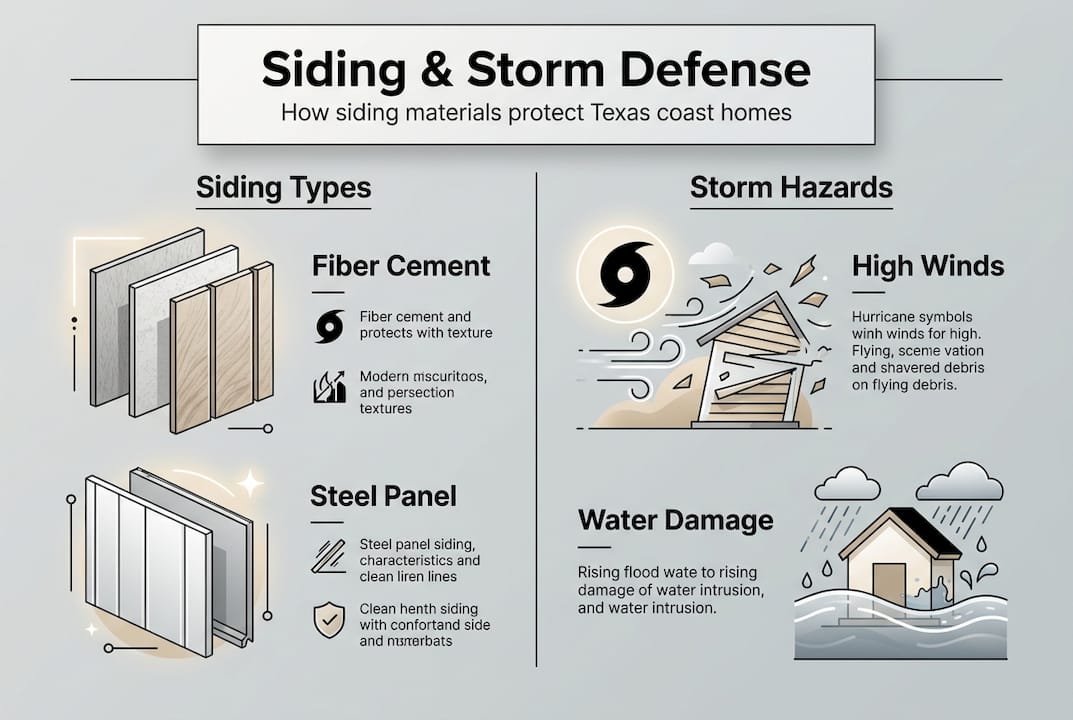
Steel siding leads the pack for raw wind and impact resistance. It won’t crack from debris strikes and holds fasteners extremely well. The tradeoff is cost. Fiber cement, like James Hardie products, offers a strong balance of impact resistance, moisture protection, and fire resistance, making it the most popular choice for coastal Texas homes. Engineered wood performs well but needs more attention to moisture sealing. Vinyl is the most affordable option but is the least resilient under high-wind and impact conditions.
Key differences to keep in mind:
- Choose vinyl if budget is the primary concern and you’re in a lower-risk wind zone
- Choose fiber cement for the best balance of protection, cost, and longevity
- Choose steel if you want maximum impact and wind protection and can absorb the higher upfront cost
- Choose engineered wood if aesthetics are a priority and you commit to regular maintenance
For a deeper look at how these storm-resistant siding options compare across wind, moisture, and impact scores, the data is clear: material choice matters, but it’s not the whole story.
“No single siding type is invincible without proper installation and assembly. The material sets the ceiling for performance, but installation determines whether you reach it.”
Choosing a material is only half the battle. Here’s why installation and assembly are equally important for weathering coastal storms.
Why installation quality matters as much as material
You can buy the best siding on the market and still end up with a home that fails in a storm. Installation is where most siding systems fall short. Siding and soffits are often the weak links in otherwise code-compliant homes, with design pressure (DP) ratings and fastener quality making the critical difference.
Here are the top installation practices for Texas coastal homes:
- Verify your contractor is listed with the Texas Department of Insurance (TDI) for wind-resistant installation
- Specify panels with high DP ratings appropriate for your wind zone
- Use stainless steel or hot-dipped galvanized fasteners to resist salt-air corrosion
- Seal all seams, joints, and penetrations with compatible flashing and caulk
- Follow FORTIFIED Home standards where possible for maximum storm resilience
| Failure point | Poor installation | Proper installation |
|---|---|---|
| Corner boards | Nailed loosely, gaps present | Sealed, fastened to stud framing |
| Panel edges | Overlapping without flashing | Flashed and caulked at all transitions |
| Fasteners | Standard nails, inconsistent spacing | Stainless fasteners, code-compliant spacing |
| Soffit connections | Loose, no wind clips | Secured with wind-rated clips |
Pro Tip: Ask your contractor specifically about DP ratings and fastener specs before signing any contract. A contractor who can’t answer those questions clearly is not the right fit for a coastal Texas installation. Review siding installation best practices to know what questions to ask.
With siding correctly chosen and installed, ongoing maintenance becomes your next line of defense against costly hurricane losses.
Maintaining siding for year-round protection
Even the toughest siding system needs regular attention to keep performing. Salt air and intense Texas sun are relentless. They cause fading, brittleness, and micro-cracks that let moisture in long before a storm ever arrives. Catching these early is far cheaper than dealing with the aftermath.
Here’s a practical maintenance schedule:
- Pre-season inspection (May): Check every panel for cracks, loose sections, or gaps. Look for fading or chalking that signals UV breakdown. Inspect caulk lines and flashing.
- Post-storm check: Walk the perimeter after any significant weather event. Look for dents, missing panels, or areas where water may have gotten behind the siding.
- Annual cleaning: Wash siding with a low-pressure rinse to remove salt deposits, mold, and dirt. Salt buildup accelerates corrosion and material breakdown.
- Prompt repairs: Don’t let small cracks or loose panels sit. Water finds every gap, and what starts as a minor repair becomes a major one fast.
Early warning signs to watch for include cracks, loose panels, and mold growth at panel edges, as well as paint that’s peeling or bubbling, which often signals moisture is already behind the surface. If you’re seeing those signs, check out identifying siding problems before the damage spreads.
Pro Tip: Never use a high-pressure washer directly on siding panels. The force can drive water behind panels and damage seals, creating the exact moisture problem you’re trying to prevent. A garden hose with a spray nozzle is enough for routine cleaning.
For a full breakdown of what to check and when, the siding maintenance tips guide covers the complete seasonal checklist. And if a storm has already done damage, storm damage repair tips can help you act fast before secondary damage sets in.
Get professional help protecting your Texas coastal home
Selecting the right siding material, having it installed to coastal code standards, and keeping up with seasonal maintenance are the three pillars of a storm-ready exterior. When all three come together, your home is genuinely prepared for what Texas weather throws at it.
At Buffalo Roofing & Exteriors, we work with homeowners across Corpus Christi, San Antonio, and Victoria to deliver expert siding solutions built for coastal conditions. Whether you need a full siding replacement, a pre-season inspection, or fast storm damage repair services after a hurricane, our team knows what it takes to protect homes in this region. Our coastal siding installation experts follow the highest installation standards so your investment holds up when it matters most. Reach out for a free estimate and let’s make sure your home is ready.
Frequently asked questions
Which siding material stands up best to Texas coast storms?
Steel siding offers the top wind and impact resistance, but fiber cement and engineered wood are excellent choices for most homes when installed properly. The right pick depends on your budget, wind zone, and long-term maintenance commitment.
How often should I inspect my siding on the Texas coast?
Inspect your siding at least twice a year, before and after hurricane season, to catch damage, fading, or loose panels early. After any major storm, do an additional walkthrough right away.
Does professional installation really matter for siding performance?
Absolutely. Even premium materials can fail without code-compliant fasteners, proper flashing, and sealed seams. Siding and soffits are consistently identified as the weak links in otherwise solid homes when installation shortcuts are taken.
Can maintaining my siding lower my insurance costs?
Well-maintained, code-compliant siding reduces the likelihood of storm claims, and some insurers reward that with lower premiums or deductibles. Keeping records of inspections and repairs can support your case when talking to your insurance provider.