A hurricane deductible is a separate, higher out-of-pocket amount that applies specifically to hurricane or named-storm losses under your homeowners policy. Unlike the standard deductible (often a flat $1,000 or $2,500), this one is usually expressed as a percentage of your dwelling coverage (Coverage A), which means it can run into the tens of thousands of dollars. The NAIC reports that as of June 2025, multiple states plus Washington, D.C. have some form of hurricane or named-storm deductible in place.
Three things to do right now:
- Pull out your declarations page and find the line labeled “hurricane deductible” or “named-storm deductible.”
- Multiply that percentage by your Coverage A dwelling limit to get the actual dollar amount you would owe after a qualifying storm.
- Set aside emergency funds or confirm a financing option that covers that amount before hurricane season opens.
The Insurance Information Institute (III) recommends keeping that declarations page somewhere accessible, because the trigger language printed there determines whether the deductible applies at all.
Key Takeaways
Understanding your hurricane deductible before a storm hits is the single most effective step coastal homeowners can take to avoid a financial shock during claims.
| Point | Details |
|---|---|
| Find your deductible now | Check the declarations page for the percentage and multiply by Coverage A to get your dollar amount. |
| Percentage beats flat math | A 5% deductible on a $300,000 home means $15,000 out of pocket, regardless of total loss size. |
| Trigger language is critical | Named-storm triggers fire more often than hurricane-only triggers — verify which one your policy uses. |
| Document and file even for small losses | Hidden damage often surfaces later; an unopened claim cannot be supplemented. |
| Buffaloroofingandexteriors | Provides free storm inspections, adjuster-aligned estimates, and full restoration across South Texas. |
Table of Contents
- How does a hurricane deductible work, and what will you actually owe?
- When does a hurricane deductible apply, and what does it leave out?
- How deductible size affects what you pay in premiums
- Should you file a claim when damage looks smaller than your deductible?
- How to prepare before hurricane season and reduce your out-of-pocket costs
- Step-by-step claims checklist after a hurricane
- What consumer protections and resources are available to you?
- A contractor’s perspective on what homeowners get wrong
- Storm damage repair and restoration from Buffaloroofingandexteriors
- Sources
How does a hurricane deductible work, and what will you actually owe?
The math is simpler than most homeowners expect, but the dollar figure is usually much larger than they anticipate.
Percentage vs. flat-dollar deductibles
Most coastal policies use a percentage deductible tied to Coverage A, not to the size of your loss. According to Investopedia, common ranges run from low single-digit percentages, though some coastal areas see higher percentages. A flat-dollar alternative (say, $5,000 or $10,000) exists in some states, but it is less common in high-risk coastal zones.
The calculation, step by step:
- Find your Coverage A limit on the declarations page (example: $300,000).
- Find your hurricane deductible percentage (example: 5%).
- Multiply: $300,000 × 5% = $15,000 out of pocket.
- That $15,000 applies whether your total loss is $20,000 or $100,000.
That last point trips up a lot of homeowners. As Latent Insurance explains, the deductible is calculated against your dwelling limit, not the damage amount. A $20,000 loss with a $15,000 deductible leaves your insurer paying only $5,000.
Pro Tip: If your policy carries an inflation-guard endorsement, your Coverage A increases automatically each year — and so does your hurricane deductible in dollar terms. Recalculate the dollar amount every renewal cycle, not just when you first buy the policy.
When does a hurricane deductible apply, and what does it leave out?
Trigger language is where policies diverge most, and where homeowners get the biggest surprises.
Common triggers
Insurers typically activate the hurricane deductible when the National Hurricane Center (NHC) or National Weather Service (NWS) issues a named-storm declaration, a hurricane watch, or a hurricane warning for your area. Timing windows commonly run from the moment a watch or warning is issued through 24–72 hours after it ends, depending on your state and insurer. A named-storm trigger activates at tropical-storm strength; a hurricane trigger requires the NHC to declare hurricane-force winds. That distinction matters: named-storm triggers fire more often.
State-level variation
| State pattern | Typical trigger | Statutory cap or note |
|---|---|---|
| Florida | Named storm or hurricane watch/warning | 2%, 5%, 10% options required |
| Texas | Wind/hail (standard) or named storm (separate) | No statewide cap; WPI-8 certificate relevant on coast |
| New York | Named storm | Disclosure required on declarations page |
| Maryland | Hurricane watch/warning | Insurer must file trigger language with state |
| Rhode Island | Named storm | Separate deductible required by regulation |
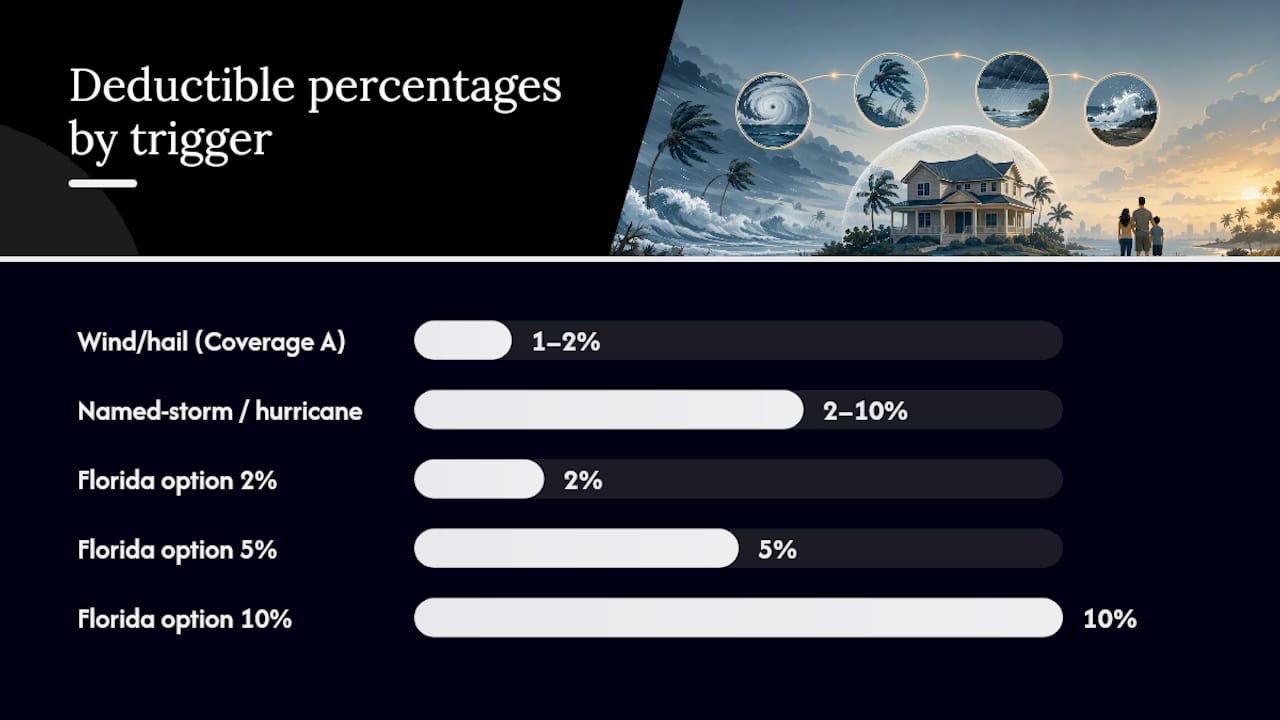
Texas deserves a closer look for coastal homeowners here. According to Granados Insurance, many Texas coastal policies carry two separate deductibles: a wind/hail deductible (commonly 1%–2% of Coverage A) for ordinary wind events, and a named-storm or hurricane deductible (commonly 2%–10%) that kicks in only when the NHC names a storm. The trigger you have determines how often you pay the higher amount.
What the deductible does NOT cover
Wind damage to your roof, siding, and structure falls under the hurricane deductible. Flood and storm surge do not. Those losses require a separate National Flood Insurance Program (NFIP) policy or private flood insurance. Confusing wind damage with flood damage is one of the most expensive mistakes coastal homeowners make after a major storm.
How deductible size affects what you pay in premiums
Higher deductibles lower your annual premium, but the trade-off deserves a hard look before you accept it.
- Lower percentage deductibles carry higher premiums but limit out-of-pocket exposure on mid-range home values.
- Moderate percentage deductibles reduce premiums noticeably but come with higher out-of-pocket costs.
- Higher percentage deductibles, found in some high-risk coastal zones, mean substantial out-of-pocket expenses before your insurer pays.
These deductibles expanded after Hurricane Andrew (1992) and Hurricane Katrina (2005) as insurers sought to limit catastrophic losses while keeping policies available in coastal markets.
Should you file a claim when damage looks smaller than your deductible?
Yes. File, or at minimum notify your insurer and document everything.
Here is why: what looks like $8,000 in visible damage often becomes $14,000 once a contractor opens the wall or inspects the attic. The III advises that additional damage frequently surfaces after the initial assessment, and a claim you never opened cannot be supplemented later.
Decision checklist:
- Get a written contractor estimate before deciding anything.
- If the estimate is within 20%–30% of your deductible, open a claim — hidden damage is common.
- If the estimate is clearly well below your deductible, document thoroughly and notify your insurer in writing anyway.
- Keep all receipts for temporary repairs (tarps, board-ups) — those costs count toward your claim.
- Check whether your state allows annual deductible aggregation; some states let multiple storms in one season share a single deductible application.
Pro Tip: In states with per-occurrence deductibles, two named storms in one season mean two separate deductible payments. Ask your agent explicitly whether your policy is per-occurrence or per-season before the next storm forms.
How to prepare before hurricane season and reduce your out-of-pocket costs
Preparation before a storm is cheaper than scrambling after one.
Pre-season checklist:
- Confirm your Coverage A limit and recalculate your deductible dollar amount.
- Photograph every room, every appliance, and the exterior from all four sides — store photos in cloud backup.
- Locate your declarations page and save a digital copy.
- Price storm shutters, hurricane-rated windows, or roof strap upgrades — some states require insurers to offer mitigation discounts for these improvements.
- Ask your agent whether switching to a flat-dollar deductible is available and what the premium difference would be.
Mitigation upgrades do more than reduce damage. In several states, insurers must offer premium credits when homeowners install qualifying wind-resistance improvements, such as impact-resistant roofing, storm shutters, or reinforced garage doors. The NAIC notes that some states cap hurricane deductibles or require specific disclosure examples on the declarations page, so checking your state insurance department’s website is worth 20 minutes of your time.
For coastal Texas homeowners, exterior upgrades that meet Texas Department of Insurance standards can sometimes qualify for windstorm credits on TWIA policies.
Pro Tip: Schedule mitigation upgrades before your policy renewal date, not after. Insurers typically require documentation of completed work before applying a premium credit, and the credit applies at renewal, not mid-term.
Step-by-step claims checklist after a hurricane
Act quickly, but do not rush past the documentation step — it protects your claim.
- Confirm safety first. Do not enter a structurally compromised building. Check for gas leaks, downed lines, and standing water.
- Photograph and video everything before touching or moving anything. Capture roof, siding, windows, interior ceilings, and any personal property damage. A thorough guide to documenting weather-related damage can help you capture what adjusters look for.
- Make temporary repairs to prevent further damage (tarps, board-ups). Keep every receipt — these costs are typically reimbursable.
- Contact your insurer to open a claim. Get a claim number and the adjuster’s contact information in writing.
- Get at least two contractor estimates with itemized line items. Vague lump-sum estimates make it harder to negotiate partial payments or recoverable depreciation.
- Track all communications with dates, names, and summaries.
When hiring a contractor, ask:
- Are you licensed and insured in Texas?
- Do you carry workers’ compensation coverage?
- Can you provide references from storm-damage repairs specifically?
- What does your estimate include, and what triggers a change order?
Red flags: contractors who demand full payment upfront, cannot provide a written estimate, or pressure you to sign an assignment of benefits before your adjuster has inspected. For guidance on working with adjusters to secure fair repair outcomes, that process is worth understanding before the adjuster arrives.
Your deductible is subtracted from the total covered loss during settlement. If your covered loss is $25,000 and your deductible is $15,000, the insurer pays $10,000. Itemized estimates matter because they give you and the adjuster a shared baseline for that calculation.

Pro Tip: Ask your contractor to document every repair with photos at each stage. That record supports any supplement claim if additional damage is found mid-repair.
What consumer protections and resources are available to you?
You have more options than most homeowners realize.
- State insurance department: File a complaint or request a policy review if your insurer disputes your claim. Every state has a department; Texas homeowners use the Texas Department of Insurance.
- NAIC consumer guidance: The NAIC published consumer guidance in June 2024 focused specifically on named-storm deductibles and disclosure requirements — a useful reference when reviewing your own policy language.
- Appraisal clause: Most homeowners policies include an appraisal process for disputed loss amounts. If you and your insurer disagree on the value of damage, this clause lets each side hire an independent appraiser.
- Public adjuster: A licensed public adjuster works for you, not the insurer, and can help document and negotiate a complex claim.
- Department of Insurance complaint process: If an insurer delays, underpays, or denies a claim without clear justification, a formal complaint often accelerates resolution.
| Resource | What it helps with |
|---|---|
| State insurance department | Policy disputes, complaint filing, trigger-language verification |
| NAIC consumer guidance (June 2024) | Named-storm deductible disclosure, state rule summaries |
| NFIP / FEMA | Flood and storm-surge coverage questions |
| Licensed public adjuster | Complex or disputed claims documentation |
| Appraisal clause (in your policy) | Disputed repair cost amounts |
A contractor’s perspective on what homeowners get wrong
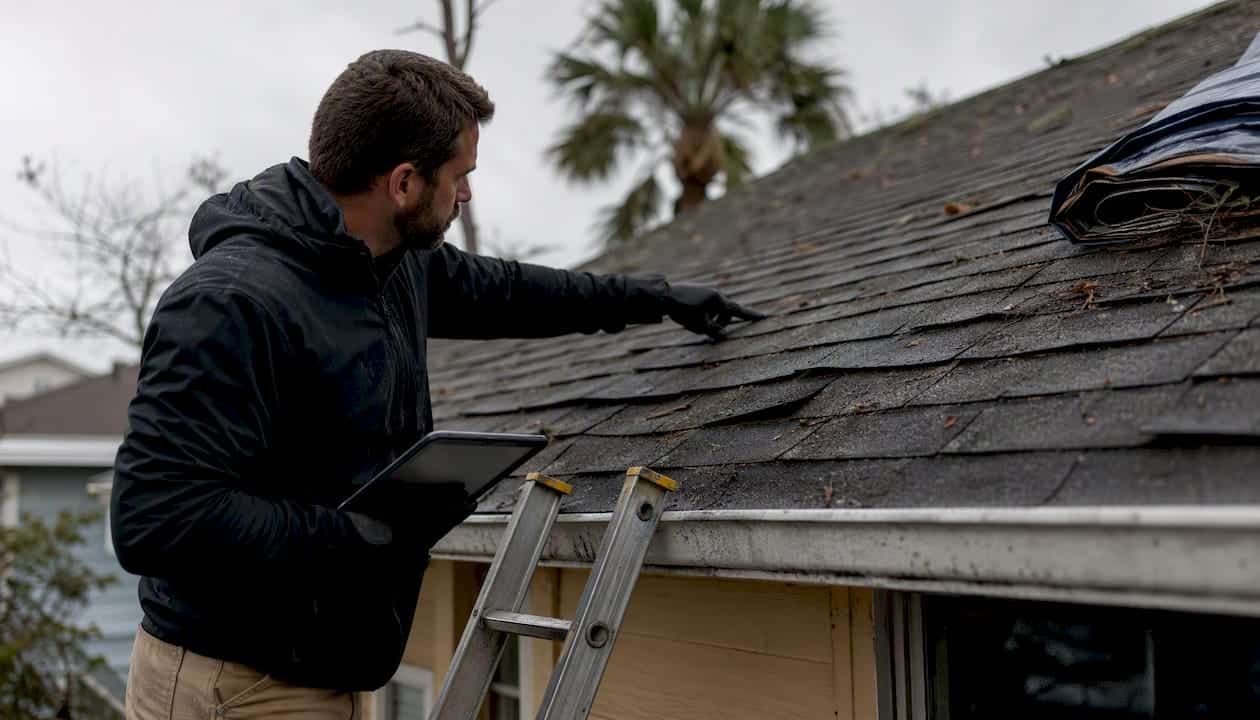
The single most common mistake we see after a named storm is homeowners waiting to call anyone because the visible damage “doesn’t look that bad.” Roofs that lose a handful of shingles often have compromised underlayment, cracked decking, or damaged flashing that only shows up weeks later as a ceiling stain. By then, the window for clean documentation has closed.
The second most common mistake is confusing wind damage with flood damage. A homeowner who files a wind claim for a flooded garage is going to have a bad time — and vice versa. Know which policy covers which peril before the storm, not during the claim.
From a contractor’s side, the homeowners who get the best outcomes are the ones who document before we arrive, keep receipts for every temporary repair, and do not sign anything until they have a written estimate in hand. Insurers respond to evidence, and a thorough photo record taken within 24 hours of a storm is worth more than any verbal description given weeks later.
Pro Tip: Choose a contractor who will walk the adjuster through the damage in person and provide a written scope of work that matches the insurer’s line items. That alignment speeds up settlement significantly.
Storm damage repair and restoration from Buffaloroofingandexteriors
When a named storm hits South Texas, the gap between a well-documented claim and an underpaid one often comes down to who shows up first and how thoroughly they work.

Buffalo Roofing and Exteriors serves homeowners across Corpus Christi, San Antonio, and Victoria with emergency tarping, full storm damage restoration, and contractor estimates built to align with insurance adjuster line items. The team handles roofing, siding, windows, and exterior repairs — the exact categories where hurricane deductibles apply most often. Free inspections are available, and the team can walk you through what your insurer will need to see. Schedule your inspection at Buffaloroofingandexteriors before the next storm season opens.
Sources
- Insurance Topics | Hurricane Deductibles | NAIC
- Understanding Hurricane Deductibles: What Homeowners Need to Know
- Texas Wind/Hail Percentage Deductibles Explained | Latent Insurance
- Texas Hurricane & Windstorm Insurance Guide
This article is general information, not a substitute for advice from a qualified financial advisor. Consult a qualified financial professional about your own circumstances before acting on anything here.