

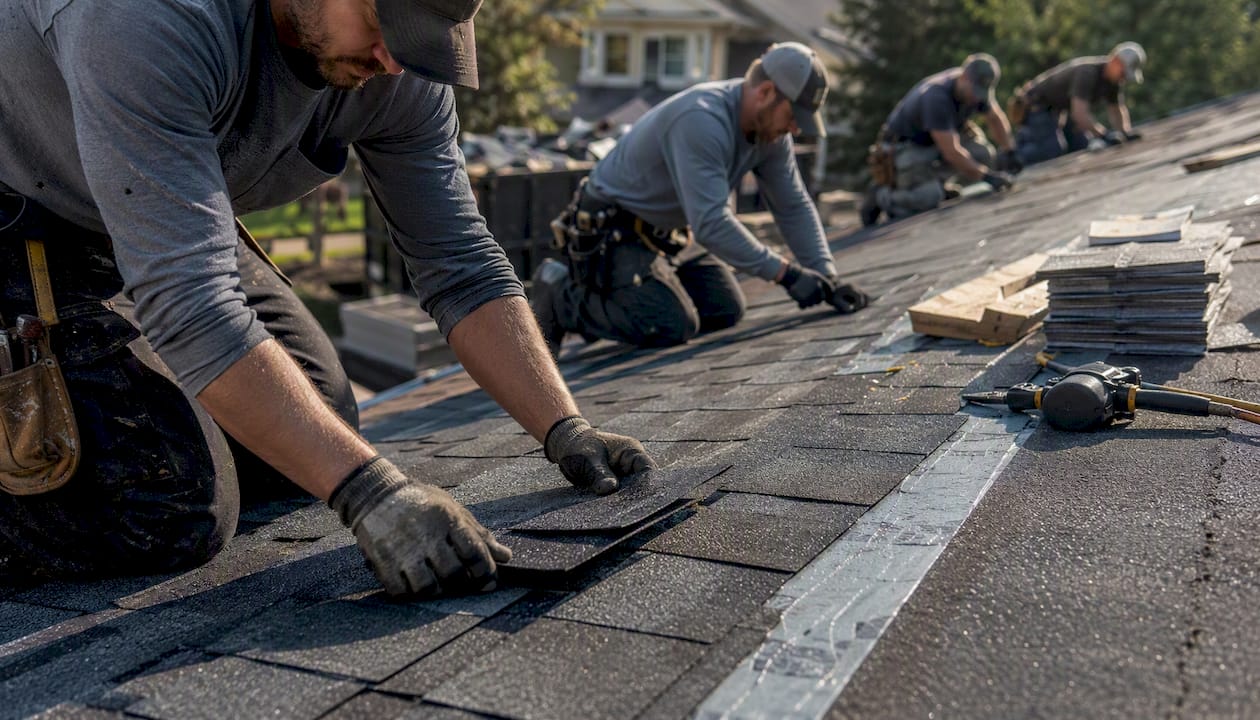
Most residential roofs take 1 to 3 days of active work on the roof itself, but the full project from signed contract to final inspection typically runs 2 to 4 weeks. That gap surprises a lot of homeowners. The install days are the short part. Permits, material ordering, and contractor scheduling fill the rest of the calendar.
A few variables can push that window significantly:
- Material choice is the biggest lever. Standard asphalt shingles ship in days; custom tile or natural slate can take 4–16 weeks to procure.
- Permits and HOA reviews range from same-day approvals to 6+ weeks in busy jurisdictions.
- Weather adds 1–7 days depending on season and region, with storm-prone summers and cold-weather installs at the longer end.
- Hidden decking damage discovered during tear-off typically adds 1–3 days and a change order.
The one thing you control most directly: finalize your material selection before signing the contract, and confirm your contractor pulls permits immediately after signing. Those two steps alone prevent the most common delays.
Key Takeaways
A realistic roof replacement timeline runs 2–4 weeks end-to-end for asphalt, with most of that window in permits and material ordering, not the 1–3 days the crew spends on the roof.
| Point | Details |
|---|---|
| Install days vs. total window | Active roof work takes 1–3 days; the full project typically spans 2–4 weeks end-to-end. |
| Material choice matters most | Asphalt ships in 1–7 days; tile takes 3–10 weeks; slate can take 4–16 weeks to procure. |
| Permits and HOA add weeks | Permit approvals range from same-day to 6+ weeks; HOA reviews add 2–12 weeks in some communities. |
| Homeowner prep prevents delays | Finalize material selections at signing, clear driveway access, and confirm staging area before crew arrival. |
| Buffaloroofingandexteriors | Serves South Texas with local crews, permit handling, and storm-response scheduling for faster project starts. |
Table of Contents
- What does the roof replacement timeline look like phase by phase?
- How long does a roof replacement take by size and material?
- What factors change your roofing project timeline?
- How do permits and HOA reviews affect your schedule?
- What should you do before and during installation day?
- What causes schedule slips and how do you protect yourself?
- Real-world project timeline scenarios
- What questions should you ask a roofing contractor about scheduling?
- Why these timeline ranges are reliable
- What homeowners consistently get wrong about roof timelines
- Buffaloroofingandexteriors gets your project moving faster
- Sources
What does the roof replacement timeline look like phase by phase?
The five standard phases of a roof replacement project are where most of the calendar actually lives, and only one of them involves anyone on your roof.
- Phase 1: Inspection and estimate (1–3 days). A contractor inspects the roof, measures square footage, assesses pitch and complexity, and delivers a written estimate. Your action: get at least two estimates and ask each contractor how they handle permit applications and material lead times.
- Phase 2: Material selection and contract (1–7 days). You choose shingles, underlayment, flashing, and ridge cap. This phase stalls when homeowners delay color or product decisions. Your action: make all selections at contract signing, not after.
- Phase 3: Permits and material ordering (3 days to 6+ weeks). The contractor submits permit applications and orders materials. Permit turnaround varies enormously by jurisdiction. Material lead times vary by product. This is the longest waiting phase for most projects. Your action: ask your contractor to submit the permit application the same day the contract is signed.
- Phase 4: Tear-off and installation (1–5 days on the roof). The crew arrives, removes the old roofing system, inspects the decking, makes any necessary repairs, and installs the new system. Day 1 is typically tear-off and deck inspection; Day 2 covers the main field installation; Day 3 handles ridge work, finishing, and initial cleanup. Complex roofs add days.
- Phase 5: Cleanup, final inspection, and closeout (1–3 days). The crew performs a magnetic sweep for nails, hauls debris, and schedules the municipal final inspection. Your action: walk the property with the crew before signing off and confirm the permit is officially closed.
The active install days sit entirely in Phase 4. Everything else is scheduling, waiting, and paperwork.
How long does a roof replacement take by size and material?
Material choice and roof size drive the install-day count more than almost anything else. The table below uses a 4–6 person experienced crew as the baseline, which is standard for residential asphalt work.
| Material | Typical install days (medium home) | Total project window | Material lead time |
|---|---|---|---|
| Standard asphalt shingles | 1–2 days | 2–4 weeks | 1–7 days |
| Architectural asphalt shingles | 1–3 days | 2–4 weeks | 1–7 days |
| Standing seam metal | 4–7 days | 4–10 weeks | 2–6 weeks |
| Clay or concrete tile | 5–10 days | 4–16 weeks | 3–10 weeks |
| Natural slate | 1–7 days | 8–20 weeks | 4–16 weeks |
| Wood shake | 3–5 days | 3–8 weeks | 1–4 weeks |
Sources: The Roofing Brief, IKO
Size modifiers: Add roughly 1 day per additional 1,000 sq ft above a 2,000 sq ft baseline for asphalt. Steep-pitch roofs (above 6:12) add 1–2 days for any material because crews work slower and need additional safety equipment. Each additional penetration group (chimney, skylight, HVAC stack) adds a few hours.
A 5–6 person experienced crew can dramatically shorten asphalt installs compared with a 2–3 person crew. If a contractor quotes a 5-day asphalt job on a 2,000 sq ft ranch, ask about crew size.
What factors change your roofing project timeline?
Several variables push the schedule out, and some of them are entirely within your control.
- Roof size and pitch. Larger roofs take more time in a roughly linear way. Steep pitches slow every phase of the install and add safety setup time.
- Complexity: valleys, dormers, and penetrations. Each valley, dormer, or penetration (chimney, skylight, vent stack) adds hours to the install. A roof with six dormers and two chimneys can take twice as long as a simple gable roof of the same square footage.
- Material lead times. Specialty materials are the dominant cause of multi-week procurement delays. Custom metal panels, non-stock tile, and natural slate regularly add 4–16 weeks to the project window. Standard asphalt ships in 1–7 days from local distributors.
- Discovered decking damage. Rotted or damaged sheathing found during tear-off adds 1–3 days and a change order. In coastal Texas, where wind-driven moisture is common, decking repairs are not rare.
- Crew size and skill. A 5–6 person experienced crew finishes asphalt installs significantly faster than a smaller one. Ask your contractor how many workers will be on-site.
- Weather. Permit timelines and weather together cause most schedule slippage. Expect 1–3 days of weather delay in spring and fall; 2–5 days in storm-prone summers; 3–7 days in cold-weather installs.
- Permits and HOA. Permit approvals range from same-day to 6+ weeks depending on jurisdiction. HOA architectural reviews add another 2–12 weeks in communities that require them.
- Site access and logistics. A narrow driveway, a low-hanging tree, or a blocked staging area can delay material delivery and dumpster placement. These are avoidable with simple prep.
Pro Tip: Pull permits immediately after contract signing, and pre-stage materials in a confirmed delivery window. These two steps compress the longest waiting phase of the project.
For a deeper look at how these variables also affect cost, the factors influencing roof cost guide covers the overlap between schedule drivers and budget drivers.
How do permits and HOA reviews affect your schedule?
Permit and HOA timelines are the most underestimated part of the roofing project timeline, and they sit entirely outside the contractor’s control once submitted.
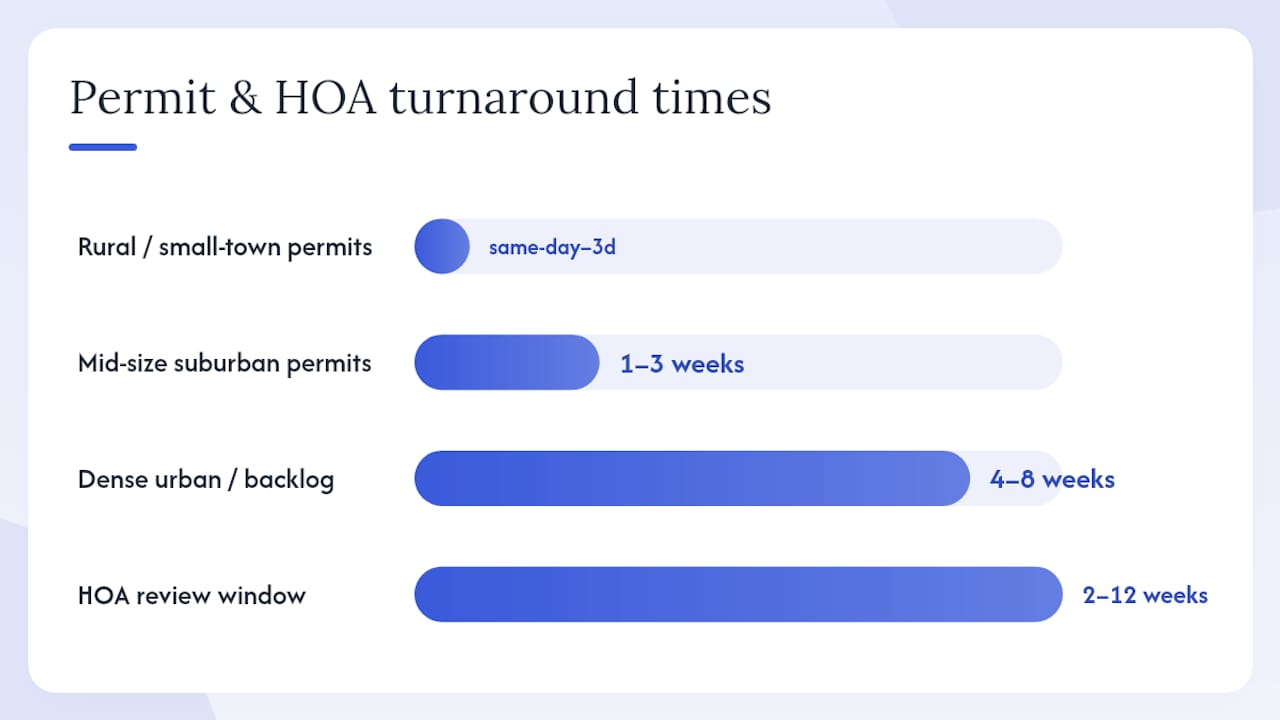
Permit turnaround by jurisdiction type:
- Rural or small-town building departments: same-day to 3 business days in many cases.
- Mid-size suburban markets: 1–3 weeks is typical.
- Dense urban markets or jurisdictions with backlogs: 4–8 weeks is not unusual; some markets run longer during post-storm surges.
What triggers a longer review: structural changes (adding a ridge vent, changing roof pitch), switching material categories (asphalt to metal), or a jurisdiction that requires a full plan review for re-roofing.
HOA architectural review windows run 2–12 weeks depending on how often the committee meets. Some HOAs meet monthly; a submission that misses a meeting date waits until the next one. Submitting the wrong color or product sample restarts the clock.
Steps to compress approval timelines:
- Submit the full permit packet the same day the contract is signed.
- Confirm with your contractor exactly which documents the local building department requires (some require energy-code compliance forms; others want a site plan).
- For HOA projects, submit the product sample, color chip, and manufacturer spec sheet together in one packet.
- Follow up with the building department at the midpoint of their stated review window.
- Build the permit turnaround time into the project schedule in writing, with a clear start-window clause so both parties know when the clock starts.
Ask your contractor to include a permit-buffer clause in the contract: a defined number of days after permit approval when work must begin, and a weather-buffer provision for the install window.
What should you do before and during installation day?
Practical prep eliminates the most common day-of delays. Homeowner indecision and blocked access convert short install windows into extended ones.
Pre-install checklist (complete 48 hours before crew arrival):
- Move all vehicles out of the driveway and confirm the staging area for materials and the dumpster location with your contractor.
- Relocate or secure pets indoors or off-site for the duration of the install.
- Remove wall hangings, mirrors, and fragile items from interior walls, especially on the top floor. Vibration from nail guns and tear-off is real.
- Clear the attic of stored items near the eaves if possible.
- Trim any tree branches that overhang the roof or block ladder placement.
- Confirm your material delivery window with the contractor so you know when the truck arrives.
- Finalize all material and color selections in writing before this point. Last-minute changes delay the order and the start date.
What to expect on installation day:
- Work typically starts at 7–8 AM and runs until dusk.
- Tear-off is the loudest phase. Expect significant noise for the first several hours.
- A safety perimeter around the house is normal. Keep children and pets away from the work zone.
- The dumpster or debris trailer will sit in your driveway or on the street.
- The crew may find decking damage during tear-off. A reputable contractor will stop, photograph the damage, and walk you through the change order before proceeding.
Post-install walkthrough checklist:
- Confirm the crew performed multiple magnetic sweeps for nails in the lawn, driveway, and flower beds.
- Check gutters for debris and shingle granules.
- Take your own photos of the completed roof from multiple angles.
- Confirm the final invoice matches the contract and any approved change orders.
- Ask for the permit closeout timeline and confirm when the final municipal inspection is scheduled.
For Texas homeowners, the roof replacement tips for Texas homeowners guide covers local prep specifics, including coastal wind and humidity considerations.
What causes schedule slips and how do you protect yourself?
Every roofing project carries schedule risk. The question is whether your contract accounts for it.
Common delay causes and typical time added:
- Weather: 1–7 days depending on season and region. Unavoidable, but a weather-buffer clause in the contract prevents disputes about restart timing.
- Permit or HOA delays: 1–6 weeks. Mitigated by early submission and a permit-buffer clause.
- Material backorders: 1–10+ weeks for specialty products. Mitigated by confirming stock availability before signing.
- Hidden decking or structural damage: 1–3 days for typical repairs; longer for widespread rot or structural issues. Documented with photos and a written change order.
- Crew rescheduling: 1–5 days if a contractor runs multiple jobs simultaneously. Ask whether your project gets a dedicated crew.
Contract language to request:
- A written change-order process that requires your written approval before any additional work begins, with documented photos of the discovered issue.
- Time-and-materials rates for decking repairs stated in the contract, not negotiated after the fact.
- A weather-buffer provision defining how many weather days are built into the schedule before a delay becomes a contract issue.
- A clear deposit and refund structure for projects delayed beyond a defined threshold.
- A start-window clause: work must begin within X days of permit approval.
When a crew discovers rotted decking, the right process is: stop work, photograph the area, call you to the site or send photos, present a written change order with the cost and added time, and wait for your signature before continuing. Any contractor who proceeds without that step is cutting corners on documentation that protects both parties.
Real-world project timeline scenarios
Four scenarios show how complexity and material choice change the actual calendar.
| Scenario | Active install days | Total project window | Main schedule driver |
|---|---|---|---|
| Small asphalt ranch (1,200 sq ft, simple gable) | 1 day | 2–3 weeks | Permit turnaround |
| Medium suburban home with dormers (2,200 sq ft, architectural shingles) | 2–3 days | 3–5 weeks | Permit + complexity |
| Steep-pitch home, architectural shingles (above 6:12 pitch) | 3–4 days | 3–6 weeks | Pitch, safety setup, permits |
| Tile or slate installation (2,000 sq ft, clay tile) | 7–10 days | 10–20 weeks | Material procurement |
Sources: The Roofing Brief, Joyland Roofing
What converts each scenario into a longer timeline:
- The small ranch doubles in duration if the HOA requires architectural review and the committee meets monthly.
- The suburban home with dormers adds 2–4 weeks if the homeowner selects a non-stock shingle color after signing.
- The steep-pitch project extends if decking damage is found across multiple sections.
- The tile installation can stretch to 20+ weeks if the tile is a custom or imported product rather than a stocked domestic option.
For commercial properties, timelines scale differently. The commercial roof replacement guide for Texas covers how project windows expand for larger footprints and flat-roof membrane systems.
What questions should you ask a roofing contractor about scheduling?
The difference between a contractor who promises fast install days and one who commits to a realistic end-to-end schedule shows up in the questions they can answer clearly.
Essential scheduling questions:
- Who pulls the permit, and how long does it typically take in this jurisdiction?
- What is your current backlog, and when would work actually begin after signing?
- How many workers will be on my roof each day?
- Is my project assigned a dedicated crew, or do you run multiple jobs at once?
- What is your process when decking damage is discovered during tear-off?
- How do you handle weather delays in the contract?
- What is your material lead time for the product I’ve selected, and is it currently in stock?
Red flags to watch for:
- Vague start dates (“we’ll get to you in a few weeks”) with nothing in writing.
- Refusal to show permit history or inability to name the local building department’s typical turnaround.
- No written change-order process.
- A quote that gives only install days with no mention of the permit or material ordering window.
- Pressure to sign before you’ve seen a written schedule.
A reputable contractor should be able to tell you the permit lead time for your specific municipality, confirm material availability before signing, and provide a written project schedule that includes all five phases, not just the install days.
Why these timeline ranges are reliable
The ranges in this article align with baselines from Owens Corning, IKO, and the IL Roofing Institute. IKO’s guidance confirms that asphalt installs commonly complete in 1–2 days for average homes, with specialty materials and complex roofs requiring multiple additional days and longer lead times. The IL Roofing Institute notes that contractor scheduling and permit backlogs often expand the total project window to 3–8 weeks from signing to final inspection, even when the install itself runs 3–5 days.
Buffaloroofingandexteriors operates across South Texas, including Corpus Christi, San Antonio, and Victoria, where coastal weather patterns, post-storm permit surges, and humidity-driven decking damage all affect real project schedules. The timeline ranges here reflect both national industry baselines and the field conditions that South Texas homeowners actually encounter. The roof installation workflow guide covers the quality checkpoints the team uses at each phase.
What homeowners consistently get wrong about roof timelines
Three misunderstandings come up repeatedly, and all three are avoidable.
Assuming install days equal total days. A contractor who says “two days” means two days on the roof. The permit, material ordering, and scheduling phases add weeks before that crew ever shows up. Plan for the full project window, not just the install window.
Underestimating decking repairs. In South Texas, wind-driven rain and high humidity accelerate sheathing deterioration. A roof that looks fine from the outside can have significant decking damage underneath. Budget time and money for this possibility before the project starts, not after tear-off reveals it.
Assuming specialty materials are in stock. If you want standing seam metal, clay tile, or a specific architectural shingle in a non-standard color, confirm availability before signing. Specialty materials are the dominant cause of multi-week procurement delays, and a material that “usually ships in two weeks” can take eight if the distributor is backordered.
One practical tip from the Buffaloroofingandexteriors team: in South Texas, the best scheduling windows are typically late fall and early winter, when hurricane season has passed and temperatures are moderate. Booking during this window shortens contractor wait times and reduces weather-delay risk. If your project is storm-driven and urgent, the team handles storm damage restoration with expedited scheduling.
Buffaloroofingandexteriors gets your project moving faster
Waiting weeks for a contractor to start is one of the most frustrating parts of a roof replacement. Buffalo Roofing and Exteriors serves homeowners across Corpus Christi, San Antonio, and Victoria with local crews who know South Texas permit offices, stock common materials locally, and handle the full permit process from submission to closeout.

The team manages every phase of the project schedule, including permit applications, material coordination, and post-storm expedited starts. Financing options and manufacturer warranties are available on qualifying projects. If your project is time-sensitive due to storm damage, the storm damage restoration service is designed for fast response. For all other projects, request a free estimate and get a written project schedule that covers all five phases, not just the install days.
Sources
- How to Determine a Roofing Project Timeline (Contractor Guide 2026)
- What to Expect During Roof Replacement: Timeline and Tips – IKO
- How Long Does a Roof Replacement Take? Real 2026 Timeline | The Roofing Brief
- Step-by-step roof installation process | MRRemodel
- What factors affect the duration of roof replacement Shelbyville, IN? – Nationwide Contracting, LLC