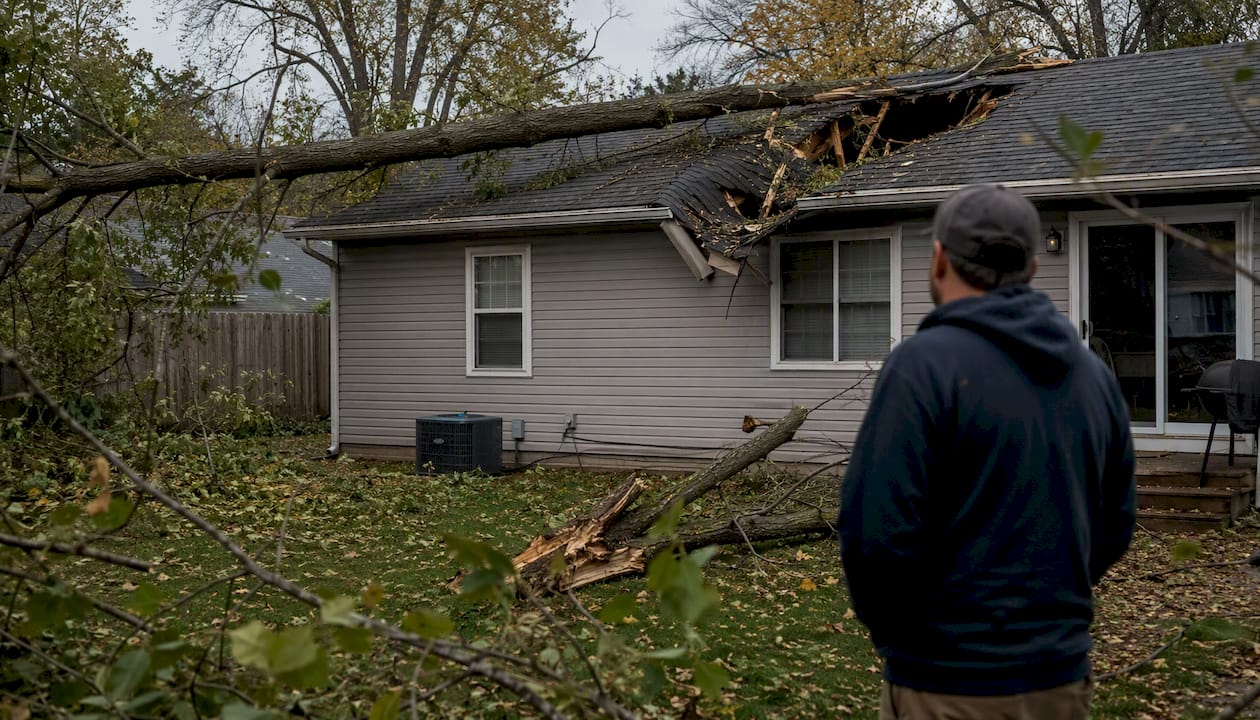
When a tree falls on your roof, do these five things in the first 60 minutes:
- Get everyone out. Move all people and pets away from the impact area immediately. If any part of the ceiling is sagging or walls have new cracks, treat the structure as unsafe and stay out until a professional clears it.
- Call 911 if anyone is injured or if you see downed or sparking power lines. Do not approach downed lines. Call your electric utility separately to report the outage or hazard.
- If you smell gas, leave the property now and call your gas company from a safe distance. Do not flip switches or use your phone inside the house.
- Document from a safe distance. Take wide exterior photos and a video walkthrough narrating what you see. Do not climb on the roof or enter damaged rooms.
- Notify your insurer to open a claim, then call a licensed roofer for emergency tarping. Schedule a certified tree removal crew after the roof is stabilized, not before.
That order matters. Tarping before tree removal is the professional standard because an unstabilized tree can shift and cause further collapse during extraction.
Key Takeaways
When a tree falls on your roof, the first hour is about safety and documentation, the first 24 hours are about stopping further damage and opening a claim, and the first week is about getting professional assessments and a clear repair plan in place.
| Point | Details |
|---|---|
| Safety comes before everything | Evacuate the impact area, call 911 for injuries or downed lines, and do not re-enter until a professional clears the structure. |
| Document before you touch anything | Wide exterior shots, impact closeups, rootball photos, and a timestamped video narration are the foundation of a strong insurance claim. |
| Emergency tarping prevents a second disaster | Water intrusion can cause mold and structural damage within 24–48 hours; use a licensed roofer, not the tree crew, for tarping. |
| Your insurer pays first, regardless of tree origin | Even if the tree came from a neighbor’s yard, you file with your own homeowners insurance; negligence by either party can affect coverage. |
| Buffaloroofingandexteriors provides emergency response | Licensed crews in South Texas handle tarping, roof repair, tree removal coordination, and insurance documentation from first call to claim closure. |
Table of Contents
- What are the most urgent safety steps after a tree hits your house?
- What should you never do after a tree falls on your roof?
- How do you document damage and file a homeowners insurance claim?
- Why emergency tarping matters and how to arrange it safely
- What does a professional emergency roofer do when they arrive?
- Who pays when a neighbor’s tree falls on your roof?
- What does the repair process look like from tarp to finished roof?
- How do you hire a safe, licensed emergency roofer or arborist?
- A note from Buffalo Roofing & Exteriors
- Buffalo Roofing & Exteriors is ready when you need emergency help
- Helpful resources to read next
- Sources
What are the most urgent safety steps after a tree hits your house?
The first priority is people, not property. Evacuate any room directly under or adjacent to the impact zone. Roof structures can fail progressively, and a ceiling that looks intact may be holding weight it cannot sustain for long.
From outside, scan for downed power lines before doing anything else. Assume every line on the ground is live. Keep a minimum of 30 feet of clearance and call 911, then your electric utility. Do not wait to see if the line sparks.
A downed power line does not have to be visibly sparking to be lethal. Electricity can energize the ground around a fallen line in a radius wide enough to kill. Treat the entire area as a hazard zone until the utility company confirms it is de-energized.
If you smell gas or notice a rotten-egg odor, leave immediately without touching any switches. Call your gas company from a neighbor’s house or from the street. Gas leaks after structural damage are more common than most homeowners expect because tree impacts can shear gas supply lines at the meter or at interior connections.
Safety red flags that mean “do not re-enter”:
- Sagging or bowed ceilings
- New cracks running diagonally from door or window corners
- Visible broken trusses or joists through a ceiling breach
- Active sparking or buzzing sounds from the roof area
- Strong gas odor anywhere in or near the house
If none of those conditions are present and the damage appears limited to one section of the roof, you can cautiously shut off utilities at the main panel, gas valve, and water main to reduce secondary damage risk. Do this only if you can reach those shutoffs without entering the damaged zone.
Pro Tip: Take a short video from the street before you do anything else. Narrate what you see out loud: the tree position, the impact point, any visible structural damage. That timestamped video becomes your first piece of insurance evidence.
What should you never do after a tree falls on your roof?
A few common instincts after tree damage to a house will either get someone hurt or cost you money on the claim.
The two most expensive mistakes homeowners make are attempting DIY removal and throwing away damaged property before documenting it. Both can reduce or eliminate insurance recovery.
- Do not touch or approach a tree that is in contact with utility lines. Even if the tree looks stable, it may be holding a line under tension. Movement can snap the line or pull a transformer.
- Do not climb on the damaged roof or try to remove large limbs yourself. A tree under load stores enormous tension. Cutting the wrong branch can cause the entire mass to shift suddenly, collapsing the section of roof it is resting on.
- Do not discard damaged furniture, flooring, or personal property before photographing and inventorying it. Adjusters need to see the damage. Throwing items out before documentation is one of the fastest ways to have a personal property claim denied.
- Do not let an unlicensed crew tarp structural roof openings. Tree companies and general laborers are not trained to assess roof deck integrity or install tarps that meet insurer mitigation requirements. An improperly installed tarp that fails and allows water intrusion can be treated as inadequate mitigation, shifting liability back to you.
How do you document damage and file a homeowners insurance claim?
Insurance adjusters work from evidence. The more organized and thorough your documentation, the faster your claim moves and the less room there is for disputes about scope.
Step-by-step documentation sequence:
- Start with wide exterior shots from all four sides of the house, showing the tree’s position relative to the structure.
- Move to closeups of the impact point: the exact breach in the roof, any crushed gutters, broken fascia, or damaged siding.
- Photograph the tree’s base or rootball. Insurers use this to determine whether the tree failed from storm force or from pre-existing disease or decay. A clean snap at the base in a windstorm reads very differently than a rotted rootball that simply tipped over.
- Move inside (only if safe) and photograph any ceiling damage, water intrusion, or structural exposure visible from below.
- Inventory damaged personal property with approximate age and replacement cost. Write it down or record a video narration.
Keep every receipt from the moment the tree falls. Emergency tarping, hotel stays, meals during displacement, and board-up costs are all potentially reimbursable. Document the damage thoroughly and notify your insurer promptly; emergency mitigation costs such as tarping and board-up are typically reimbursable as loss mitigation.
What to tell your insurer when you call:
- The date, time, and cause of loss (wind, storm, or other)
- Whether the structure is currently safe to occupy
- What emergency mitigation you have arranged or plan to arrange
- Ask specifically: Will an adjuster visit in person? Is emergency tarping reimbursable? Does my policy include loss-of-use or additional living expenses if I cannot stay in the home?
Homeowners insurance may cover tree damage to a structure when the loss is caused by a covered peril such as wind or storm, but policies commonly exclude losses from ignored dead or diseased trees. That distinction is exactly why the rootball photo matters.
Loss-of-use coverage, sometimes called Coverage D, pays for temporary lodging and reasonable living expenses while your home is uninhabitable. Save every hotel receipt, restaurant receipt, and laundry receipt. Adjusters expect itemized documentation, not estimates.
Why emergency tarping matters and how to arrange it safely
Water intrusion is the second disaster after the tree strike. Adjusters and restoration contractors treat a breached roof as an urgent mitigation priority because water can create mold and structural damage rapidly. A roof open to rain for even one night can turn a manageable repair into a full gut-and-rebuild.
- Use a licensed roofer for emergency tarping, not the tree removal crew. Structural roof openings require someone who can assess deck integrity before walking on it and who knows how to anchor tarps in a way that holds through continued wind.
- Document the tarp installation. Take before-and-after photos and keep the contractor’s invoice. Most insurers reimburse reasonable emergency stabilization costs; having the receipt and photos removes any ambiguity about whether mitigation was performed.
- If an active storm makes immediate tarping unsafe, document the weather conditions (a screenshot of a weather app with timestamp works), note it in your insurer communication, and schedule tarping for the next safe window. Insurers generally understand force majeure delays when you document them.
- Board-up of broken windows or doors in the impact zone follows the same logic: licensed contractor, written invoice, before-and-after photos.
Pro Tip: Ask your emergency roofer to write a brief condition report when they install the tarp. A one-page document noting the size of the breach, the tarp dimensions, and the installation method gives your adjuster exactly what they need to approve reimbursement without a follow-up visit.
What does a professional emergency roofer do when they arrive?
Knowing what a licensed contractor should do on arrival helps you evaluate whether the crew you called actually knows what they are doing. Here is the standard workflow from a qualified emergency response team like Buffaloroofingandexteriors:
1. Safety triage and hazard isolation
The crew confirms no active utility hazards before approaching the structure. They check for live lines, assess visible structural stability, and establish a safe perimeter. No one goes on the roof until this step is complete.
2. Structural stability assessment
A licensed roofer evaluates the roof deck, visible truss or rafter condition, and the load path of the tree. This determines whether the tree can be removed safely without triggering further collapse.
3. Staged tree removal planning
For large trees or those resting across multiple structural members, a certified arborist assesses the load distribution. Some extractions require crane assistance to lift sections straight up rather than dragging them across the roof deck. Cutting sequence matters: the wrong cut releases stored tension and can drop a limb through an already-weakened section.
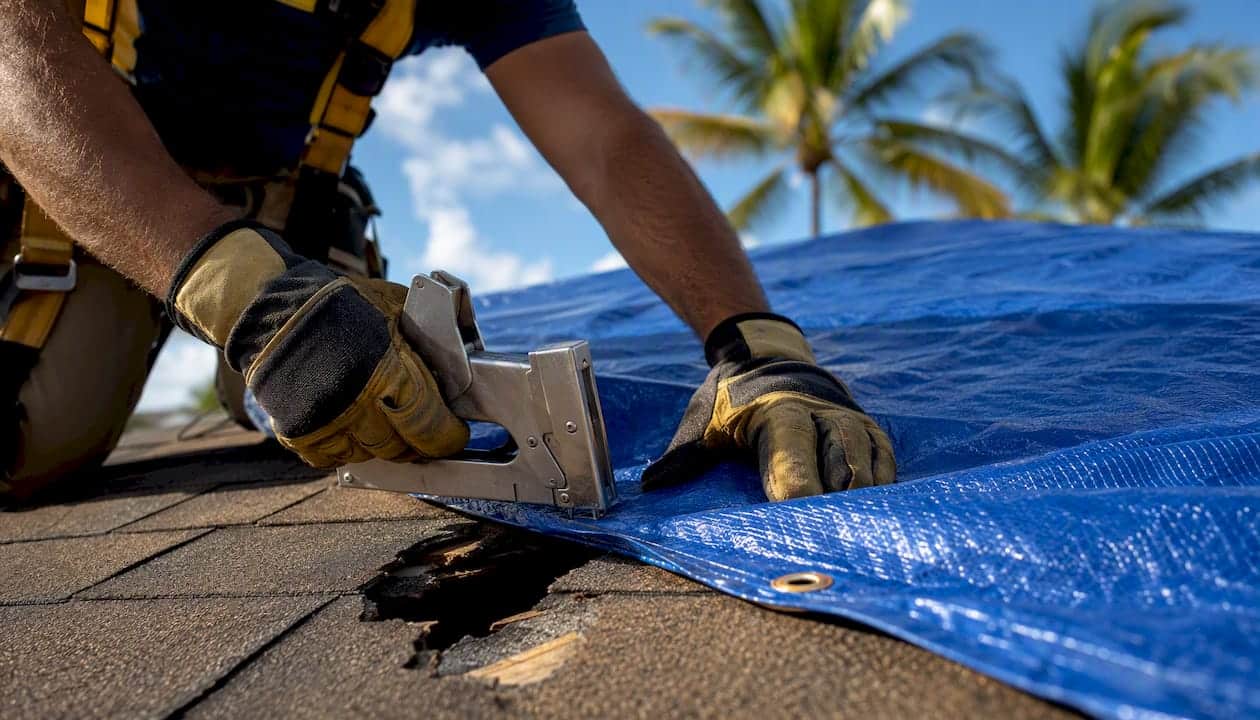
4. Emergency stabilization
Professional tarping and board-up installed to meet insurer mitigation requirements and local building codes. This is not a tarp thrown over a hole. It is a secured, measured installation with documentation.
5. Damage assessment and photo-backed estimate
The licensed roofer documents roof deck damage, sheathing condition, truss or joist failures, and any interior exposure. The written estimate with photos becomes part of your insurance claim file.
Typical timeframes:
- Emergency tarp and board-up: same day, often within hours of your call
- Tree removal: 24–72 hours depending on crew availability, access, and whether crane equipment is needed
- Full structural repair: scheduled after adjuster review, typically 1–4 weeks out
For a detailed look at storm damage repair approaches, the process from stabilization to final restoration follows a consistent sequence regardless of the tree’s size.
Who pays when a neighbor’s tree falls on your roof?
The general rule in U.S. homeowners insurance surprises most people: you file with your own insurer, even if the tree was rooted on your neighbor’s property. The location where the damage occurred, not the tree’s origin, determines which policy responds first.
| Scenario | Who typically pays | Notes |
|---|---|---|
| Storm topples neighbor’s healthy tree onto your roof | Your homeowners insurance | Neighbor is generally not liable for an act of nature |
| Neighbor’s dead or diseased tree falls on your roof | Your insurer pays; may pursue neighbor via subrogation | Requires proof neighbor knew of hazard |
| Your own neglected dead tree falls on your roof | Your insurer may deny the claim | Negligence exclusion applies |
| Tree falls in yard, no structural damage | Limited coverage or none | Debris removal caps apply |
Homeowners insurance does not typically cover damage from a fallen tree if it resulted from homeowner negligence, such as failing to remove a known rotting, diseased, or dead tree. That applies to your own trees and, in some cases, to a neighbor’s tree if you failed to act on a known hazard on your own property.
If you previously sent a neighbor written notice about a hazardous tree and they ignored it, keep copies of that correspondence. Your insurer may pursue their policy through subrogation after paying your claim. Verbal warnings do not carry the same weight as a dated letter or email.
Key points on liability:
- Debris removal from the yard (no structural damage) is often subject to a separate cap, sometimes $500–$1,000, under most standard policies.
- A tree that blocks a driveway without hitting a structure is treated differently than one that strikes the house. Coverage rules and limits differ.
- Document any prior written notices to neighbors about hazardous trees. If you expect to claim negligence later, that paper trail is your evidence.
What does the repair process look like from tarp to finished roof?
The path from emergency stabilization to a finished, permitted repair follows a predictable sequence. Knowing it helps you set realistic expectations and avoid being pressured into rushed decisions.
Repair sequence:
- Emergency stabilization (tarp, board-up)
- Insurer adjuster visit and scope review
- Contractor estimates and written scopes of work
- Permit application (required for structural repairs in most jurisdictions)
- Structural framing repair (trusses, rafters, sheathing)
- Finish roofing (underlayment, shingles or membrane)
- Interior restoration (drywall, insulation, paint)
Typical U.S. cost ranges (these vary significantly by region, scope, and material):
These figures are general U.S. ranges. Your actual costs depend on roof pitch, material, local labor rates, and the extent of structural damage. Get at least two written estimates before authorizing permanent work.
Timing expectations:
- Adjuster visit: typically within a few days of filing
- Temporary repairs: same day to 48 hours
- Structural work: 1–4 weeks after adjuster approval and permit issuance
- Full replacements in busy storm seasons: potentially months
Keep every document: adjuster reports, contractor invoices, permits, and post-repair photos. That file closes your claim cleanly and serves as your warranty record. For a step-by-step breakdown of the permanent repair process, the roof repair guide for storm damage covers permit considerations and sequencing in detail.
How do you hire a safe, licensed emergency roofer or arborist?
Storm damage creates a predictable surge of unlicensed contractors working neighborhoods after major events. Hiring the wrong crew can void your insurance mitigation reimbursement, create new structural damage, or leave you with no recourse when work fails.
Verification checklist before work starts:
- Ask for the contractor’s state roofing license number and verify it with your state licensing board.
- Request a certificate of liability insurance and workers’ compensation coverage. Ask for the policy limits, not just the certificate.
- Confirm the arborist holds an ISA (International Society of Arboriculture) certification or equivalent if tree work is involved.
- Get a written scope of work with separate line items for emergency mitigation, tree removal, and permanent repairs. A single lump-sum price makes it impossible to document mitigation costs for reimbursement.
- Ask who will install the tarp. If the answer is “the tree guys,” that is a problem.
Red flags:
- Pressure to pay in cash only, or demands for full payment upfront
- No written contract or refusal to provide one
- Inability or unwillingness to show license and insurance before work begins
- One crew offering to handle both tree removal and structural tarping when they are not licensed as roofers
- Door-to-door solicitation immediately after a storm with no local address or references
Questions worth asking:
- What is your typical response time for emergency tarping?
- Will you provide photo documentation of the tarp installation for my insurer?
- Who handles adjuster coordination if the scope changes after the tree is removed?
- What warranty do you offer on the permanent repair?
Pro Tip: Call your insurer before authorizing permanent repairs. Some policies require insurer approval before work beyond emergency mitigation begins. Getting that approval in writing protects your reimbursement.
A note from Buffalo Roofing & Exteriors
When a tree comes through a roof, the first call most homeowners make is to a family member or a neighbor. The second call should be to a licensed contractor who has handled this exact scenario before. Buffaloroofingandexteriors has responded to storm and impact damage across South Texas, from Corpus Christi to San Antonio and Victoria, with licensed crews who know how to stabilize a structure safely, document damage for insurance, and get a family back under a solid roof as fast as the work allows. The right steps taken in the first few hours protect both the structure and the claim. That is what licensed emergency response is for.
Buffalo Roofing & Exteriors is ready when you need emergency help
When a tree strikes your home, the hours immediately after determine how much damage you contain and how smoothly your claim proceeds. Buffaloroofingandexteriors provides 24/7 emergency tarping and board-up, licensed roof repair and replacement, coordination with certified tree removal partners, and full insurance documentation support from first contact through claim closure.

Homeowners in Corpus Christi, San Antonio, and Victoria can reach Buffaloroofingandexteriors for an emergency response assessment. Have your insurer’s claim number ready if you have it, along with your photos and a description of the damage. The team will walk you through what needs to happen first and what the repair timeline looks like for your specific situation. For local emergency roofing support, contact Buffalo Roofing & Exteriors to get a licensed crew dispatched and your home stabilized. Work comes with written documentation and warranty coverage so your claim file is complete from day one.
Helpful resources to read next
These sources cover coverage rules, debris removal caps, and emergency reporting guidance in more detail:
- What to Do When a Tree Falls on Your Property — Progressive’s homeowner guidance on documentation, mitigation reimbursement, and claim filing steps.
- Fallen Tree Damage and Homeowners Insurance — Allstate’s breakdown of covered perils, exclusions for neglected trees, and what adjusters examine.
- Tree Damage and Insurance — Iowa’s consumer protection resource explaining negligence exclusions and neighbor liability scenarios.
- Insurance and Wind Storms — Oregon Department of Financial Regulation’s guide to debris removal caps, flood exclusions, and emergency stabilization coverage.
- Storm Damage Restoration Guide — Buffaloroofingandexteriors’s full restoration resource for South Texas homeowners, from emergency mitigation to final inspection.
- How to Document Weather-Related Home Damage Fast — A practical walkthrough for collecting photos and receipts that support your claim.
This article is general information, not a substitute for advice from a qualified financial advisor. Consult a qualified financial professional about your own circumstances before acting on anything here.
Sources
- What to Do When a Tree Falls on Your Property – Progressive
- Fallen Tree Damage and Homeowners Insurance | Allstate
- Tree damage and insurance | Smarther (Iowa.gov)
- Insurance and wind storms (440-5519) – Oregon DFR