
TL;DR:
- “Impact-rated” decking often lacks a standardized testing process and can be misleading without specific test details.
- Effective storm protection for coastal Texas involves system-level design, proper hardware, and verified impact performance.
- Homeowners should always request the actual test reports and standards to ensure their decks withstand hurricane debris and high winds.
Coastal Texas homeowners invest serious money in their outdoor living spaces, and storm season puts every one of those dollars at risk. When a contractor or retailer tells you a deck is “impact-rated,” it sounds like a promise. It sounds official. The truth is more complicated, and understanding the difference between a marketing claim and a verified performance standard could save you thousands in storm damage repairs. This guide breaks down what impact-rated decking really means, which standards actually matter, and how to make smart decisions for your home on the Texas Gulf Coast.
Table of Contents
- What does impact-rated decking actually mean?
- Decking test standards and performance ratings
- Impact resistance: More than just surface boards
- Choosing impact-rated decking solutions for coastal Texas
- The uncomfortable truth about “impact-rated” decking claims
- Protect your coastal Texas home with expert decking solutions
- Frequently asked questions
Key Takeaways
| Point | Details |
|---|---|
| No universal impact rating | Most impact-rated decking claims are marketing terms rather than regulatory or code-based standards. |
| System-level storm protection | True impact resistance depends on the whole deck assembly, not just the surface boards. |
| Verify test standards | Homeowners should ask for the exact impact/debris test and report when evaluating products. |
| Professional installation matters | Assembly and connection quality are critical for storm-ready performance, especially in coastal Texas. |
What does impact-rated decking actually mean?
Here is the first thing most homeowners do not know: there is no single, universal standard called an “impact rating” for decking. None. The term gets used freely in product brochures, contractor pitches, and home improvement store displays, but it does not point to one regulated category with defined requirements.
In practice, “impact-rated decking” is not a single, universal decking code category. It is usually a marketing label for decking products that claim enhanced resistance to impact or debris damage, and the actual meaning depends entirely on the specific test standard being referenced. That distinction matters enormously for coastal Texas homeowners who face flying debris, tropical storm winds, and severe weather every season.
What you might actually be getting when a product is called “impact-rated”:
- A board that scored well on a hardness or dent-resistance test under laboratory conditions
- A product marketed toward regions with high-wind exposure without a specific debris test
- A composite material that resists surface scratching better than standard wood
- A board that passed a fire test, a slip test, or a weathering test, none of which relate to storm debris impact
“Impact-rated is a phrase that can mean nearly anything a manufacturer wants it to mean unless they specify the exact test standard behind it. Your job as a homeowner is to ask for that standard by name.”
When you start asking the right questions about impact-resistant upgrades for your home, you quickly realize that the label on the product is just the beginning of the conversation. Demand specifics. If a salesperson cannot name the exact performance standard a product was tested against, that is a red flag worth taking seriously.
Decking test standards and performance ratings
Once you understand that “impact-rated” is not a regulated term, the next step is learning which standards do exist and what they actually measure. For composite decking, one of the most commonly referenced documents is ASTM D7032.
ASTM D7032 is one of the core performance-rating standards for wood-plastic composite decking referenced in decking evaluations and documentation. However, it is not inherently an “impact rating” standard. It covers properties like flexural strength, fastener holding capacity, and resistance to decay, but it does not certify a board against hurricane debris or falling objects in the way the term “impact-rated” implies. Homeowners should always request the exact impact test standard or performance report cited for any product they are considering.
Here is a comparison of common rating types you will encounter when shopping for decking materials:
| Rating type | What it measures | Relevant for coastal Texas? |
|---|---|---|
| Impact resistance | Debris or object strike damage | Yes, but verify the test method |
| Fire performance (Class A) | Flame spread and smoke development | Yes, especially in wildland interface areas |
| Slip resistance | Surface traction when wet | Yes, around pools and wet areas |
| Abrasion resistance | Surface wear over time | Moderate relevance |
| Weathering/UV resistance | Color and structure under sun exposure | High relevance for coastal sun |
| Flexural strength | Load-bearing capacity of the board | Yes, for structural integrity |
When evaluating deck building options, ask the contractor or supplier to provide documentation for each relevant category. Do not assume a product is strong across the board just because it earned one rating.
Key questions to ask before purchasing any decking product:
- What specific ASTM or ICC test standard was used?
- Can you provide the actual test report or third-party certification?
- Was this rating achieved as a standalone board or as a complete assembly?
- Does the rating apply to the fastener system as well?
Pro Tip: Ask your supplier for the test report directly, not just the product spec sheet. Spec sheets often use broad language, while test reports show exactly how the product performed and under what conditions. This single document can reveal a lot about whether a claim is legitimate or just marketing language.
Understanding deck life expectancy also ties into this conversation. A product with a strong weathering and flexural rating will naturally last longer than one that only passed a surface scratch test, regardless of what label was applied to the packaging.

Impact resistance: More than just surface boards
This is where many homeowners and even some contractors miss the mark entirely. Coastal storm protection is not just about whether your deck boards are tough. The boards are actually one of the less critical pieces of the puzzle.
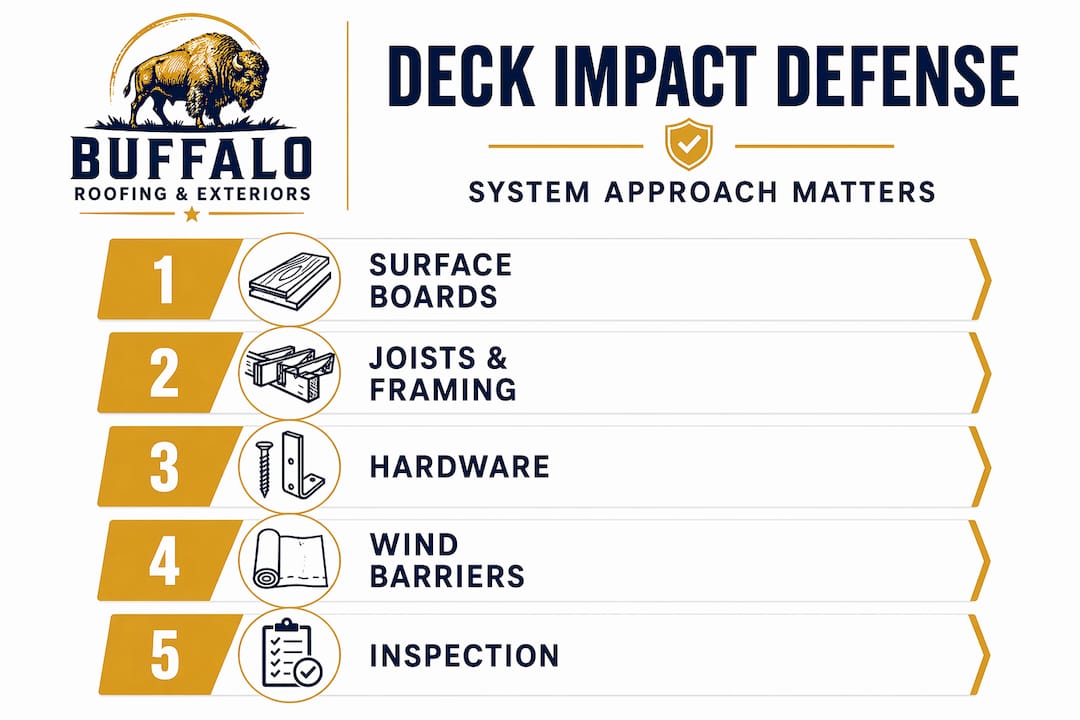
In coastal and high-wind homeowner contexts, impact protection in practice is often a system-level problem involving fasteners, framing connections, and assembly performance, not just the surface board material. A premium composite board held down with inadequate fasteners in an improperly framed structure will fail in a tropical storm long before a standard pressure-treated board secured with hurricane ties and proper blocking.
Here is how a complete deck assembly should be evaluated for coastal performance:
- Framing and ledger connections. The ledger board connects your deck to the house. In high-wind events, this connection is often the first failure point. It must be secured with through-bolts and flashed properly to resist both wind uplift and lateral loads.
- Post and footing design. Posts anchored directly into concrete without proper hardware can rotate or lift under high winds. Adjustable post bases with uplift ratings are the standard for coastal construction.
- Joist hangers and structural hardware. Every joist-to-beam connection should use rated galvanized or stainless steel hardware. In salt-air environments like Corpus Christi, standard galvanized hardware corrodes faster than you expect.
- Decking fasteners. Screws, clips, and hidden fasteners all have different pull-through values. The pull-through value tells you how much force is needed to drive a fastener through the board during wind uplift. This matters more than most homeowners realize.
- Perimeter framing and edge treatment. Open perimeter framing with no blocking gives wind a place to grab the entire deck structure. Proper blocking and rim joist design significantly improve uplift resistance.
Here is a general look at how different assembly components contribute to storm performance:
| Assembly component | Primary risk without proper installation | Recommended specification for coastal TX |
|---|---|---|
| Ledger connection | Deck separation from house | Through-bolts with positive drainage flashing |
| Post bases | Lateral movement and uplift | Rated uplift-resistant post anchors |
| Joist hangers | Joist separation under load | Triple-zinc or stainless steel hangers |
| Deck fasteners | Board lift or ejection | Concealed clips with rated pull-through values |
| Rim joist and blocking | Wind getting under the deck | Solid blocking at perimeter with galvanized hardware |
“A deck assembly is only as strong as its weakest connection. That is not a figure of speech. In storm investigations, the failure almost always traces back to one compromised connection point, not the board material itself.”
High-wind regions have been ahead of the curve on this. Areas with Miami-Dade style requirements require that the whole assembly be tested and approved, not just individual components. While Texas does not universally mandate the same level of scrutiny, coastal county codes near the Gulf are moving in a similar direction, particularly for new construction in hurricane-prone areas.
For guidance on how to approach coastal deck building from a system perspective, or to understand what a full deck hurricane protection plan looks like, a qualified coastal contractor can walk you through local code requirements and best practices for your specific address.
Choosing impact-rated decking solutions for coastal Texas
Now that you understand how the system works together, here is a practical framework for selecting decking that genuinely performs in coastal conditions rather than just carrying a compelling label.
Start by verifying the claim behind any rating. Some product listings you will encounter use the phrase “rated” to describe fire performance, such as a Class A flame spread rating, ignition resistance, or slip resistance tested under ASTM F2913. These are real, meaningful ratings, but some “rated” claims may actually be about fire performance, ignition resistance, slip resistance, abrasion, puncture, or weathering rather than impact resistance. Always verify the specific rating type and test method before assuming any claim relates to storm debris impact.
Steps to validate impact-rated claims before buying:
- Request the test report. Not a brochure, not a web page. The actual report. If the manufacturer cannot or will not provide it, move on.
- Identify the test standard by name. A legitimate claim will cite something like ASTM D2394, ASTM D7032, or another traceable standard.
- Confirm the scope. Ask whether the test was performed on the board alone or on a complete assembly with specified fasteners and framing.
- Check the testing body. Third-party certified results from organizations like ICC Evaluation Service carry more weight than self-reported manufacturer testing.
- Compare the failure threshold. Ask what level of impact the product was tested to withstand, not just whether it passed.
When comparing two decking systems for coastal Texas conditions, prioritize products that have been tested in combination with their recommended fastener systems. A board that was rated as part of a complete assembly with specific clips and screws offers you a clear performance pathway. A board that was tested alone leaves you guessing about how the whole system holds up.
Pro Tip: Ask your contractor whether they have installed this specific product or system in a coastal environment before, and request references from homeowners in similar locations. A contractor who regularly works near the Gulf of Mexico will have direct experience with how products perform after real storm exposure, not just laboratory conditions.
For weather-resistant exteriors designed specifically for the Texas coast, and a weatherproofing storm guide tailored to Gulf Coast conditions, the right local contractor can help you cut through the marketing language and focus on what actually works.
The uncomfortable truth about “impact-rated” decking claims
After years of working with homeowners across coastal Texas, we have seen one pattern repeat itself over and over. A homeowner pays a premium for “impact-rated” decking, feels confident going into storm season, and then discovers after a tropical storm that their deck boards survived fine while the connections holding everything together failed completely. The boards were technically fine. The deck was not.
The uncomfortable truth is that marketing terms create false confidence. Manufacturers know that “impact-rated” sounds like exactly what a coastal homeowner wants to hear. So the phrase gets applied broadly, loosely, and sometimes with almost no connection to actual storm performance data. We are not saying manufacturers are dishonest across the board. We are saying that the label alone is not enough information to make a sound decision.
Always demand the test details. That is not being difficult. That is being a smart buyer.
Storm protection is genuinely a team effort between material selection, system design, installation quality, and ongoing maintenance. No single product label replaces that system. We have seen modest-cost pressure-treated decks with proper hardware and installation outperform expensive composite systems that were installed without attention to fastener ratings or connection details.
The homeowners who fare best after a major storm are the ones who asked hard questions before the storm, not after it. They checked the test reports. They confirmed that the assembly, not just the boards, was rated for coastal conditions. They hired contractors who understood the difference between a product spec sheet and an actual performance standard. They invested in impact-resistant upgrades at the system level, not just at the surface level.
That mindset is what makes the real difference when the next hurricane season arrives.
Protect your coastal Texas home with expert decking solutions
Living on the Texas Gulf Coast means your outdoor spaces face conditions most decks were never designed for. At Buffalo Roofing & Exteriors, we work with homeowners in Corpus Christi, Victoria, and San Antonio to build and restore decks that are engineered for real storm performance, not just attractive marketing claims.
Browse our decking project images to see the level of craftsmanship we bring to coastal exterior work. If your current deck has already taken a beating from recent weather, our storm damage restoration guide walks you through every step of the recovery process. And when you are ready to protect your whole home, we also offer weather-resistant roofing solutions built for the Texas coast. Reach out for a free estimate and let us help you build something that stands when it counts.
Frequently asked questions
Is impact-rated decking required by code in coastal Texas?
There is no universal impact-rating code for decking in Texas, but some coastal areas require system-level wind and debris resistance standards. Coastal deck design commonly emphasizes wind uplift calculations and connection hardware, with high-wind regions requiring whole-assembly approval rather than component-level claims alone.
How do I check if a decking product’s “impact rating” is legitimate?
Always ask for the exact impact test standard or a copy of the performance report from the manufacturer or installer. Homeowners should request the specific test standard name and a third-party certified report, not just a marketing spec sheet, before making any purchase decision.
Can impact-rated decking protect my home from hurricanes?
Impact resistance helps, but full hurricane protection requires the entire deck assembly and adjacent structures to be upgraded for storm performance. Whole-assembly testing and approved connection hardware are essential in high-wind regions, and relying on component claims alone leaves significant gaps in your storm defense.
Does impact-rated mean fire-resistant or slip-resistant too?
No. Impact-rated addresses only one type of performance, and products may carry separate ratings for fire, slip, or other hazards. Some “rated” claims may actually refer to fire performance, ignition resistance, slip resistance, abrasion, puncture, or weathering rather than storm debris impact, so always confirm exactly what type of rating is being claimed.