TL;DR:
- Low-e glass uses metallic coatings to reflect infrared heat while remaining highly transparent to visible light. It reduces energy loss by 30% to 50%, blocks UV radiation, and enhances year-round comfort. Proper climate matching and installation are essential for maximizing its benefits and avoiding higher energy costs.
Low-e glass is defined as window glass coated with an ultrathin metallic layer that reflects infrared heat while allowing visible light to pass through freely. The industry term is “low-emissivity glass,” and it is the standard behind most energy-efficient window upgrades today. According to the U.S. Department of Energy and Lawrence Berkeley National Laboratory, low-e coatings reduce window heat loss by 30% to 50% compared to uncoated glass. That single improvement makes low-e glass one of the highest-return upgrades a homeowner or builder can make. It also blocks a significant portion of ultraviolet radiation, protecting furniture, flooring, and fabrics from fading.
What is low-e glass and how does it actually work?
Low-e glass works by controlling radiant heat transfer, the invisible movement of heat energy through a surface. Standard glass has a high emissivity rating, meaning it absorbs and re-radiates heat easily. Low-e coatings drop that emissivity dramatically. Soft-coat low-e glass achieves emissivity as low as 0.04, compared to 0.84 for ordinary uncoated glass. That difference is the entire mechanism behind the energy savings.
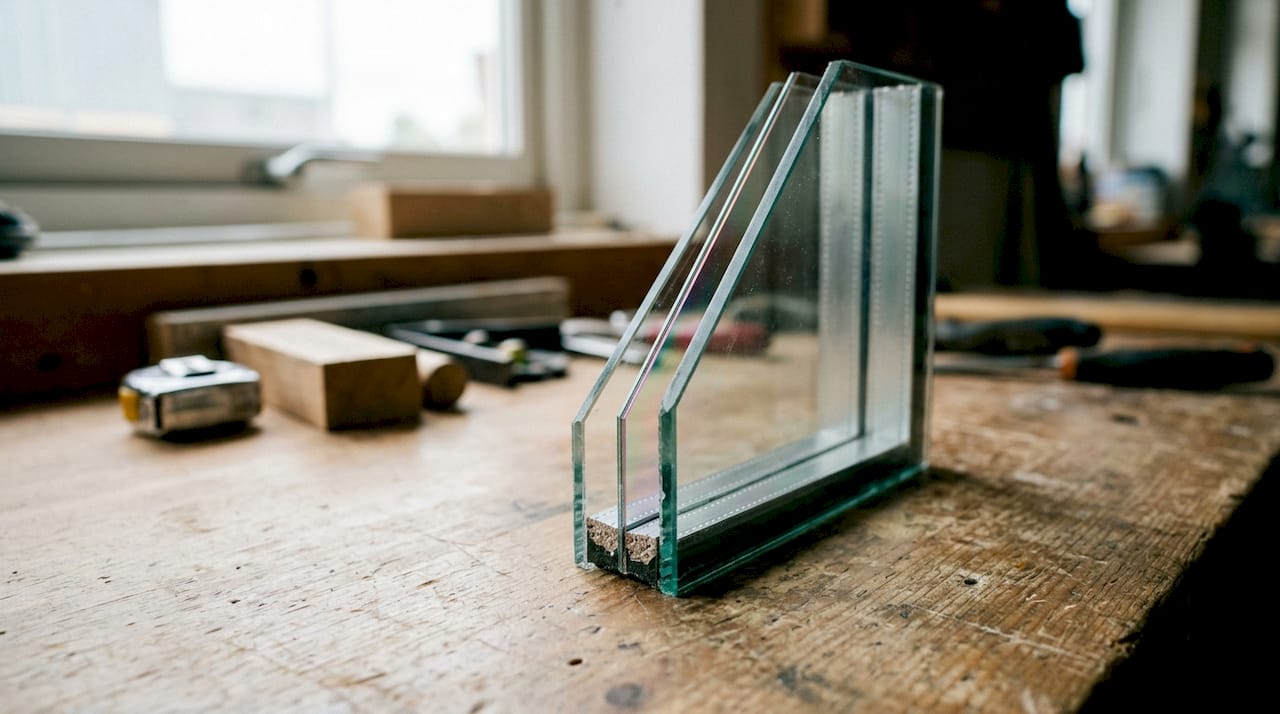
The metallic layers in the coating act as a thermal mirror. In winter, they reflect heat from your heating system back into the room instead of letting it escape through the glass. In summer, the same coating reflects solar heat back outside before it can warm your interior. This two-way effect is what separates low-e glass from simple tinted glass, which only blocks light.
Visible light transmission stays high despite the coating. The metallic layers are measured in nanometers, far too thin to affect room brightness in any noticeable way. Low-e coatings also block up to 99% of harmful UV radiation. That level of UV protection is what prevents carpets, wood floors, and upholstery from fading over time.
Pro Tip: Think of low-e glass as a one-way thermal mirror. It lets sunlight in but sends radiant heat back to its source, whether that source is your furnace in January or the Texas sun in August.
What are the types of low-e glass coatings?
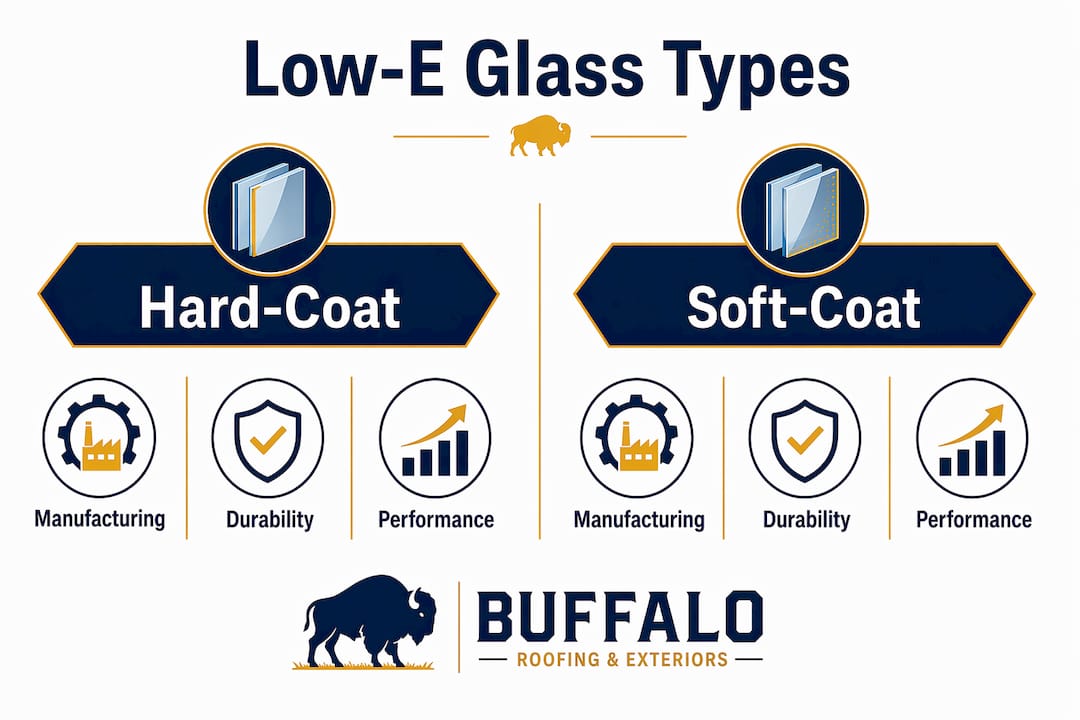
Two main coating types exist: hard-coat and soft-coat. Each is manufactured differently, performs differently, and suits different applications.
| Feature | Hard-coat (pyrolytic) | Soft-coat (sputtered) |
|---|---|---|
| Manufacturing process | Applied during glass production at high heat | Applied in a vacuum chamber after glass is made |
| Emissivity | Moderate (around 0.15–0.20) | Very low (as low as 0.04) |
| Durability | Highly durable, can be used in single-pane applications | Delicate, must be sealed inside an IGU |
| Energy performance | Good | Superior |
| Cost | Lower | Higher |
Hard-coat glass is bonded to the surface during the float glass process. The result is a coating that is physically part of the glass and can withstand exposure to air and handling. It works well in applications where the glass may not be sealed inside an insulated glass unit (IGU).
Soft-coat glass uses vacuum sputtering to deposit multiple silver layers onto the glass surface. The result is a far more efficient coating, but one that degrades quickly if exposed to air or moisture. This is why soft-coat low-e must always be sealed inside an IGU, with the coated surface facing the inert gas cavity between the panes.
The number of silver layers also matters. More layers reduce the solar heat gain coefficient (SHGC) and the U-factor, both of which appear on the NFRC rating label of any certified window. Never buy low-e glass based on marketing language alone. Always check the NFRC numbers.
Pro Tip: Ask your window supplier for the NFRC label before purchasing. The U-factor and SHGC numbers tell you far more than the product name does.
What are the real benefits of low-e glass for homeowners?
The financial case for low-e glass is straightforward. Installing low-e glass adds only 10% to 15% to total window cost but reduces energy loss by 30% to 50%. That translates to energy savings of $50 to $100 or more per window annually, with a typical payback period of 3–7 years. For a home with 15 windows, the long-term savings are substantial.
The benefits go beyond the utility bill:
- UV protection: Low-e coatings block up to 99% of UV radiation, which is the primary cause of fading in carpets, hardwood floors, and furniture fabrics.
- Year-round comfort: The thermal mirror effect keeps rooms warmer in winter and cooler in summer without changing your thermostat settings.
- No visible tint: Modern low-e coatings allow 70% to 95% visible light transmission. Rooms stay bright and clear.
- Code compliance: Low-e glass is now required or strongly incentivized under most residential building energy codes in 2026, making it a standard feature rather than a luxury upgrade.
- Reduced HVAC wear: Less heat transfer means your heating and cooling system cycles less often, extending equipment life.
The misconception that low-e glass darkens a room is one of the most common reasons homeowners hesitate. It is simply not accurate. The coating is invisible to the naked eye. A room with low-e windows looks identical to one with standard glass, except it stays more comfortable throughout the year.
For homeowners in Texas, where summer cooling loads are extreme, the SHGC reduction from low-e glass directly cuts air conditioning costs. Pairing low-e glass with energy-efficient window frames amplifies those savings further.
How do you choose the right low-e glass for your climate?
Choosing the wrong low-e coating for your climate can actually increase energy costs. Using a high-solar-gain coating in a hot climate like South Texas means the glass traps solar heat indoors, raising cooling bills instead of cutting them. Climate matching is not optional. It is the difference between a smart upgrade and an expensive mistake.
Follow these steps to choose correctly:
- Identify your climate zone. The U.S. Department of Energy divides the country into climate zones 1 through 7. Texas coastal areas fall in zones 2 and 3, which are hot and mixed-hot climates.
- Match SHGC to your zone. Hot climates need a low SHGC (below 0.25) to minimize solar heat gain. Cold climates benefit from a higher SHGC (above 0.40) to capture passive solar heat in winter.
- Check the U-factor. A lower U-factor means better insulation. The NFRC label on every certified window lists both the U-factor and SHGC. Verify both before purchasing.
- Choose soft-coat for maximum performance. If your windows will be factory-sealed IGUs, soft-coat low-e delivers the best energy performance for the investment.
- Verify IGU seal integrity. Seal failure in soft-coat IGUs exposes the coating to air and moisture, degrading performance rapidly. Fogging or condensation between panes is the warning sign. Address it immediately.
- Consider spectrally selective coatings for sunny regions. These coatings block heat while maximizing visible light, making them ideal for homes in high-sun areas like Corpus Christi and San Antonio.
For mixed climates, balanced coatings with a moderate SHGC around 0.25 to 0.40 and a low U-factor offer the best year-round performance. A window U-value guide can help you interpret these numbers before you buy.
Pro Tip: In Texas coastal climates, prioritize a low SHGC over a low U-factor. Keeping solar heat out is a bigger energy driver than insulation alone in zones 2 and 3.
Key Takeaways
Low-e glass is the single most cost-effective window upgrade available, cutting heat loss by 30% to 50% while adding only 10% to 15% to window cost.
| Point | Details |
|---|---|
| Definition and mechanism | Low-e glass uses metallic coatings to reflect infrared heat while maintaining high visible light transmission. |
| Coating types matter | Soft-coat outperforms hard-coat on efficiency but requires sealed IGU installation to prevent degradation. |
| Climate matching is critical | Using the wrong SHGC for your climate zone increases energy costs instead of reducing them. |
| UV protection is a real benefit | Low-e coatings block up to 99% of UV radiation, protecting interior furnishings from fading. |
| Verify NFRC ratings | Always check the U-factor and SHGC on the NFRC label, not just the product marketing name. |
Why low-e glass is no longer optional in 2026
Low-e glass has crossed a threshold. It is no longer a premium add-on that builders offer to budget-conscious clients as an upgrade. Building energy codes in most U.S. states now require it or make it effectively mandatory through energy modeling requirements. Builders who spec standard uncoated glass in new construction are not saving money. They are creating code compliance problems and handing future owners higher utility bills.
The misconception I hear most often from homeowners is that low-e glass will make their rooms darker or give windows a greenish tint. That was a fair concern with early-generation coatings from the 1980s. Modern coatings are invisible. A well-specified low-e window looks and feels exactly like standard glass from inside the room.
What I find most underappreciated is the installation quality issue. The best low-e glass in the world performs poorly if the IGU seal fails. I have seen homeowners replace perfectly good low-e units because of fogging between the panes, which is an installation or manufacturing defect, not a glass failure. Choosing a contractor who understands IGU integrity is as important as choosing the right glass specification.
The other point worth making directly: climate matching is not a detail. It is the core decision. A homeowner in Corpus Christi who installs high-solar-gain low-e glass because it was on sale is going to pay more to cool their home every summer. The NFRC label exists precisely to prevent that mistake. Read it before you buy.
— Buffaloroofingandexteriors
Energy-efficient windows from Buffalo Roofing and Exteriors
Buffalo Roofing and Exteriors installs energy-efficient windows across Corpus Christi, San Antonio, and Victoria, Texas, with full expertise in low-e glass selection and IGU installation. Choosing the right coating for South Texas heat requires local knowledge, and that is exactly what the team brings to every project.
Whether you are replacing aging windows or building new, Buffaloroofingandexteriors matches the right low-e specification to your climate zone and budget. The team handles everything from NFRC rating verification to proper IGU sealing, so your windows perform as specified for years. Request a free estimate through the windows service page or learn more about exterior renovation options for your Texas home.
FAQ
What is the difference between low-e glass and regular glass?
Regular glass has an emissivity of around 0.84, meaning it absorbs and re-radiates heat freely. Low-e glass uses a metallic coating to drop emissivity as low as 0.04, reducing heat transfer by 30% to 50%.
Does low-e glass make rooms darker?
No. Modern low-e coatings allow 70% to 95% visible light transmission, which is nearly identical to uncoated glass. The coating is invisible to the naked eye and does not tint the glass.
Is low-e glass worth the extra cost?
Low-e glass adds only 10% to 15% to total window cost while cutting energy loss by 30% to 50%. Most homeowners recover the investment within 3–7 years through lower utility bills.
How do I know if my low-e glass is failing?
Fogging or condensation between the panes of an insulated glass unit signals IGU seal failure. Once the seal breaks, the soft-coat low-e coating degrades rapidly and the unit needs replacement.
Which low-e glass is best for hot climates like Texas?
Hot climates require a low solar heat gain coefficient, ideally below 0.25, to block solar heat before it enters the home. Spectrally selective soft-coat low-e glass with a verified NFRC label is the best choice for Texas coastal zones.