TL;DR:
- Weatherproofing for coastal Texas homes involves a comprehensive, integrated building envelope system that resists wind, rain, and humidity. Proper detailing at transitions and adherence to windstorm compliance are essential to prevent costly failures and ensure insurance coverage. Materials must be selected for durability against salt, storms, and vapor permeability, making system continuity and professional installation crucial.
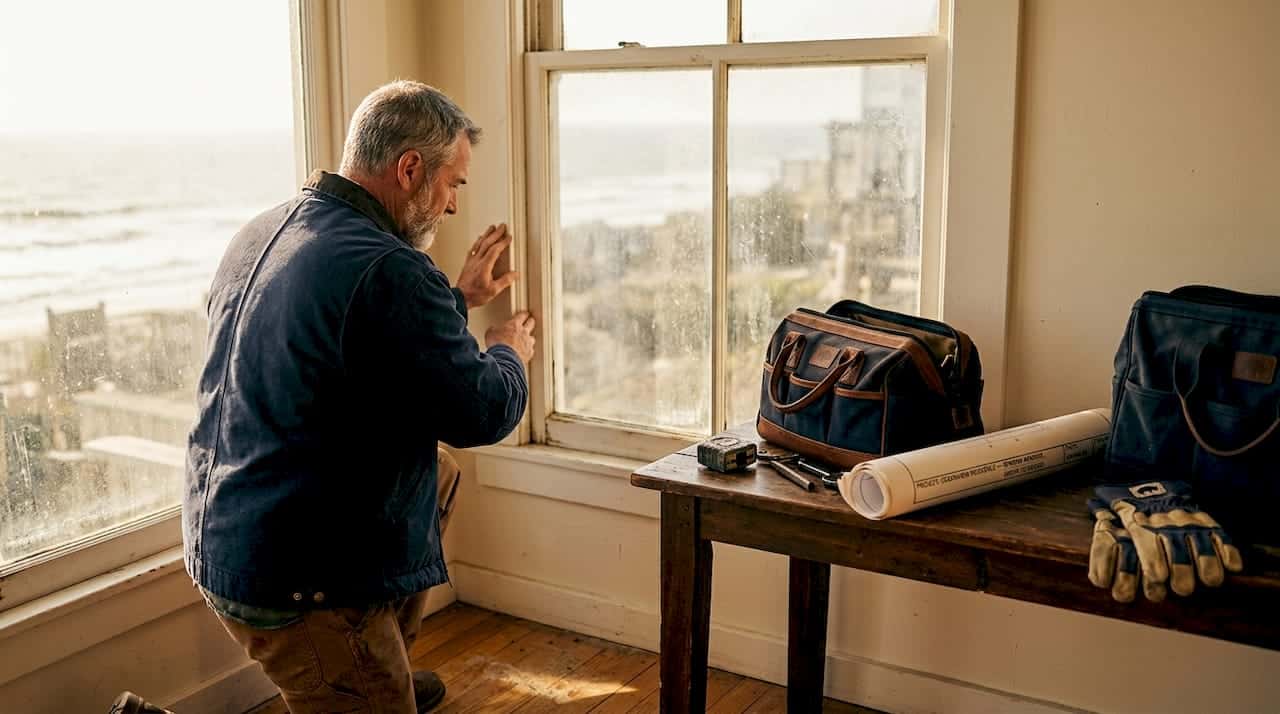
Most homeowners think weatherproofing means spraying a sealant on the deck and calling it done. That’s a costly misunderstanding. Weatherproofing, by definition, is preventing wind and rain from penetrating or affecting a structure, and along the Texas Gulf Coast, where tropical storms, salt-laden humidity, and hurricane-force winds are facts of life, that definition carries serious weight. What is weatherproofing in practice? It’s a whole-house system involving your roof, walls, windows, and every joint in between. This guide breaks it all down for coastal Texas homeowners who need real answers, not surface-level advice.
Table of Contents
- Understanding weatherproofing: Beyond surface protection
- Weatherproofing vs waterproofing: Key differences for Texas homes
- Challenges of weatherproofing coastal Texas homes
- Implementing effective weatherproofing strategies for your home
- Materials and products that improve weatherproofing
- Why weatherproofing success hinges on system continuity and transition details
- Get expert weatherproofing solutions for your coastal Texas home
- Frequently asked questions
Key Takeaways
| Point | Details |
|---|---|
| Weatherproofing definition | Weatherproofing protects homes by managing moisture, air, and temperature to prevent weather damage. |
| Difference from waterproofing | Weatherproofing resists multiple elements but doesn’t fully block water like waterproofing does. |
| Critical weak points | Transitions—such as roof edges and window openings—are the most vulnerable to weatherproofing failures. |
| Coastal Texas challenges | Homes must meet strict windstorm codes and use integrated systems to endure storms and get insurance. |
| System continuity | Successful weatherproofing requires continuous, well-detailed barriers and proper material installation. |
Understanding weatherproofing: Beyond surface protection
Weatherproofing is not a product. It’s a performance goal. And the structure that delivers that performance is called the building envelope, which is every element of your home that separates conditioned interior space from outdoor conditions. Think of it as your home’s skin, and like skin, it has to manage multiple threats at once.
Designing the building envelope correctly means addressing moisture control, air movement, and thermal regulation together, not as separate tasks. A well-sealed wall that leaks air at the window frame will still allow moisture-laden Gulf Coast air to push into your insulation and rot your sheathing from the inside out.
The key insight most homeowners miss is that continuity of the building envelope system matters far more than any single product. Wind-driven rain does not politely knock at your front door. It probes every joint, every penetration, and every transition point until it finds a gap.
Here’s what a complete weatherproofing system actually includes:
- Structural layer: Your framing and sheathing, which must be solid and correctly fastened for wind resistance
- Water-resistive barrier (WRB): A membrane installed over sheathing that blocks liquid water while allowing vapor to escape
- Air barrier: A layer that stops air movement through the assembly, which is the vehicle that carries moisture deep into wall cavities
- Thermal insulation: Controls heat transfer and reduces condensation risk inside wall assemblies
- Flashing: Metal or membrane transitions at every joint where materials change, such as where your roof meets a wall, or where a window frame meets your siding
- Sealants and caulking: Close the small gaps that flashing cannot cover, particularly around penetrations like pipes and electrical conduits
Every one of these layers must protect Texas coastal homes as an integrated unit. Remove one layer or install it incorrectly, and the whole system weakens at that point.
Weatherproofing vs waterproofing: Key differences for Texas homes
This distinction matters more than most homeowners realize, and confusing the two leads to real, expensive damage.
Weatherproofing resists multiple weather elements including wind, rain, UV exposure, and airborne debris, but it does not necessarily create a fully impermeable barrier to water. That’s intentional. Weatherproof coatings and membranes are often designed to be breathable, meaning vapor can escape outward while liquid water is repelled. This prevents trapped moisture from building up inside your wall assembly, which causes mold and wood rot.
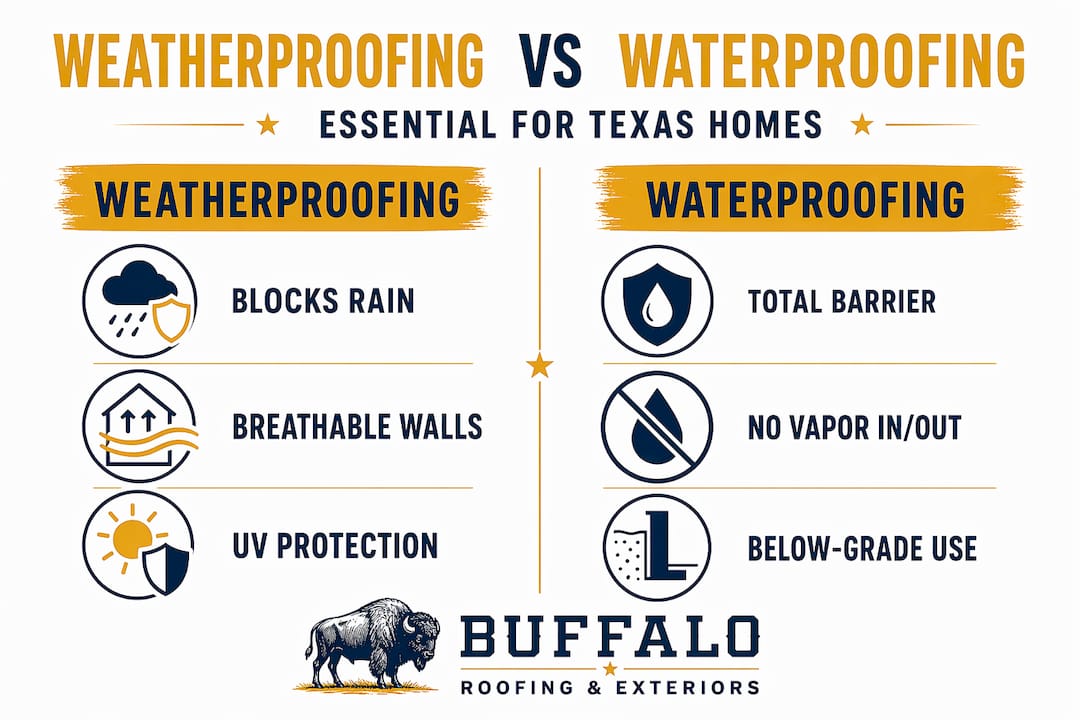
Waterproofing, by contrast, is designed to fully block water penetration in both liquid and vapor form. It belongs in specific locations: below-grade foundations, basement walls, shower pans, and anywhere that faces constant or prolonged water contact with no ability to dry out.
| Feature | Weatherproofing | Waterproofing |
|---|---|---|
| Primary function | Resists weather elements (wind, rain, UV) | Fully blocks water penetration |
| Vapor permeability | Often breathable | Typically vapor impermeable |
| Best used on | Exterior walls, roofing, siding, windows | Foundations, basements, wet areas |
| Failure mode | Allows moisture in under sustained exposure | Can trap moisture if applied incorrectly |
| Coastal Texas priority | Exterior envelope, storm exposure surfaces | Foundation and below-grade elements |
Using waterproofing on an above-grade wall where it needs to breathe can trap vapor inside your assembly, leading to exactly the rot and mold you were trying to prevent. On the other hand, relying on a breathable weatherproof coating on a foundation wall where hydrostatic pressure is pushing water from the outside is equally inadequate.
For coastal Texas homes specifically, your siding weatherproofing strategy on above-grade walls should prioritize breathable, weather-resistant membranes. Below your slab and around your foundation, fully waterproofed systems are non-negotiable.
Challenges of weatherproofing coastal Texas homes
Living near the Texas Gulf Coast comes with a specific set of weatherproofing requirements that go well beyond standard building codes in other parts of the country.
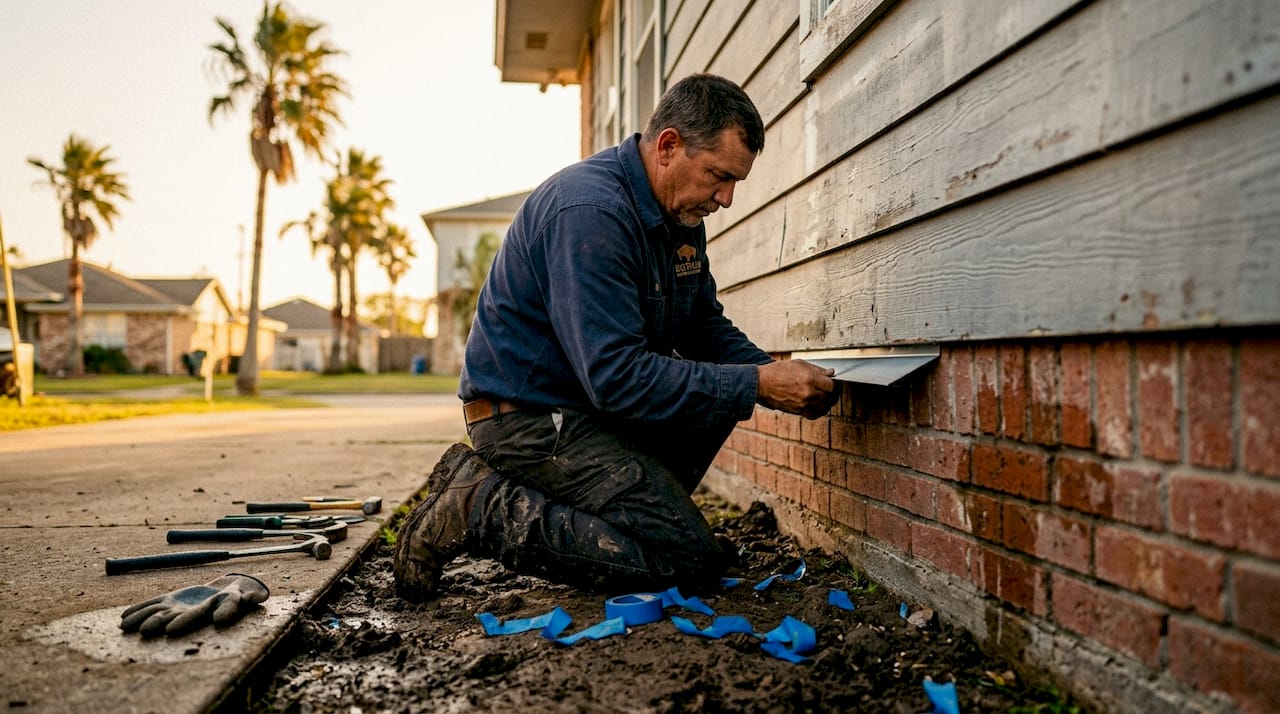
Windstorm compliance is not optional. If you live in a designated Seacoast Territory, which covers counties along the Texas coast including Nueces, Aransas, and Calhoun, your roof and exterior construction must meet Texas Department of Insurance windstorm standards. A WPI-8 inspection is required to qualify for Texas Windstorm Insurance Association (TWIA) coverage. Skip the inspection, and you lose access to windstorm insurance entirely, regardless of how well-built your home actually is.
Here are the most common weatherproofing failure points specific to coastal Texas homes:
- Roof edges and eaves: Wind uplift is strongest at the perimeter. Improperly fastened shingles and underlayment at the drip edge are the first things to fail in a storm.
- Roof-to-wall transitions: The junction where a sloped roof meets a vertical wall must be flashed with metal and sealed, not just caulked.
- Window and door openings: Frame-to-wall gaps, missing sill flashing, and improper installation of the housewrap around these openings are extremely common, and extremely costly.
- Penetrations: Pipes, exhaust vents, electrical conduits, and HVAC lines that pass through exterior walls are each a potential entry point for wind-driven rain.
- Soffits and fascia: In hurricane conditions, wind-driven rain enters these areas even on homes that appear otherwise sealed.
Proper drainage planes and flashing integration at all penetrations are not just best practices here. In a windstorm insurance context, they are the difference between a compliant home and one that leaves you uninsured after a major storm.
Pro Tip: After any roofing or siding work is completed on your coastal Texas home, request documentation of the WPI-8 inspection before your contractor leaves the job. Many homeowners discover missing certificates only after storm damage makes it relevant, and by then it’s too late.
Implementing effective weatherproofing strategies for your home
Knowing what weatherproofing is gives you the framework. Now here’s how to actually apply it to your home.
The most important principle is continuity. Every layer of your building envelope must connect to the next without gaps, even at the most awkward transitions. Transitions at roof-to-wall, window, and door openings are consistently where weatherproofing systems break down, not because of bad materials, but because detailing those transitions requires care and experience.
Here’s a practical checklist for weatherproofing your exterior:
- Inspect all caulk joints annually. Caulk around windows, doors, and penetrations deteriorates in the Texas heat and UV exposure within three to five years. Replace it before cracks form, not after.
- Check your housewrap or WRB after any remodeling. New siding, windows, or additions create new transitions that must be properly lapped and sealed back into the existing barrier.
- Flash first, caulk second. Caulk is a supplement to flashing, not a substitute. Any junction that depends solely on caulk will eventually fail.
- Look at your soffits and fascia after every significant storm. Damage here lets water track back under your roof deck, causing hidden rot that isn’t visible until it’s extensive.
- Evaluate insulation alongside air sealing. Thermal and moisture performance are linked. Gaps in insulation create cold spots where condensation forms on the inside of your walls.
Assessing storm readiness goes well beyond visible surface condition. A home can look perfectly maintained and still have failed air barriers inside wall cavities that are quietly allowing moisture to accumulate.
Pro Tip: Hire a contractor who can pressure-test or thermally image your exterior envelope rather than just visually inspecting it. Thermal imaging reveals cold spots and moisture intrusion that are invisible to the naked eye, and on the Texas coast, that information is worth the extra cost.
Materials and products that improve weatherproofing
Understanding what materials are weatherproof, and which are not, helps you make smarter decisions when it’s time to repair or upgrade.
Water-resistive barriers and air barriers serve related but distinct functions. A WRB like house wrap or felt paper blocks bulk water while allowing vapor to escape. An air barrier, which can be a rigid foam board, a taped sheathing system, or a fluid-applied membrane, prevents air movement through your wall assembly. Both are essential and must be properly integrated.
| Material type | Primary function | Vapor permeability | Best application |
|---|---|---|---|
| Housewrap (WRB) | Blocks bulk water | Permeable | Exterior wall sheathing |
| Rigid foam board | Air and thermal barrier | Varies by product | Wall and roof assemblies |
| Fluid-applied membrane | Air, water, and vapor control | Low to impermeable | Complex transitions, around openings |
| Metal flashing | Directs water away from joints | N/A | Roof edges, window heads, wall transitions |
| Polyurethane sealant | Closes small gaps | Low | Around penetrations and frames |
Some products worth knowing for weather-resistant Texas exteriors in coastal conditions include:
- Fluid-applied flashing membranes: These are applied around window and door rough openings before the unit is installed. They form a continuous, flexible seal that accommodates building movement.
- Self-adhered underlayments: These stick directly to your roof deck and provide far better wind-driven rain resistance than mechanically fastened felt, which is critical in TWIA compliance zones.
- Fiber cement siding: Salt air destroys wood and vinyl over time. Fiber cement holds paint better, resists impact, and does not absorb moisture the way wood-based products do.
Choosing materials designed for severe weather is not an upgrade in coastal Texas. It’s the baseline. Standard materials that perform adequately in Dallas or Houston frequently fail prematurely in Corpus Christi’s salt, humidity, and storm exposure.
Why weatherproofing success hinges on system continuity and transition details
After fifteen years of working on homes along the Texas coast, here’s the hard truth: the best materials on the market will not save a poorly detailed house. We’ve seen brand-new homes with premium products fail within five years because the contractor rushed the transitions. And we’ve seen older homes with modest materials that are still tight and dry because every joint was carefully lapped, flashed, and sealed.
Failures almost always occur at transitions where materials change, such as where your roof meets your wall, where a window frame meets your housewrap, or where a deck ledger bolts through your exterior. These are the points where materials move differently in heat and wind, where installers have to improvise because the instructions only cover the easy flat sections, and where shortcuts are hardest to detect visually.
The industry talks a lot about product performance, and manufacturers publish impressive test data. But a proven integrated system with correctly sequenced layers and compatible materials outperforms any single high-end product installed carelessly. Compatible matters specifically because some tapes and sealants bond poorly to certain housewraps, and some fluid-applied membranes react with foam products. Using products from a tested system rather than mixing whatever is available at the supply house removes that variable.
Our advice to any coastal Texas homeowner: do not evaluate weatherproofing by how good the surface looks after installation. Ask your contractor how they detailed the window sills. Ask them to show you the flashing at the roof-wall junction before it gets covered up. Ask them for the WPI-8 documentation. Those questions separate contractors who understand how weatherproofed exteriors reduce storm damage from those who are just selling you a coat of paint with an impressive product name on the label.
Get expert weatherproofing solutions for your coastal Texas home
If this guide has made one thing clear, it’s that effective weatherproofing on the Texas coast is not a DIY weekend project. It requires system knowledge, material compatibility, and documentation that protects your insurance coverage and your investment.
At Buffalo Roofing & Exteriors, we specialize in weather-resistant roofing systems built for Corpus Christi’s coastal conditions. Our team is certified in TDI windstorm compliance and manages WPI-8 inspections so your home stays insurable. From exterior weatherproofing assessments to full storm damage restoration, we handle every layer of your building envelope with the detailing standards the Gulf Coast demands. If a recent storm has raised questions about your home’s condition, our storm damage restoration service starts with a thorough inspection and honest assessment. Contact us today for a free estimate.
Frequently asked questions
What is the difference between weatherproofing and waterproofing?
Weatherproofing resists multiple weather elements like wind and rain without fully blocking water, while waterproofing creates a complete barrier to prevent any water penetration. Applying the wrong method in the wrong location can cause failure under prolonged exposure.
Why is weatherproofing important for homes in coastal Texas?
Coastal Texas homes face strong winds, heavy rainfall, and tropical storms, so weatherproofing protects structural integrity and prevents moisture damage. WPI-8 windstorm compliance is also required to qualify for TWIA windstorm insurance coverage in designated seacoast territories.
What are common points of failure in weatherproofing?
Most failures happen at transitions where materials meet and move, including roof-to-wall junctions, window and door openings, and pipe or conduit penetrations. These high-failure transition areas are where detailing and flashing quality define long-term performance.
How do air barriers and water-resistive barriers differ in weatherproofing?
Water-resistive barriers block liquid water intrusion from rain, while air barriers stop moisture-laden air from moving through your wall assembly and condensing inside. These two complementary barrier types must both be installed and integrated properly to function as a complete system.
What documentation ensures my coastal Texas home complies with windstorm weatherproofing standards?
A Certificate of Compliance, known as Form WPI-8, is issued after a qualified inspector verifies that your roof and exterior meet Texas Department of Insurance windstorm construction standards, and is required for TWIA coverage eligibility.