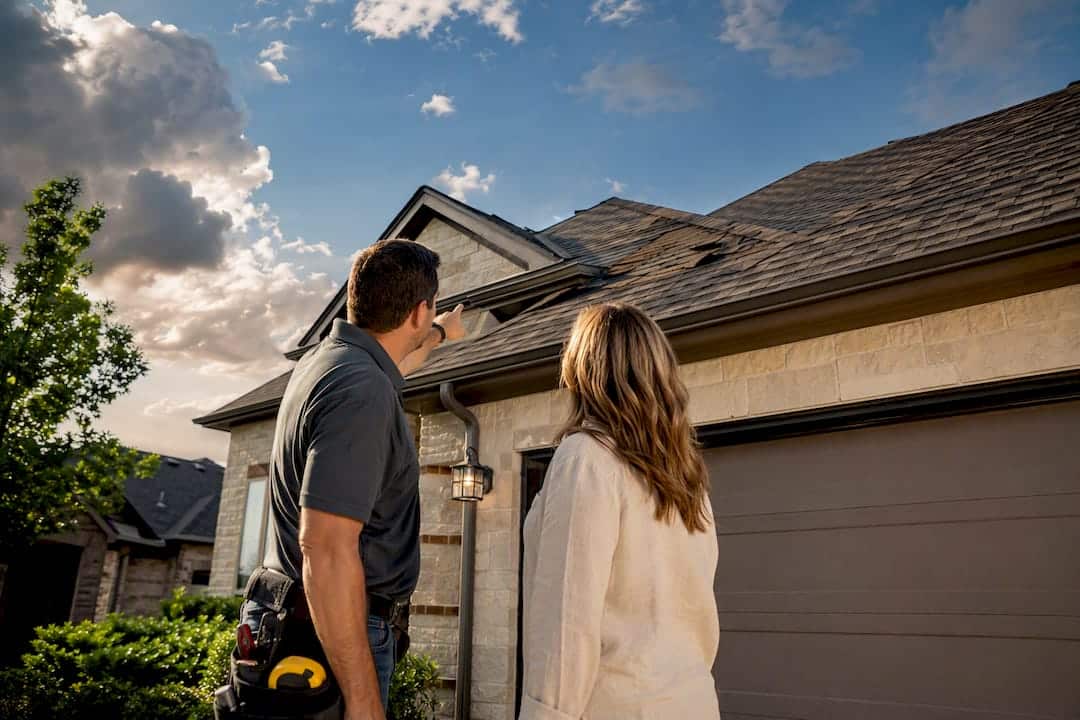
Unsolicited roofers knocking on your door after a storm are, more often than not, storm chaser roofers. Don’t sign anything on the spot. Document your damage, call your insurer, and vet any contractor against your state licensing board before a single dollar or signature changes hands. The FEMA contractor fraud guide and the BBB’s storm chaser advisory both back this up: speed is the scam’s biggest weapon, and slowing down is your best defense.
TL;DR:
- Storm chaser roofers often operate with new LLCs, no local address, and aggressive door-to-door tactics within days of a storm, signaling potential fraud.
- Red flags include out-of-state plates, high deposits, lack of local references, and reluctance to show permits or manufacturer certifications.
- Verify contractors through state licensing, business registration, physical address, manufacturer certifications, and direct insurance confirmation before signing anything.
- Avoid insurance fraud risks by not endorsing checks, waiving deductibles, or signing assignment of benefits without thorough research and approval.
- Choosing a local contractor with a permanent office provides ongoing accountability, warranty reliability, and better long-term repair quality.
Table of Contents
- What Storm Chaser Roofers Are and How They Operate
- The Red Flags That Separate a Storm Chaser From a Real Roofer
- Five Checks to Verify a Roofer Before You Sign Anything
- Insurance Traps That Can Cost You More Than a Bad Roof
- Your First 24 to 72 Hours After the Storm
- Why a Durable Local Contractor Is the Safer Bet
- Legal Protections You Should Know Before You Sign
- Finding a Reputable Local Roofer Without the Guesswork
- What Actually Happens During a Storm Repair or Replacement
- Financial Scams That Go Beyond the Obvious Red Flags
- The Long Game: Warranty Problems and Bad Workmanship
- An Editor’s Take on the Storm Chaser Problem
- Get Storm Damage Repaired by a Local Team That’s Still Here Next Year
- Sources
What Storm Chaser Roofers Are and How They Operate
A storm chaser roofer is a contractor who follows severe weather from region to region, canvassing neighborhoods within days of a hailstorm or hurricane and moving on once the insurance checks clear. Some are legitimate crews picking up honest overflow work. Many aren’t. The pattern the National Storm Authority documents is consistent: rapid deployment into a damaged zip code, aggressive door-to-door pitches, and an exit before anyone has to answer for a leaking roof six months later.
The business structure is the tell. Storm chasers frequently operate under a freshly formed LLC with no physical office, no local employees, and no history a homeowner can check.
- They knock on doors within 48 to 72 hours of a storm, often before you’ve even called your insurance agent.
- They quote a full roof replacement on the spot, sometimes from a truck parked at the curb.
- They’re gone within weeks, leaving no local presence to answer a warranty claim.
That last point is the one homeowners underestimate. A roof installed badly doesn’t fail on day one. It fails in year three, when the crew, the company, and the phone number are all gone.
The Red Flags That Separate a Storm Chaser From a Real Roofer
Not every red flag means fraud, but stack three or four of these together and you’re almost certainly dealing with a storm chaser. Treat this as a scoring system, not a single deal breaker.
- Door-to-door solicitation with a “sign today” push. Legitimate roofers rarely need to pressure you into a same-day contract. If a rep is standing on your porch pushing you to sign before you’ve even filed a claim, walk away.
- Out-of-state plates or a business registered days ago. A quick Secretary of State search often reveals an LLC formed the week of the storm. That “phoenix” pattern, forming a new entity right after severe weather, is one of the clearest fraud signals the National Storm Authority tracks.
- A P.O. box instead of a street address. The BBB specifically calls out storm chasers who list temporary contact details rather than a verifiable local office.
- Pressure to endorse your insurance check or “cover your deductible.” Both practices skirt insurance fraud statutes in most states, and a contractor who offers this upfront is telling you exactly how they operate.
- No local references, no permits, no manufacturer certification. Ask for three recent addresses in your own city. A contractor who can’t produce them, or resists the question, isn’t planning to be around for a callback.
- Many cities require a solicitation permit for door-to-door sales. Asking to see it is a fast way to separate a licensed local operator from someone who drove in overnight.
Pro Tip: Ask for three recent local job addresses and actually drive by or call the homeowner. Contractors with real local history will hand these over without hesitation; storm chasers stall, deflect, or offer “references” that turn out to be other crew members.
Five Checks to Verify a Roofer Before You Sign Anything
You can run every one of these checks in under an hour, most of them from your phone.
- State licensing board. Nearly every state maintains a searchable contractor license database. If the name on the truck doesn’t match an active license, that’s disqualifying on its own.
- Secretary of State registration age. Pull up the business entity filing. An LLC registered the same week as your storm is the “phoenix” pattern worth flagging, and a quick search often settles the question in seconds.
- Physical address on Google Maps. Drop the address into the map and look at the street view. A real roofing company has a yard, a warehouse, or an office, not a residential mailbox or an empty lot.
- Manufacturer certification. If a contractor claims to be GAF or Owens Corning certified, both manufacturers post searchable directories of certified installers on their own sites. Confirm it there, not on the contractor’s word.
- Proof of insurance, verified directly with the carrier. Don’t just accept a certificate. Call the insurance company listed on it and confirm the policy is active and covers the work being quoted.
State consumer protection offices also publish advisories worth bookmarking. The North Carolina Department of Justice’s roofer guidance is a good model for what most state AG sites now offer, and many other states run comparable resources.
If a contractor balks at any single one of these checks, that’s your answer. A legitimate local roofer expects to be verified and usually welcomes it, because it’s free proof they’re the real thing.
Insurance Traps That Can Cost You More Than a Bad Roof
Some of the riskiest storm chaser tactics have nothing to do with the roof itself and everything to do with how they handle your insurance claim.
- Deductible absorption. A contractor offering to “waive” or “cover” your deductible is often inflating the invoice to hide it, a practice that can constitute insurance fraud in many states and puts your own name on the claim.
- Assignment of benefits (AOB). Signing an AOB hands your contractor the legal right to bill your insurer directly and negotiate on your behalf. The NAIC warns this is a primary driver of inflated billing and post-claim disputes, and once signed, you may lose the ability to control your own claim.
Post-disaster roofing fraud is common enough that the National Insurance Crime Bureau treats it as a recurring, seasonal pattern rather than an occasional problem, and fraud-tracking organizations note that contractor-driven claims fraud adds real cost across the insurance system every storm season.
If a contractor pushes any of these three tactics, stop and call your insurer directly. If you suspect outright fraud, your state insurance regulator and the NICB both take direct consumer reports.
Your First 24 to 72 Hours After the Storm
What you do in the first three days shapes everything that follows, including whether your claim gets approved cleanly.
- Photograph everything, with timestamps. Shingles, gutters, siding, fencing, anything visibly damaged. If you have pre-storm photos of your roof, pull them for comparison.
- Call your insurer before you call any contractor. Ask specifically whether they run a preferred-contractor program, and get your claim number on record.
- Collect at least two written estimates from verified local contractors. Never accept a single quote from whoever showed up first.
- If you need emergency tarping, get a limited-scope written receipt. It should list exactly what was done, the cost, and the contractor’s license number and contact information, not a verbal promise.
A step-by-step damage inspection checklist can help you document damage methodically instead of missing something an insurer later disputes.
Why a Durable Local Contractor Is the Safer Bet
The single biggest differentiator between a legitimate roofer and a storm chaser isn’t the sales pitch. It’s the business behind it. The HUD contractor guidelines draw this distinction directly: contractors with a permanent office and W-2 employees are far easier to hold accountable on a warranty claim than a crew working out of temporary lodging.
A reputable local roofing contractor operates from a fixed base with permanent offices and a verifiable service history that homeowners can check before signing anything.
- A physical office presence in three Texas markets, not a truck and a phone number
- Manufacturer certifications you can independently confirm on the manufacturer’s own site
- Storm damage restoration, emergency repairs, financing options, and workmanship warranties tied to a business that isn’t leaving town
| What to check | Storm chaser | Established local contractor |
|---|---|---|
| Business address | P.O. box or none | Verifiable physical office |
| Entity age | Days old, formed post-storm | Years of filed business history |
| Crew status | Transient, out-of-town | Local, on payroll |
| Warranty enforceability | Difficult to nearly impossible | Backed by a business that stays put |
Legal Protections You Should Know Before You Sign
Consumer protection law gives homeowners more leverage than most people realize, but only if you know it exists before you sign, not after.
Most states enforce a three-day right of rescission on door-to-door contracts, meaning you can legally cancel a roofing agreement signed at your home within three business days, no penalty, no explanation required. Storm chasers count on homeowners not knowing this window exists, which is exactly why they push for same-day payment or a rushed deposit before that window closes.
Many municipalities also require a solicitation permit for door-to-door sales, something the BBB flags as an easy, fast check. Ask to see it. A contractor who’s actually registered to solicit in your city will have it on hand.
Assignment of benefits carries its own legal weight. Several states have passed laws restricting or requiring specific disclosures on AOB forms precisely because the NAIC identified them as a major fraud and dispute driver. Signing one before an independent adjuster has assessed your roof can strip you of control over your own claim.
Insurance fraud statutes also apply to contractors who offer to cover your deductible or inflate an invoice to disguise that arrangement. That’s not a gray area in most states, it’s a specific violation, and it’s one more reason to get everything in writing before any work starts.
Finding a Reputable Local Roofer Without the Guesswork
Start closer to home than a search engine. Ask neighbors who’ve had storm repairs done, check your state licensing board’s public database, and look at how long a business has actually operated in your city.
A few practical filters cut through most of the noise fast:
- Confirm the company has a local address you can visit, not just a listing.
- Check their BBB profile for accreditation status and complaint history.
- Ask directly for three recent local project addresses and follow up on at least one.
- Get multiple written estimates before committing, and compare scope of work line by line, not just the bottom-line price.
Resources like the effective storm damage repair tips guide walk through what a legitimate estimate should actually include, which makes it much easier to spot a lowball or inflated quote when you’re comparing bids side by side.
What Actually Happens During a Storm Repair or Replacement
A legitimate roof repair or replacement follows a predictable sequence, and knowing it helps you spot a contractor who’s skipping steps.
It starts with an inspection, ideally paired with your insurance adjuster’s visit, followed by a written scope of work detailing materials, labor, and timeline. Permitting comes next; in most Texas coastal jurisdictions, that means pulling a building permit and, depending on your windstorm coverage, meeting WPI-1 inspection requirements before work begins. Skipping this step can jeopardize your windstorm insurance eligibility entirely.
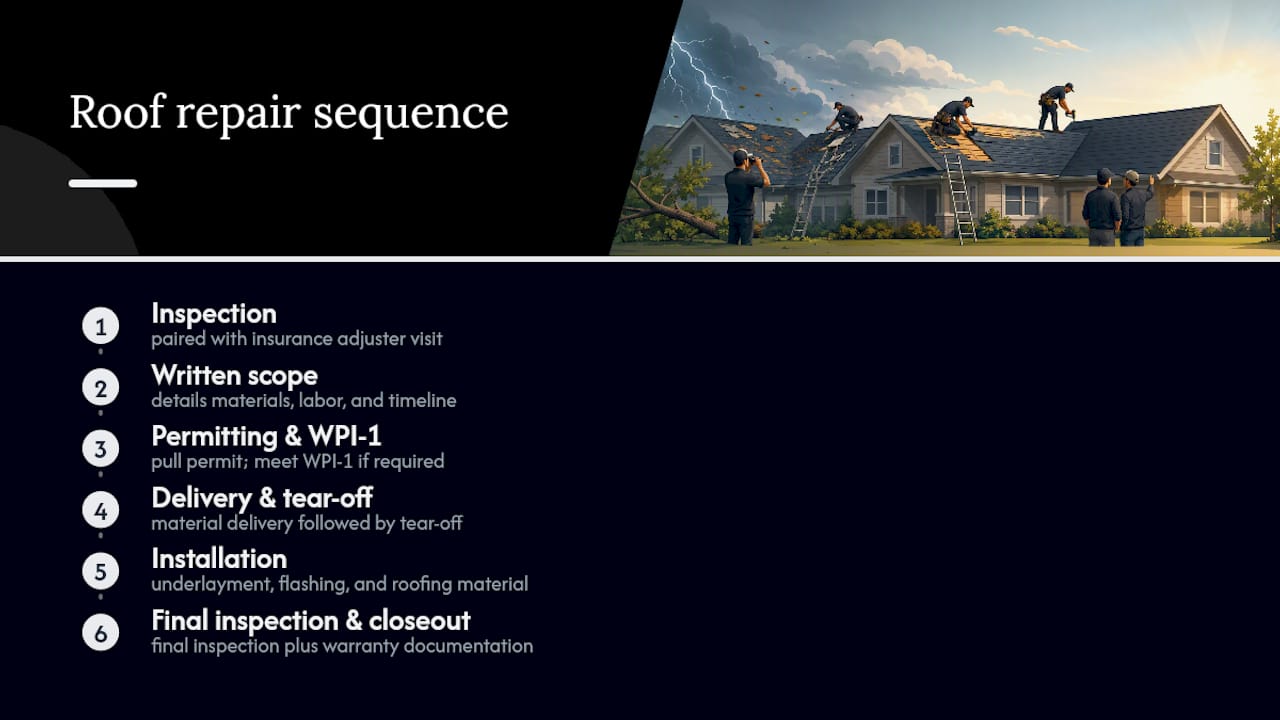
Material delivery and tear-off follow, then installation of underlayment, flashing, and the roofing material itself, whether shingles, tile, or a flat roofing system. A final inspection closes out the job, along with delivery of your warranty documentation. The full breakdown, including realistic timelines for each stage, is laid out in this step-by-step roof repair guide.
A storm chaser typically compresses or skips several of these steps entirely, most often the permit and the final inspection, because neither one benefits a crew that’s already planning its next move.
Financial Scams That Go Beyond the Obvious Red Flags
Some scams surface only after you’ve already agreed to work, which is what makes them so damaging. Watch for a contractor who collects your deposit, starts minor demolition, then vanishes for weeks citing “material delays” that never resolve. That stalling tactic often means the deposit already funded a different job entirely.
Another pattern: change orders that balloon the price mid-project, submitted verbally and never in writing, so there’s no paper trail when you dispute the final bill. Always require every change to scope or cost in writing, signed by both parties, before work continues.
Watch too for a contractor who submits a supplemental insurance claim in your name without your review, padding the scope to inflate the payout, then keeping the difference. This is part of the broader pattern the NICB tracks as recurring post-storm fraud. If anything gets filed with your insurer that you haven’t personally seen and approved, call your carrier immediately.
The Long Game: Warranty Problems and Bad Workmanship
The damage from a storm chaser rarely shows up on installation day. It shows up two winters later, when flashing installed too fast starts leaking, or shingles nailed with the wrong pattern start lifting in the next windstorm.
Manufacturer warranties on materials like GAF or Owens Corning shingles typically require installation by a certified contractor to stay valid. A storm chaser without certification can void that warranty before the first nail goes in, leaving you covering the full replacement cost yourself if something fails early.
Workmanship warranties are worse, because they depend entirely on the contractor still existing. A five-year labor warranty from a company that dissolved its LLC eight months after your storm is worth exactly nothing. That’s the real cost of choosing speed over verification: not just a bad roof, but zero recourse when it fails.
An Editor’s Take on the Storm Chaser Problem
The uncomfortable truth is that storm chasers succeed because homeowners are exhausted, scared, and want the problem gone immediately. The fix isn’t more willpower, it’s a system: verify first, sign later, every time.
Print or screenshot this before your next storm:
- Photograph all damage with timestamps
- Call your insurer before any contractor
- Check the state license database
- Check Secretary of State registration age
- Confirm manufacturer certification directly
- Get two written estimates minimum
- Refuse any deposit over a third of the contract
- Never sign an AOB before an independent inspection
Report anything suspicious to your state insurance regulator or the NICB. The paper trail you build now is what protects you if a claim gets disputed later.
— Results
Get Storm Damage Repaired by a Local Team That’s Still Here Next Year
Choosing a contractor with a permanent office in multiple locations offers a reliable alternative to door-to-door pitches and transient operations that leave town after checks clear, providing ongoing accountability for storm damage repairs.

That local presence means someone answers the phone if a repair needs a follow-up call two years from now, which is exactly the accountability a storm chaser structurally can’t offer. A reliable contractor handles storm damage restoration, emergency repairs, full roof replacement, and related exterior work, supported by financing options and workmanship warranties tied to a business with an actual physical address.
If your roof took a hit this season, start with a free storm damage restoration consultation and get a written estimate from a crew you can verify before you sign a thing.