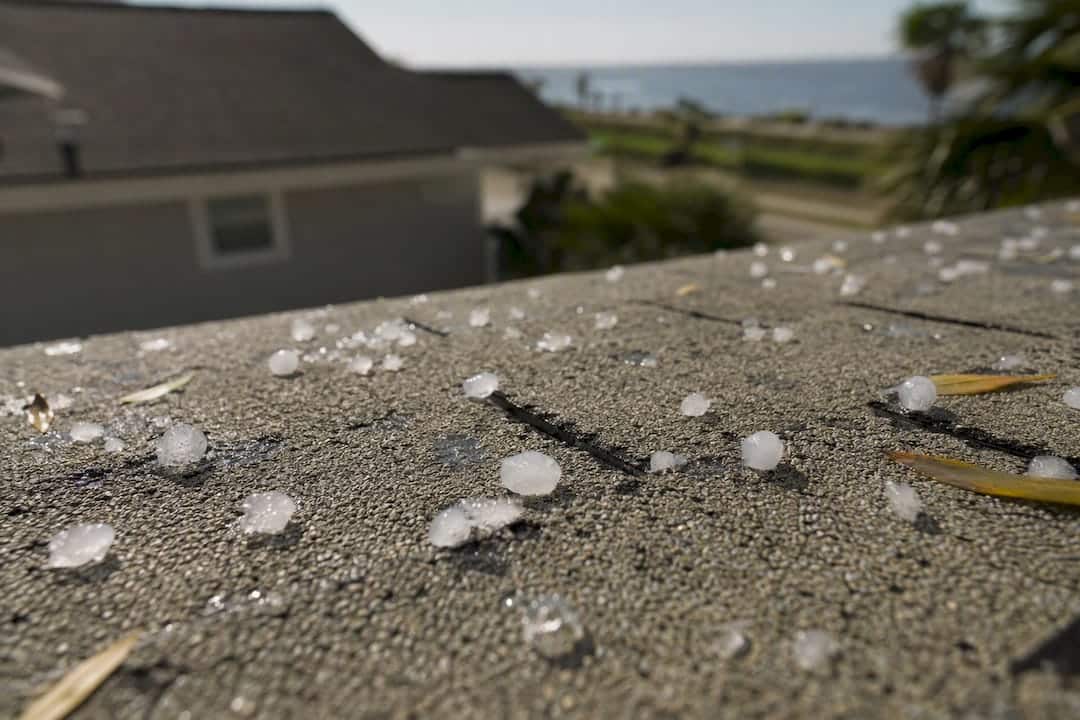
Quarter-sized hail, about 1.0 inch across, is the point where many common roof systems start taking real, functional damage. That is the threshold worth remembering, but it is not the whole story. Older 3-tab shingles can bruise and crack right around that mark, while architectural shingles, cedar shakes, and concrete tile often hold up until stones reach 1.25 to 2.0 inches or more.
If your neighborhood just got hit, here is what to do before you even look at your roof:
- Stay off the roof and check for downed lines or storm debris first.
- Walk the ground and photograph gutters, downspouts, window screens, and vehicle panels for dents.
- Note the hail size against a coin if you can find intact stones.
- Call Buffaloroofingandexteriors or another licensed inspector for an on-roof assessment.
- If the ground-level evidence points to functional damage, notify your insurer promptly.
Pro Tip: The National Weather Service (NWS) uses 1 inch as the severe-hail reporting threshold, which is one reason contractors treat quarter-sized hail as the line worth investigating. Products rated to UL 2218 impact classes are tested against exactly this kind of size progression.
Key Takeaways
Quarter-sized hail near 1.0 inch is the practical threshold where most aging roofing materials begin sustaining functional damage, though the exact number shifts by material and roof age.
| Point | Details |
|---|---|
| Know your threshold | Quarter-sized hail (about 1.0 inch) damages older 3-tab shingles; tougher materials need 1.25 to 2.0+ inches. |
| Trust site evidence | Dented gutters, downspouts, and AC fins prove actual impact energy better than regional storm reports. |
| Understand the 25% rule | If damage exceeds 25% of a roof slope, many insurers and codes require full replacement of that slope. |
| Document before repairs | Photograph damage with scale references and keep records before any temporary fixes happen. |
| Call a professional early | Buffaloroofingandexteriors offers free inspections that document damage and support insurance claims. |
Table of Contents
- How Does Hail Size Affect Roof Damage?
- What Hail Size Damages Each Roofing Material?
- How Do You Identify and Document Hail Damage?
- How Do Insurers Handle Hail Damage Claims?
- Does 0.75-Inch Hail Damage a Roof?
- How Were Hail Damage Thresholds Determined?
- Frequently Asked Questions
- Sources
How Does Hail Size Affect Roof Damage?
Size gets the headlines, but it is only one variable in the damage equation. A hailstone’s destructive power comes from kinetic energy, and kinetic energy scales with both mass and the square of velocity. That second part matters more than most homeowners realize: a hailstone twice as large does not just hit twice as hard, it can hit four times as hard once you account for how much heavier and faster it falls.
Several factors combine to determine whether a given storm leaves cosmetic marks or genuine functional damage:
- Density and shape: Hard, compact ice does far more damage than porous, slushy hail of the same diameter. Irregular, jagged stones bruise and cut more than smooth round ones.
- Impact angle: A stone falling straight down onto a low-slope roof transfers more force than one glancing off a steep pitch at an angle, especially in wind-driven storms.
- Terminal velocity: Larger stones fall faster, sometimes exceeding 100 mph in extreme cases, which multiplies the energy delivered on contact.
Pro Tip: Skip the guesswork about “how big was that hail, really.” Check your metal gutters, downspouts, and HVAC fins for fresh dents. Those dented metal surfaces are more reliable evidence of actual impact energy at your specific property than any regional storm report.
What Hail Size Damages Each Roofing Material?
Not all roofs fail at the same size, and that gap is bigger than most homeowners expect. Age matters as much as material: a 15 year old asphalt shingle roof can sustain functional damage at sizes that would leave a brand new version of the same product untouched.
| Roofing Material | Typical Damage Threshold | Notes |
|---|---|---|
| 3-tab asphalt shingles | Around 1.0 inch | Older, brittle shingles fail at the low end of this range |
| Architectural/laminated shingles | 1.25 to 2.0 inches | Thicker mat resists bruising better than 3-tab |
| Cedar shingles/shakes | 1.25 to 2.0 inches | Splits and cracks rather than bruising |
| Fiber-cement or concrete tile | 1.25 to 2.0 inches | Cracks and chips rather than punctures |
| Standing seam metal | 1.25 to 2.0 inches | Dents cosmetically before functional failure |
| Built-up/gravel roofing | 2.0 inches or more | Membrane and ballast absorb smaller impacts |
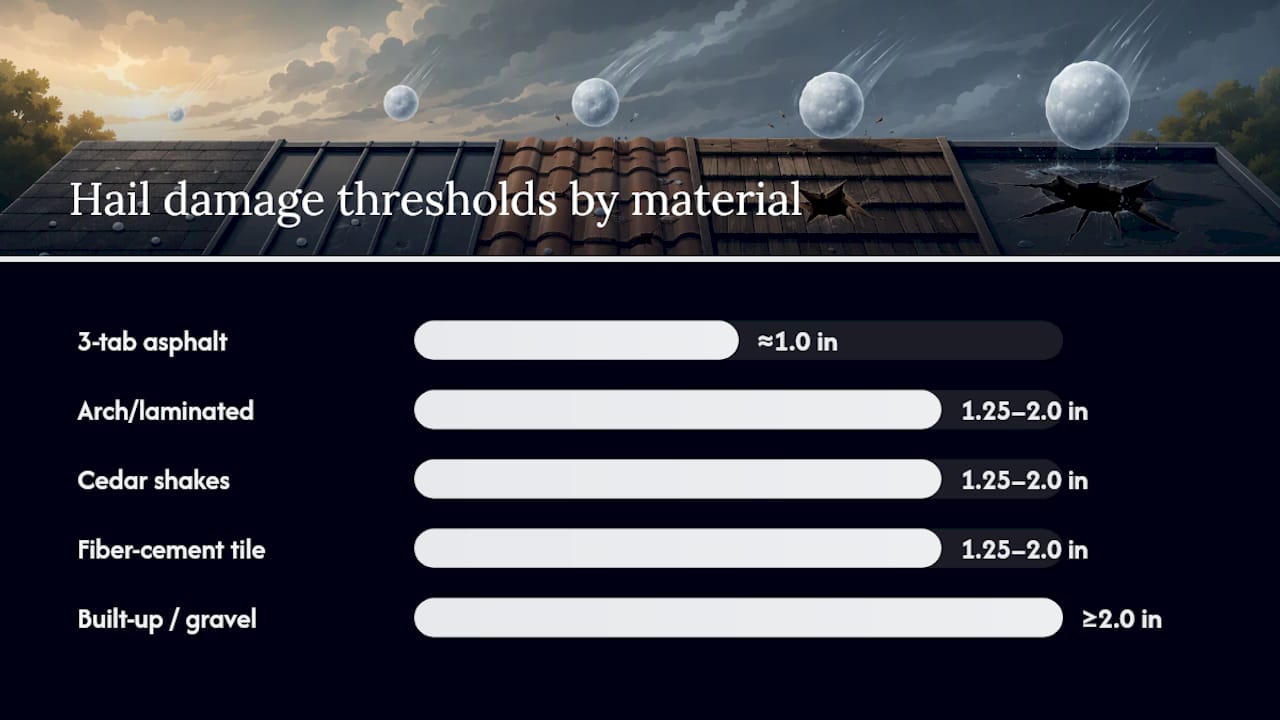
Lab testing and field surveys back up these ranges, showing damage onset near 1.0 inch for aging 3-tab products and considerably higher thresholds for impact-resistant materials. Kinetic energy is the common criterion used to compare test results across these different product types.
A few areas fail well below these general thresholds regardless of material:
- Thin aluminum flashing and gutter aprons dent easily and often show damage first.
- Skylights and solar panel glass can crack at sizes that leave nearby shingles untouched.
- Ridge caps and valley metal take direct hits and wear thinner than field shingles.
How Do You Identify and Document Hail Damage?
Inspectors look for specific signatures, not just “it looks rough up there.” On asphalt shingles, that means circular bruises where granules have been knocked loose, exposing the black asphalt mat underneath. On cedar, it means splits and fractured shakes. On metal, it means dents and dings, often clustered on one slope depending on wind direction during the storm.
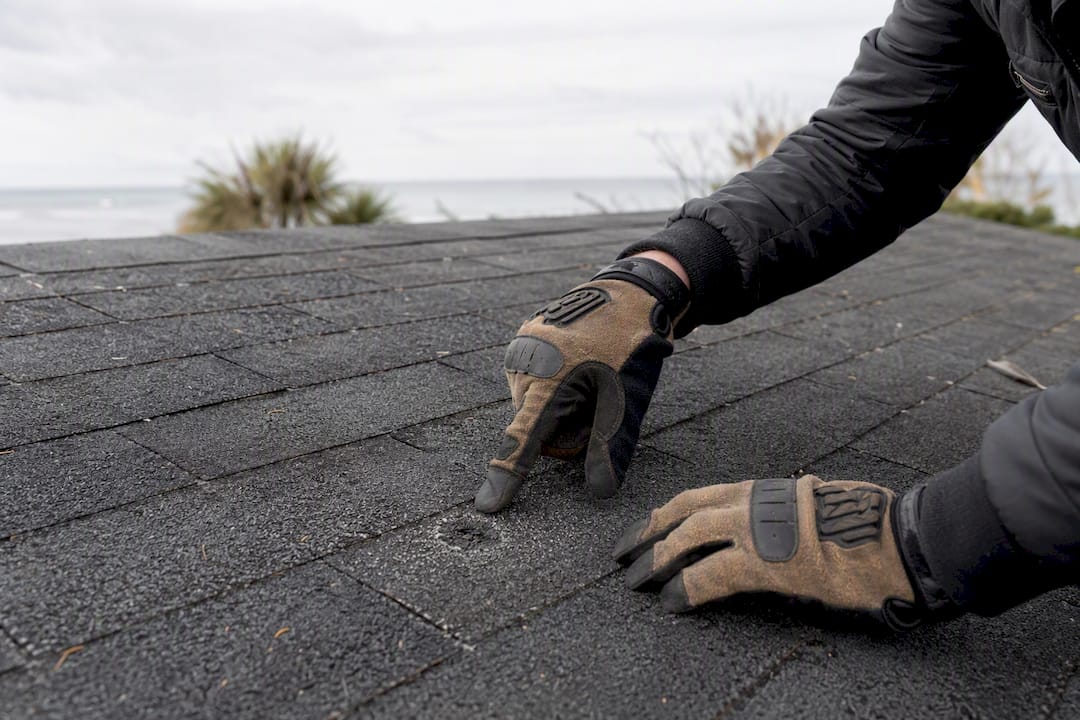
Granule loss alone is not proof of hail. Normal aging, blistering, and algae growth can look surprisingly similar to impact damage, which is exactly why insurers want a trained eye on the claim rather than a homeowner’s photo from the driveway.
If you do document damage yourself, do it right:
- Photograph from multiple angles, including wide shots showing the affected slope.
- Place a coin or ruler next to any dent or bruise for scale reference.
- Capture gutters, downspouts, AC condenser fins, and vehicle hoods as corroborating evidence.
- Keep every photo timestamped and organized by location on the property.
Never climb a wet, steep, or storm-damaged roof yourself. A professional storm damage inspection carries the right harness gear and knows what a genuine hail signature looks like versus routine wear, which matters more than most people assume when a claim is on the line.
How Do Insurers Handle Hail Damage Claims?
Most insurance policies and building codes reference something called the 25% rule: if more than 25% of a roof slope needs repair, many jurisdictions and insurers require replacing that entire slope rather than patching it. This rule varies significantly by state and by policy language, and some adjusters apply it per slope rather than to the whole roof, so the math depends heavily on where the damage actually falls.
Here is the sequence that keeps a claim moving instead of stalling out:
- Document everything before any temporary repairs happen.
- Notify your insurer with photos and a description of the storm date.
- Get an independent inspection from a licensed contractor, not just the adjuster’s assessment.
- Compare the contractor’s scope of work against the insurer’s estimate.
- Keep every receipt for tarps, temporary repairs, and materials.
Repair costs vary widely depending on the extent of damage and material, and timelines run anywhere from a few days for a targeted repair to a few weeks for a full tear-off and replacement, longer if the roof needs custom materials. Before signing anything, ask your contractor and adjuster:
- Does local code trigger a full replacement under the 25% rule for this damage?
- What warranty applies to a partial repair versus a full replacement?
- Does the insurer expect matching materials on the untouched slopes?
Does 0.75-Inch Hail Damage a Roof?
Dime and penny-sized hail, around 0.75 inch, rarely causes functional damage to a sound, newer roof. It can still bruise or crack older, brittle asphalt shingles and dent thin metal trim, so “small hail” does not always mean “no risk,” especially on a roof already past its prime.
Repeated small hailstorms add up even when no single event crosses the 1 inch threshold. Cumulative impacts can weaken shingle mats over several seasons, setting up problems that surface later as leaks rather than storm-day damage.
Call an inspector after smaller hail if you notice any of these:
- Fresh dents in gutters or HVAC fins after the storm.
- Circular granule loss patterns on shingles visible with binoculars from the ground.
- A roof already past 10 years old, where the margin for error is thinner.
How Were Hail Damage Thresholds Determined?
The 1 inch and larger thresholds cited throughout this guide come from a combination of controlled ice-ball impact tests and large-scale field surveys, not guesswork. Labs fire ice balls or steel balls at roofing samples to approximate real hailstone terminal velocities, then measure the percentage of surface damage to establish a repeatable threshold for each product type.
Field surveys across many roofs have confirmed those lab thresholds hold up in the real world, while also showing that age, installation quality, and support condition create real variation between two roofs hit by the same storm. That is the reason a published threshold is a starting point, not a verdict. Your specific roof, with its specific age and history, still needs eyes on it.
A Local Roofer’s View on Hail Response
South Texas storms move fast and hit hard, and we have walked enough roofs after them to know the damage pattern rarely matches what a homeowner expects from the ground. A roof that looks fine from the driveway can hide granule loss that shortens its life by years. Waiting rarely helps your claim or your roof.
Get a Free Hail Damage Inspection From Buffaloroofingandexteriors
If your roof took a hit, the fastest way to know where you stand is a trained eye, not another hour of squinting at shingles through binoculars. Buffaloroofingandexteriors handles storm damage restoration across the Corpus Christi, San Antonio, and Victoria areas, from emergency tarps that stop a leak the same day to full documentation support for your insurance claim.

Our crews inspect the roof, document every affected slope with photos, and give you a clear scope, whether that means targeted repairs or a full flat roof or shingle replacement. Financing options are available for homeowners who need repairs done now and would rather not wait on insurance timelines, and every job comes backed by a workmanship warranty. Request a free inspection through our storm damage restoration page and get a written estimate before you sign anything with your insurer.
Frequently Asked Questions
Does 0.75-inch hail damage a roof?
Rarely on a sound, newer roof, but it can bruise or crack older asphalt shingles and dent thin metal trim, so age matters as much as size.
What size hail causes roof damage?
Quarter-sized hail around 1.0 inch is the commonly cited threshold for older 3-tab shingles, with tougher materials needing 1.25 to 2.0 inches or more.
Can small, repeated hailstorms still hurt my roof?
Yes. Cumulative impacts from multiple sub-threshold events can weaken shingles over time even when no single storm meets the 1 inch mark.
How do I know if my roof needs a professional inspection after hail?
Fresh dents in gutters or HVAC fins, circular granule loss patterns, or a roof older than 10 years are strong signals to call an inspector.
Sources
- Guideline to Assess Hail Damage to Shingle Roofs — Nelson Forensics
- Hail research (ice‑ball impact tests and field surveys) — PSU (hail_research.pdf)
- Identifying roof hail damage — Travelers Insurance
- Hail threat defined — National Weather Service
- Hail damage to roofing; Assessment and classification — NRCA