TL;DR:
- Living on the Texas coast exposes roofs to extreme weather, making proper inspection, compliance, and documentation essential for storm protection and insurance claims. Homeowners should verify contractors’ licensing, insurance, storm-specific procedures, and detailed scope of work, including decking and code requirements, to avoid costly mistakes. Asking targeted questions about windstorm compliance, storm damage evidence, and supplement procedures ensures comprehensive protection and successful claim resolution.
Living on the Texas coast means your roof takes a beating that most homeowners in other states never experience. Hurricanes, tropical storms, and extreme hail can strip shingles, crack decking, and void your insurance coverage overnight. But picking a roofing company isn’t just about who gives the lowest bid. It’s about who knows the local building codes, who handles windstorm compliance, and who protects your insurance claim from start to finish. Asking the right questions upfront separates a confident, protected decision from an expensive mistake.
Table of Contents
- Checklist: Core questions for any roofing company
- Texas windstorm compliance: What to ask for eligibility
- Storm damage and insurance workflow: Evidence and reporting
- Decking, code-required repairs, and supplements: Preventing missed items
- Our take: The overlooked questions that make the biggest difference
- Connect with local experts for weather-resistant roofing
- Frequently asked questions
Key Takeaways
| Point | Details |
|---|---|
| Verify credentials first | Always start with questions about licensing, insurance, and written estimates before trusting any roofing company. |
| Windstorm compliance matters | Ask specifically about Texas windstorm inspections and certificates to protect insurance eligibility. |
| Documentation for claims | Make sure your roofer provides comprehensive damage reports and photo evidence for smooth insurance processing. |
| Decking and code repairs | Don’t overlook code-required items and decking during repairs—these impact storm protection and claim approval. |
| Ask about supplements | Clarify how the roofer handles supplements and missed items to avoid out-of-pocket extras later. |
Checklist: Core questions for any roofing company
Every roofing project starts with trust, and trust starts with verified credentials. Before you agree to anything, you need to know you’re dealing with a licensed, insured professional who understands how coastal Texas roofing actually works.
Start with these baseline questions:
- Are you licensed and insured in Texas? Ask for the actual license number and certificate of insurance. A reputable contractor hands those over without hesitation.
- What does your installation process look like from tear-off to final inspection? A vague answer here is a red flag. You want a step-by-step walkthrough.
- What warranty do you offer, and what does it actually cover? Manufacturer warranties and workmanship warranties are very different. A solid contractor explains both clearly.
- What happens if you discover hidden structural damage after the tear-off begins? This is critical. Hidden rot, soft spots, or damaged decking change the scope of work fast.
- Who will be physically working on my roof? Subcontractors are common, but you need to know who’s accountable for the final product.
As a confident roofing checklist recommends, always ask your roofer to show they are licensed and insured, explain their installation process, describe their warranty coverage, and tell you exactly how they handle hidden damage discovered after tear-off.
Pro Tip: Request a written scope of work before signing anything. A legitimate contractor won’t hesitate. If they push back on putting details in writing, walk away.
The warranty question deserves extra attention. Some warranties only cover materials, not labor. Others have fine print that voids coverage if you miss a maintenance step. Ask specifically: “If a leak develops six months from now, what’s covered and what’s not?” The answer tells you everything about how much the company stands behind its work.
Timeline transparency matters too. Ask for a realistic start date, a projected completion date, and a clear process for communicating delays. Texas coastal weather can push timelines, but a professional contractor accounts for that from day one. For more detailed roof replacement tips built around the realities of coastal Texas weather patterns, it helps to go in prepared before the first call.
Texas windstorm compliance: What to ask for eligibility
With the basics covered, Texas coastal homeowners have to ask a second layer of questions that most people in other states never even think about. Windstorm insurance eligibility through TWIA (Texas Windstorm Insurance Association) depends on whether your roof work meets specific building code requirements.
Ask these windstorm-specific questions in order:
- Does this project require a windstorm inspection under the Texas Windstorm Building Code?
- Who schedules and performs the windstorm inspection, and at what stage of the project does it happen?
- Will you provide a Certificate of Compliance, and how quickly after project completion?
- How do you document compliance for my insurance records?
- Have you worked with TWIA-approved inspectors before, and can you provide references?
According to Texas Department of Insurance guidelines, for Texas coastal homes, you need to confirm whether your project requires Texas Windstorm Building Code compliance and a Certificate of Compliance so you can maintain or obtain TWIA windstorm and hail eligibility. Missing this step can cost you your entire windstorm coverage.
Here’s a quick comparison of what compliance looks like versus what it doesn’t:
| Factor | Compliant contractor | Non-compliant contractor |
|---|---|---|
| Windstorm inspection | Schedules it proactively | Doesn’t mention it |
| Certificate of Compliance | Provided after project | Not offered |
| Approved materials | Uses TWIA-listed products | Uses whatever is cheapest |
| Documentation | Full written records | Verbal only |
| Insurance coordination | Works with your insurer | Leaves it to you |
The inspection itself happens at a critical stage during the project, not after everything is done. The inspector needs to see certain structural elements before they’re covered by new roofing materials. If your contractor finishes the roof and then tries to schedule the inspection, it’s already too late. That’s a failure that voids eligibility and costs you far more in the long run.
Statistic callout: Homes in the Texas coastal zone that do not receive a valid windstorm Certificate of Compliance after major roof work may face policy cancellation or claim denial, regardless of whether they pay their premiums on time.
Understanding your Texas windstorm certification requirements before work begins is not optional for coastal homeowners. It’s the difference between being protected and being exposed. Review the relevant wind ratings guide so you understand what ratings your materials need to meet. And for longer-term planning, storm prevention tips can help you make choices now that reduce damage risk in future storm seasons.
Storm damage and insurance workflow: Evidence and reporting
Beyond compliance, storm claims require a very specific type of evidence. What a roofer documents, photographs, and reports directly affects how much your insurance company pays. Ask about this before you sign the work order, not after the crew shows up.
Key questions to ask:
- What does your damage inspection report include, and can I see a sample?
- How many photographs do you take, and do you photograph from the ground and the roof surface?
- Do you coordinate directly with my insurance adjuster, or do I handle that myself?
- How quickly can you provide documentation after the initial inspection?
- What happens if the adjuster’s scope misses damage you identified?
After a hail or wind event in Texas, you should document storm damage thoroughly, including photographs and a professional inspection report, to support your insurance claim. A contractor who can’t describe their documentation process in detail is likely to leave gaps that reduce your payout.
Here’s what a solid storm damage documentation package should include:
| Document type | Purpose | Who provides it |
|---|---|---|
| Professional inspection report | Establishes scope of damage | Roofing contractor |
| Photographs (roof surface, interior, exterior) | Visual evidence for adjuster | Roofing contractor |
| Damage measurement data | Supports material replacement claims | Contractor |
| Supplement request | Covers missed items in initial claim | Contractor submits to insurer |
| Communication log | Documents all insurer interactions | Homeowner + contractor |
Pro Tip: Ask specifically whether the roofer has experience submitting supplement requests. This is where claim amounts increase when initial adjuster estimates fall short. A contractor who has done this before knows how to document the gap clearly and professionally.
The best contractors treat storm documentation like a legal file. Every shingle, every dented flashing, every bruised ridge cap gets cataloged. They know that insurance adjusters work from what they can see in writing and photographs, not from conversations. For a detailed claim checklist built around Texas storms, you’ll find exactly what should be included. It’s also worth learning how to identify storm damage yourself so you can verify what the contractor reports. If you want a professional to evaluate your current situation, a storm damage inspection gives you a starting point before any claims paperwork begins.
Decking, code-required repairs, and supplements: Preventing missed items
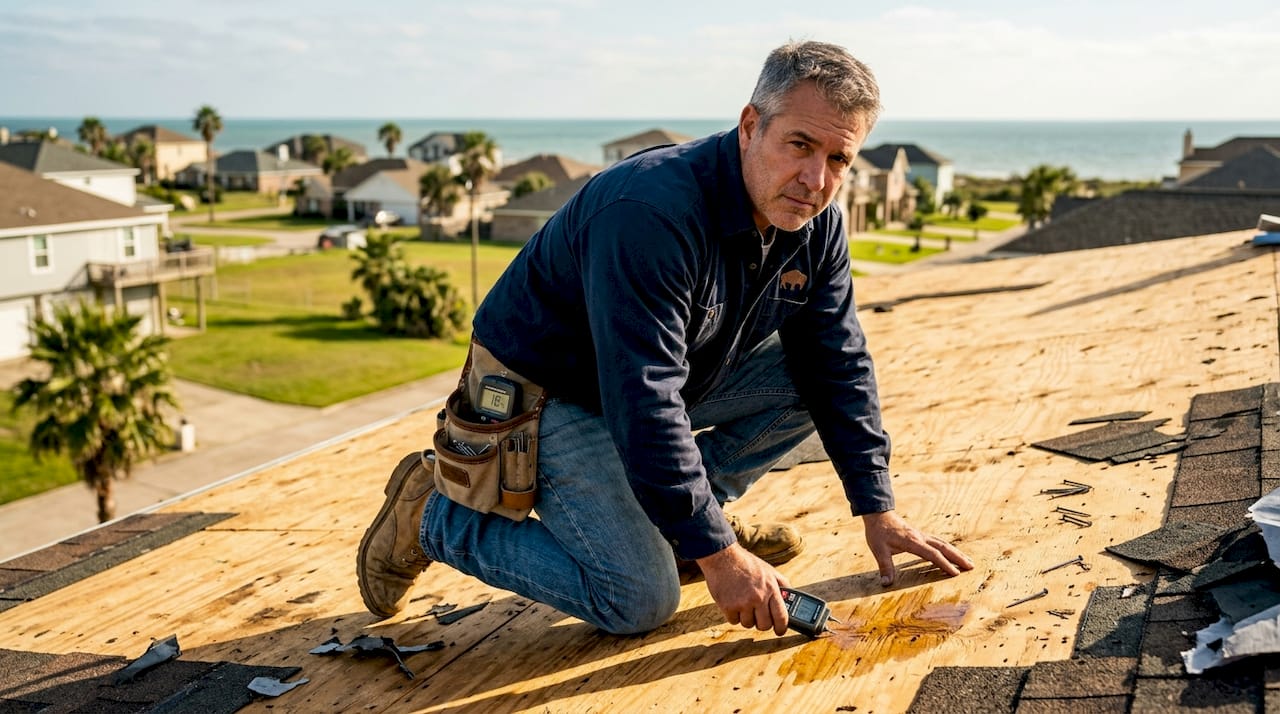
Once documentation standards are clear, the focus shifts to structural and code-required work that often gets skipped. Roof decking (the plywood or OSB layer beneath your shingles) takes serious damage in storms but rarely gets included in an insurance estimate unless someone asks.
Ask your roofer these questions before work begins:
- Will you inspect the decking once the old roofing material is removed?
- What is your process for replacing damaged decking, and is it included in the estimate?
- Does your scope include code-required underlayment and flashing replacement?
- If the adjuster’s initial estimate didn’t include code items, will you file a supplement?
- Can you walk me through exactly what a supplement request involves and how long it takes?
According to TDI guidance on wind resistance, roofers should inspect roof decking and replace damaged decking if needed, particularly because wind performance depends heavily on the integrity of the deck when roofing covering is removed.
A strong written estimate should align with the full insurance claim scope. As noted in a Texas roof insurance claim guide, the written estimate needs to include required items that adjusters may miss, such as underlayment, flashing, and other code-required components. These aren’t optional. They’re mandated by Texas building code, and skipping them creates liability.
Here’s a quick reference for what should always be included in a full coastal Texas roof repair scope:
| Item | Why it matters | Often missed by adjusters |
|---|---|---|
| Decking replacement | Structural integrity and wind resistance | Yes |
| Code-required underlayment | Moisture barrier and code compliance | Sometimes |
| Flashing replacement | Prevents leaks at joints and edges | Frequently |
| Ridge cap replacement | Critical for wind seal | Often partial |
| Drip edge installation | Prevents water intrusion at eaves | Common omission |
For a thorough damage assessment guide that covers these structural elements in detail, walking through the full picture before speaking with a contractor gives you a major advantage in the conversation.
Our take: The overlooked questions that make the biggest difference
Most roofing articles give you a credentials checklist and call it done. License? Check. Insurance? Check. But here’s the uncomfortable truth: those baseline questions only eliminate the worst contractors. They don’t help you find the best one.
The questions that actually reveal a contractor’s competence are the ones about mechanics and methodology. Ask how they protect vulnerable roof components, specifically decking, roof-to-wall connections, and skylights, when work is in progress. Ask what they do when damage isn’t visible from the ground. How they answer tells you immediately whether they think systemically or whether they’re just replacing what they can see.
Windstorm scheduling questions separate good from great even further. Does the contractor know which inspection stages require a TDI-approved inspector present? Can they explain the sequencing off the top of their head? A contractor who fumbles this question in a coastal Texas market is simply not ready for the job.
The supplement workflow question is the most telling of all. Most homeowners don’t even know what a supplement is. The contractors who can’t explain it clearly are the same ones who leave thousands of dollars in legitimate coverage unclaimed. We’ve seen it happen repeatedly. Insurance adjusters work fast and miss things. The right contractor fills in those gaps professionally and persistently.
Our storm damage inspection process was built around exactly these issues, because we’ve seen what happens when they get skipped.
Connect with local experts for weather-resistant roofing
Knowing the right questions is the first step. The second step is finding a team that answers them confidently and completely.
At Buffalo Roofing & Exteriors, we specialize in weather-resistant roofing built for the specific demands of the Texas coast, from Corpus Christi to Victoria and San Antonio. Whether you’re dealing with fresh storm damage or planning a full replacement, our team handles windstorm compliance, insurance documentation, decking inspections, and supplement requests as standard parts of every project. Explore our full installation workflow guide to see how we approach each stage, and review our storm damage restoration process if you’re already dealing with damage. Contact us for a free estimate and see what it feels like to work with a team that actually knows coastal Texas roofing.
Frequently asked questions
Do all roof repairs in coastal Texas require windstorm certification?
No, not all repairs require certification. Minor repairs under 100 square feet that don’t involve decking typically don’t need a windstorm inspection, but larger or structural projects do.
What evidence should a roofer provide for insurance claims after storm damage?
A full professional inspection report, detailed photographs covering both roof surface and interior indicators, and thorough damage measurements are required to properly support your insurance claim.
What is a supplement in a roof insurance claim?
A supplement is an additional request for coverage submitted by your roofer when the initial adjuster’s estimate misses code-required repairs, hidden structural damage, or materials needed for full code compliance.
Why is decking inspection critical for Texas coastal repairs?
Decking provides the structural foundation for wind resistance. After storms or during reroof projects, damaged decking must be identified and replaced to meet Texas Windstorm Building Code requirements and protect your home’s long-term structural integrity.